


Advantage+ is now branded Advantage+ Sales, Meta’s automated campaign type that handles audience, placement, budget, and creative testing on your behalf. It rewards accounts with strong pixel signal, a clean catalogue, and a healthy creative pipeline, and it punishes accounts that skip prerequisites. Before you launch anything, verify your Pixel and Conversions API are firing correctly and confirm you have enough creative variety to feed it.
TL;DR:
- Advantage+ Sales requires a strong pixel signal, a complete catalogue with accurate GTINs, and at least 50 conversions in the past 30 days to perform well.
- Finer control over ad set budgets and audience exclusions is now available, making management more transparent and scriptable through the Marketing API.
- Campaigns should have a weekly budget aligned with the target CPA times 50 and avoid mid-week edits to prevent resetting the learning phase.
- Creative assets should be diverse, refreshed every two to four weeks, and include UGC and short videos to maximize performance and reduce fatigue.
- Manual campaigns remain valuable for small-volume or highly targeted accounts, while Advantage+ works best with mature accounts with steady spend and a creative pipeline.
Table of Contents
- What is Advantage+ today?
- How does Advantage+ Sales differ from the original ASC?
- Prerequisites and step-by-step Ads Manager setup
- What creative and catalogue setup does Advantage+ need?
- How much budget do you need to exit the learning phase?
- How reliable is Advantage+ measurement?
- When should you run Advantage+ versus a manual campaign?
- What optimisation habits prevent Advantage+ failures?
- Oxedent’s Advantage+ readiness checklist
- How does automation change a media buyer’s actual job?
- Get your Advantage+ account audited before you scale it
- Sources
- FAQ
What is Advantage+ today?
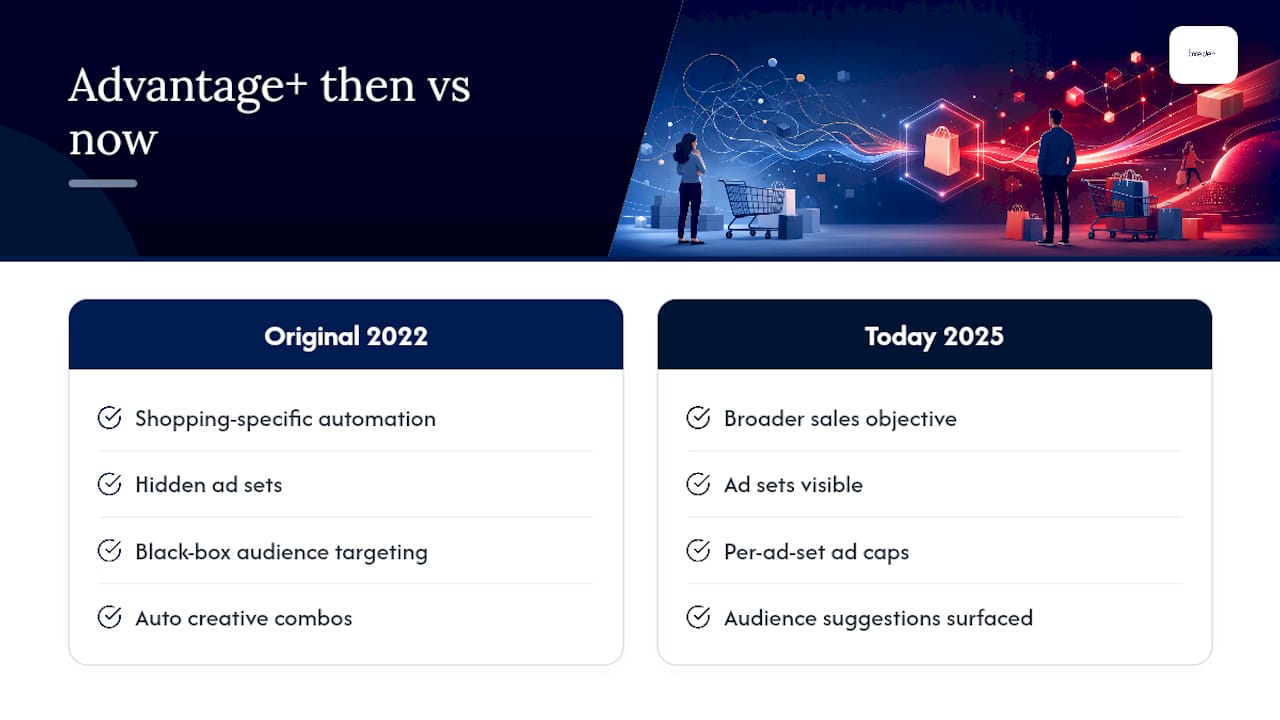
If you’ve been away from Ads Manager for a year, the naming alone will throw you. Advantage+ Shopping Campaigns, launched in August 2022, became Advantage+ Sales by 2025, folding shopping-specific automation into a broader sales objective. The core mechanics survived the rebranding: Meta still handles audience targeting, placement selection, budget allocation, and creative testing within a single campaign, testing dozens of creative combinations automatically rather than forcing you to build ad sets by hand.
What’s different in the interface matters more than the name. Ad sets are back, visibly, inside the campaign structure, something the original Advantage+ Shopping format hid from view. Each ad set now carries its own ad caps, and Meta surfaces audience suggestions rather than locking you into a fully automated black box. The Meta for Developers documentation confirms these controls exist in the Marketing API, which means you can script and audit them rather than trusting the UI blind. For anyone running Advantage+ shopping campaigns at scale, that visibility is the difference between managing a system and hoping it behaves.

How does Advantage+ Sales differ from the original ASC?
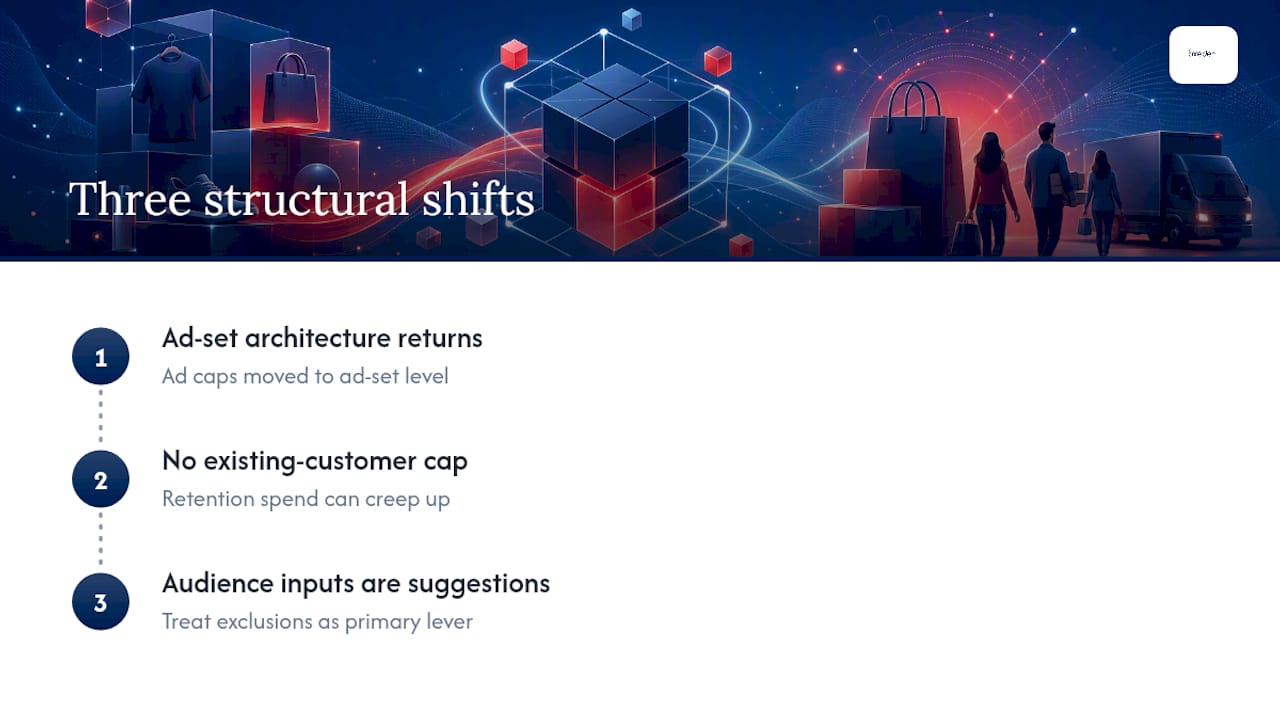
Three structural shifts define the jump from Advantage+ Shopping to Advantage+ Sales, and each one changes how you should build a campaign.
Ad-set architecture returned, and with it came ad caps set at the ad-set level rather than the campaign level. That gives you finer control over how many creatives compete for spend within any one audience segment. Second, Meta removed the dedicated existing-customer budget cap, a feature that used to stop the algorithm quietly pouring your budget into past purchasers. Losing it means retention spend can creep upward without you noticing, unless you rebuild the guardrail yourself. Independent analysis on what changed from Advantage+ Shopping recommends splitting audiences into separate ad sets with customer-list exclusions to replicate that old cap manually. Third, audience inputs are now suggestions the algorithm can override, not hard constraints, so exclusions do far more work than inclusions ever did. If you want to keep new-customer acquisition on track, treat exclusion lists as your primary lever, not an afterthought.
Prerequisites and step-by-step Ads Manager setup
Nothing kills an Advantage+ launch faster than skipping the groundwork. Run through this before you touch the campaign builder:
- Confirm Pixel and Conversions API are both live and sending matching events; server-side redundancy protects you when browser tracking drops.
- Check Event Match Quality in Events Manager. Anything below a strong score signals missing customer data Meta needs to match conversions to real people.
- Audit your catalogue for complete GTINs, accurate availability status, and pricing that matches your live site.
- Confirm purchase history, ideally at least 50 conversions in the prior 30 days across the account, so the algorithm has sufficient data to learn from.
Once those pass, build the campaign itself:
- Select the Sales objective, then confirm the Advantage+ toggle is enabled at campaign creation, not added retroactively.
- Set your campaign budget, using the learning-phase formula covered below rather than guessing.
- Build ad sets with any exclusions you need for existing customers, then attach your product catalogue.
- Upload creative assets across every supported format before launch, not in a slow trickle afterwards.
Freeze structural edits for the first week. Every budget change, audience edit, or new ad set resets the learning phase, and deduplication issues between Pixel and CAPI events will quietly inflate your reported conversions if you don’t check for them early.
What creative and catalogue setup does Advantage+ need?
Advantage+ is only as good as what you feed it. Meta’s own launch data claims the system can test up to 150 creative combinations, but that ceiling is meaningless if you upload three static images and call it done.
- Start with a minimum spread across formats: several static images, at least two to three video assets, and a handful of Collection or carousel builds.
- Keep GTINs accurate and availability status current in your catalogue; a mismatch here silently drops products from delivery.
- Use dynamic creative pairing so headlines and descriptions can rotate against different product sets automatically.
- Refresh creative every two to four weeks, based on practitioner best-practice guidance, to keep fatigue from eroding cost per purchase.
- Lean on UGC and short-form video hooks; a customer holding the product tends to outperform a studio shot for scroll-stopping power.
Pro Tip: Build your next batch of creative while the current set is still performing well, not after metrics start sliding. A refresh queue beats a refresh scramble every time.
How much budget do you need to exit the learning phase?
Advantage+ needs volume to learn, and the rule of thumb practitioners rely on is a certain number of conversions within a rolling seven-day window. Below that threshold, delivery stays erratic and cost per result swings wildly.
The budgeting formula that maps directly to this target is simple: weekly budget should sit near your target cost-per-acquisition multiplied by a recommended factor. For example, a target CPA and budget should align to meet learning phase thresholds. Accounts running below their formula-derived minimum tend to sit permanently learning-limited, never accumulating enough signal to stabilise.
If you land in that state, the fix is rarely more patience. Raise the budget to match the formula, resist the urge to tweak audiences or creatives mid-week, and give the new spend a full seven-day cycle before judging results. Constant small edits are the single most common reason accounts never escape learning-limited status.
How reliable is Advantage+ measurement?
Platform-reported ROAS inside Ads Manager tends to overstate performance, particularly since iOS privacy changes shortened and fragmented attribution windows. Meta’s own numbers are directional, not gospel.
Blended MER, total revenue divided by total ad spend across channels, gives you a cleaner read because it sidesteps platform attribution entirely. Holdout tests, where you withhold ads from a control group and compare organic-only revenue against the exposed group, remain the most credible way to measure true incrementality. Run one whenever you scale spend meaningfully or when in-platform numbers look suspiciously strong.
Diagnostically, check Event Match Quality first when results dip, then frequency, then whether the campaign is flagged learning-limited. Weak EMQ quietly degrades everything downstream, and it’s the most overlooked fix in the toolkit, worth tracking alongside your broader Meta Ads strategy.
When should you run Advantage+ versus a manual campaign?
Advantage+ earns its keep on accounts with strong pixel signal, meaningful monthly spend, and a steady creative pipeline. Feed it well and the automation genuinely outperforms manual bidding on cost efficiency.
Manual campaigns still win where volume is thin, targeting needs to be surgical, or regulatory constraints (financial services, certain health categories) demand precise audience control that automated suggestions can’t guarantee.
Most mature ecommerce accounts land on a hybrid: a majority share of budget in Advantage+ Sales for scale, alongside dedicated manual campaigns to test new creative concepts or audience hypotheses. Once a manual test proves a winning angle, fold that creative into Advantage+ and let automation scale it. That pattern sits comfortably next to broader channel decisions, including how Google Ads and Meta Ads should split your budget in the first place.
What optimisation habits prevent Advantage+ failures?
Most Advantage+ underperformance traces back to a handful of repeatable mistakes, not bad luck. Build a routine and most of them never happen.
- Weekly: check frequency, learning-limited flags, and whether existing-customer spend has crept above your target share.
- Daily: glance at cost per purchase against your formula-derived target, not against yesterday’s number in isolation.
- Creative retirement: pull underperforming assets gradually across a week rather than in one purge, which avoids an unnecessary learning-phase reset.
- Bias correction: split existing-customer traffic into its own excluded ad set the moment retention spend looks disproportionate.
- Catalogue hygiene: re-check GTINs and pricing weekly; a stale feed causes silent delivery drops that look like algorithm problems but aren’t.
Pro Tip: Log every account change in a simple spreadsheet, date, change, budget before and after. When performance dips a week later, you’ll know instantly whether it was the algorithm or your own edit that caused it.
Oxedent’s Advantage+ readiness checklist
Before Oxedent takes on Advantage+ management for a client, the account gets measured against a fixed rubric rather than a gut feeling. Pixel and CAPI health, Event Match Quality score, catalogue completeness, creative inventory depth, and a realistic budget plan against the learning-phase formula all get scored before launch.
That scoring feeds a simple decision: scale accounts that clear every threshold, test accounts that pass most but need a manual pilot first, and hold accounts where tracking or catalogue gaps would waste spend on a broken signal. If you want that audit run against your own account, Oxedent’s PPC management service applies this same rubric before touching a single campaign.
How does automation change a media buyer’s actual job?
The honest shift isn’t that automation replaces media buyers. It reallocates their time. Less of the week goes into manual bid tweaking, more goes into creative strategy and measurement design, the two levers Advantage+ can’t optimise for you.
Control doesn’t disappear either; it moves upstream, into exclusion lists, budget formulas, and holdout tests that keep the algorithm honest. Teams that treat Advantage+ as “set and forget” tend to drift into learning-limited stagnation.
— Biplab
Get your Advantage+ account audited before you scale it
Getting Advantage+ Sales genuinely profitable takes more than flipping the automation toggle. It takes correct tracking, a creative pipeline that doesn’t run dry, and a measurement approach that doesn’t lean on platform ROAS alone. That’s the exact gap Oxedent closes for established ecommerce brands: exclusive focus on eCommerce PPC, no long-term contracts, and account decisions driven by profitability rather than vanity metrics.

If you’re weighing whether your account is ready to scale, Oxedent’s Free Google/Facebook Ads Audit reviews your Pixel and CAPI health, catalogue completeness, and existing-customer spend bias before recommending a structure. To request one, come prepared with ad account access, your current monthly spend, monthly revenue, and any conversion-rate notes from your landing pages. From there, ongoing PPC management starts from £350 per month, covering setup, optimisation, and the weekly monitoring routine this guide walks through. Book the audit and find out exactly where your account stands before you commit another pound of spend.
Sources
- Introducing new automation tools to increase sales and drive growth — Meta newsroom
- Advantage+ Shopping Campaigns | Meta for Developers
- Admanage
- Advantage+ Sales campaigns explained: what changed from Advantage+ Shopping
- Meta Advantage+ Shopping Campaigns: The Complete Guide for 2026
FAQ
What is ASC in Meta advertising?
ASC stands for Advantage+ Shopping Campaigns, Meta’s original automated ecommerce campaign type launched in 2022, now rebranded and restructured as Advantage+ Sales.
What are the benefits of shopping with Advantage+ automation?
For advertisers, Advantage+ automates audience, placement, budget, and creative testing in one system, with Meta’s own 15-test benchmark reporting a 12% lower cost per purchase versus standard campaigns when set up correctly.
How many conversions does Advantage+ need to exit the learning phase?
Roughly 50 conversions within a rolling seven-day window is the benchmark practitioners use, with weekly budget calculated as target CPA multiplied by 50.
Should I run Advantage+ Sales or a manual campaign?
Advantage+ suits accounts with strong signal, steady spend, and varied creative; manual campaigns still fit low-volume accounts or those needing precise targeting, and most mature accounts run both together.
Can Oxedent manage my Advantage+ Sales campaigns?
Yes. Oxedent runs Advantage+ Sales as part of its PPC management service, starting from £350 per month, applying a readiness audit before scaling any account.