


The verdict is simple: bid on branded keywords to protect conversions you’ve already earned, and invest in non-branded keywords to win the customers who’ve never heard of you yet. Both belong in your budget. Neither should dominate it alone.
If you’re auditing an account this week, three moves matter most. First, open Google Search Console and check its branded queries filter to see how much of your organic traffic already knows your name. Second, decide whether you need defensive PPC bids on your own brand terms, particularly if competitors are bidding on them. Third, start a non-branded content sprint targeting the generic, problem-first searches that bring in people who’ve never typed your name. Tools like Semrush and Ahrefs will help you classify and prioritise both lists, though as you’ll see below, neither gets it perfectly right.
- Check Search Console’s branded filter to baseline your existing brand awareness.
- Set defensive branded bids only where competitor encroachment is measurable.
- Launch non-branded content targeting mid-funnel, problem-aware searches.
Branded search share climbs with company size, from roughly 19% for SMBs to around 42% for global brands, according to Ahrefs. If your branded share looks unusually low or high for your size, that’s your first diagnostic clue.
Key Takeaways
Balancing branded and non-branded keywords requires distinct SEO content, separate PPC ad groups, and measurement that tracks each type by its own relevant KPIs.
| Point | Details |
|---|---|
| Branded captures, non-branded discovers | Branded keywords convert existing awareness; non-branded keywords build the audience that later searches your name. |
| Branded share scales with size | Branded search runs from around 19% for SMBs to roughly 42% for global brands, per Ahrefs. |
| Validate tool classifications manually | Semrush, Ahrefs, and Search Console can all misclassify ambiguous or generic brand terms. |
| Separate campaigns, separate metrics | Track branded on conversion rate and CPA; track non-branded on CTR and assisted conversions. |
| Get specialist help at scale | Oxedent manages branded and non-branded PPC strategy for ecommerce brands running Shopping and Performance Max campaigns. |
Table of Contents
- What is the difference between brand vs non brand keywords?
- Why do branded and non-branded keywords matter for the funnel?
- How should you use branded vs non-branded keywords in SEO and PPC?
- How do tools classify branded keywords, and where do they get it wrong?
- How do you measure branded vs non-branded performance?
- What’s a practical budget and bidding playbook?
- Frequently asked questions
- Sources
What is the difference between brand vs non brand keywords?
A branded keyword contains your company or product name, a common misspelling of it, or a “brand plus modifier” combination, such as “Oxedent pricing” or “Nike trainers sale”. A non-branded keyword describes the need or product category without naming a specific provider. It’s how people search before they know who you are.
Take “running shoes for flat feet” versus “Brooks Adrenaline GTS 23 review”. The first is generic intent, pure category research. The second names a product and signals the searcher already knows what they want, likely just needs a final nudge or a price check.
Edge cases trip up even experienced teams. A single-word brand like “Dove” gets complicated fast, since it means soap to one search and chocolate to another. Trademarked names that become generic in casual usage (think “Hoover” for vacuum cleaners) create the same headache. Semrush’s own guidance notes that classification depends on uniqueness: if a term isn’t attributable to a single provider, it may get excluded from branded reports entirely, even when it should count.
The cleanest way to build your first branded list is to start with your exact brand name, then layer in product line names, founder names if they’re search-relevant, and your three most common misspellings. Review it quarterly, because new product launches and rebrands shift the list constantly.
Pro Tip: Pull your top 500 organic queries from Search Console, then manually tag each one as branded or non-branded before trusting any automated tool’s classification. It takes an hour and it will catch errors that cost you budget accuracy for months.
Why do branded and non-branded keywords matter for the funnel?
Branded keywords sit at the bottom of the funnel. Someone searching your brand name has usually already done their comparison shopping elsewhere, and they’re now deciding whether to complete the purchase with you specifically. Non-branded keywords sit higher up, in the awareness and consideration stages, where the searcher is still exploring options and hasn’t settled on a provider.
This split explains why the two keyword types earn their budget in different ways:
- Non-branded search is your primary engine for new customer acquisition, because it’s where people discover you exist in the first place.
- Branded search converts at a higher rate and defends your narrative against competitors bidding on your name.
- Semrush’s analysis confirms this split directly: branded terms capture users who already know you, while non-branded terms expand your reach to people who don’t yet.
Company size changes the mix. Branded search share runs from around 19% for smaller businesses to roughly 42% for established global brands, which tells you something practical: if you’re a growing ecommerce brand with a thin branded share, that’s not a problem to fix. It’s a sign you’re still in acquisition mode, and your budget should reflect that.
How should you use branded vs non-branded keywords in SEO and PPC?
Your SEO content should split cleanly by intent. Guides, comparisons, and buying-advice content earn non-branded traffic, because they answer the questions people ask before they know your name. Product pages, support documentation, and press coverage should own your branded queries, since anyone searching your name directly wants a fast, authoritative answer, not a persuasive pitch.
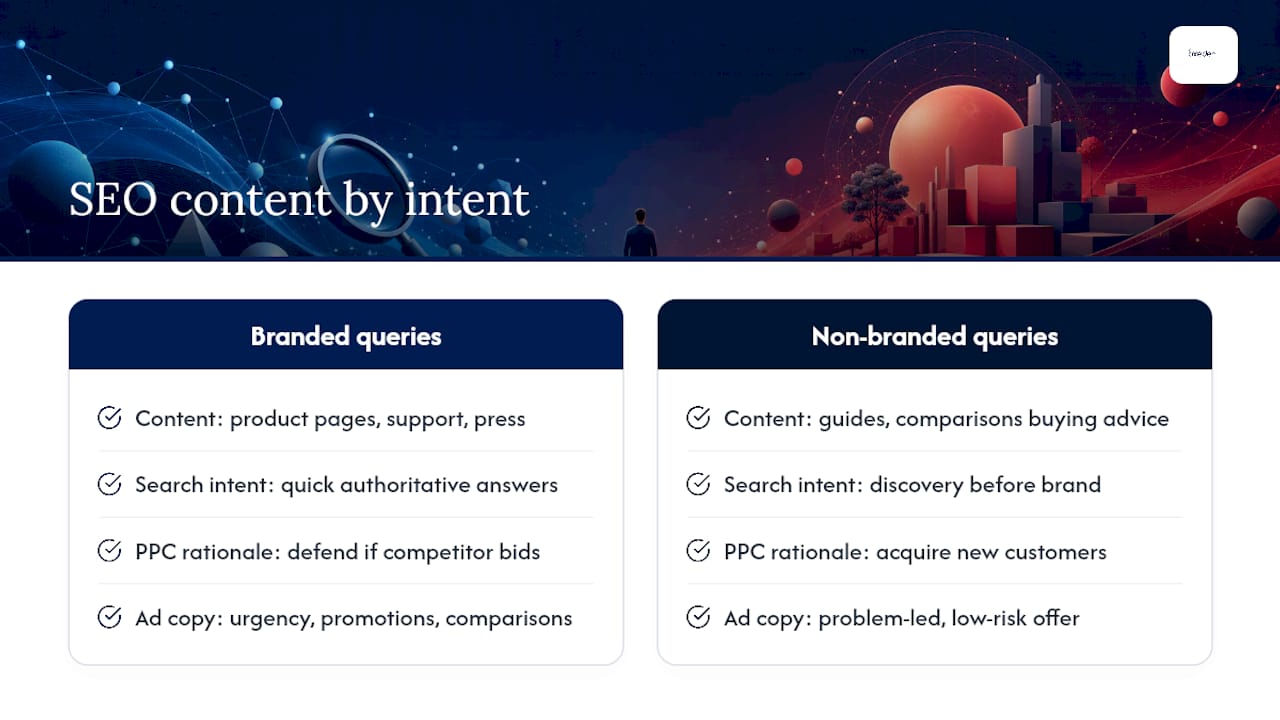

PPC works differently, and this is where the “should I bid on branded keywords” debate gets genuinely contentious. Bidding on your own brand terms feels wasteful. Why pay for a click you’d get organically anyway? Three scenarios justify it regardless: a competitor is bidding on your name, your organic listing doesn’t fully control the message searchers see, or you’re running a promotion you want to surface instantly above your organic result.
Ad copy should shift with keyword type. A non-branded ad needs to earn trust from a stranger, so lead with the problem you solve and a low-risk offer. A branded ad, aimed at someone who already knows you, can lead with urgency, a specific promotion, or a direct comparison against the competitor bidding on your name. Structure campaigns around this split, using Google Ads campaign types suited to each stage, and keep branded and non-branded in separate ad groups so you’re never diluting Quality Score or blending performance data.
Every pound spent defending a branded click you would have earned organically anyway is a pound not spent finding your next customer. Defend branded terms only where the data proves someone else is stealing that click.
Pro Tip: Add your own brand name as an exact-match negative keyword inside non-branded campaigns. It stops your generic ads cannibalising branded traffic and keeps your reporting honest about which budget is doing which job. Reviewing your search term reports weekly is the fastest way to catch this kind of overlap before it wastes real spend.
How do tools classify branded keywords, and where do they get it wrong?
Not all platforms classify branded terms the same way, and treating their outputs as gospel is where reporting errors creep in. Semrush and Ahrefs each apply proprietary methods, generally a combination of brand lists and pattern matching, while Google’s Search Console now uses an AI-assisted system introduced in November 2025.
Three pitfalls show up constantly:
- Ambiguous single-word brands get misclassified in either direction, depending on how common the word is elsewhere.
- Generic product names that started as trademarks (aspirin, escalator) rarely get flagged as branded even when they should be.
- Multi-brand product terms, like a retailer selling several brands under one search phrase, often fall outside any brand list entirely.
The Search Console filter itself carries a caveat worth remembering: it can misidentify some queries, because the classification is dynamic and machine-driven rather than manually curated. Semrush’s own knowledge base is candid about the same limitation, noting that uniqueness drives the split, so a brand token shared with unrelated products can slip through as non-branded.
Never trust a single tool’s branded label without a manual spot check. Pull 50 queries flagged as branded, read them individually, and see whether a human would agree with the software’s call.
Pro Tip: When two tools disagree on a query’s classification, side with Search Console’s raw click and impression data over any third-party estimate. It’s the only source pulling directly from Google’s own index.
How do you measure branded vs non-branded performance?
Set this up with three data sources working together: Search Console’s branded filter for organic volume, GA4 segments for behaviour and revenue, and your PPC platform’s search term reports for paid performance. Each one alone gives you a partial picture.


Track different metrics for each keyword type. Branded terms should be judged on conversion rate, cost per acquisition, and how much of your organic branded traffic you’re needlessly paying to recapture through ads. Non-branded terms need click-through rate, assisted conversions, and revenue per user, since the first touch rarely converts immediately and you’re measuring a longer path.
GA4’s default channel groupings don’t separate branded from non-branded automatically, so you’ll need custom segments built from your query list to avoid double-counting a single customer’s journey across paid and organic touchpoints.
Build one segment for “first touch non-branded, converted via branded” and watch how large it grows. That number is usually the strongest argument for keeping non-branded budget intact, even when its direct ROAS looks unimpressive on its own.
A monthly reporting checklist should cover branded share of total organic clicks, branded versus non-branded conversion rate, PPC spend split against that same ratio, and any month-on-month shift worth flagging to stakeholders.
What’s a practical budget and bidding playbook?
Turn the strategy into weekly habits with a simple sequence:
- Set your starting split based on company size and funnel maturity, weighting new or scaling brands toward 70 to 80% non-branded spend.
- Review competitor bidding on your brand terms monthly, and only raise defensive bids where auction insights show real encroachment.
- Apply exact match to branded campaigns for tight control, and broader match types to non-branded campaigns where discovery matters more than precision.
- Add negative keywords in both directions, brand names excluded from non-branded, generic terms excluded from branded, to stop internal cannibalisation.
- Rebalance quarterly as your branded search share grows, shifting budget gradually rather than reactively.
Pro Tip: Every Monday, scan your search term report for any non-branded query that’s quietly turned branded, a competitor name creeping in, your own product name gaining traction, and reclassify it before it muddies your reporting.
When does it make sense to hire a specialist instead of managing this in-house?
Three signals suggest it’s time: your ad budget has crossed a threshold where inefficiencies cost real money, you’re managing Performance Max or Shopping alongside standard search and lack the bandwidth to optimise all three properly, or performance has plateaued despite obvious effort.
Before briefing an agency, ask:
- Can you show direct experience defending branded terms against competitor bidding?
- What’s your typical reporting cadence, and does it separate branded from non-branded ROAS?
- What ROAS outcomes have you delivered for accounts of a similar size to mine?
A practitioner’s view on getting the balance right
The mistake most ecommerce brands make isn’t picking the wrong keyword type. It’s treating branded and non-branded as competing priorities instead of one connected system. Non-branded discovery content builds the audience that eventually searches your name directly, and that later branded search is what proves the earlier investment worked. Cut non-branded spend too early and you starve the pipeline that feeds your branded conversions six months later. Oxedent’s own account work across Google Shopping and Performance Max builds consistently shows this pattern: the accounts with the strongest branded conversion rates are almost always the ones that never stopped investing upstream.
When it’s time to bring in specialist PPC support
Balancing branded defence with non-branded acquisition across multiple channels takes ongoing attention, not a one-off audit. Oxedent runs eCommerce PPC exclusively, meaning every account decision, from Shopping feed structure to branded bid strategy, gets made by a team that isn’t splitting focus across unrelated industries. If your account has meaningful ad spend but you’re unsure whether your branded and non-branded split is actually working as hard as it should, a proper audit will show you exactly where budget is leaking. Explore Oxedent’s eCommerce PPC management service and get a clear read on where your accounts stand today.
Frequently asked questions
Should I bid on branded keywords if I already rank organically?
Only where competitors bid on your name or your organic listing doesn’t fully control the message. Otherwise, that budget usually works harder on non-branded acquisition.
Are non-branded keywords worth the extra effort compared with branded ones?
Yes, particularly for growing brands. Non-branded search brings in the customers who become tomorrow’s branded searches, and academic research on consumer behaviour shows non-brand-devoted shoppers evaluate product attributes more carefully, so strong non-branded content converts them when it answers those specific concerns.
How do I stop branded and non-branded campaigns from competing with each other?
Add your brand name as a negative keyword in non-branded campaigns, and add generic category terms as negatives in branded campaigns. Review search term reports weekly to catch overlap early.
Does branded search really matter more for AI-driven search results?
Growing evidence suggests it does; for more on how consistent brand signals elevate luxury fashion online, see the role of SEO in branding. Built In’s 2026 analysis found branded web mentions correlate strongly with AI visibility, meaning consistent brand signals across the web now feed both traditional SEO and AI-generated answers.
Sources
- Branded vs non‑branded keywords
- Search Console branded queries filter
- Consumer responses to branding and attributes (academic study)