


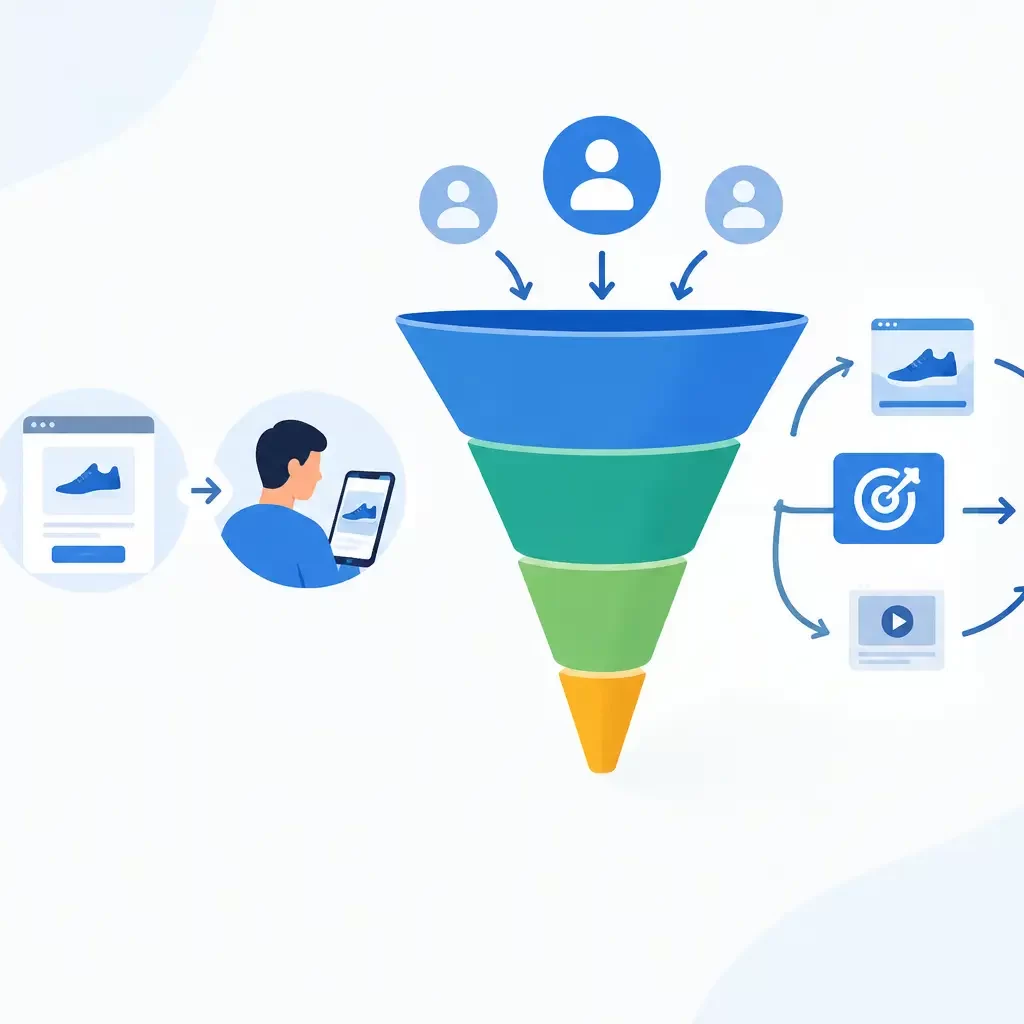
A shopper views a £120 product, adds it to basket, then disappears. Most brands either leave that revenue behind or chase it with the same generic ad for 30 days. Neither approach is serious remarketing.
How you build ecommerce remarketing funnel stages determines whether paid media recovers profitable demand or simply discounts sales you would have won anyway. For established retailers, the objective is not to follow visitors around the internet. It is to use intent, product data and contribution margin to move qualified shoppers towards a purchase at a cost your business can sustain.
Start with economics, not audiences
Remarketing is often treated as cheap revenue because the audience has already interacted with the brand. That can make platform reporting look impressive while hiding a harder question: would that customer have converted without the ad?
Before setting budgets or exclusions, establish the commercial boundaries. Know your break-even cost of sale by product category, your average order value, gross margin after fulfilment and returns, and the proportion of new versus returning customers you can profitably acquire. A £20 remarketing CPA may be excellent for a high-margin bundle and unacceptable for a low-margin single item.
This also changes how you assess return on ad spend. Blended profitability matters more than a headline remarketing ROAS. If aggressive retargeting causes existing customers to buy only when offered a discount, it can erode margin while the ad platform claims credit for revenue already in motion.
Your funnel should therefore have a clear job: convert undecided, high-intent shoppers; bring back valuable past customers when there is a genuine reason to return; and stop spending on people who have already purchased or are unlikely to buy.
Build ecommerce remarketing funnel stages by intent
The strongest funnel separates people by what they did, how recently they did it and what they viewed. A product-page visitor from yesterday is not equivalent to someone who watched a video three weeks ago. Treating both groups identically is a fast route to wasted spend.
1. Product viewers: create relevance before pressure
Product viewers have shown interest, but they may still be researching options, comparing prices or checking whether your brand is credible. This audience typically needs proof rather than urgency.
Use dynamic product ads where the catalogue is clean and product attributes are accurate. Show the item viewed, or a tightly related alternative when stock, margin or product suitability requires it. Pair the product with a clear reason to choose you: delivery threshold, warranty, expert support, verified reviews or a meaningful product benefit.
Keep the recency window short at first. The initial three to seven days usually carry more purchase intent than day 25. Broader windows can work for higher-consideration purchases, but they should be tested separately rather than lumped into one audience.
2. Basket abandoners: remove friction, do not panic-discount
A basket event is stronger intent, but it is not a licence to offer 15% off immediately. Shoppers abandon for many reasons: delivery costs appear late, they need to check sizing, they get interrupted, or they are waiting for pay day.
The first message should resolve predictable objections. Make delivery and returns clear. Reinforce availability. Show the exact item and, where appropriate, complementary products that improve the purchase rather than dilute it. If you use an incentive, reserve it for a later touchpoint and only where the margin can support it.
This is where frequency control matters. Showing the same basket ad ten times in two days does not create urgency. It creates annoyance, weakens the brand and inflates frequency without improving incremental sales.
3. Checkout abandoners: focus on completion
Checkout abandoners are the smallest and often most valuable audience. They have progressed beyond browsing and may need only a prompt to return. Exclude purchasers quickly, particularly if purchase tracking has a reporting delay, so you are not serving conversion ads to people who have just paid.
Creative can be simpler here. Remind them what they left behind, make the next action obvious and remove uncertainty around delivery, payment options and returns. For premium products, social proof and reassurance frequently outperform a blunt discount.
4. Existing customers: protect repeat revenue intelligently
Remarketing should not end at the first sale. Repeat purchase campaigns can be highly efficient when they reflect the buying cycle. Consumables, skincare, supplements and pet products may have predictable replenishment windows. Apparel and homeware may respond better to new arrivals, complementary ranges or seasonal triggers.
The key is to segment customers by purchase history, product ownership and value. Do not promote the same item to someone who bought it last week. Do not send a low-value, one-off customer the same message as a high-value repeat buyer. Customer lists and product-level exclusions make this work harder to build, but materially more commercially useful.
Make the product feed do more of the selling
For ecommerce advertisers, the product feed is part of the funnel, not a back-office file. Weak titles, generic imagery, missing attributes and inaccurate availability reduce relevance before the ad creative has a chance.
Feed optimisation matters most in dynamic remarketing and Shopping-led activity. Product titles should reflect how customers search, while images need to show the product clearly on the placements where they appear. Variant data, pricing and sale prices must be correct. If a bestseller is out of stock, exclude it promptly rather than paying to advertise a dead end.
There is a trade-off. A heavily segmented feed can improve control, but too many labels and campaigns can fragment data and make learning slower. Start with distinctions that affect profit: margin bands, bestseller status, seasonality, price point and stock depth. Expand only where there is enough volume to justify the complexity.
Choose channels based on the role they can perform
Google and Meta can both be effective, but they capture different moments. Google remarketing often reaches people when they are actively returning to search or browsing products. Meta is stronger for reintroducing products, building desire and using creative to overcome hesitation.
Performance Max can include remarketing signals, but it should not be treated as a closed retargeting campaign. Its automation can reach beyond your existing audiences. That may be valuable for scale, yet it makes clean measurement and budget control more difficult. If you need a clear read on pure remarketing performance, retain dedicated campaigns and audience exclusions alongside broader automated activity.
Creative fatigue is also channel-specific. A catalogue ad may work efficiently on Meta for a short window, while Google display placements need tighter frequency caps and stronger exclusion lists. There is no universal audience duration, bid strategy or attribution setting. The right answer depends on purchase cycle, traffic volume and the quality of your first-party data.
Measure incrementality, not just platform attribution
Remarketing campaigns naturally receive a lot of conversion credit because they target people closest to buying. That does not automatically mean they created the sale.
Review performance through more than one lens. Compare new customer revenue, blended MER, total paid spend and overall conversion rate. Watch whether remarketing spend rises faster than total revenue. If possible, use controlled tests: reduce spend in selected geographies or audience segments, then assess whether total sales genuinely fall by the amount the platform predicted.
You should also monitor audience overlap. If Meta, Google and email are all pursuing the same checkout abandoner with identical offers, the customer experience is poor and attribution becomes a fight between channels. Coordinate suppression windows and messaging so each touchpoint has a distinct role.
Set rules for scaling and cutting waste
A profitable remarketing funnel is managed like a commercial system, not left on autopilot. Scale budget when spend remains within your cost-of-sale threshold, frequency is controlled and incremental revenue supports the increase. Cut or rebuild when an audience is saturated, a product group has poor margin, or performance relies on repeated discounts.
Be particularly careful with very small audiences. Platforms need enough volume to deliver, but forcing spend into a tiny basket-abandoner pool can produce high frequency and misleading attributed ROAS. In that case, combine closely related high-intent groups or move more budget into prospecting until traffic volume supports deeper segmentation.
The best remarketing programme feels disciplined rather than aggressive. It shows the right product, to the right shopper, at the point their hesitation can still be resolved. Get that right, and remarketing becomes more than a recovery tactic: it becomes a controlled way to turn existing demand into profitable revenue without training customers to wait for the next discount.