



The fastest way to improve Meta ad creative is a hypothesis-driven test run under controlled conditions: isolate one variable, protect proven winners with ABO, and let it run 7 to 14 days until you hit roughly 50 optimisation events. Meta’s own Experiments tool exists precisely for this. Oxedent builds every ecommerce account around that discipline, because guessing costs more than testing ever will.
TL;DR:
- Using hypothesis-driven tests with clear control and a single variable improves meta ad creative performance, especially with 7 to 14 days of data gathering.
- Small accounts should prioritize ad set budget optimization with 2 to 3 concept variants, while larger accounts can leverage auction-based testing for scale.
- Setting up tests in separate campaigns, matching all conditions except testing variables, and avoiding mid-test edits ensures accurate results.
- Monitoring early indicators like hook rate, CTR, and frequency twice a week helps detect creative fatigue before it impacts cost per acquisition.
- Prioritize concept diversity and predefined decision rules over small variations, aligning testing with the new delivery system’s emphasis on creative over audience precision.
Table of Contents
- What is creative testing on Meta, and which method should you use?
- How do you set up a controlled creative test in Meta Ads Manager?
- Building a repeatable testing workflow that scales
- What are the warning signs of creative fatigue on Meta ads?
- Which Meta tools and integrations actually improve testing accuracy?
- How does Oxedent approach creative testing for ecommerce clients?
- Your creative testing launch checklist
- Why concept-first testing is the only strategy built for 2026 delivery
- Sources
What is creative testing on Meta, and which method should you use?
Creative testing on Meta means running controlled comparisons between ad variants to find out which images, videos, copy angles, or hooks actually drive profitable action, rather than which ones simply feel right to the marketing team. There are three practical methods, and each suits a different situation.
Experiments (A/B testing) splits your audience into randomised, non-overlapping segments and shows each segment only one creative variant. This is the only method that gives you true statistical isolation, because Meta’s Experiments feature removes auction overlap between your test cells. Use it when a decision carries real budget risk, such as choosing a new hero creative for a campaign that will absorb most of your monthly spend.
Auction/ad-ranking tests run multiple creatives inside the same ad set and let Meta’s delivery system allocate spend towards whichever performs best. This is faster to launch and cheaper to run, but it is not a clean test. The algorithm decides the winner based on early signals, which can punish a genuinely strong creative that simply took longer to find its audience. Treat this method as a triage tool, not a verdict.
Iterative sequencing breaks testing into rounds. You test broad concepts first (a product-demo video against a customer-testimonial carousel, for instance), find the winning concept, then run micro-tests on execution within that concept (thumbnail, hook line, call-to-action). This sequencing matters more than most advertisers realise. Since Advantage+ became the default delivery system, concept-level diversity is what unlocks different pockets of audience. Near-identical variations tend to get grouped by the algorithm and end up cannibalising each other’s reach instead of adding incremental performance.
The governing rule across all three methods is the same: test concepts before you test execution, and isolate a single variable per test. Changing the hook, the thumbnail, and the offer simultaneously tells you that something worked, never what worked.
Budget should shape which method you lean on:
- Small accounts (under £3,000/month): favour ABO with 2 to 3 concept-level variants. Tight budgets can’t support Experiments splits and dynamic tests at the same time, so pick controlled isolation over speed.
- Mid-sized accounts (£3,000 to £15,000/month): blend iterative sequencing for concept discovery with occasional Experiments for high-stakes decisions, such as a new campaign structure or a seasonal creative overhaul.
- High-spend accounts (£15,000+/month): you can afford auction-based tests at scale, because enough volume flows through to generate a fair read even with looser controls, and dynamic tests let the system sort winners faster than manual review could.
How do you set up a controlled creative test in Meta Ads Manager?
Getting the structure right before launch matters more than any optimisation you’ll make once the test is live. Get this wrong and no amount of analysis afterwards will fix a contaminated read.
- Build a dedicated exploration campaign. Keep it separate from your main performance campaign so a losing variant never drags down an account average you rely on for reporting.
- Use ABO (ad set budget optimisation), not CBO, for the test itself. CBO will shift spend towards an early leader before you’ve collected enough data, which defeats the purpose of a fair comparison. ABO forces equal spend across variants.
- Match everything except the one variable you’re testing. Same audience, same placements, same bid strategy, same budget per ad set. If you’re testing hook lines, the video, offer, and targeting stay identical.
- Adopt a naming convention you’ll actually stick to. Something like
EXP_HookTest_ConceptA_Datesaves hours of confusion three weeks later when you’re comparing five overlapping tests. - Set your runtime and minimum spend before launch, not during. Aim for 7 to 14 days per variant and don’t call a winner until each has logged around 50 optimisation events.
- Use Meta’s Experiments tool when the decision is high-stakes. It randomises audience assignment properly, which auction-based tests cannot do.
- Check results on a fixed cadence, day 3, day 7, day 14, rather than daily. Daily checking invites emotional decisions on noisy, early data.
What not to touch mid-test: budgets, targeting, and creative edits on any live variant. Editing an ad resets its learning phase and invalidates whatever data it had already accumulated, which means you’re effectively starting the clock over without realising it.
Pro Tip: Duplicate your control ad set rather than editing it when you want to add a new variant mid-test. Editing live ad sets is the single most common way testing data gets quietly corrupted.
Building a repeatable testing workflow that scales
A one-off test tells you something once. A workflow tells you something every month, and that repeatability is what separates agencies that scale accounts from advertisers who get lucky occasionally.
Phase one: research and hypothesis generation. Mine customer reviews, comments on organic posts, and past top performers for language and angles that already resonate. A hypothesis worth testing reads like “customers who leave five-star reviews mention delivery speed twice as often as price, so a delivery-speed hook will outperform a discount hook”, not “let’s try a new video”.
Phase two: exploration. Structure this as ABO, with 2 to 5 concept-level variants competing at once. Set a spend floor per variant (enough to reach early diagnostic signals like hook rate and CTR) and watch those diagnostics rather than conversions this early, since conversion volume typically lags behind creative signal by several days.
Phase three: validation. Take your exploration-phase leader and push more spend behind it with full conversion tracking active. This is where confidence thresholds matter: don’t call a winner until you’re at 80% to 95% confidence, or until CPA sits within a predefined margin of your target for a sustained period. Set these thresholds before you look at any results, or you’ll rationalise whatever number you’re already hoping to see.
Phase four: scale. Promote the validated winner into your main performance campaign. Increase budget in increments of no more than 20% to 30% at a time, because larger jumps trigger a fresh learning phase and temporarily tank efficiency just when you thought you’d solved the problem.
Phase five: retirement and vaulting. Fatigued creative doesn’t need deleting, it needs resting. Vault winners with a note on why they worked, and bring them back in three to six months once frequency has cooled off and the audience has partially refreshed.
- Research: mine reviews and organic comments for hypothesis material
- Exploration: 2 to 5 concepts, ABO, watch diagnostics not conversions
- Validation: higher spend, full tracking, hard confidence thresholds
- Scale: gradual budget increases, never a sudden jump
- Retirement: vault, don’t delete, and reintroduce after a rest period
What are the warning signs of creative fatigue on Meta ads?
Creative fatigue shows up in your leading indicators weeks before it shows up in cost-per-acquisition, and by the time CPA moves, you’ve already burned budget you can’t get back.
Leading indicators worth checking two to three times a week include hook rate (how many people stop scrolling in the first three seconds), hold rate through the video, click-through rate, and the ratio of first-time impressions to repeat impressions. A rising CPM against flat or falling CTR is often the earliest tell that Meta’s delivery system is struggling to find fresh, receptive audience for that creative.
Lagging metrics, CPC, CPA, and ROAS, confirm what the leading indicators already warned you about, but they arrive after the damage is measurable in wasted spend. Waiting for CPA to move before acting is the single most expensive habit in Meta media buying.
| Signal | Healthy range | Fatigue warning | Where to check it |
|---|---|---|---|
| CTR trend | Stable or rising week on week | Drop of 20% to 30% or more | Ads Manager, Performance columns |
| Frequency (cold audience) | Under 2 to 3 | Above 3 to 4 for prospecting campaigns | Ads Manager, Delivery breakdown |
| CPM trend | Flat relative to account baseline | Rising while CTR falls | Ads Manager, Delivery insights |
| Hook/hold rate | Consistent with past top performers | Noticeable drop over 7 to 14 days | Ads Manager, Video metrics |
When frequency climbs and CTR falls at the same time, that’s a genuine fatigue signal, refresh the creative. When CPM rises but CTR and frequency stay stable, that’s more likely broader auction pressure (seasonality, competitor spend increases) than fatigue in your specific ad, and swapping creative won’t fix it. Diagnosing which one you’re facing before you act saves you from refreshing perfectly good creative for the wrong reason.
Which Meta tools and integrations actually improve testing accuracy?
Good creative can still produce a bad test if the measurement underneath it is weak, so the tooling matters as much as the creative concepts themselves.
- Conversions API (CAPI) alongside the Pixel closes the gap left by browser tracking restrictions and improves the signal quality Meta uses to optimise and report your tests. Accounts running CAPI properly tend to see materially cleaner attribution than pixel-only setups.
- Dynamic Creative lets Meta auto-combine your images, headlines, and copy blocks, which is useful for quick execution-level testing but poor for concept-level isolation, since you lose visibility into exactly which combination drove the result.
- Creative Hub is Meta’s free mock-up tool for previewing ad formats across placements before you spend a pound. Use it to catch layout and cropping issues before launch, not as a substitute for real audience testing.
- Third-party creative management platforms help with asset rotation and bulk publishing across accounts, genuinely useful once you’re running testing at volume across multiple product lines or clients.
- Conversion Lift studies and marketing mix modelling (MMM) give you the most honest read on whether a creative drove incremental sales, rather than sales that would have happened anyway. This matters because standard attribution can overstate creative impact, particularly for brands with strong existing demand. Oxedent’s own work on incrementality testing treats lift measurement as a standard part of validating any creative decision that will influence real budget, not an optional extra for later.
How does Oxedent approach creative testing for ecommerce clients?
Oxedent frames every test as a falsifiable claim before a single pound gets spent. That discipline comes directly from customer reviews and organic engagement, not internal opinion. If reviews repeatedly mention fast shipping over price, the hypothesis becomes “a delivery-speed hook will beat a discount hook”, and that’s what gets tested, not five vaguely different videos hoping one sticks.
Spend thresholds scale with account size. Smaller ecommerce accounts get tighter ABO structures with fewer concurrent variants, because thin budgets can’t support a wide test and still reach meaningful volume. Larger accounts get more concurrent concepts and, where the stakes justify it, a proper Experiments split.
The trade-off Oxedent protects hardest is momentum. A validated winner keeps running at protected spend while new concepts test alongside it on a separate slice of budget, so no account has to choose between finding the next winner and keeping the current one alive.
Refresh cadence, vaulting rules, and case-level performance data are documented internally and refined per account rather than applied as a one-size template.
Your creative testing launch checklist
- Pre-launch: write the hypothesis, confirm tracking (Pixel and CAPI live), match budgets across variants, apply your naming convention.
- Launch: confirm ABO structure, set runtime (7 to 14 days), schedule your day 3, day 7, day 14 check-ins.
- Reading windows: day 3, watch for setup errors only; day 7, review early diagnostics; day 14, apply your decision rule.
- Decide: kill clear losers, validate borderline results with more spend, scale confirmed winners.
- Post-winner: duplicate into the scale campaign, increase budget gradually, vault the loser’s concept for a future rest-and-retest cycle.
Why concept-first testing is the only strategy built for 2026 delivery
Most Meta advertising advice still treats creative testing as an audience problem wearing a creative costume, tweak the image, keep the targeting, hope the algorithm sorts it out. That worked when Meta’s delivery system leaned heavily on the audience signals advertisers fed it. Under Advantage+ and Andromeda-era delivery, creative itself has become the primary lever the system reads, which flips the priority: concept diversity now matters more than audience precision.
The conventional advice that falls shortest is the instinct to test small variations, three thumbnails, two headlines, and call it thorough. It isn’t. Near-identical creative gets grouped by the delivery system and starves itself of reach rather than competing fairly. Genuine concept diversity, tested against a hypothesis grounded in real customer language, produces the clearest signal.
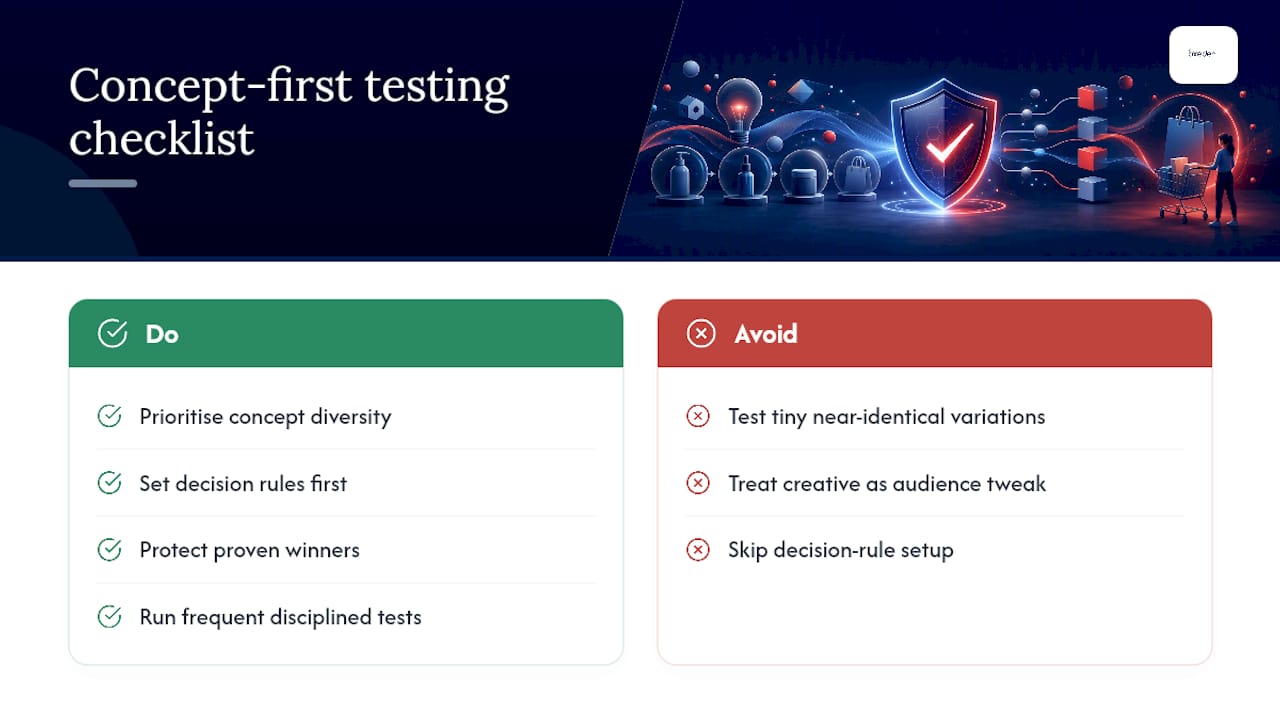

What should you prioritise first? Decision rules, before creative. Fix your confidence threshold, runtime, and minimum spend before you write a single hook line. Advertisers who skip that step aren’t testing creative, they’re just watching numbers move and calling the story afterwards.
For accounts ready to run this properly at scale without burning internal hours on manual review, Oxedent’s ecommerce PPC management builds exactly this structure into ongoing account management, protecting proven winners while frequent, disciplined tests keep finding the next one.
— Biplab
Sources
- Set up a creative test in Meta Ads Manager
- Meta Creative Testing Framework 2026 Ultimate Guide
- Creative Testing for Meta Ads: The 2026 Structure That Actually Works