



Cross-border ecommerce advertising is the practice of running paid campaigns in countries beyond your home market to acquire new customers and grow revenue. Cross-border sales are projected to account for nearly 22% of total online retail volume by the end of 2027. That figure means international expansion is no longer optional for established direct-to-consumer brands. If you want to expand ecommerce ads into new markets profitably, you need a data-led process, not guesswork. This guide gives you exactly that, covering prerequisites, market validation, campaign structure, and scaling.
What you need before you expand ecommerce ads into new markets
Launching paid ads internationally without the right foundations wastes budget fast. Three operational pillars must be in place before you spend a single pound abroad.
Store and payment infrastructure
Your store must handle multiple currencies and languages without friction. Shopify Markets Pro is one widely used solution for this, as it manages duties, taxes, and localised checkout in a single setup. Payment method coverage matters enormously. A shopper in the Netherlands expects iDEAL; one in Germany expects Klarna or SEPA. Missing local payment options kills conversion rates before your ads even get a chance to perform.


Logistics and fulfilment
Reliable regional fulfilment is non-negotiable. Customers in new markets will not tolerate the same delivery windows they might accept from a domestic brand they already trust. Audit your carrier network before launch. Confirm tracked delivery options, return policies, and realistic transit times for each target country.
Ad creative and landing page readiness
Ad performance in international markets differs markedly from domestic results. You need market-specific landing pages, even if your full website is not yet translated. A localised landing page with the correct currency, a local phone number, and relevant social proof will outperform a generic homepage every time.
| Prerequisite | What to check |
|---|---|
| Multi-currency checkout | Currencies display correctly; no forced conversion at checkout |
| Local payment methods | iDEAL, Klarna, Bancontact, or equivalent covered per market |
| Regional fulfilment partner | Tracked delivery under 5 working days confirmed |
| Localised landing page | Currency, language, and social proof match the target market |
| Ad creative assets | Product images and copy ready for market-specific testing |
Running an ecommerce ad account audit before international launch also surfaces structural issues in your existing campaigns that would compound in new markets.
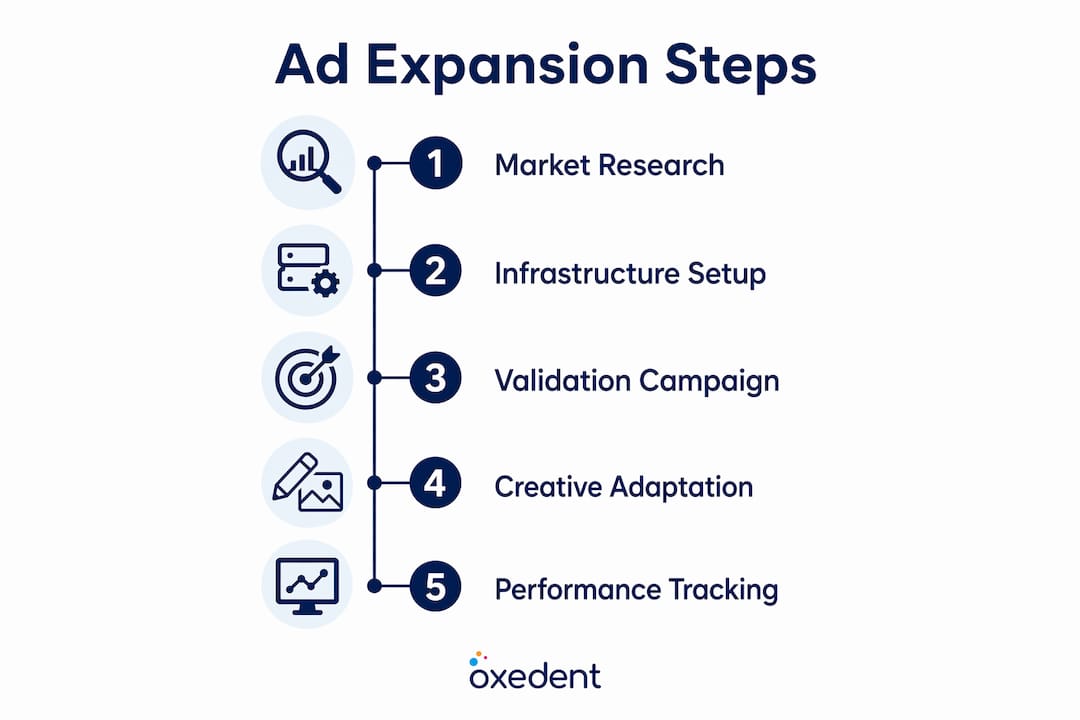

How do you select and validate target countries for ad expansion?
Market selection is where most brands make their first expensive mistake. They pick large markets by instinct, Germany or France, because they feel significant. The data rarely supports that instinct.
The three-factor scoring model
Score each candidate market across three dimensions: demand signals, regulatory complexity, and logistics viability. Demand signals come from your Google Analytics organic traffic data. If you already receive unpaid visits from a country, that is evidence of latent demand. Regulatory complexity covers VAT registration requirements, import duties, and platform advertising restrictions. Logistics viability is a simple yes or no: can you deliver reliably and profitably to that country at your current order values?
Data-led market prioritisation should focus on real-time CPC and simulated ROAS rather than market size or intuition. High CPCs in saturated markets like Germany reduce profitability despite the country’s scale. Smaller Tier 2 markets often offer lower CPCs, less competition, and faster paths to positive ROAS.
Running a validation campaign
- Select your top three candidate markets from the scoring model.
- Build a single broad-targeting campaign per market with no audience restrictions.
- Set your daily budget equal to your target cost per acquisition (CPA).
- Run the campaign for exactly five days without making changes.
- Review post-test CPA, click-through rate, and add-to-cart rate per market.
- Rank markets by actual CPA versus your target CPA threshold.
- Proceed to full launch only in markets where CPA is within 30% of your target.
A validation campaign costs around £200–£250 per market and takes five days to generate usable data. That is a small price to pay before committing a full monthly budget to an unproven geography.
Pro Tip: Before translating a single word, test English-language ads in Tier 2 European markets such as the Netherlands, Sweden, or Denmark. English ads frequently outperform local translations in these markets because English is perceived as premium and international. This cuts your initial localisation costs significantly.
Reviewing competitor ad copy and pricing in each candidate market also sharpens your positioning. Competitor ad intelligence per market helps you craft messaging that stands out before you spend on paid reach.
What campaign structures work best for international ecommerce ads?
Once a market is validated, campaign structure determines whether you scale profitably or burn budget. The principles of Google Ads campaign types apply internationally, but with important local adjustments.
Adapting creative without full localisation
Full website translation is a significant investment. You do not need it on day one. What you do need is a localised landing page and ad copy that reflects local pricing, currency, and at least one piece of local social proof. Localised social proof increases conversion rates meaningfully compared to imported testimonials from your home market. A review from a customer in the same country as the shopper carries far more weight than a five-star rating from London when you are targeting Amsterdam.
Platform and targeting considerations
Google Shopping and Performance Max work well for product-led ecommerce brands entering new markets, provided your product feed is correctly localised with local currency and accurate titles. Meta campaigns benefit from broad targeting in the validation phase, then tighten to interest and lookalike audiences once you have local pixel data. TikTok is worth testing in markets with younger demographics, particularly in Southern Europe and Southeast Asia, where CPMs are lower than on Meta.
Key campaign optimisation techniques for new markets:
- Segment campaigns by country from day one. Never group multiple countries into a single campaign, as budget allocation and bidding will skew toward the cheapest clicks, not the most profitable market.
- Set separate ROAS targets per market. A 4x ROAS target that works in the UK may be unachievable in a market with higher CPCs and lower average order values.
- Use local currency in ad copy. Showing prices in the shopper’s currency increases click-through rate and reduces checkout abandonment.
- Test one variable at a time. When entering a new market, change only the audience or the creative, not both simultaneously, so you know what drove the result.
- Monitor CPM differences weekly. CPM in emerging markets can be 40–60% lower than in the UK, which changes your break-even calculation entirely.
Pro Tip: In new markets, paid ads are the only immediately effective customer acquisition channel. CPC becomes the decisive metric for market viability, not brand awareness or impressions. Watch it daily in the first two weeks.
How do you measure success and scale international ecommerce campaigns?
Scaling without a clear measurement framework is how profitable markets get abandoned and unprofitable ones get overfunded.
Market-level contribution margin tracking
Track contribution margin per market, not just ROAS. Contribution margin accounts for ad spend, cost of goods, fulfilment costs, and returns. A market showing a 3x ROAS can still be unprofitable if returns are high or shipping costs are elevated. Segment your reporting by country from the first day of launch. Blended reports hide market-level problems and lead to incorrect optimisation decisions.
Review market profitability on a four-week cadence for the first three months. After that, monthly reviews are sufficient unless a market shows a sudden CPA spike or conversion rate drop.
Diagnosing underperforming markets
After 180 days of advertising, a market that has not reached your CPA target requires structured diagnosis. Work through four possible causes in order: logistics issues (delivery times or return friction), payment method gaps, creative resonance problems, and product-market fit. Do not cut a market before ruling out each cause. Many brands exit markets prematurely because of a logistics problem they could have fixed in two weeks.
| Scaling scenario | Typical outcome |
|---|---|
| Scale budget before CPA is stable | CPA inflates; ROAS drops; budget wasted |
| Scale after 4-week CPA stability | Predictable growth with manageable CPA increase |
| Enter multiple markets simultaneously | Data is diluted; no clear winner identified |
| Enter one market at a time | Clear performance signals; faster optimisation |
| Ignore contribution margin | Profitable-looking ROAS masks negative margin |
| Track contribution margin from day one | Accurate picture of true market profitability |
Pro Tip: Before scaling budget in a new market, run a profitability audit on your existing campaigns. Structural inefficiencies in your home market campaigns will replicate and amplify internationally.
For brands expanding to Amazon alongside their own store, international seller strategies follow similar validation logic: test demand before committing to full catalogue localisation.
Key takeaways
Expanding ecommerce advertising internationally requires validated demand, market-level contribution margin tracking, and localised campaign structures before any meaningful budget is committed.
| Point | Details |
|---|---|
| Validate before scaling | Run a £200–£250 broad-targeting campaign for 5 days to test CPA in each candidate market. |
| Prioritise by CPC, not market size | High CPCs in large markets reduce profitability; Tier 2 markets often deliver better ROAS. |
| Localise landing pages first | A localised landing page with local currency and social proof outperforms a generic homepage. |
| Segment campaigns by country | Grouping markets in one campaign skews budget and hides individual market performance. |
| Track contribution margin, not just ROAS | Fulfilment costs and returns can make a high-ROAS market unprofitable. |
What I have learned from running multi-market ecommerce campaigns
The brands that succeed internationally are rarely the ones with the biggest budgets. They are the ones that treat market entry as a hypothesis to test, not a territory to conquer.
The most common mistake I see is brands entering Germany or France because those markets feel important. The data almost never supports that instinct for a brand in its first international expansion phase. Smaller markets with lower CPCs and less established local competition frequently deliver faster payback periods and cleaner data.
Treating localisation as a product decision rather than a marketing afterthought is the single biggest mindset shift that separates successful international brands from those that retreat after six months. If your product does not fit the local market at a pricing, sizing, or regulatory level, no amount of ad spend will fix it.
The validation campaign framework is not glamorous. Spending £200 to test a market feels underwhelming when you are used to managing five-figure monthly budgets. But that £200 test has saved brands from committing £20,000 to a market where the unit economics simply do not work.
Maintain disciplined performance measurement from day one. Blended reporting is the enemy of international expansion. The moment you stop seeing each market as its own profit and loss, you lose the ability to make good decisions about where to invest next.
— Biplab
Oxedent’s approach to international ecommerce PPC
Expanding paid media across borders requires more than copying your home market campaigns into a new geography. It requires a different bidding logic, localised feed management, and market-specific performance benchmarks.

Oxedent specialises exclusively in ecommerce PPC, which means every campaign structure, every feed optimisation, and every budget decision is built around profitability rather than reach. For brands ready to test and scale internationally, Oxedent’s ecommerce PPC management service covers multi-market Google Ads, Performance Max, and Shopping campaigns with contribution margin tracking built in from the start. If you are planning international expansion and want a clear-eyed view of where your ad budget will actually work, speak to the Oxedent team.
FAQ
What is a validation campaign for new markets?
A validation campaign is a low-cost paid ad test costing around £200–£250, run for five days with broad targeting and a daily budget equal to your target CPA. It generates real CPC and conversion data before you commit a full budget to a new market.
Should I translate my ads before entering a new market?
Not necessarily. English-language ads frequently outperform translated ads in Tier 2 European markets such as the Netherlands and Sweden, where English is perceived as premium. Test English ads first, then localise only if data supports it.
How long should I run ads before judging a new market?
Run a five-day validation campaign first, then commit to a minimum of 90 days before drawing conclusions. Review contribution margin on a four-week cadence and diagnose logistics, payment, and creative issues before exiting a market.
Which metric matters most when entering a new international market?
CPC is the decisive early metric because paid ads are the only immediate acquisition channel in a new market. Once you have conversion data, shift focus to contribution margin per market rather than blended ROAS.
How many markets should I enter at once?
Enter one market at a time. Testing multiple markets simultaneously dilutes your data, makes it harder to identify what is working, and spreads your operational attention too thin during a critical learning phase.