


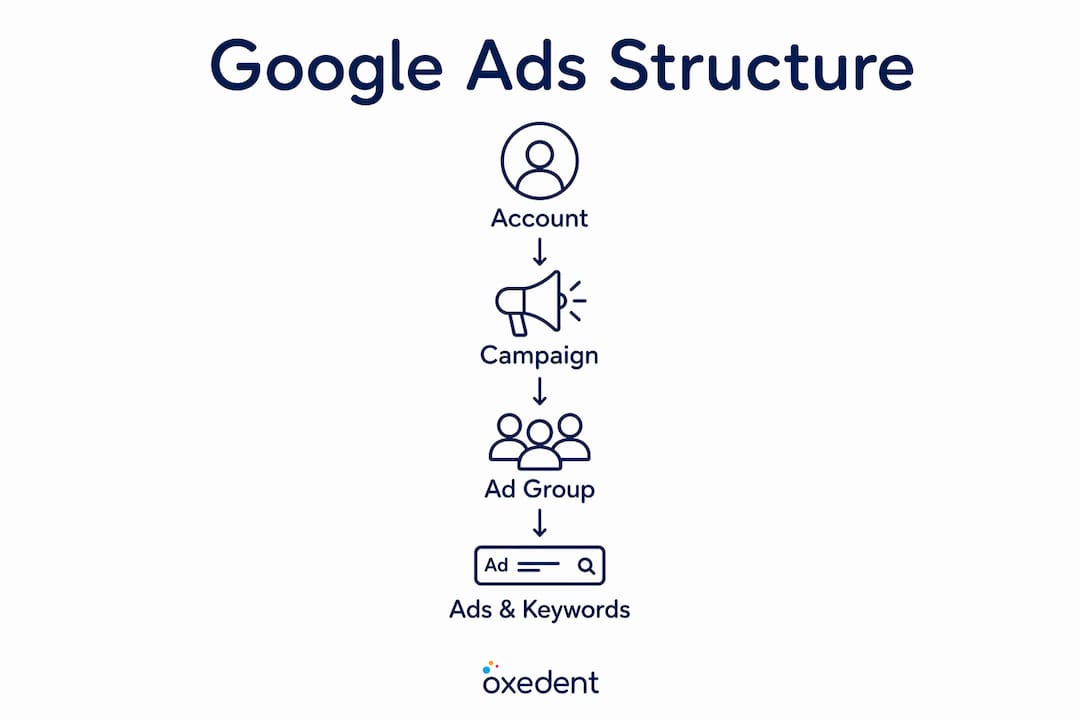
Google Ads account structure is the four-level hierarchy of Account, Campaign, Ad Group, and Ads/Keywords that controls how your budget is allocated, how your targeting is applied, and how Google’s machine learning interprets your performance data. Get this hierarchy right and everything else, from Smart Bidding to Quality Score, works in your favour. Get it wrong and you are essentially paying Google to learn the wrong lessons. This guide breaks down every layer, explains how structure drives algorithmic performance, and gives you the best practices that actually matter in 2026, including how Performance Max fits into the picture.
What is Google Ads account structure and how does it work?
Google Ads account structure is defined as the four-level hierarchy of Account, Campaign, Ad Group, and Ads/Keywords, with settings cascading downwards from each level. This is the standard framework Google uses to organise every paid search and shopping campaign, and understanding it is the foundation of effective Google Ads management.
The account level sits at the top. It holds your billing information, time zone, currency, and access permissions. Nothing here directly affects ad delivery, but these global settings underpin everything below.


The campaign level is where the real decisions happen. Each campaign controls its own budget, bidding strategy (such as Target CPA or Target ROAS), network settings, and geographic targeting. Think of each campaign as a distinct business lever. If you sell winter coats and summer dresses, those belong in separate campaigns so you can control spend independently.
The ad group level sits inside each campaign and groups thematically related keywords with their corresponding ads. A well-structured ad group contains 5 to 15 closely related keywords focused on a single intent theme. For example, an ad group for “men’s running shoes” should not also contain keywords about “men’s hiking boots.” Mixing intent at this level dilutes relevance and harms Quality Score.
The ads and keywords level is where your creatives and search triggers live. Responsive Search Ads, call ads, and the keywords that activate them all sit here. The tighter the alignment between your keywords, your ad copy, and your landing page, the higher your Quality Score and the lower your cost per click.
Pro Tip: Label every campaign, ad group, and ad with a consistent naming convention from day one. Consistent naming reduces management complexity, especially when multiple team members are working across the account, and makes auditing far faster.
How does account structure improve performance and machine learning?
A well-organised Google Ads account hierarchy does more than keep things tidy. It directly determines how well Google’s automated bidding algorithms can learn and perform on your behalf.

Smart Bidding, which includes strategies like Target CPA and Target ROAS, relies on conversion data to make real-time bid adjustments. The algorithm needs roughly 30 conversions per month per campaign to learn effectively. That figure matters because it shapes how you divide campaigns. If you split your budget across too many campaigns, each one starves for data and Smart Bidding underperforms. This is known as signal starvation, and it is one of the most common and costly structural mistakes.
Here is how good structure improves performance across four measurable dimensions:
- Budget efficiency. Campaigns that overlap in targeting compete against each other in the same auction, inflating your own costs and confusing attribution. Clean segmentation prevents this.
- Quality Score gains. A Quality Score of 8 or above can reduce your cost per click by 20 to 50% compared with lower scores. That improvement comes directly from aligning keywords, ad copy, and landing pages at the ad group level.
- Reporting clarity. When each campaign has a single, documented purpose, your performance data tells a clear story. You can see exactly which product category, location, or audience segment is generating profit and which is not.
- Scalability. A structured account is far easier to expand. Adding a new product line means adding a new campaign with a clear brief, not untangling a messy existing structure.
“The algorithm automatically decides who sees ads and when. Your role as the advertiser is to be the architect of structure that provides effective signals, not to micromanage manual bids.” — Search Engine Journal
Accurate conversion tracking setup is the prerequisite for all of this. Without reliable conversion signals, no amount of structural elegance will produce consistent results.
What are the best practices for Google Ads account structure in 2026?
The principles of good Google Ads campaign organisation have not changed dramatically, but the rise of Performance Max and increasingly automated bidding has shifted how you apply them. Here is what works in 2026.
| Practice | Old approach | Current best practice |
|---|---|---|
| Campaign segmentation | Segment by match type (exact, phrase, broad) | Segment by business lever: product category, margin, location, or season |
| Performance Max asset groups | Group by audience signal | Group by product theme for better optimisation alignment |
| Branded vs non-branded | Often mixed in same campaign | Separate branded campaigns to allow tailored bidding and protect brand equity |
| Seasonal campaigns | Pause and restart existing campaigns | Layer seasonal campaigns alongside evergreen ones to preserve historical learning |
| Naming conventions | Informal or inconsistent | Standardised naming for every campaign, ad group, and ad for auditability |
Start simple and scale with data. A common mistake is building a complex structure before you have the conversion volume to support it. Begin with one Search campaign per major product category, add Performance Max once you have baseline data, and layer in additional campaigns as your monthly conversion count grows.
Fix your offer and landing page before restructuring. If your conversion rate is poor, restructuring campaigns will not fix it. The issue is usually the page or the offer, not the account architecture.
Pro Tip: When setting up Smart Bidding for the first time, set your initial Target CPA 20 to 30% higher than your actual goal. This gives the algorithm room to gather data during the 1 to 2 week learning period without restricting delivery too aggressively.
For a deeper look at how these principles apply specifically to retail, the ecommerce Google Ads structure guide from Oxedent covers the four-level hierarchy with a retail-specific lens.
How do you choose the right campaign types and number of campaigns?
Choosing the right campaign types is one of the most consequential decisions in your Google Ads account setup. The wrong choice wastes budget; the right choice feeds the algorithm exactly the signals it needs.
Here is a practical framework for selecting and sizing your campaign portfolio:
- Search campaigns are best for capturing explicit, high-intent queries. They give you precise keyword control and are the right starting point for most businesses. Use them for your core product categories and for branded terms.
- Performance Max campaigns run across all Google inventory, including Search, Shopping, YouTube, Display, and Gmail. They perform best when you have clean conversion tracking, a well-structured product feed, and sufficient historical data. Do not launch Performance Max before you have baseline conversion data from Search.
- Branded vs non-branded separation is non-negotiable at scale. Branded campaigns typically convert at a lower cost and protect your brand from competitor bidding. Mixing them with non-branded campaigns skews your performance data and makes it impossible to evaluate true acquisition cost.
- One campaign per business lever is the guiding principle for campaign purpose clarity. Separate campaigns for different product categories, geographic markets, or margin tiers give you independent budget control and clean attribution.
- Minimum conversion thresholds matter. A campaign running on Target CPA or Target ROAS needs at least 30 conversions per month to function well. If a campaign cannot reach that threshold independently, consider consolidating it with a related campaign rather than letting it run data-starved.
You can explore the full breakdown of campaign types for ecommerce to understand when each format is the right tool for your goals. The number of campaigns you run should always be driven by your conversion volume, not by a desire for granular reporting.
A consolidated account with broad product targeting and no clean segmentation wastes budget and reduces algorithm efficiency. But the opposite extreme, splitting every product into its own campaign, causes signal starvation just as reliably. The goal is purposeful segmentation, not maximum segmentation.
Key takeaways
A well-structured Google Ads account is the single most controllable factor in how efficiently your budget converts into revenue, because it determines the quality of signals your bidding algorithm receives.
| Point | Details |
|---|---|
| Four-level hierarchy | Every Google Ads account follows Account, Campaign, Ad Group, and Ads/Keywords, with settings cascading downwards. |
| Smart Bidding data needs | Each campaign needs roughly 30 conversions per month for Smart Bidding to learn and perform effectively. |
| Avoid signal starvation | Over-segmenting campaigns splits conversion data too thinly and prevents the algorithm from optimising bids. |
| Separate branded campaigns | Branded and non-branded campaigns should always be split to allow tailored bidding and accurate performance evaluation. |
| Structure before scaling | Start with a simple structure aligned to business levers and add campaigns only as conversion volume grows. |
Structure is the strategy: what I’ve learnt from managing ecommerce accounts
By Biplab
The most persistent mistake I see in Google Ads accounts is not poor ad copy or weak landing pages. It is over-engineering the structure before there is enough data to support it. Advertisers build elaborate campaign trees with dozens of tightly segmented ad groups, each with a handful of keywords, and then wonder why Smart Bidding is erratic. The answer is almost always signal starvation.
My honest view is that the industry has overcomplicated this. In 2026, with Performance Max absorbing more inventory and Smart Bidding handling real-time adjustments, your job as the account manager is simpler in concept but harder in discipline. You need to give the algorithm enough data to work with, keep campaigns purposeful and non-overlapping, and resist the urge to restructure every time performance dips.
The other thing I would caution against is treating structure as a substitute for conversion tracking accuracy. I have audited accounts where the campaign architecture was genuinely impressive, but the conversion actions were misconfigured or double-counting. The algorithm was optimising towards phantom data. Fix your conversion tracking before you touch anything else.
The accounts that perform best are not the most complex. They are the most deliberate. Each campaign has a documented purpose, a clear budget, and enough conversion volume to learn. That is the standard worth holding yourself to.
— Biplab
How Oxedent helps you build a Google Ads structure that scales
If you are running an ecommerce brand and your Google Ads account has grown organically without a clear structure, you are almost certainly leaving revenue on the table.

Oxedent specialises exclusively in ecommerce PPC management, which means every account we build or audit is structured around profitability, not vanity metrics. We handle Performance Max setup, Smart Bidding configuration, conversion tracking verification, and campaign architecture tailored to your product catalogue and margin profile. Our ecommerce PPC management service is built for established brands ready to scale with a partner who understands the full picture. If you want to see what a properly structured account looks like for your business, get in touch with the Oxedent team.
FAQ
What is Google Ads account structure?
Google Ads account structure is the four-level hierarchy of Account, Campaign, Ad Group, and Ads/Keywords that organises how your paid campaigns are managed, budgeted, and targeted. Each level has distinct settings that cascade downwards to control ad delivery and performance.
How many keywords should an ad group contain?
An ad group should contain 5 to 15 closely related keywords focused on a single intent theme. Keeping keyword volume tight improves ad relevance, Quality Score, and ultimately your cost per click.
Why does campaign structure affect Smart Bidding performance?
Smart Bidding needs roughly 30 conversions per month per campaign to learn effectively. Campaigns with insufficient conversion data experience signal starvation, which causes erratic bidding and poor return on ad spend.
Should branded and non-branded keywords be in separate campaigns?
Yes. Branded campaigns typically convert at a lower cost and require different bidding strategies compared with non-branded campaigns. Mixing them distorts your performance data and makes it harder to evaluate true acquisition costs.
What is the best structure for Performance Max campaigns?
Performance Max asset groups perform best when organised around product themes rather than audience segments. Structuring by audience signal causes misalignment with product economics and reduces the algorithm’s ability to optimise effectively.