


Performance Max campaigns promise to put Google’s full inventory at your disposal, yet for most ecommerce marketing managers, the reality is murkier. Budgets disappear into channels you cannot see, conversion data tells one story whilst revenue tells another, and the automation that was supposed to save time ends up demanding more of it. Finding genuine google ads agency performance max expertise is the difference between a campaign that burns spend and one that compounds returns. This guide walks you through the prerequisites, optimisation frameworks, and data practices that expert agencies apply to turn Performance Max into a genuinely profitable channel.
Table of Contents
- Key takeaways
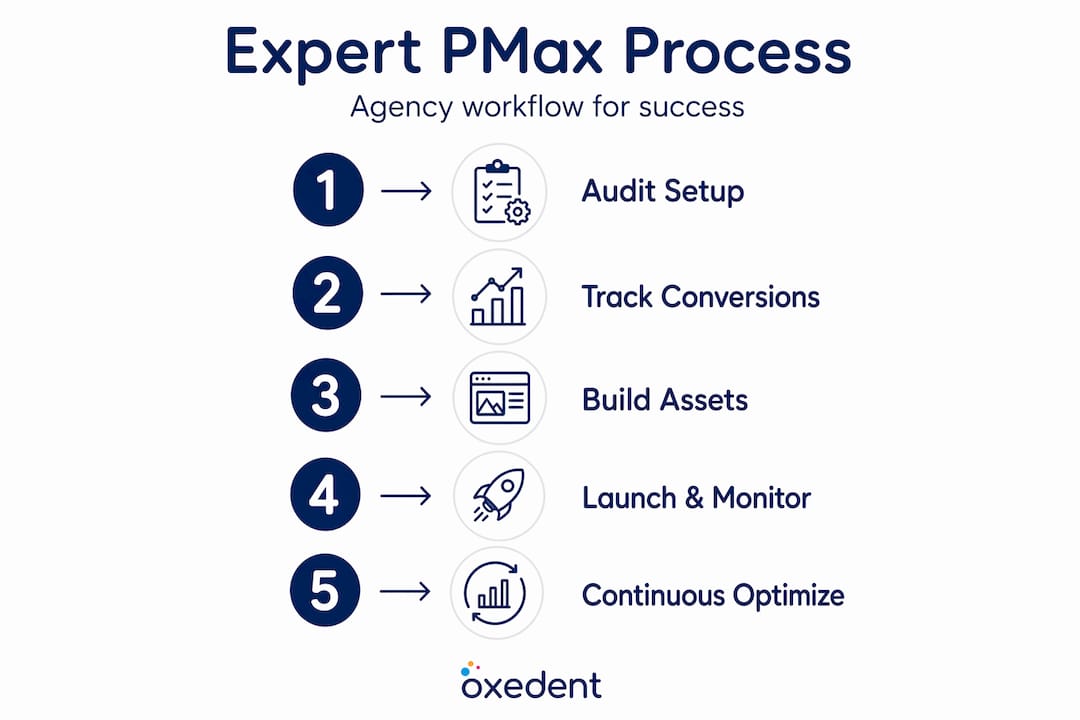
- What agencies do before launching Performance Max
- How expert agencies optimise Performance Max step by step
- Using first-party data to feed Google’s AI
- Common pitfalls and how to fix them
- Measuring Performance Max results accurately
- My perspective on what actually makes the difference
- Work with Performance Max experts at Oxedent
- FAQ
Key takeaways
| Point | Details |
|---|---|
| Budget and data quality first | A minimum monthly budget of £1,500 to £2,500 and clean conversion data are non-negotiable before PMax can learn effectively. |
| Hybrid structures outperform solo PMax | Running Standard Shopping alongside Performance Max gives you control over top SKUs while PMax handles prospecting. |
| Feed quality drives AI behaviour | Your product feed is the single biggest lever for improving what Google’s algorithm serves and to whom. |
| First-party data transforms bidding | Integrating CRM and offline conversion data shifts optimisation from clicks to closed revenue. |
| Measurement must go beyond reported ROAS | Cross-referencing GA4, CRM, and pre-PMax baselines reveals the true incremental impact of your campaigns. |
What agencies do before launching Performance Max
Before any expert agency touches campaign settings, they audit the foundations. Skipping this stage is the most common reason ecommerce brands see disappointing results.
Budget and conversion volume are the starting point. Experts advise a minimum monthly budget of £2,000 to £3,000 to give Google’s machine learning enough data to optimise rather than guess. Below that threshold, the algorithm cycles through a prolonged learning phase and never stabilises. Related to this, PMax needs at least 30 conversions in the last 30 days to exit the learning phase effectively. If you cannot hit that volume, you are not ready for PMax as your primary growth driver.
Conversion tracking must be airtight. Agencies configure enhanced conversions, verify that purchase values are firing correctly, and where possible, pull in offline conversion data from your CRM. This is not optional polish. It is the data the algorithm uses to decide where to bid.
Here is a quick summary of what a thorough pre-launch audit covers:
| Prerequisite | Minimum standard | Agency action if missing |
|---|---|---|
| Monthly ad budget | £2,000+ | Delay PMax; optimise Shopping first |
| Conversion volume | 30+ purchases per month | Build volume through other campaign types |
| Product feed quality | No disapprovals; rich attributes | Feed optimisation and supplemental feeds |
| Asset groups | 3+ images, 1+ video, headlines, descriptions | Creative production or sourcing |
| Audience signals | Customer lists, website visitors | Pixel installation and list building |
Asset group quality matters more than most brands realise. Google’s AI favours campaigns with video assets and well-segmented asset groups tailored to placement contexts. An agency will typically create separate asset groups by product category, price point, or audience segment rather than uploading one generic set and hoping for the best.
Pro Tip: Set up your audience signals using a combination of customer match lists, remarketing audiences, and in-market segments before launch. These signals do not restrict who the campaign targets but give Google a meaningful head start rather than asking it to learn from scratch.
The foundational setup insights around asset group configuration and audience signal creation are worth reviewing before you finalise any campaign structure.
How expert agencies optimise Performance Max step by step
Once the foundations are solid, the real work begins. Expert agencies follow a structured process rather than tweaking settings reactively.
-
Build a hybrid campaign structure. 82% of advertisers use Performance Max alongside other campaign types, and hybrid setups consistently outperform standalone PMax. The practical model is to run Standard Shopping for your highest-margin or bestselling SKUs where you want granular bid control, and use PMax for prospecting, seasonal pushes, and broader discovery. This hybrid campaign structure gives you the best of both worlds: precision on known winners, scale on new opportunities.
-
Segment asset groups deliberately. Create separate asset groups for each major product category, and go further by splitting gift buyers from repeat purchasers if your audience data supports it. Each group gets its own images, copy, and calls to action. This is not busywork. It directly improves relevance scores and placement quality.
-
Apply brand exclusions from day one. Campaign-level brand exclusions prevent PMax from consuming budget on branded queries that your branded search campaign already covers at a fraction of the cost. Google updated campaign priority rules in late 2024, so ad rank now determines auction winners. Without explicit exclusions, your PMax campaign will cannibalise your branded traffic and inflate your reported ROAS deceptively.
-
Use search theme inputs strategically. Rather than letting PMax run entirely open-ended, agencies add search themes to guide the algorithm towards relevant query categories. These act as a soft steer without the hard constraints of keywords, giving you a degree of control without undermining the machine learning.
-
Refresh creative assets regularly. PMax surfaces your assets across Search, Shopping, Display, Discover, Gmail, and YouTube. Creative that performs well on Shopping looks flat on YouTube. Agencies audit asset performance ratings monthly and replace low-rated assets before they drag down overall campaign quality.
-
Add negative keywords at account level. Work with your Google rep or use account-level negative keyword lists to exclude irrelevant queries. This becomes especially critical if you sell in a category with significant informational search intent, such as electronics or supplements.
Pro Tip: When assessing which Standard Shopping campaigns to run alongside PMax, prioritise your top 20% of SKUs by gross margin rather than revenue. Protecting margin, not just turnover, is what keeps scaling profitable.
Using first-party data to feed Google’s AI


This is where performance max advertising agency work separates genuine experts from those who simply adjust bids. Top-tier agencies function as extensions of RevOps, feeding offline sales data back into Google Ads to optimise bids for closed-won revenue rather than just leads, clicks, or micro-conversions.
The practical levers are:
- Profit margin data: Pass margin values rather than sale prices as conversion values where possible. This tells Google to prioritise high-margin SKUs, not high-volume ones.
- Customer Lifetime Value signals: Upload CRM-derived LTV segments as audience lists so the algorithm can weight bids in favour of customers likely to return.
- Offline conversion tracking: Import CRM outcomes such as confirmed orders or returned purchases back into Google Ads. This moves optimisation from surface metrics to realised revenue.
- Inventory signals: Reduce bids or pause asset groups for out-of-stock products by integrating inventory data into your feed management workflow.
The fundamental challenge for PPC managers in 2026 is managing the data behind bids, requiring agencies to become data engineers rather than mere bid managers. Tools like Campaign Orchestrator from smec enhance campaign transparency by enabling you to feed live business logic into PMax beyond what native Google automation allows.
Bid strategy alignment is equally critical. Expert google ads consultants set target ROAS at the campaign level based on business revenue targets, not Google’s suggested values. They also segment bid strategies by product group margin tier, so a high-margin category runs at a different target ROAS to a commoditised one.

| Data input | What it improves | Integration method |
|---|---|---|
| Profit margin per SKU | Bids weighted to margin, not revenue | Supplemental feed or custom label |
| CRM LTV segments | Bidding favours high-value customer profiles | Customer match upload |
| Offline conversion data | Algorithm optimises for actual sales | Google Ads offline import or GA4 |
| Inventory levels | Spend avoided on out-of-stock products | Feed rules or automated labels |
Common pitfalls and how to fix them
Even well-resourced in-house teams fall into the same traps. Recognising them early saves significant budget.
- Treating PMax as set-and-forget. Performance Max automation requires active management. Without regular asset refreshes, bid strategy reviews, and feed updates, spend drifts towards low-quality placements and inflated CPCs.
- Poor feed quality. Your product feed is the primary signal Google uses to match your ads to queries. Missing GTINs, thin titles, and low-resolution images directly reduce impression share and conversion rate.
- No hybrid structure. Running PMax as your only campaign means Google decides where every pound goes. Without a Standard Shopping campaign protecting your best SKUs, your top performers can end up buried beneath prospecting spend.
- Insufficient conversion volume. Launching PMax with fewer than 30 monthly purchases leads to permanently unstable results. The algorithm cannot learn meaningful patterns from sparse data.
- Ignoring channel-level cannibalisation. If your PMax campaign is spending heavily on branded queries, your reported ROAS will look impressive whilst your incremental return is actually poor. Segment and exclude rigorously.
- Neglecting asset group segmentation. A single asset group covering your entire catalogue gives the algorithm no context. It produces generic placements that underperform across every channel.
Pro Tip: Run a search terms report through Google Ads scripts or a third-party tool monthly. Even though PMax does not expose query data natively, pattern analysis from your broader account and GA4 audience data reveals where spend is leaking.
For a detailed view of scaling PMax profitably and avoiding these structural errors, the stepwise guidance there is worth bookmarking.
Measuring Performance Max results accurately
Reported ROAS from PMax is not the same as incremental ROAS. This distinction matters enormously for established ecommerce brands.
- Compare pre and post-PMax account performance. Pull total account revenue and ROAS from the three months before PMax launched and compare against the equivalent period after. If total account revenue has grown and cost-per-purchase has held, PMax is contributing. If the metrics look similar but spend is higher, you may be paying for conversions that would have happened anyway.
- Track new customer acquisition separately. PMax tends to favour returning visitors and low-funnel conversions. Use GA4’s new versus returning user segmentation and your CRM to verify whether PMax is genuinely growing your customer base or recirculating existing intent.
- Use GA4 as a cross-reference. Google Ads and GA4 will rarely agree exactly on conversion numbers, but large discrepancies signal tracking issues or attribution model conflicts that need resolving before you can trust any reported figure.
- Assess asset group performance ratings. While PMax does not expose full asset-level attribution, the asset performance ratings (Low, Good, Best) in the campaign interface give you enough signal to identify and replace underperforming creative.
- Set revenue-based KPIs. Clicks, impressions, and even conversion numbers are secondary. Align your KPIs to cost of goods, contribution margin, and new customer revenue so that campaign success maps directly to business outcomes.
The role of PPC in ecommerce growth provides useful context for setting KPIs that connect paid channel performance to genuine business revenue rather than platform-reported metrics.
My perspective on what actually makes the difference
The agency market is full of teams that can set up a Performance Max campaign. Far fewer can manage one well over 12 months as budgets scale and product ranges evolve.
In my experience, the brands that get the most from PMax are not necessarily the ones with the biggest budgets. They are the ones whose agencies treat data engineering as the primary job. Getting your CRM outcomes back into Google Ads, keeping your feed clean, and structuring your campaigns so the algorithm receives honest, margin-weighted signals is what separates a 4x ROAS account from a 9x ROAS account.
I have also seen too many brands drawn in by impressive reported ROAS figures that collapsed the moment we looked at incremental revenue. PMax will find the easiest conversions first. Branded queries, recent site visitors, and warm audiences all convert at low cost and inflate your headline number. The uncomfortable question is always: would those people have purchased anyway? Honest agencies ask that question. The ones who do not are protecting their reporting, not your margin.
My advice is to treat PMax as one part of a deliberate account architecture. Pair it with Standard Shopping for control, feed it first-party data for precision, and measure it against business outcomes rather than platform numbers. The ecommerce Google Ads optimisation approach that focuses on this architecture is what sustainable scaling actually looks like.
— Biplab
Work with Performance Max experts at Oxedent
If you have read this far and recognised gaps in how your current PMax campaigns are structured or measured, that recognition is worth acting on.

Oxedent specialises exclusively in ecommerce paid media. Every service, from campaign setup and feed optimisation to CRM data integration and hybrid account architecture, is built around one objective: profitable, scalable revenue growth. There are no long-term contracts, no vanity metric reporting, and no generalist account managers who handle PMax one week and brand awareness the next.
If your brand is spending meaningfully on Google Ads and you want to know precisely what is working and what is not, Oxedent’s eCommerce PPC management service is the right starting point. Get in touch to request a campaign audit and find out where your current campaigns are leaving returns on the table.
FAQ
What does a Google Ads agency do with Performance Max?
A specialist Google Ads agency builds hybrid campaign structures, manages feed quality, integrates first-party data, and monitors asset performance to ensure PMax optimises for real revenue rather than surface metrics like clicks or impressions.
How much budget do you need for Performance Max to work?
Experts recommend a minimum monthly budget of £2,000 to £3,000 alongside at least 30 monthly conversions so Google’s algorithm can exit the learning phase and produce stable results.
Can Performance Max replace Standard Shopping campaigns?
No. The hybrid strategy of running Standard Shopping alongside PMax consistently outperforms solo Performance Max, because Standard Shopping gives you granular control over your highest-margin SKUs.
Why does Performance Max report high ROAS but revenue stays flat?
PMax often cannibalises branded queries and existing demand, which makes reported ROAS look strong without genuine incremental growth. Cross-reference GA4 and CRM data against pre-PMax baselines to assess true impact.
How do agencies use first-party data in Performance Max?
Agencies integrate CRM and offline conversion data into Google Ads to shift bidding optimisation from clicks and form fills to closed sales, margin-weighted outcomes, and high-LTV customer acquisition.
Recommended
- Master Google Ads agency reporting for better ROI – Oxedent
- Google Ads Decoded: A Comprehensive Guide to Cost, Performance, and Strategy in 2024 – Oxedent
- 5 things you need to know before you set up your Google Performance Max campaign – Oxedent
- How to Choose the Right Google Ads Agency in 2025 – Oxedent