


A Google Ads agency smart bidding approach is defined as an AI-powered method that sets bids automatically at auction time, using machine learning to maximise conversions or revenue within your budget. Google evaluates signals including device, location, time of day, query intent, demographics, and remarketing lists in milliseconds to set the bid per auction. The four core smart bidding strategies are Target CPA, Target ROAS, Maximise Conversions, and Maximise Conversion Value. Each aligns with a specific business goal, and choosing the wrong one wastes budget fast. This guide walks you through the prerequisites, execution steps, and fixes for the most common problems eCommerce businesses face with automated bidding.
What prerequisites do you need before implementing smart bidding?
Smart bidding is only as good as the data feeding it. Before you switch on any automated bidding technique, your measurement foundation must be solid.
The most critical requirement is accurate conversion tracking. Server-side tracking, Enhanced Conversions, and CRM imports provide the highest quality signals for auction-time decisions. Standard pixel tracking alone misses a significant portion of conversions due to browser restrictions and ad blockers. Without clean data, the algorithm bids on noise rather than real revenue signals.


Volume matters just as much as accuracy. Google recommends a minimum of 30 conversions per month for Target CPA and 50 for Target ROAS. Fewer conversions produce volatile bidding decisions and erratic spend patterns. If your account sits below these thresholds, smart bidding will underperform regardless of how well everything else is configured.
Campaign structure also shapes algorithm performance. Fragmented campaigns with thin data pools force the algorithm to guess. Consolidating campaigns gives the machine learning model a richer signal set to work with, which accelerates learning and produces more consistent results.
Key data requirements at a glance:
| Requirement | Why it matters |
|---|---|
| Server-side or Enhanced Conversions | Captures conversions missed by browser-based pixels |
| 30+ conversions per month (CPA) | Minimum threshold for reliable Target CPA learning |
| 50+ conversions per month (ROAS) | Minimum threshold for reliable Target ROAS learning |
| Consolidated campaign structure | Pools data signals for faster algorithm calibration |
| Aligned conversion actions | Ensures the algorithm optimises for your actual business goal |
For eCommerce businesses, your primary conversion action should be the purchase event with accurate revenue values passed through. Tracking add-to-cart or page views as primary conversions misleads the algorithm into optimising for the wrong behaviour.
Pro Tip: Use the omnichannel transaction tracking guide to audit your conversion data across all retail touchpoints before activating any smart bidding strategy.
How do you choose the right smart bidding strategy?
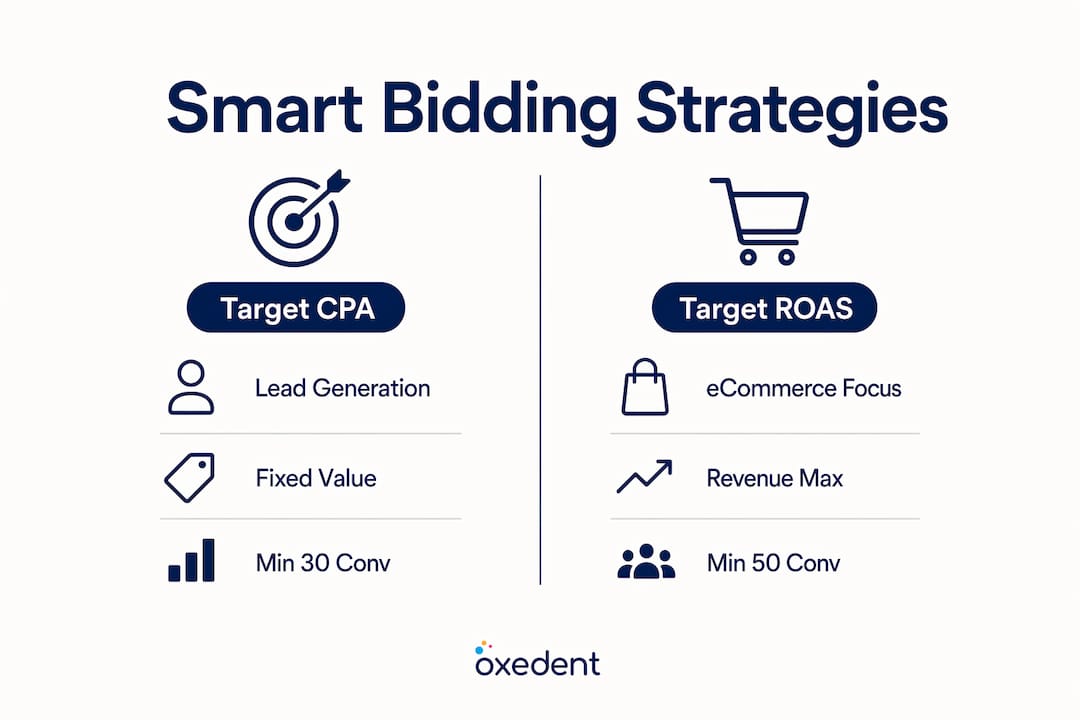

Choosing the right strategy is the single decision with the greatest impact on your return on ad spend. Each of Google’s four smart bidding strategies serves a different commercial objective, and misalignment is a major cause of wasted spend.
Target CPA
Target CPA instructs Google to acquire as many conversions as possible at or below your specified cost per acquisition. It works best for lead generation campaigns where each conversion carries a consistent value. An eCommerce brand selling a single product at a fixed price can also use it effectively. It is the wrong choice when order values vary significantly across transactions.
Target ROAS
Target ROAS tells Google to maximise conversion value relative to spend. It is the natural fit for eCommerce accounts where basket sizes differ across orders. Setting a Target ROAS of 400% means Google aims to return £4 in revenue for every £1 spent. This strategy requires accurate revenue values in your conversion tracking, making the measurement foundation even more critical.
Maximise Conversions and Maximise Conversion Value
These two strategies work without a specific CPA or ROAS target. Maximise Conversions spends your full budget to get as many conversions as possible. Maximise Conversion Value does the same but prioritises higher-value transactions. Both are useful during the early stages of a campaign when you lack enough historical data to set reliable targets. They are also appropriate when you want to test a new campaign structure before committing to a fixed efficiency target.
Smart bidding strategy comparison:
| Strategy | Best use case | Minimum data requirement |
|---|---|---|
| Target CPA | Lead generation, fixed-value products | 30 conversions per month |
| Target ROAS | eCommerce with varied order values | 50 conversions per month |
| Maximise Conversions | New campaigns, budget-first scaling | No minimum, but more data helps |
| Maximise Conversion Value | Revenue-focused scaling | No minimum, but revenue values required |
Manual CPC and Enhanced CPC still have a place in accounts with very low conversion volumes or highly specific targeting requirements. Once your account consistently hits the conversion thresholds above, the shift to smart bidding almost always improves efficiency.
Pro Tip: If you run a Google Shopping campaign alongside Search, align both to Target ROAS from the same portfolio bid strategy to pool conversion data across campaign types.
Step-by-step guide to implementing smart bidding campaigns
Getting the setup right from day one prevents weeks of wasted learning time. Follow these steps in order.
- Verify your conversion tracking. Confirm that purchase events fire correctly, revenue values pass through accurately, and no duplicate conversions inflate your data. Fix any tracking gaps before proceeding.
- Consolidate your campaign structure. Merge campaigns with overlapping targeting or thin conversion data. Fewer, larger campaigns give the algorithm more to work with.
- Select your smart bidding strategy. Match the strategy to your business goal using the comparison table above. For most eCommerce accounts, Target ROAS is the right starting point once volume thresholds are met.
- Set realistic initial targets. Base your starting CPA or ROAS target on your last 30 days of actual performance. Setting an aspirational target from day one starves the algorithm of traffic and slows learning.
- Enable broad match keywords alongside your smart bidding strategy. Broad match paired with smart bidding expands the auction pool and accelerates algorithm learning. It works because the machine learning model filters irrelevant queries using your conversion data.
- Respect the learning period. Smart bidding requires 7–14 days of learning after any significant change. During this window, performance fluctuates. Do not adjust bids, budgets, or targeting mid-learning.
- Use portfolio bid strategies for low-volume campaigns. Portfolio bid strategies share conversion data across multiple campaigns, enabling smart bidding where a single campaign lacks sufficient volume.
- Monitor and adjust targets cautiously. Once the learning period ends, review performance over a 14-day window before making any target adjustments. Change targets by no more than 10–15% at a time to avoid triggering a new learning phase.
Common implementation mistakes to avoid:
- Switching strategies mid-learning period
- Setting CPA or ROAS targets far outside historical performance
- Tracking micro-conversions as primary conversion actions
- Running too many small campaigns instead of consolidating
- Ignoring the conversion rate issues that prevent the algorithm from learning
Pro Tip: Treat your first two weeks after launch as a data collection phase, not a performance phase. Evaluate results only after the learning period closes.
How do you troubleshoot poor smart bidding performance?
Poor smart bidding performance almost always traces back to one of three root causes: bad data, insufficient volume, or an unstable account structure.
Symptoms to watch for:
- Budget depletes daily with few or no conversions recorded
- Bids swing erratically between auctions with no clear pattern
- Cost per conversion climbs steadily after an initial stable period
- The campaign shows a “Learning” status for more than 14 days
The most common underlying cause is tracking failure. Accurate conversion data is the foundation that smart bidding relies on. If your pixel fires on the wrong page, counts duplicate purchases, or misses mobile transactions, the algorithm optimises for a distorted picture of reality. Audit your conversion tracking first before changing any bidding settings.
If tracking is clean but volume remains low, consolidate campaigns and consider switching to a portfolio bid strategy. Pooling conversions across campaigns gives the algorithm the data density it needs to make reliable decisions.
“Smart bidding is a tool, not a stand-alone strategy. Success depends on integrated measurement, campaign structure, and messaging working together. Most agencies fail by treating bidding automation as a fix without addressing foundational tracking and targeting issues.”
When performance deteriorates despite clean tracking and sufficient volume, examine your ad messaging and landing pages. A disconnect between what your ad promises and what your landing page delivers suppresses conversion rates. The algorithm cannot compensate for a poor user experience after the click.
If all else fails, pausing smart bidding and reverting to manual CPC temporarily is a legitimate tactic. Use the manual period to rebuild conversion volume, fix tracking gaps, and restructure campaigns before re-engaging automation.
Pro Tip: Check your Google Ads conversion problems report weekly during the first month of any smart bidding campaign. Early detection of tracking issues saves weeks of wasted spend.
Key takeaways
Smart bidding delivers results only when measurement, campaign structure, and strategy selection work together as a single system.
| Point | Details |
|---|---|
| Measurement comes first | Fix conversion tracking before activating any smart bidding strategy. |
| Match strategy to goal | Use Target ROAS for eCommerce revenue; Target CPA for consistent-value leads. |
| Respect the learning period | Avoid changes for 7–14 days after launch to prevent algorithm instability. |
| Consolidate for data density | Merge thin campaigns into portfolio bid strategies to hit volume thresholds. |
| Broad match accelerates learning | Pairing broad match with smart bidding expands auction signals and speeds optimisation. |
Smart bidding works when the foundations are right
I have reviewed hundreds of Google Ads accounts where smart bidding was active but delivering poor results. In almost every case, the problem was not the bidding strategy itself. The problem was that the account had been handed over to automation before the foundations were ready.
The most common mistake I see is agencies activating Target ROAS on accounts with fewer than 30 monthly conversions and then blaming the algorithm when performance collapses. The algorithm is not broken. It simply has nothing reliable to learn from. Garbage in, garbage out is not a cliché here. It is a precise description of what happens.
The second mistake is treating the learning period as a performance period. Clients see spend without conversions in the first week and panic. They change targets, adjust budgets, or switch strategies. Each change resets the learning clock. What should have been a two-week calibration phase turns into two months of instability.
The approach I advocate is what Oxedent calls the 3-Pillar Method™: measurement, structure, and messaging. You cannot fix a bidding problem with a bidding solution if the measurement is broken or the campaign structure is fragmented. All three pillars must be solid before automation can do its job. The role of Google Ads in eCommerce revenue growth is significant, but only when the account is built to support it.
Smart bidding is genuinely powerful when the conditions are right. The agencies that get consistent results from it are not doing anything magical. They are simply doing the boring, unglamorous work of getting measurement right before they touch a single bid setting.
— Biplab
How Oxedent’s Google Ads management services support smart bidding
Oxedent builds every Google Ads campaign on the 3-Pillar Method™: measurement, structure, and messaging. Before any smart bidding strategy goes live, the team implements server-side tracking, Enhanced Conversions, and CRM imports to give the algorithm the cleanest possible data signals.

Every account Oxedent manages receives founder-led strategy, transparent reporting, and results-based pricing with no long-term contracts. For eCommerce businesses ready to scale, Oxedent’s eCommerce PPC management service covers the full stack: campaign structure, feed optimisation, and smart bidding configuration aligned to your actual revenue targets. If you want smart bidding to work the way Google designed it to, the foundations have to be right from day one.
FAQ
What is smart bidding in Google Ads?
Smart bidding is an automated bidding technique that uses machine learning to set bids at auction time, optimising for conversions or conversion value based on real-time signals such as device, location, and query intent.
How many conversions do you need for smart bidding to work?
Google recommends at least 30 conversions per month for Target CPA and 50 per month for Target ROAS. Below these thresholds, the algorithm lacks sufficient data to make reliable bidding decisions.
How long does the smart bidding learning period last?
The learning period typically lasts 7–14 days. Making changes to bids, budgets, or targeting during this window resets the learning process and extends the instability period.
Which smart bidding strategy is best for eCommerce?
Target ROAS is the most effective strategy for eCommerce accounts with varied order values, as it optimises for revenue relative to spend rather than a fixed cost per conversion.
Can you use smart bidding with low conversion volumes?
Yes, by using portfolio bid strategies that pool conversion data across multiple campaigns. This approach allows smart bidding to function effectively where individual campaigns lack sufficient volume on their own.