


You could be running well-structured ads with compelling creative, and still haemorrhage budget every single day. The uncomfortable truth is that most eCommerce brands misdiagnose Google Ads underperformance, blaming copy or bids when the real culprits are buried deeper: broken tracking, misaligned targeting, structural inefficiencies, or compliance issues quietly throttling results. A Google Ads campaign audit is the diagnostic tool that cuts through the noise, surfaces what is actually happening, and gives you a prioritised roadmap to genuine, measurable profit improvement.
Table of Contents
- What is a Google Ads campaign audit?
- Core components of a Google Ads audit
- Conversion tracking: the audit starting point
- Beyond numbers: strategic and compliance checks
- From audit to action: executive summaries and prioritising fixes
- Why most Google Ads audits fail: our experience
- Get expert help with your Google Ads audit
- Frequently asked questions
Key Takeaways
| Point | Details |
|---|---|
| Fixes start with tracking | Audits must validate conversion tracking before judging campaign performance. |
| Combine data and strategy | Blending quantitative and qualitative checks reveals hidden profit drains in Google Ads. |
| Prioritise action, not just reporting | Effective audits turn insights into a prioritised, actionable fix list for improved returns. |
| Compliance matters | Checking policy and disapproval status prevents invisible serving issues. |
| Professional support pays off | Expert audits go beyond free checklists and deliver lasting eCommerce campaign results. |
What is a Google Ads campaign audit?
Campaign underperformance rarely announces itself clearly. You might see rising cost per acquisition, flat revenue despite increased spend, or inconsistent return on ad spend (ROAS) that never quite makes sense. These symptoms often get attributed to creative fatigue or seasonal shifts. But frequently, the root cause is something more structural and entirely fixable.
A Google Ads campaign audit is a structured, comprehensive review of an Ads account and campaigns aimed at identifying inefficiencies such as wasted spend, weak targeting, and broken measurement, then prioritising fixes to improve performance and return on ad spend.
In practical terms, this means examining every layer of your account: how campaigns are structured, which keywords are triggering your ads, whether your bidding strategy aligns with your margin goals, and whether your measurement setup actually reflects real business outcomes. It is not a quick glance at your dashboard. It is a methodical investigation.
For eCommerce brands, audits matter for three core reasons:
- Protecting ROAS: Every pound or dollar of wasted spend is profit leaving your business. An audit identifies where budget is leaking and redirects it towards what works.
- Aligning campaigns with business goals: Campaigns that were set up months or years ago may no longer reflect your current product mix, margins, or growth priorities. An audit realigns strategy with where your business actually is today.
- Prioritising fixes over guesswork: Without a structured review, optimisation becomes reactive and inconsistent. An audit replaces guesswork with an ordered list of high-impact actions.
If you want to go deeper on the tactical side, reviewing search ads optimisation steps alongside your audit findings will help you act faster. And if cost efficiency is a priority, understanding how to lower cost per conversion is a natural next step once your audit surfaces where spend is going.
Core components of a Google Ads audit
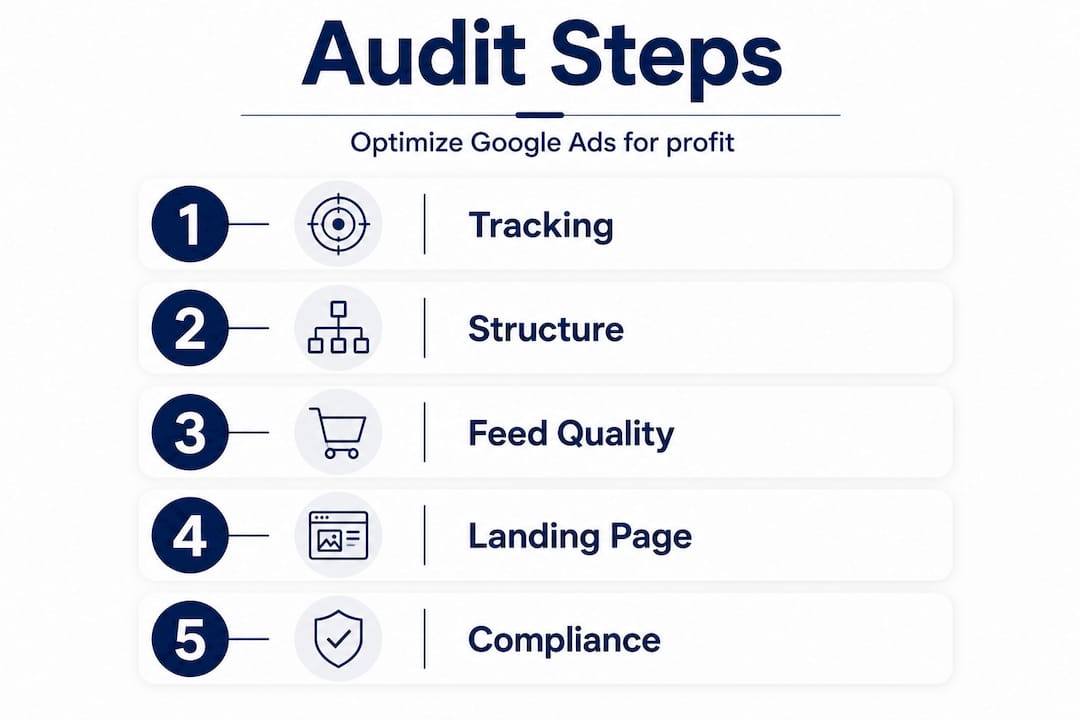
With the definition in place, it is crucial to unpack which campaign elements a quality audit covers and how each affects results. Audit work typically examines elements like account and campaign structure, keywords and match types, ad copy and assets, landing page experience, bidding and budgets, and conversion tracking accuracy and data quality. Each of these areas can independently cause performance issues, and they often interact in ways that make problems harder to spot without a structured review.


| Audit component | Common eCommerce pitfall |
|---|---|
| Account and campaign structure | Mixing branded and non-branded keywords in the same campaign, distorting ROAS data |
| Keywords and match types | Over-reliance on broad match without negative keyword lists, wasting budget on irrelevant queries |
| Ad copy and assets | Generic headlines that do not reflect product benefits or differentiate from competitors |
| Landing page experience | Sending traffic to homepage instead of category or product pages, reducing conversion rate |
| Bidding and budgets | Using Target ROAS before there is sufficient conversion data, causing erratic bidding |
| Conversion tracking | Counting micro-conversions (like add-to-cart) as primary goals, inflating apparent performance |
| Shopping and feed quality | Incomplete product titles, missing GTINs, or poor image quality reducing impression share |
Each row in that table represents a category where real budget is being lost right now in many eCommerce accounts. The landing page component is particularly underestimated. Sending paid traffic to a slow or irrelevant page is the equivalent of paying for a full-page magazine advert and then giving readers a disconnected phone number. You can maximise Google Ads conversion rates significantly by fixing landing page alignment before adjusting bids. Similarly, effective ad copywriting that matches user intent and landing page messaging is one of the fastest ways to improve Quality Score and reduce cost per click.
For brands running Shopping or Performance Max, feed quality is a separate but equally important audit area. Weak product data limits how well Google can match your ads to relevant queries. If you are scaling shopping campaigns, your feed health directly determines your ceiling.
Pro Tip: Always include landing page load speed and relevance as your first checks. A technically perfect campaign sending traffic to a three-second-load product page will consistently underperform, and no amount of bid adjustment will compensate for it.

Conversion tracking: the audit starting point
Amongst all elements, one area deserves special attention at the very start of any audit: conversion tracking. It is the foundation everything else rests on. If your tracking is wrong, every insight drawn from your data is wrong too, including the recommendations your bidding algorithms act upon.
An audit is not just reporting; it is intended to produce an actionable list of prioritised recommendations, because decision quality depends entirely on accurate conversion tracking and measurement. This is why experienced auditors tackle tracking validation before drawing any conclusions about bids, budgets, or creative.
| Good conversion tracking practice | Poor conversion tracking practice |
|---|---|
| Tracking only completed purchases as primary conversions | Counting page views or add-to-cart events as primary conversion goals |
| Using Google Tag Manager with verified tags | Hardcoded tags that break after site updates |
| Excluding returns and cancelled orders where possible | Counting all transactions including refunded ones |
| Single, consistent conversion action per campaign goal | Multiple overlapping conversion actions creating duplicate reporting |
| Regular tag audits after site changes | Assuming tracking remains intact after CMS or theme updates |
The risk here is subtle but significant. Performance can appear optimised while actually being driven by bad signals, such as wrong conversion definitions, duplicate or incorrect conversions, or mis-measurement. Smart Bidding strategies like Target ROAS or Target CPA are only as good as the data they learn from. Feed them inaccurate signals and they will optimise confidently towards the wrong outcomes.
Common pitfalls we see regularly include: tracking the same purchase event twice due to both a global site tag and a third-party integration firing simultaneously; counting email sign-ups as equal-value conversions alongside purchases; and broken tracking codes that simply stop firing after a Shopify theme update. For brands on Shopify specifically, reviewing Shopify conversion fixes is a practical starting point for getting tracking right.
Pro Tip: If a campaign’s metrics look almost too good, treat that as a warning sign rather than a celebration. Suspiciously low cost per conversion or unusually high conversion rates often indicate duplicate tracking or misconfigured goals, not genuine performance.
Beyond numbers: strategic and compliance checks
Whilst numbers are vital, top-performing audits also cover strategic and compliance checks that are sometimes left out of basic reviews. These qualitative elements can be the difference between an audit that produces a tidy report and one that actually transforms performance.
Strong audits blend quantitative checks, such as spend, search queries, keyword performance, Quality Score, and conversion tracking gaps, with qualitative and strategic checks including intent alignment, messaging and landing page promise match, account structure choices, and competition and seasonality. Each type of check catches different failure modes. Quantitative checks find where money is leaking. Qualitative checks reveal why it is leaking.
Here are five strategic and compliance checks that every audit must include:
- Intent alignment review: Are your keywords and ad messaging aligned with where buyers are in their purchase journey? Informational queries matched to transactional ads waste budget and frustrate users.
- Message match audit: Does your ad headline match what appears on your landing page? Inconsistency between ad promise and landing page content increases bounce rates and lowers Quality Score.
- Audience and remarketing review: Are your remarketing lists properly segmented? Are you excluding recent purchasers from acquisition campaigns? Many accounts waste spend retargeting customers who just bought.
- Change history review: What changes have been made to the account in the last 90 days? Automated recommendations applied without review, bid strategy switches, or budget reallocations can all have unintended downstream effects.
- Policy and compliance check: Google policy and compliance issues can create a serving problem that looks like poor performance. Disapproved ads, restricted assets, or landing page violations can silently reduce impression share without triggering an obvious alert.
“Audits should check for policy status and ensure disapproved ads, assets, and landing pages are fixed or appealed so the ads can serve again.”
This compliance dimension is frequently skipped in basic audits. A disapproved ad running alongside active ads can skew performance data, and if you do not check policy status explicitly, you may never know it is happening. For a broader view of how strategy and compliance in Ads interact, it is worth reviewing your full account health alongside any audit findings.
Pro Tip: Always review Google’s change history log before drawing conclusions from performance dips. A sudden drop in conversions may not be a market shift. It may be an automated bid strategy change applied three weeks ago that nobody noticed.
From audit to action: executive summaries and prioritising fixes
Once you have completed your audit, the next challenge is turning findings into real-world improvements. A list of problems without a clear action plan is just a list. The value of an audit lies entirely in what happens next.
A practical audit deliverable commonly includes an executive summary of what is holding performance back, a prioritised fix list, and after measurement and tracking is corrected, a test backlog to methodically validate improvements over time. This structure matters because not all fixes are equal. Some will have an immediate and significant impact on profitability. Others are longer-term improvements that require testing to validate.
A well-structured audit action plan typically includes:
- Executive summary: A plain-language overview of the three to five biggest issues found, with an estimate of their impact on ROAS or cost per acquisition.
- Prioritised fix list: Issues ranked by urgency and potential impact. Measurement fixes always come first. Structural changes come second. Creative and copy improvements follow.
- Quick wins: Changes that can be implemented immediately with minimal risk, such as adding negative keywords, fixing broken tracking, or pausing zero-conversion ad groups.
- Test backlog: A structured list of hypotheses to test over the following four to eight weeks, with clear success metrics defined in advance.
- Baseline metrics: A snapshot of current performance before changes are made, so you can measure the genuine impact of each fix.
“After measurement and tracking is corrected, a test backlog allows you to methodically validate improvements over time rather than making multiple simultaneous changes that obscure which fix drove results.”
The test-and-learn approach is more reliable than making sweeping changes all at once. When you change five things simultaneously and performance improves, you have no idea which change drove the result. Structured testing gives you repeatable, scalable insight. For brands running Performance Max campaign tips, this disciplined approach to post-audit testing is especially important given how opaque those campaigns can be.
Why most Google Ads audits fail: our experience
Let us be direct about something most audit guides will not say. The majority of Google Ads audits do not produce meaningful improvement. Not because the findings are wrong, but because the process is wrong from the start.
We see a consistent pattern with eCommerce brands who come to us after a previous audit produced little change. The audit was a box-ticking exercise. Someone ran through a checklist, flagged a few keyword issues, noted that Quality Scores could be higher, and delivered a PDF. No measurement validation. No qualitative review. No prioritisation based on actual profit impact. Just a document that looks thorough but changes nothing.
The most impactful audits we have conducted share one characteristic: they started with measurement. Not keywords, not bids, not creative. Measurement first. We have seen accounts where Smart Bidding was confidently optimising towards a conversion action that had been firing twice per transaction for eight months. The campaign looked like it was performing. ROAS appeared healthy. But real revenue per ad spend was nearly half what the dashboard suggested. Fixing the tracking alone transformed the account’s actual profitability, before a single bid or keyword was touched.
The other failure mode is ignoring qualitative signals entirely. An audit that only looks at numbers will miss the fact that your top-spending campaign is targeting purchase-intent keywords with awareness-stage messaging. That is a strategic misalignment no spreadsheet will surface unless someone actually reads the ads and thinks about the customer journey.
Our view is firm: only audits that blend deep analytics, strategic analysis, and compliance review deliver sustainable profit gains. A checklist is a starting point, not a substitute for expertise. If you want to see what a structured, actionable review looks like in practice, our practical audit checklist is a good place to begin.
Get expert help with your Google Ads audit
If your campaigns are not delivering the returns your business needs, a structured audit is the fastest way to understand why and what to do about it. The difference between a surface-level review and a genuinely expert audit is the difference between a tidy report and real profit improvement.

At Oxedent, eCommerce PPC is all we do. We work with established online retail brands in the US and UK who are ready to stop guessing and start scaling with data. Whether you are evaluating your options or ready to act, exploring the best eCommerce PPC agencies will help you understand what specialist support looks like. If you are based in the UK, our guide to top eCommerce PPC agencies UK covers what to look for in a genuine performance partner. When you are ready to talk, Oxedent is here to help you build campaigns that actually grow your business.
Frequently asked questions
What does a Google Ads campaign audit cover for eCommerce?
It reviews structure, targeting, creative, budgets, bidding, landing pages, and especially conversion tracking to find and fix wasted spend or weak performance. Audit work typically examines account and campaign structure, keywords and match types, ad copy and assets, landing page experience, bidding and budgets, and conversion tracking accuracy and data quality.
How do Google Ads audits prioritise fixes?
They focus first on correcting measurement and conversion tracking, then address other issues by their impact on profitability. An audit is intended to produce an actionable list of prioritised recommendations, because decision quality depends on accurate conversion tracking and measurement.
Why can ‘healthy’ campaigns hide problems?
Because performance metrics may look strong due to invalid signals such as wrong conversion definitions or mis-measurement. Performance can appear optimised while actually being driven by bad signals, so an audit checks whether metrics reflect genuine business value.
What compliance issues can audits uncover?
Disapproved ads, policy violations, or landing page problems that stop ads from running or quietly reduce impression share. Google policy and compliance issues can create a serving problem that looks like poor performance, making compliance checks an essential part of any thorough audit.