


Google Ads quality optimisation is the process of improving ad relevance, expected click-through rate, and landing page experience to increase campaign performance and return on investment. It operates across two distinct but connected layers: the diagnostic Quality Score metric, which signals where your ads fall short, and the newer AI-driven asset optimisation tools that automate creative adaptation at scale. Both matter. Together, they determine how efficiently your budget converts into revenue. For eCommerce managers and digital marketers running meaningful ad spend, understanding both layers is the difference between campaigns that scale profitably and campaigns that bleed budget quietly.
What is Google Ads quality optimisation and why does it matter?
Google Ads quality optimisation is defined as the systematic improvement of the signals Google uses to evaluate your ads, including keyword relevance, creative alignment, and landing page quality, so that your ads win better placements at lower costs. The industry standard term for the core metric underpinning this process is Quality Score, a diagnostic figure Google assigns at the keyword level on a scale of 1 to 10.
Quality Score is built from three component evaluations, each rated as Below Average, Average, or Above Average:
- Expected click-through rate (CTR): How likely Google predicts users are to click your ad when it appears for a given keyword, based on historical performance data.
- Ad relevance: How closely your ad copy matches the intent behind the search query triggering it.
- Landing page experience: How relevant, useful, and fast your landing page is for users who arrive from that ad.
These three components do not just produce a score for reporting purposes. They feed directly into Ad Rank, the formula Google uses to determine where your ad appears and what you pay per click. A higher Quality Score means you can achieve strong placements at a lower cost-per-click than a competitor with a lower score bidding the same amount. That cost efficiency compounds over time, making quality optimisation one of the highest-return activities in any Google Ads account.
One critical misconception to address: Quality Score is a diagnostic metric, not a direct performance lever. Chasing a score of 10 across every keyword is not the goal. The goal is to use the component ratings to identify where user experience friction exists and fix the underlying issue. A Below Average landing page experience rating tells you something specific and fixable. A score of 6 on its own tells you very little.
How AI asset optimisation is reshaping Google Ads quality
Asset optimisation is the second major pillar of quality improvement in Google Ads, and it has evolved significantly in 2026. Where Quality Score focuses on keyword-level diagnostics, asset optimisation automates creative controls to match user intent and landing page content using AI features including text customisation, final URL expansion, and video resizing.


Google recently consolidated these controls for Demand Gen campaigns into a single asset optimisation panel with clear toggles, allowing advertisers to audit and selectively enable automations rather than accepting them wholesale. This is a meaningful shift. Previously, asset-level automation was buried across multiple settings. Now you can see exactly which automations are active and turn them on or off with precision.
The practical implications for eCommerce campaigns are significant:
- Video resizing: AI automatically adapts video assets to fit different placements and aspect ratios, removing the need to produce multiple versions manually.
- Landing page image pulls: Google can extract images directly from your landing page to populate ad creatives, improving visual relevance without additional creative production.
- Text customisation: Headlines and descriptions can be dynamically adjusted to better match the specific query or audience segment being served.
The catch is that poor source assets produce poor automated outputs. If your original images are low resolution, your videos are off-brand, or your landing pages are visually sparse, the AI has nothing quality to work with. Automation amplifies what you give it. It does not compensate for weak creative foundations.
Pro Tip: Before enabling any AI asset automations, audit your source materials first. Every image should be high resolution and brand-consistent. Every video should have a clear focal point in the first three seconds. Think of your source assets as the raw ingredients. The AI is the kitchen, not the chef.
In Performance Max and Demand Gen campaigns specifically, asset optimisation has largely replaced manual keyword-level Quality Score management. The marketer’s role has shifted from tuning individual keywords to governing the quality and alignment of creative inputs. That is a fundamentally different skill set, and the brands that adapt to it earliest gain a structural advantage.
How to improve Google Ads quality optimisation in practice
Improving your Google Ads quality requires a structured approach. Skipping steps produces temporary gains that revert within 30 days, because the improvement process has a specific order that must be respected.
-
Tighten your ad group structure. Each ad group should contain keywords that share a single, clear intent. If one ad group covers “men’s running shoes,” “running trainers for men,” and “best men’s trail shoes,” that is acceptable thematic grouping. Mixing “running shoes” with “gym equipment” is not. Thematic tightness is the foundation of ad relevance.
-
Write ad copy that mirrors keyword intent. Your headlines should reflect the specific language your audience uses. If someone searches “waterproof hiking boots women,” your headline should contain those words or their closest synonyms. Use ad copy writing formulas that prioritise relevance over cleverness. Clever headlines that do not match intent hurt your ad relevance score.
-
Optimise your landing page for relevance and speed. The landing page a user arrives on must deliver exactly what the ad promised. If your ad promotes a specific product, the landing page should feature that product prominently, not a generic category page. Page speed matters too. A slow-loading page damages landing page experience ratings regardless of how relevant the content is.
-
Use the asset optimisation panel with governance. Enable AI automations selectively. Video resizing and landing page image pulls are generally safe to activate once your source assets are in good shape. Text customisation requires more caution, as dynamically generated headlines must still align with your brand voice and compliance requirements.
-
Test creative asset variations systematically. A/B testing in Performance Max campaigns allows you to measure the quantitative impact of adding new assets or enabling new automations. Do not assume an automation is working. Measure it.
-
Apply negative keywords and match type discipline. Broad match and Smart Bidding expand query eligibility significantly. Without a well-maintained negative keyword list, your ads will serve for irrelevant queries, dragging down expected CTR and ad relevance scores across the account.
Pro Tip: After restructuring ad groups or rewriting ad copy, allow two to four weeks before evaluating Quality Score movement. Score updates after structural changes require sufficient auction impression data to recalculate, and checking too early leads to premature conclusions.
Legacy Quality Score methods vs. modern automation approaches
The way marketers managed quality in Google Ads five years ago looks very different from what works today. Understanding that contrast helps you prioritise your effort correctly.
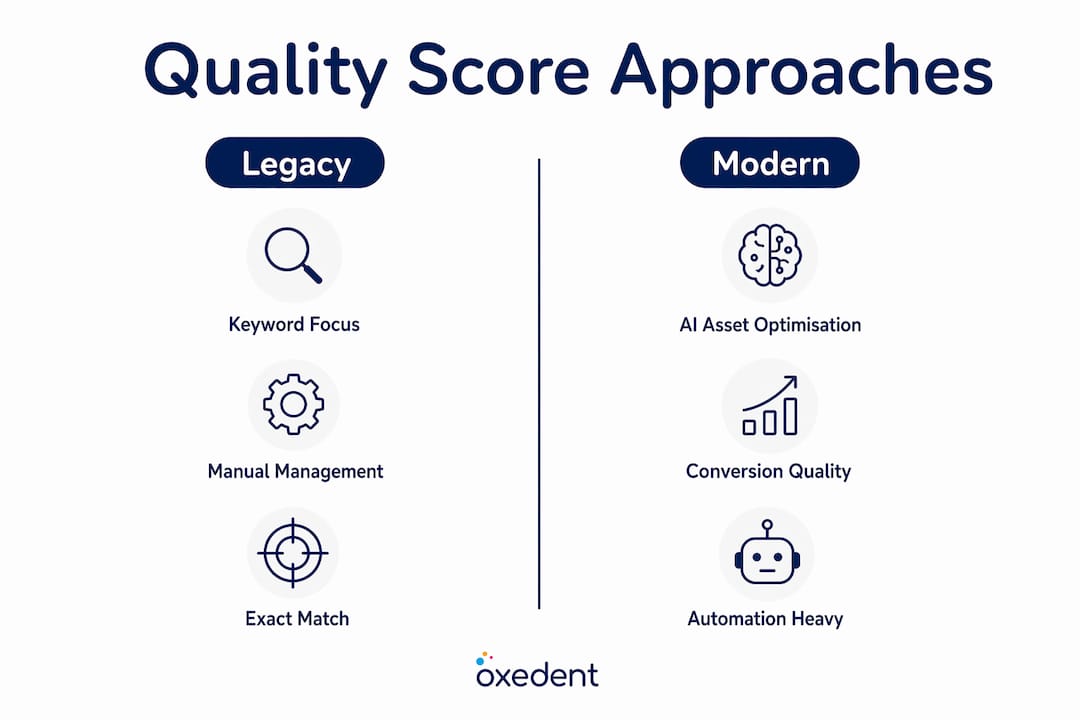

| Approach | Legacy Quality Score management | Modern AI-driven asset optimisation |
|---|---|---|
| Primary focus | Keyword-level CTR, ad relevance, landing page ratings | Asset quality, creative alignment, automation governance |
| Main activity | Writing tightly themed ad groups, manual A/B copy testing | Supplying high-quality source assets, managing automation toggles |
| Quality signal | Quality Score (1-10) per keyword | Asset performance ratings, conversion quality, ROAS |
| Campaign types | Search campaigns with exact and phrase match keywords | Performance Max, Demand Gen, broad match Search |
| Key risk | Low Quality Score inflating cost-per-click | Poor source assets producing off-brand or irrelevant automated creatives |
| Measurement | Quality Score component ratings | ROI metrics, conversion value, incremental revenue |
The legacy approach rewarded meticulous keyword management. Marketers who built tightly structured accounts with exact match keywords and hand-crafted ad copy could achieve Quality Scores of 9 or 10 across most keywords and enjoy meaningful cost advantages. That approach still works in tightly controlled Search campaigns.
The modern approach demands a different discipline. In automation-heavy setups, conversion quality matters more than keyword-level Quality Scores. Broad match and Smart Bidding expand query eligibility far beyond what any keyword list can control, so the visible Quality Score becomes less actionable as a day-to-day metric. What matters is whether your assets are generating relevant, high-converting traffic at a profitable cost.
The recommendation is not to abandon Quality Score monitoring. It remains a useful health check. But for eCommerce brands running Performance Max or Demand Gen campaigns, the primary governance activity is maintaining brand-aligned source materials so that AI optimisations produce outputs you would actually approve manually. That is where your time is best spent in 2026.
Key takeaways
Google Ads quality optimisation works best when Quality Score diagnostics and AI asset governance are treated as complementary disciplines rather than separate concerns.
| Point | Details |
|---|---|
| Quality Score is diagnostic | Use component ratings to identify friction points, not to chase a perfect score. |
| Asset quality determines automation output | High-resolution, brand-aligned source assets are the prerequisite for effective AI optimisation. |
| Structural changes take time | Allow two to four weeks after ad group or copy changes before evaluating Quality Score movement. |
| Modern campaigns need asset governance | In Performance Max and Demand Gen, managing creative inputs matters more than keyword-level tuning. |
| Measure by ROI, not score | In automation-heavy accounts, conversion quality and return on ad spend are the primary performance signals. |
Quality Score and AI assets: what I’ve actually learned managing eCommerce accounts
I have seen marketers spend weeks obsessing over a keyword’s Quality Score of 5, rewriting headlines daily and refreshing the interface looking for movement. That energy is almost always misplaced. Quality Score is a health check, not a scoreboard. When a component rating shows Below Average for landing page experience, the right response is to fix the landing page, not to write a new headline.
The more interesting shift I have observed is what happens when brands invest seriously in their source assets before enabling AI automations. The accounts that see the strongest performance from Performance Max are not the ones with the most automations switched on. They are the ones where someone has genuinely curated the creative inputs: proper lifestyle imagery, videos with clear product focus, headlines that reflect real customer language. The AI then has something worth working with, and the results reflect that.
What I would caution against is treating automation as a substitute for strategic thinking. Google’s asset optimisation tools are genuinely useful, particularly the new consolidated panel for Demand Gen campaigns. But they require governance. You need to review what the AI is producing, check that automated creatives align with your brand, and test systematically rather than assuming the algorithm has it covered. For eCommerce brands running Google Ads at scale, the competitive advantage increasingly comes from the quality of your inputs, not the sophistication of your settings.
— Biplab
How Oxedent helps eCommerce brands optimise Google Ads quality
If you are managing Google Ads for an eCommerce brand and want to move beyond guesswork, Oxedent’s specialist eCommerce PPC management service is built for exactly this. Oxedent works exclusively with online retail brands, focusing on Quality Score diagnostics, asset governance, and campaign structures that drive profitable revenue rather than vanity metrics.

From Performance Max asset audits to Search campaign restructuring and feed optimisation, Oxedent brings the depth of a specialist rather than the breadth of a generalist agency. If your current campaigns are underperforming or you want an expert review of your quality optimisation approach, get in touch with the Oxedent team to discuss what a tailored strategy looks like for your brand.
FAQ
What is Google Ads quality optimisation?
Google Ads quality optimisation is the process of improving ad relevance, expected click-through rate, and landing page experience to achieve better ad placements at lower costs. It includes both Quality Score management and AI-driven asset optimisation.
What are the three components of Google Ads Quality Score?
Quality Score comprises expected click-through rate, ad relevance, and landing page experience, each rated as Below Average, Average, or Above Average. These components identify specific areas where your ads or landing pages need improvement.
What is Google Ads asset optimisation?
Asset optimisation in Google Ads uses AI to automatically adapt creative elements such as text, images, and video to match user intent and landing page content. It reduces manual effort while improving creative relevance across placements.
How long does it take to improve Quality Score?
Quality Score updates after structural changes typically take two to four weeks to reflect meaningful movement, as Google requires sufficient auction impression data before recalculating component ratings.
Does Quality Score still matter in Performance Max campaigns?
Quality Score is less directly actionable in Performance Max, where conversion quality and ROAS are the primary performance signals. Asset quality and creative alignment matter more than keyword-level score management in these campaign types.