


Google Ads spend efficiency is defined as the ratio of profitable revenue generated to the total amount spent on advertising, and it is the single most important metric for any eCommerce business running paid search. Most marketers track clicks and impressions, but those numbers tell you nothing about profit. The metrics that matter are Return on Ad Spend (ROAS), Cost Per Click (CPC), and Cost Per Acquisition (CPA). Optimised campaigns reduce wasted spend by 25% on average, which means a £10,000 monthly budget could be leaking £2,500 before you even look at the results. Google’s 2026 AI features, including campaign total budgets and demand-led pacing, are changing how that efficiency is achieved.
What are the key metrics that define Google Ads spend efficiency?
Spend efficiency is not a single number. It is a picture built from several interconnected metrics, each revealing a different layer of campaign performance.
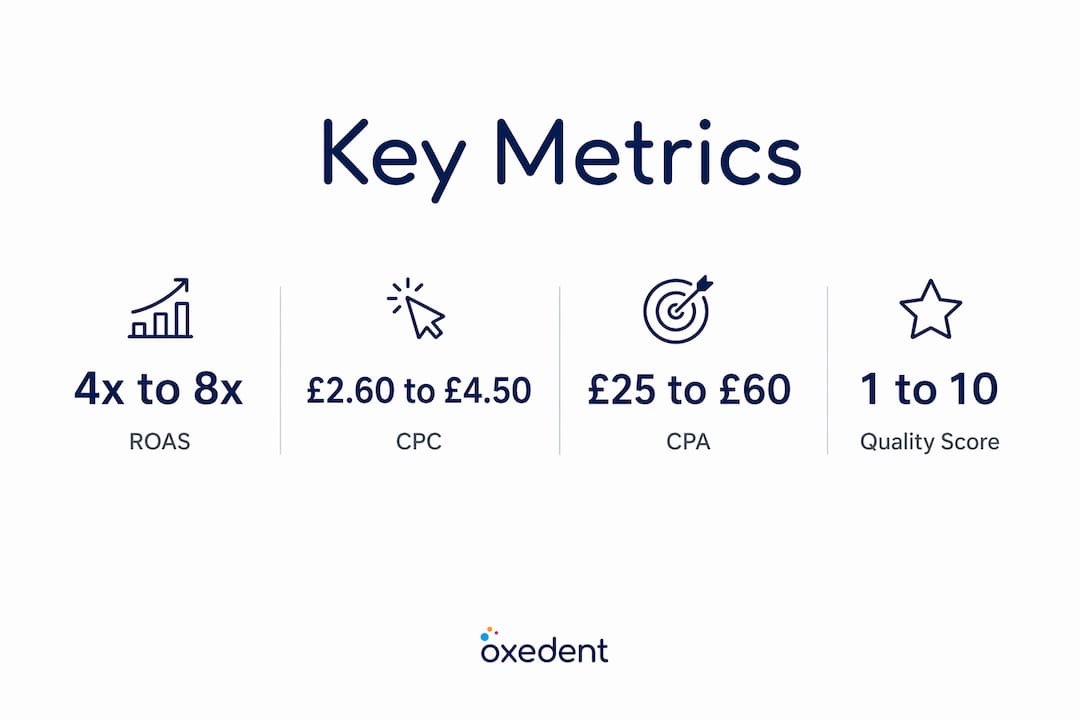
Return on Ad Spend (ROAS) is the most direct measure. You calculate it by dividing revenue generated by the amount spent. Mature campaigns target ROAS of 4:1 to 8:1 depending on your margins. A 4:1 ROAS means every £1 spent returns £4 in revenue. That sounds healthy, but it only tells the full story when you account for your cost of goods.


Cost Per Click (CPC) tells you how much you pay each time someone clicks your ad. Average Search CPC ranges between £2.69 and £5.42 across industries. A lower CPC stretches your budget further, but only if those clicks are converting.
Cost Per Acquisition (CPA) measures how much you spend to win one customer. Paid search achieves an average CPA of £25–£75, though this varies significantly by sector and product price point.
Quality Score is the hidden lever most advertisers underuse. Google assigns a score of 1–10 to each keyword based on ad relevance, expected click-through rate, and landing page experience. A score of 10 can halve your CPC compared to a score of 5. That reduction directly improves your spend efficiency without touching your budget.
| Metric | Typical range | What it signals |
|---|---|---|
| ROAS (paid search) | 4.0x – 8.0x | Revenue return per £1 spent |
| Average CPC | £2.69 – £5.42 | Cost to attract one visitor |
| Average CPA | £25 – £75 | Cost to acquire one customer |
| Quality Score | 1 – 10 | Ad relevance and landing page fit |
| Conversion rate | ~4.4% | Share of clicks that become buyers |
Pro Tip: Track all three metrics together. A low CPC with a high CPA signals a targeting problem. A high CPC with a low CPA signals strong intent. Neither number alone is enough.

How can digital marketers optimise Google Ads spend efficiency without increasing budget?
The most common misconception in paid search is that better results require more budget. They do not. Most businesses waste 20–30% of their Google Ads budget on clicks that are unlikely to convert. Fixing that waste is the fastest route to better efficiency.
Here are the most effective tactics, in order of impact:
-
Audit your negative keywords every fortnight. Irrelevant search terms drain budget silently. A negative keyword list that blocks terms like “free,” “cheap,” or competitor brand names can recover thousands in wasted spend within weeks.
-
Tighten your match types. Broad match keywords cast a wide net. Phrase match and exact match give you far more control over which searches trigger your ads. Start with phrase match for new campaigns and expand only when you have conversion data to support it.
-
Use campaign total budgets. Google’s AI-driven campaign total budgets reduce manual budget adjustments by 66%. The system automatically shifts spend toward higher-performing periods, removing the need for daily manual intervention.
-
Set up conversion tracking properly. You cannot improve what you cannot measure. Ensure Google Ads is tracking purchases, not just page views. Without accurate conversion data, Smart Bidding cannot optimise effectively.
-
Refine your audience targeting. Use Customer Match lists, in-market audiences, and remarketing lists for search ads (RLSA) to focus spend on users who are most likely to buy. Layering audiences onto search campaigns consistently improves CPA.
-
Pause underperforming keywords monthly. Any keyword spending budget without generating conversions in 30 days deserves scrutiny. Pause it, review the search terms it triggered, and decide whether to refine or remove it.
Pro Tip: Run a search term report weekly, not monthly. Irrelevant queries accumulate fast, and catching them early prevents compounding waste across your budget.
What role does artificial intelligence play in enhancing Google Ads spend efficiency?
Google’s 2026 AI updates represent the most significant shift in budget management since automated bidding launched. The platform is moving from rule-based spending to intent-based spending, and the difference in efficiency is substantial.
Demand-led pacing is the headline feature. Rather than distributing your daily budget evenly across 24 hours, the system aligns spend with consumer intent in real time. Budget concentrates during high-conversion windows and pulls back during low-intent periods. This approach reduces ineffective spend by 20–30% during low-conversion periods. That is not a marginal gain. For a £5,000 monthly budget, it could mean £1,000–£1,500 redirected toward moments when buyers are actually ready to purchase.
Smart Bidding Exploration allows Google’s AI to test new audience segments and search queries beyond your existing targeting. The system identifies conversion opportunities you would not have found manually. It is particularly useful for eCommerce brands looking to scale without proportionally increasing spend.
Journey-aware bidding adjusts bids based on where a user sits in the purchase journey. A first-time visitor browsing a category page receives a different bid weight than a returning visitor who previously added a product to their cart. This granularity was previously only achievable through complex manual bid adjustments.
“The rollout of demand-led pacing signals a strategic shift in how Google Ads spending control works. Marketers who adopt bell curve budgeting to capture peak demand without overspending will hold a clear advantage over those still managing budgets manually.”
The practical implication is this: AI handles the micro-decisions, but you still need to set the right strategic parameters. Feed quality, conversion tracking accuracy, and campaign structure remain your responsibility. AI amplifies good inputs and amplifies poor ones in equal measure.
How to measure and benchmark Google Ads spend efficiency for your eCommerce business
Setting a benchmark requires honest numbers, not platform-reported ones. Platform-reported ROAS can overstate efficiency by 15–40% when fully loaded costs are excluded. Your true efficiency metric must account for cost of goods sold, fulfilment, returns, and overhead.
Setting a realistic starting budget
SMBs commonly start Google Ads budgets between £1,000 and £2,500 per month to collect meaningful optimisation data. Below that threshold, you simply do not generate enough clicks and conversions to make statistically reliable decisions. You can read more about setting appropriate budgets in Oxedent’s agency guide for 2026.
Calculating your break-even CPA
Before you scale, calculate your break-even CPA. Take your average order value, subtract your cost of goods and fulfilment costs, and the remaining figure is the maximum you can spend to acquire a customer and still break even. Any CPA below that number is profitable. Any CPA above it is a loss, regardless of what your ROAS figure says. Oxedent’s guide to profitable customer acquisition covers this modelling in detail.
Using multi-touch attribution
Last-click attribution gives all the credit to the final ad a customer clicked before purchasing. This systematically undercredits upper-funnel campaigns and distorts your efficiency picture. Data-driven attribution, available in Google Ads, distributes credit across all touchpoints. Switch to it as soon as your account has sufficient conversion volume.
| Budget level | Expected monthly clicks | Estimated conversions (4.4% CVR) | Optimisation readiness |
|---|---|---|---|
| £1,000 | ~185–370 | 8–16 | Minimal data; test phase |
| £2,500 | ~460–925 | 20–40 | Sufficient for Smart Bidding |
| £5,000 | ~925–1,850 | 40–81 | Strong optimisation signal |
Pro Tip: Never judge a campaign’s efficiency in its first 30 days. Smart Bidding requires a learning period of at least two to four weeks before it can optimise effectively. Evaluate performance after the learning phase completes.
Common pitfalls that destroy Google Ads spend efficiency
Poor account architecture is the primary cause of wasted spend, not platform pricing. The following mistakes consistently undermine efficiency across eCommerce accounts.
- Broad targeting without audience layers. Running broad match keywords without RLSA or audience bid adjustments means you are paying the same price for a casual browser as for a high-intent buyer. Layer audiences onto every campaign.
- Neglecting Quality Score. A low Quality Score raises your CPC and lowers your ad position simultaneously. Improving ad relevance and landing page experience is one of the highest-return activities in account management.
- Stale ad creatives. Ads that have not been refreshed in three or more months typically see declining click-through rates. Declining CTR damages Quality Score, which raises CPC. Test new headlines and descriptions every six to eight weeks.
- Ignoring budget pacing. Spending your monthly budget evenly across all days ignores the reality that conversion rates peak on specific days and times. Bell curve budgeting reserves more budget for high-conversion periods and reduces spend during low-intent windows.
- Treating ROAS as the only success metric. A 6:1 ROAS on a product with a 10% margin is far less profitable than a 3:1 ROAS on a product with a 60% margin. Always connect ROAS back to actual profit contribution.
Pro Tip: Run a Google Ads audit every quarter. Review search terms, Quality Scores, audience performance, and device bid adjustments. Small inefficiencies compound over time and erode profitability faster than most owners realise.
Key takeaways
Google Ads spend efficiency is determined by ROAS, CPA, and Quality Score working together, and improving all three simultaneously is the only reliable path to profitable scaling.
| Point | Details |
|---|---|
| Define efficiency with profit, not revenue | Always calculate ROAS using fully loaded costs to avoid overstating campaign performance. |
| Quality Score is your cost lever | A score of 10 can halve your CPC, directly improving efficiency without increasing budget. |
| AI pacing reduces waste by 20–30% | Demand-led pacing concentrates spend during high-intent periods, cutting ineffective budget use. |
| Start with £1,000–£2,500 monthly | Budgets below this threshold generate insufficient data for Smart Bidding to optimise reliably. |
| Negative keywords are non-negotiable | Regular audits of search terms can recover 20–30% of budget lost to irrelevant clicks. |
Spend efficiency is where I have seen the biggest wins
After working with eCommerce brands across a wide range of sectors, the pattern I see most consistently is this: businesses are not losing money because Google Ads is expensive. They are losing money because their accounts are structured in a way that makes waste inevitable.
The brands that scale profitably are not the ones with the biggest budgets. They are the ones who know their break-even CPA before they spend a single pound, who treat Quality Score as a financial metric rather than a technical one, and who audit their accounts with the same rigour they apply to their P&L.
The AI features rolling out in 2026 are genuinely useful. Demand-led pacing and campaign total budgets remove a significant amount of manual work. But I have seen accounts where automation amplified poor structure rather than correcting it. The machine learns from your data. If your conversion tracking is broken or your targeting is too broad, the AI will optimise toward the wrong outcomes faster than any human could.
My honest view is that the marketers who will get the most from these tools are those who invest time in getting the foundations right first. Clean account structure, accurate conversion tracking, and a clear understanding of unit economics are not optional extras. They are the conditions under which AI-driven efficiency actually works.
The Google Ads campaign types guide from Oxedent covers how to structure campaigns for 2026 in a way that gives automation the right signals from day one.
— Biplab
How Oxedent can improve your Google Ads spend efficiency
If you are running Google Ads and suspect your budget is not working as hard as it should, Oxedent can help you find out exactly where the waste is and what to do about it.

Oxedent is a specialist eCommerce PPC agency. Every campaign we manage is built around profitability, not vanity metrics. We handle Google Ads, Google Shopping, Performance Max, and Facebook Ads for established online retail brands with meaningful budgets. Our process starts with a thorough audit of your current account, identifying wasted spend, Quality Score issues, and structural problems before we touch your budget. If you are ready to make your ad spend work harder, explore our eCommerce PPC management services and see how we approach efficiency-led growth.
FAQ
What is Google Ads spend efficiency?
Google Ads spend efficiency is the ratio of profitable revenue generated to the total amount spent on advertising. It is measured using ROAS, CPA, and CPC, and it improves when wasted spend is reduced and conversion quality increases.
What is a good ROAS for Google Ads?
A good ROAS for paid search sits between 4:1 and 8:1 for most eCommerce businesses, though the right target depends on your product margins. Always calculate ROAS using fully loaded costs, not just revenue, to get an accurate picture.
How do I reduce wasted spend in Google Ads?
Audit your negative keyword lists fortnightly, tighten match types, and review your search term reports weekly. Most accounts waste 20–30% of budget on irrelevant clicks, and regular audits are the most direct way to recover that spend.
How much should I spend on Google Ads to see results?
SMBs typically need a minimum of £1,000–£2,500 per month to generate enough data for meaningful optimisation. Below that level, Smart Bidding lacks sufficient conversion signals to perform reliably.
Does Quality Score affect Google Ads spend efficiency?
Quality Score directly affects CPC. A score of 10 can halve your cost per click compared to a score of 5, which means higher Quality Scores deliver more clicks and conversions for the same budget, improving overall spend efficiency.