


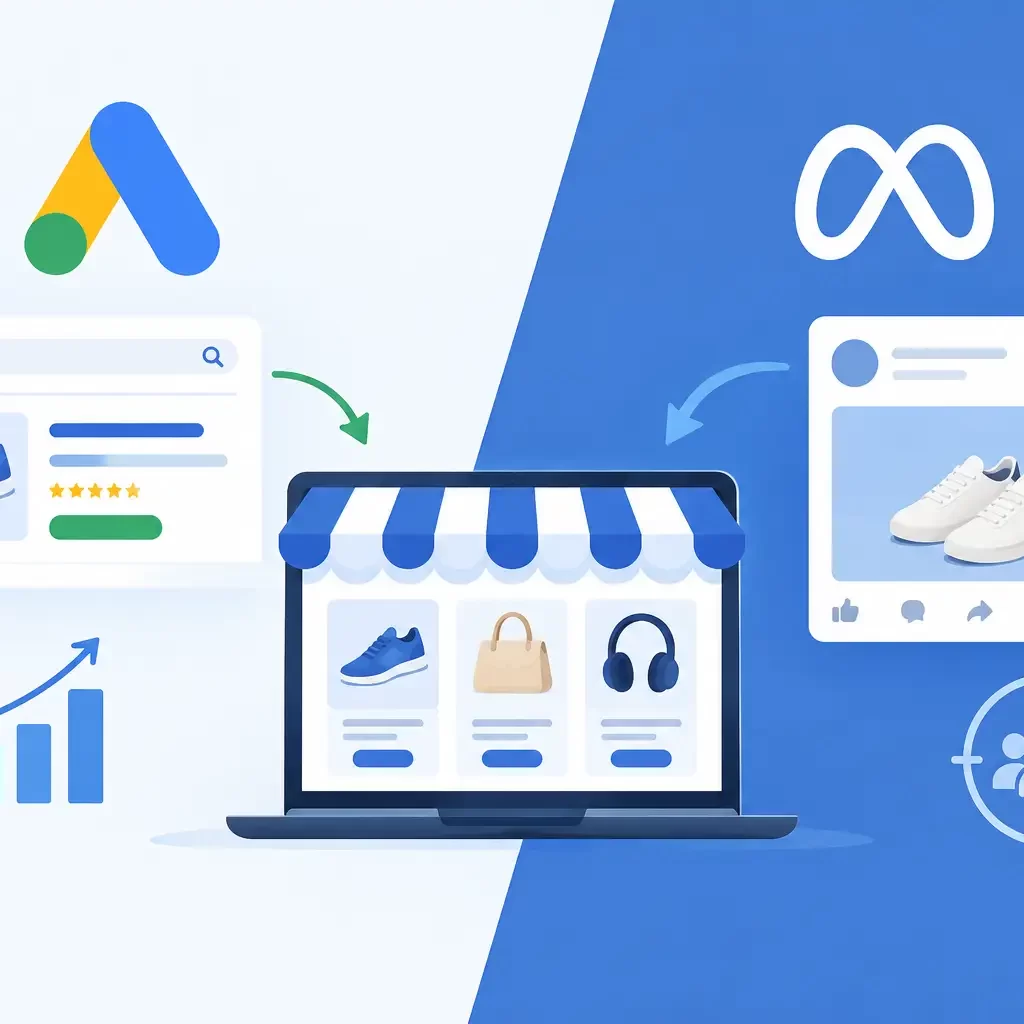
A £10,000 monthly ad budget can produce very different results depending on where it goes. Put it all into Google and you may capture ready-to-buy demand while leaving future customers untouched. Put it all into Facebook and you may create demand efficiently, but struggle to turn that attention into profitable revenue quickly enough.
That is the real Google Ads versus Facebook Ads question for established eCommerce brands. It is not which platform has the cheaper click, the more attractive dashboard, or the biggest reported revenue number. It is which channel can acquire customers at a cost your margin can support, then scale without eroding profit.
Google Ads versus Facebook Ads: different commercial jobs
Google Ads captures intent. A shopper searches for a product, brand, category or solution because they are already looking. Google Shopping, Search and Performance Max can put your product in front of that buyer at the point of decision. This makes Google particularly strong for products with known demand, clear search behaviour and competitive pricing.
Facebook Ads, now managed through Meta’s advertising platform, works differently. People are not generally opening Instagram or Facebook to search for a new pair of trainers, supplements or garden furniture. They are there to consume content. Your creative has to earn attention, establish relevance and give them a reason to act.
Neither is inherently better. They sit at different points in the buying journey. Google tends to harvest existing demand. Facebook is often better at creating demand, reaching new audiences and giving a product a compelling visual context.
For an eCommerce business with a proven offer, the strongest answer is frequently both channels, managed as one profit system rather than two disconnected reporting lines.
When Google Ads deserves the larger share
Google should usually be the starting point when people already search for what you sell. That does not mean bidding only on your brand name and congratulating yourself on a high return. It means building a structure that competes for profitable non-brand demand, protects branded searches, and uses a clean product feed to win Shopping placements.
The product feed matters more than many brands realise. Weak titles, missing product attributes, poor categorisation and generic imagery make it harder for Google to understand what is being sold and when to show it. You cannot outbid a poor feed indefinitely. Better feed quality can improve relevance before another pound is added to the budget.
Google also tends to be more forgiving where the offer is practical rather than emotional. Replacement parts, specialist tools, commodity products and high-intent categories can perform exceptionally well because the customer already knows what they need. In these cases, the job is to be visible, competitive and frictionless at checkout.
The trade-off is that intent is expensive. If ten competitors sell a similar product, they can all bid on the same search. A high click-through rate means little if price, delivery terms, product reviews or landing-page experience lose the sale. Search demand is finite too. Once the profitable impression share is close to its ceiling, increasing budget may simply buy less efficient traffic.
Where Facebook Ads can outperform Google
Facebook Ads are powerful when your product benefits from demonstration, social proof or a strong creative angle. A useful before-and-after, a clear problem-solution video, a credible founder story or customer-led content can introduce a product to people who had no plan to search for it that day.
This is particularly valuable for brands selling products with broad appeal but limited search volume. A distinctive skincare product, a clever home accessory or a new fashion proposition may have plenty of potential customers but very few people searching for the exact item. Waiting for search demand alone limits growth.
Meta can also help a brand move beyond the narrow group actively comparing products right now. Its delivery system learns from conversion signals and can find people likely to buy, provided it receives enough clean data and the creative does not go stale.
But Facebook is not a permission slip to ignore economics. Broad targeting cannot rescue weak positioning. Discounts may lift first-purchase conversion while quietly damaging contribution margin. And creative fatigue is real: an advert that drives profitable purchases for three weeks may need replacing before performance deteriorates. The winning account is not the one with the most campaigns. It is the one with a repeatable creative testing process and a clear view of which messages bring in valuable customers.
Choose by margin, demand and buying cycle
The right channel mix begins with commercial facts, not platform preference. Start with your breakeven cost of sale. Factor in gross margin, fulfilment, payment fees, returns, discounting and any costs that rise with each order. If your allowable acquisition cost is unclear, no channel decision will be reliable.
Next, assess existing demand. Are customers searching for the product category and are those searches commercially viable? Google can often take more budget when the answer is yes. If the product needs explaining, demonstrating or reframing, Facebook usually deserves meaningful investment alongside it.
The buying cycle changes the answer too. Low-cost, impulse-friendly products can work well on Meta because the advert can create desire and prompt an immediate purchase. Higher-consideration products may need Facebook to build awareness, followed by Google when customers return to compare, search reviews or look for your brand.
A practical way to think about it is simple. Google is often the channel for converting an existing hand-raise. Facebook is often the channel for generating the hand-raise in the first place. A customer may see your product on Instagram on Monday, search the brand on Google on Thursday and purchase through a branded Shopping ad. Giving all the credit to the final click creates the wrong optimisation decisions.
Do not let attribution choose the winner
Platform reporting has a built-in bias: each platform wants to claim the sale. Facebook may report view-through conversions that would have happened anyway. Google may overstate the value of branded search when social activity has generated the brand interest. Neither dashboard should be treated as the complete truth.
Use platform data for optimisation, but judge performance through the wider business picture. Track blended revenue against total paid media spend, contribution margin, new-customer acquisition cost and repeat purchase behaviour. Compare the period before and after meaningful budget changes. Watch branded search volume, direct traffic and returning customer revenue, while allowing for seasonality and promotions.
For serious spend, conversion tracking needs to be accurate. Purchase values should reflect actual revenue, duplicate transactions must be controlled, and consent setup should not leave major gaps in measurement. Server-side tracking and enhanced conversion signals can improve visibility, but they do not eliminate uncertainty. The goal is not perfect attribution. It is making better budget decisions than your competitors with the evidence available.
Build a channel mix that can scale
Do not split spend equally simply because there are two platforms. Give budget to the channel with a profitable opportunity, then expand only when performance holds at a larger spend level. Google may take the lead for a mature, high-search category. Meta may need to lead for a visually compelling product with limited search demand. The balance should move as stock levels, seasonality, creative strength and marginal returns change.
Keep enough budget in each active channel for the data to be meaningful. Starving Meta of spend while demanding rapid learning is pointless. Equally, forcing more budget into Google after profitable non-brand demand is exhausted is a fast route to waste.
The best accounts remain fluid. They protect profitable demand, test new audiences and creative, improve feeds and landing pages, and cut spend where marginal returns weaken. That requires active management, not a set-and-forget campaign structure.
A sensible next step is to take the last 90 days of paid media data and compare it against your actual margin, not reported ROAS alone. The channel that looks best in a dashboard is not always the channel making the business stronger. Build around profitable customer acquisition, and let the budget follow the evidence.