


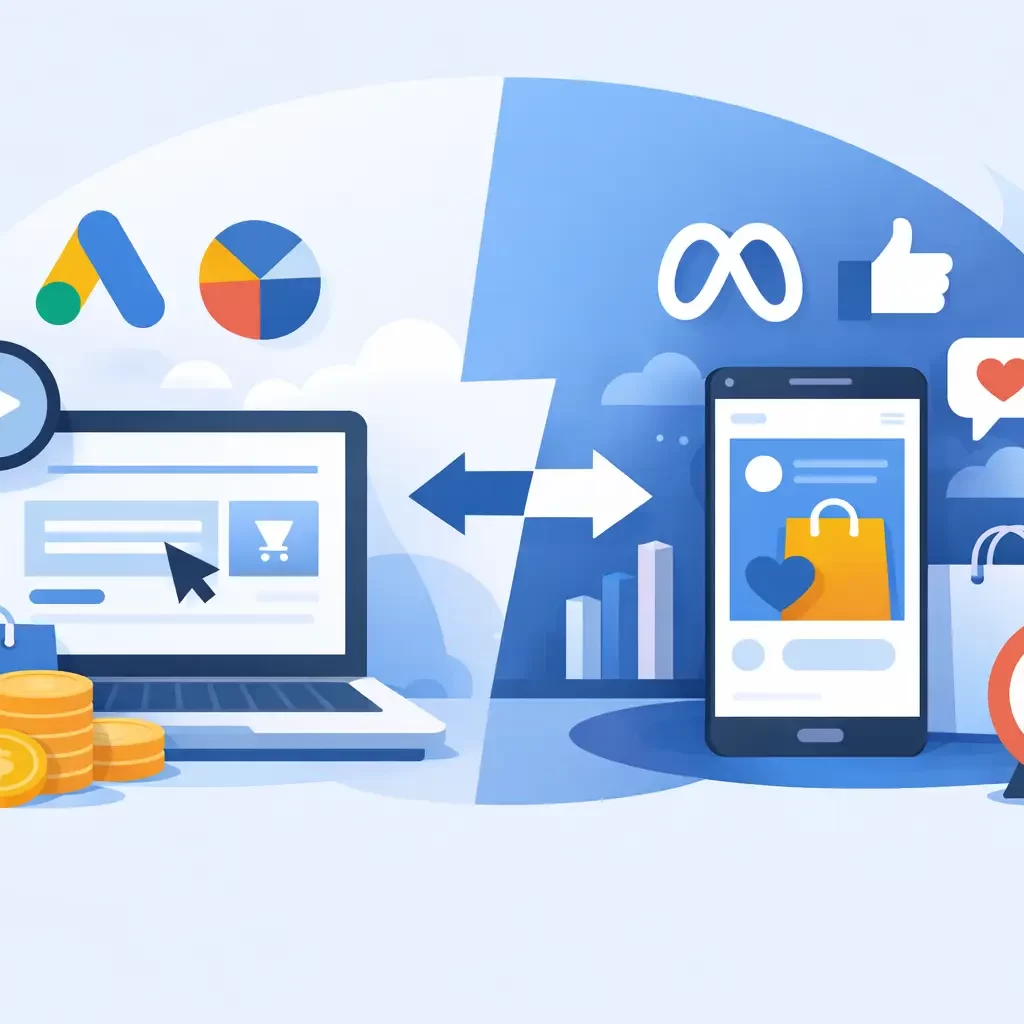
If your paid media budget has to earn its place, the Google Ads vs Meta Ads question is not academic. It affects margin, stock turn, customer acquisition cost and how quickly you can scale without burning cash. For eCommerce brands, the right answer is rarely about which platform is better in general. It is about which platform is better for your product, your price point, your buying cycle and your current stage of growth.
Too many brands treat these platforms as interchangeable traffic sources. They are not. Google captures demand that already exists. Meta helps create and shape demand before a customer has decided to search. That difference matters because it changes everything from targeting and creative to attribution and expected return on ad spend.
Google Ads vs Meta Ads: the core difference
Google Ads is intent-led. People go to Google when they want to solve a problem, compare options or buy something. If someone searches for a product you sell, the commercial signal is already there. That is why Google Shopping, search campaigns and Performance Max often become the backbone of profitable eCommerce acquisition.
Meta Ads works differently. It interrupts attention rather than capturing it. Your audience is not on Facebook or Instagram actively searching for your product. They are browsing. That means the platform relies more heavily on creative, offer strength and audience resonance to generate demand.
This is the first filter serious brands should apply. If your product serves clear existing demand, Google often gets you closer to conversion faster. If your product needs more explanation, visual persuasion or repeated exposure, Meta can be extremely effective. Neither platform wins by default.
Where Google Ads tends to outperform
For eCommerce, Google is often the stronger bottom-of-funnel channel. Shopping ads place products in front of users who are already comparing options. Search campaigns allow you to bid on high-intent terms. Performance Max can extend reach across Google properties, though it only works properly when feed quality, account structure and conversion data are under control.
The commercial advantage is obvious. You are not guessing who might be interested. You are responding to declared intent. For established brands with proven products, this usually means faster learning, cleaner buying signals and a clearer route to profitability.
Google also tends to suit products with practical demand. Think replacement items, problem-solving products, products with established search volume or categories where buyers already know what they want. If someone searches for a specific supplement type, kitchen appliance, pet product or luxury skincare concern, Google can intercept that demand at exactly the right moment.
That does not mean it is easy money. High-intent traffic is valuable, so competition can be aggressive. Cost per click can climb quickly in crowded categories. You also need strong product feeds, disciplined search term control and accurate conversion tracking. Without those basics, spend leaks fast.
Best fit scenarios for Google
Google usually takes the lead when your catalogue has clear product-market fit, your margins can support competitive auction prices and your customers already search for what you sell. It also becomes more powerful when you have enough conversion volume for smart bidding to work properly.
For brands that care about profitability over vanity metrics, that matters. Intent traffic is often easier to model against breakeven targets than awareness-led traffic.
Where Meta Ads tends to outperform
Meta is strongest when creative can do the heavy lifting. If your product is visually compelling, emotionally driven or easier to buy after seeing it in context, Meta can generate demand at scale. This is especially true for fashion, beauty, home, lifestyle and impulse-friendly products.
Meta also gives you more room to influence the buying journey before search happens. A strong video, a convincing hook or a sharp product demonstration can create interest where none existed five seconds earlier. That is powerful if your brand is still building category awareness or if customers need to see the product before they understand its value.
Retargeting remains useful as well, though it is not the easy win it once was. Privacy changes have reduced some of the precision advertisers used to rely on. You can still build efficient retargeting and prospecting systems on Meta, but success depends much more on first-party data, account structure and relentless creative testing.
Meta often struggles when the offer is weak, the creative is bland or the product requires strong existing intent to convert. If your ads do not stop the scroll and explain the value quickly, the platform will spend money teaching you that lesson.
Google Ads vs Meta Ads on targeting and data
Google targeting is grounded in search behaviour, shopping intent and platform signals. Meta targeting is grounded more in audience modelling, engagement patterns and algorithmic prediction. Both platforms have become more automated, but they still start from different data foundations.
For many eCommerce brands, Google data feels more commercially direct. Search terms, product engagement and shopping behaviour map closely to buying intent. Meta data can be incredibly valuable, but it often needs stronger creative inputs and a longer view of attribution.
This is where weak reporting causes damage. If you judge Meta only on last-click returns, you may undervalue it. If you judge Google only on platform-reported conversions, you may overvalue branded demand capture. Serious decision-making requires a broader view that includes incrementality, assisted revenue and contribution to total account performance.
Cost, ROAS and the profit question
Brands often ask which platform is cheaper. That is the wrong question. Cheap traffic is useless if it does not convert profitably.
Google can produce higher-intent sessions and stronger conversion rates, but click costs may be higher. Meta can sometimes generate lower-cost traffic and broader reach, but conversion quality can vary more heavily based on creative, landing page quality and offer strength.
The smarter comparison is this: which platform gets you customers at a sustainable cost of sale once returns, discounting and fulfilment are factored in? If your margin structure is tight, platform choice becomes less about scale and more about control.
For example, a high average order value brand with clear search demand may find Google delivers more stable profitability. A visually driven brand with strong repeat purchase behaviour may accept a softer first-order return on Meta because the lifetime value justifies it. That is a commercial decision, not a channel preference.
Should eCommerce brands choose one or run both?
Most established brands should not think in absolutes. The better question is which platform should lead, and which should support.
If you are constrained on budget, start with the channel most likely to produce profitable signal fastest. In many cases, that is Google, especially when branded and non-branded search demand already exists. Once that base is stable, Meta can expand the top of funnel, improve customer acquisition volume and help the brand reach audiences who would never have searched unaided.
If your product is new, visually persuasive and not yet supported by much search demand, Meta may deserve the first serious investment. But even then, Google should not be ignored. Branded search, shopping coverage and demand capture become increasingly important as awareness grows.
The strongest accounts usually use both platforms for different jobs. Google closes active demand. Meta creates and nurtures future demand. When these roles are clear, budgets become easier to allocate and performance becomes easier to judge.
How to decide between Google Ads vs Meta Ads
Start with your numbers, not your preferences. Look at average order value, gross margin, repeat rate and breakeven cost per acquisition. Then look at your product type. Is there obvious search demand? Does the product need visual explanation? Is the purchase immediate or considered?
After that, assess your assets. Google needs clean tracking, accurate feeds and sensible campaign structure. Meta needs strong creative testing, clear messaging and landing pages that match the promise in the ad. Brands fail on both platforms when they expect media buying alone to fix weak fundamentals.
It is also worth being honest about scale. If you are spending enough to matter, platform inefficiency becomes expensive very quickly. This is where channel specialism matters. Generalist campaign management often leads to blended reporting, vague optimisation and too much tolerance for wasted spend. A specialist eCommerce PPC team will look at feed quality, search term control, creative fatigue, attribution gaps and margin pressure as part of one commercial system.
That is the standard Oxedent works to, because paid media should be accountable to profit, not platform narratives.
The real answer
Google Ads vs Meta Ads is not a debate with a universal winner. Google is usually stronger at harvesting intent. Meta is usually stronger at generating it. The best choice depends on what your customers need before they buy and what your numbers allow after they do.
If you want a simple rule, use this one: choose the platform that matches buying behaviour first, then expand once the economics are proven. Growth gets much easier when your channel strategy follows commercial reality rather than marketing folklore.