


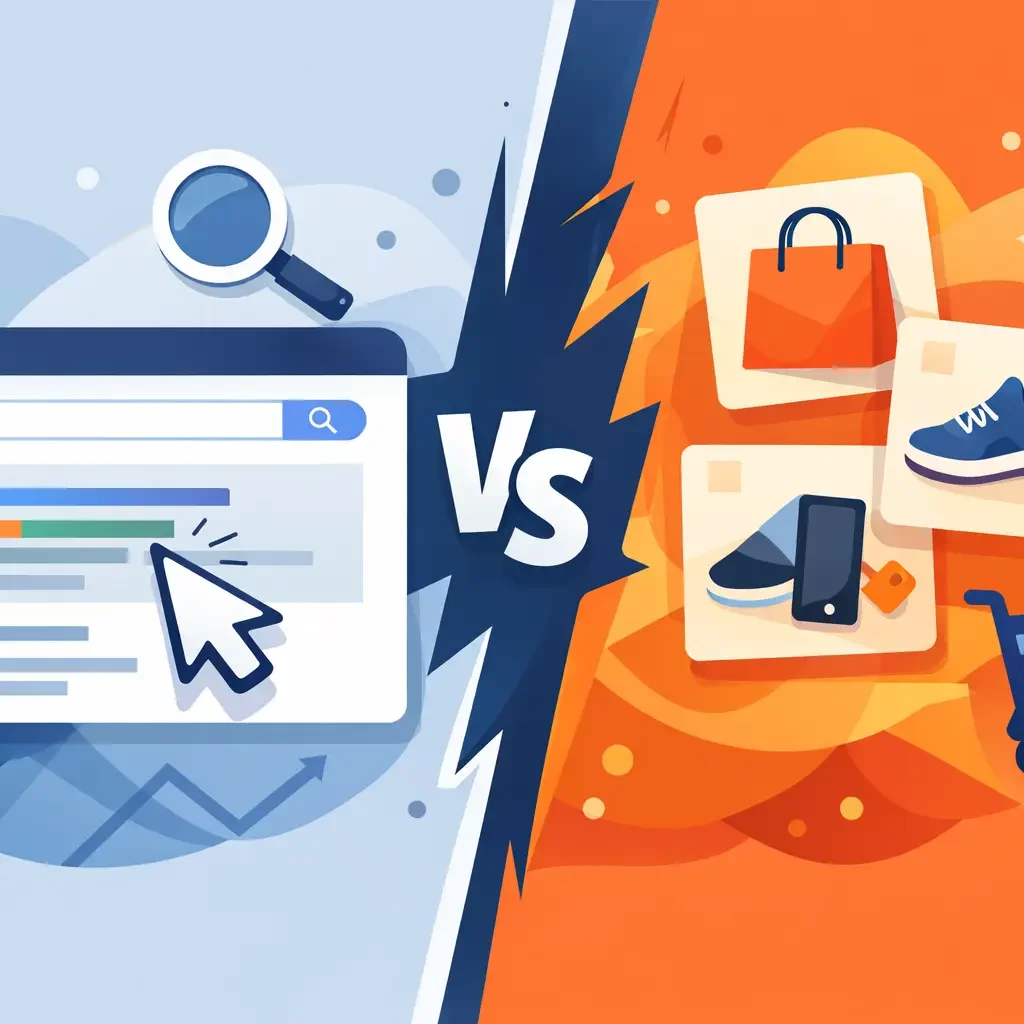
If your product pages convert, your margins are clear, and you still cannot get paid search to scale profitably, the usual problem is not effort. It is channel fit. The google ads vs shopping ads question matters because these two campaign types reach buyers in very different ways, and choosing the wrong one can quietly drain budget for months.
For established eCommerce brands, this is not a debate about clicks. It is about commercial intent, margin control, feed quality, and how quickly a campaign can turn ad spend into revenue you actually want. Both can work. Both can also waste money if they are built badly.
Google Ads vs Shopping Ads: the core difference
When most people say Google Ads, they usually mean search ads. These are the text ads that appear when someone types a query into Google. You choose keywords, write ad copy, and send users to a landing page or product page.
Shopping ads work differently. They are product-based placements powered by your feed rather than traditional keyword targeting. Instead of leading with ad copy, they lead with the product image, price, brand name, and merchant details. For eCommerce, that difference is not small. It changes who clicks, why they click, and what they expect when they land.
Search ads are strong when the buyer needs persuasion, clarity, or category guidance. Shopping ads are strong when the buyer already knows they want a product and is comparing options fast.
That is why the better question is rarely which platform is better in general. It is which format matches the buying behaviour around your products.
Where search ads outperform
Search ads give you control that Shopping often cannot. You decide which keywords matter, how aggressively to bid on them, and what message appears for different types of intent.
If you sell products that need explanation, this matters. A shopper searching for “best office chair for back pain” is not always ready to click the cheapest listing with a product photo. They may need reassurance around ergonomics, warranty, delivery, or suitability. A well-structured search campaign can speak directly to that intent and move them closer to purchase.
Search also gives you a stronger route into non-brand category terms, competitor terms where appropriate, and problem-aware queries. It is often the better tool for products that are not immediately understood from an image alone.
There is another advantage. Search campaigns are useful when your feed is weak. If your titles are vague, your product data is inconsistent, or your imagery is average, Shopping will struggle. Search can still perform while you fix the feed.
That said, search comes with more room for waste. Broad match gone unchecked, poor query control, generic ad copy, and weak landing pages can turn high-intent traffic into expensive indecision. Search rewards discipline. Without it, costs climb quickly.
Where Shopping ads outperform
For many online retailers, Shopping is the faster route to profitable scale. That is because the ad pre-qualifies the click. The user sees the product, price, and brand before they visit the site. In plain terms, fewer people click out of curiosity.
That usually means stronger commercial intent. If a shopper clicks a product listing after seeing the price, they are often closer to buying than someone clicking a generic text ad.
Shopping is especially effective for products with clear visual appeal, competitive pricing, and straightforward demand. Fashion, homeware, beauty, electronics accessories, pet products, and many giftable categories tend to fit this model well. If the product can win in a side-by-side comparison, Shopping deserves serious attention.
It also scales well when feed management is treated properly. Product titles, images, GTINs, categories, custom labels, pricing strategy, promotional annotations, and stock accuracy all shape performance. Too many brands treat the feed as an export file and then wonder why results plateau.
The trade-off is control. You do not target keywords in the same direct way as standard search. Google uses your product data to decide when and where your listings appear. If your feed is poor, your visibility suffers. If your structure is lazy, budget gets pulled towards the wrong products.
Google Ads vs Shopping Ads for eCommerce profitability
If your only goal is revenue, both channels can look healthy. If your goal is profitable growth, the picture changes.
Shopping often produces lower-funnel traffic and can deliver stronger return on ad spend for product-led categories. But that does not automatically make it the right choice. A high ROAS campaign built on low-volume, branded demand is not the same as a scalable acquisition engine.
Search can bring in more expensive traffic, but it can also capture demand earlier in the buying journey and support categories where product comparison starts with research rather than price. In those cases, judging search only on last-click efficiency misses the commercial reality.
This is where serious account management matters. Profitability depends on more than platform choice. It depends on product segmentation, margin-aware bidding, query filtering, landing page alignment, and whether you are pushing budget into proven winners or funding catalogue dead weight.
A campaign is not good because it generates orders. It is good when it generates the right orders at a cost that leaves room for profit and repeat growth.
When Shopping ads are the better first move
If you run an established eCommerce brand with a solid catalogue, reliable pricing, and strong product imagery, Shopping is often the cleaner starting point. It usually gets you in front of high-intent shoppers quickly and gives clearer signals on which products can scale.
This is particularly true if your site already converts and your average order value supports paid acquisition. In that scenario, Shopping can expose waste fast, highlight feed weaknesses, and show which categories deserve more aggressive investment.
It also works well when your products are already understood by the market. If people know what they are buying and simply need the right option at the right price from a credible retailer, Shopping is built for that decision.
When search ads should take the lead
Search should often lead when your product range needs more context, your buyers use longer research queries, or your differentiation is hard to show in a product image.
It is also the stronger choice for branded defence. If someone searches specifically for your brand or product line, a tight search campaign helps you own that demand and control the message. That is especially important if competitors are aggressive.
Search also makes sense when promotions, bundles, financing, service add-ons, or trust factors are central to conversion. A text ad can communicate these clearly. A Shopping tile cannot do nearly as much heavy lifting.
The real answer: most serious brands need both
For mature eCommerce accounts, google ads vs shopping ads is rarely an either-or decision. The strongest setups use both, but with clear roles.
Shopping captures bottom-funnel, product-aware demand. Search covers branded queries, high-value category terms, and intent that needs more messaging control. Used together, they give broader reach across the buying journey without relying on one traffic source to do every job.
The mistake is running both without a framework. If search and Shopping are competing for the same demand with no segmentation, no negative strategy, and no product-level performance logic, you end up paying for overlap instead of growth.
That is why specialist management matters more than platform hype. At Oxedent, the difference we usually see is not whether an account has search and Shopping live. It is whether the structure reflects commercial reality.
What to assess before choosing
Before pushing more budget into either format, look at the fundamentals. Are your margins strong enough to absorb acquisition costs? Is your feed clean and enriched? Do your product pages convert on mobile? Are you clear on breakeven cost of sale by category, not just account-wide averages?
Then look at intent. Are buyers searching for exact products, comparing prices, or asking problem-led questions? If the demand is product-specific and visual, Shopping may do more of the heavy lifting. If the demand is broader or more research-led, search deserves more emphasis.
Finally, look at scale potential. Some campaigns look efficient because they are only harvesting easy demand. Efficient does not always mean expandable. The right mix is the one that protects profit while still opening room to grow.
There is no prize for choosing a simpler channel mix if it caps revenue. There is also no value in adding complexity if the economics do not hold.
The useful way to think about this is simple. Search ads let you shape the message. Shopping ads let the product speak first. The winning choice depends on whether your buyer needs convincing, comparison, or both. If you judge that with clean data instead of guesswork, your budget tends to stop leaking and start compounding.