


If you’re running an established ecommerce business and your Google Ads account feels like a money pit rather than a revenue engine, you’re not alone. Many store owners decide to hire a Google Ads agency for ecommerce after months of wasted spend, unclear attribution, and campaigns that generate clicks but not profit. The right agency changes that picture entirely. This guide walks you through exactly how to prepare, evaluate, hire, and manage a Google Ads agency so you get genuine returns on your ad budget rather than a polished report full of impressive-sounding but meaningless numbers.
Table of Contents
- Key takeaways
- Preparing to hire a Google Ads agency for ecommerce
- Evaluating potential agencies
- How to hire and onboard your chosen agency
- Monitoring and verifying agency performance
- My honest take on hiring Google Ads agencies
- How Oxedent can help you scale Google Ads
- FAQ
Key takeaways
| Point | Details |
|---|---|
| Define goals before you search | Clarify your ROAS targets, budget, and key metrics before approaching any agency. |
| Revenue partnership beats vanity metrics | Prioritise agencies that tie success to closed revenue, not clicks or impressions. |
| Agency vs freelancer trade-offs matter | Agencies offer scale; freelancers offer direct attention. Choose based on your growth stage. |
| Onboarding sets the tone | Clear KPIs, access to all platforms, and agreed reporting cadences prevent early misalignment. |
| Monitor beyond surface metrics | Track ROAS, customer lifetime value, and offline conversions to verify real performance. |
Preparing to hire a Google Ads agency for ecommerce
Before you contact a single agency, spend time getting clear on what you actually need. This sounds obvious, but most businesses skip it and end up in a frustrating partnership where neither side is quite sure what success looks like.
Start with your budget. Know the monthly ad spend you are prepared to commit, because agencies price their management fees as a proportion of that figure. Agency fees typically range between 10 and 20% of ad spend, meaning a £15,000 monthly budget will cost you an additional £1,500 to £3,000 or more in management fees on top. Build that into your projections now.
Next, define the metrics that genuinely matter to your business. The average ecommerce ROAS on Google Ads sits at around 2.87:1 overall, but varies significantly by sector. Fashion brands often achieve 4.3:1, while supplement brands average closer to 2.3:1. Use figures like these as a starting benchmark, not a ceiling.
You also need to decide between hiring an agency, a freelancer, or building in-house. Each has real trade-offs worth understanding:
- Agency: Structured teams, broader expertise, scalable account management. Risk of junior staff handling your account day to day.
- Freelancer: Direct access to the person doing the work, typically lower cost. Freelancer fees range from £800 to £3,500 for similar ad spends. Limited scalability and a single point of failure if they become unavailable.
- In-house: Full control and deep brand knowledge. High recruitment cost and ongoing salary commitment regardless of performance.
For most established ecommerce brands with serious ad budgets, a specialist agency offers the best blend of expertise and capacity to scale.
Pro Tip: Before briefing any agency, pull your last 90 days of Google Ads data and identify your three worst-performing campaign segments by ROAS. This gives you a concrete starting point and immediately tests whether a prospective agency knows how to read account data critically.
Evaluating potential agencies
Not all agencies are created equal. Plenty of them are excellent at winning new clients and considerably less excellent at managing their accounts. Here is how you cut through the noise.
The single most important filter is whether an agency understands revenue attribution through CRM integration. If they cannot explain their offline conversion tracking process or how they connect ad spend to your internal sales data, they are essentially optimising towards proxies rather than profit. That matters enormously when you are spending five or six figures per month.

Equally critical is technical depth. Look specifically for expertise in feed optimisation and campaign governance, including Merchant Centre product feed management and negative keyword discipline. These are unglamorous but they are where budget leaks happen most quietly.
| Evaluation criterion | What to look for | Red flag |
|---|---|---|
| Revenue attribution | CRM integration and offline conversion tracking | Reporting only on clicks and impressions |
| Feed management | Merchant Centre expertise, feed health audits | No mention of product feed optimisation |
| Campaign experience | Performance Max, Shopping, and Search experience | Only familiar with one campaign type |
| Pricing model | Transparent fee structure with clear deliverables | Vague retainers with no defined scope |
| Team structure | Named account manager and senior strategist | Unclear who actually manages your account |
| Case studies | Revenue-focused results in your vertical | Testimonials citing click-through rates only |
When reviewing agencies, ask directly: who will manage your account day to day? Agencies often assign junior account managers while senior strategists take a limited oversight role. That is not automatically a problem, but you need to know the answer before you sign anything.
Also consider whether the agency has genuine Performance Max campaign experience. Google replaced Smart Shopping and Local campaigns with Performance Max in 2022, and it requires a different management philosophy because it uses AI automation across multiple channels simultaneously. An agency still thinking in terms of manual bid structures alone is already behind.
Finally, be cautious about agencies that position themselves as experts in everything from social media to SEO to video production. When evaluating the best Google Ads agency specialisations for ecommerce, depth beats breadth every time.
How to hire and onboard your chosen agency
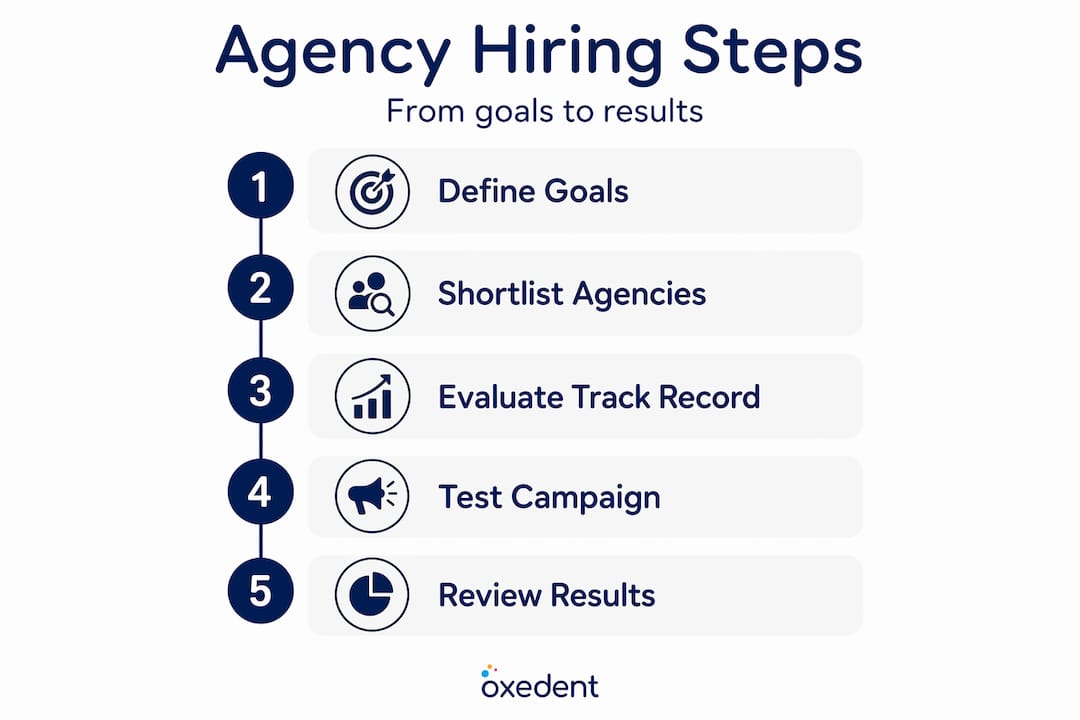
Once you have shortlisted two or three agencies you trust, the hiring and onboarding process itself becomes the foundation of everything that follows. Get this right and you will save months of misalignment.
-
Write a clear brief. Document your campaign objectives, historical performance data, top products by margin, and what “success” looks like in specific, measurable terms. Share your last 12 months of Google Ads and Google Analytics 4 data.
-
Set agreed KPIs upfront. ROAS targets, monthly revenue goals, cost per acquisition by product category. Agree on these in writing before work begins. Successful ecommerce brands align agency success directly with closed revenue, not campaign-level vanity metrics.
-
Define your reporting cadence. Weekly updates for the first two months, then bi-weekly once the account stabilises, with a monthly strategy review. Agree on the format and who attends.
-
Grant full platform access. Your agency needs access to Google Ads, Google Merchant Centre, Google Analytics 4, and ideally your CRM. Without CRM access, they cannot close the loop between ad spend and actual revenue.
-
Align on creative responsibilities. Clarify who produces ad creative, who owns product feed updates, and who manages landing page changes. Ambiguity here kills campaign performance quietly.
-
Agree on contract terms that suit both sides. Oxedent, for instance, does not lock clients into long-term contracts, which is worth looking for because it keeps the agency accountable to performance rather than tenure.
-
Plan a structured audit period. The first four weeks should include a full account audit, a feed health review, and a restructured campaign plan with clear timelines.
Pro Tip: Ask every agency you consider: “Show me an account where ROAS improved after the first 60 days and walk me through specifically what you changed.” The quality of that answer tells you more than any pitch deck.
Monitoring and verifying agency performance
Hiring the right agency is only half the job. Staying close to the numbers ensures you keep getting value as your business grows.
The metrics worth tracking go well beyond what most agencies feature in their default reports. Focus on these:
- ROAS by campaign and product category, not just account-wide averages
- Customer acquisition cost relative to average order value and projected lifetime value
- Offline conversion data connected to your CRM to verify that ad clicks actually produce revenue
- Add-to-cart rate and checkout abandonment by traffic source to identify where the funnel loses buyers
Google Analytics 4 paired with CRM integration gives you the clearest picture of how ad spend connects to closed revenue. If your agency is not helping you build that connection, your reporting is incomplete by definition.
One thing to watch closely is optimisation frequency. Agency optimisation cadence is typically limited to business hours a few times per week. That is not necessarily insufficient, but it means you should expect a clear log of what changes were made and when, not just a summary report at month end.
Clear indicators that you need a serious conversation with your agency include: ROAS declining for two consecutive months with no structural explanation, campaign spend concentrating on low-margin products without adjustment, and reports that consistently emphasise impressions and clicks rather than revenue outcomes.
Good ecommerce keyword research and ongoing keyword list refinement should be a visible, documented part of your agency’s monthly work. If you never see evidence of new keyword expansion or negative keyword updates, the account is likely running on autopilot.

My honest take on hiring Google Ads agencies
I have worked with and alongside a lot of Google Ads agencies over the years. Here is what I have found to be true, even when it is uncomfortable to say.
Most agencies are better at reporting than they are at managing. The slide decks look good. The dashboards are colourful. But when you press into the actual account changes made in the last 30 days, the list is often shorter than you would expect for the fee being charged. That is not malice. It is structure. Senior people win the business; junior people run the accounts.
The agencies worth working with are the ones that speak in revenue terms from the very first conversation. Not click-through rates. Not impression share. Revenue, margin, and customer acquisition cost relative to lifetime value. When an agency naturally frames everything through that lens, it tells you how they actually think.
I also think the rise of AI-driven optimisation tools is reshaping expectations in ways most ecommerce owners have not fully processed yet. AI-powered tools can improve Google Ads efficiency by 25 to 40% and deliver significantly improved ROAS within weeks. Agencies that are not incorporating these capabilities are not just behind on trend. They are leaving your budget on the table.
The best agencies act as growth partners rather than service providers. They push back when your brief is unclear, flag problems before you notice them, and treat your product feed with the same care they give campaign structure. That is the standard worth holding out for, and it is not as rare as it used to be.
— Biplab
How Oxedent can help you scale Google Ads
If you are ready to move from guesswork to a measurable, revenue-focused Google Ads strategy, Oxedent is built precisely for that.

Oxedent specialises exclusively in ecommerce PPC management, covering Google Ads, Google Shopping, Performance Max, and Facebook Ads for established online retail brands. Every campaign decision is driven by profitability and return on ad spend. There are no long-term contracts, no vanity metric reporting, and no junior-led accounts with a senior name on the cover page. If you want a partner that treats your ad budget like their own and reports in revenue terms, explore what Oxedent offers and request a consultation. You can also review how to choose the right agency as a useful next step before reaching out.
FAQ
What does it cost to hire a Google Ads agency for ecommerce?
Most agencies charge between 10 and 20% of your monthly ad spend, so a £15,000 budget typically adds £1,500 to £3,000 in management fees. Some agencies use a flat retainer model instead.
How is a Google Ads agency different from a freelancer for ecommerce?
Agencies offer broader team expertise and can scale with your account, while freelancers give you direct access to the person doing the work at lower cost. The right choice depends on your budget size and growth ambitions.
What KPIs should I track when working with a Google Ads agency?
Prioritise ROAS by campaign, customer acquisition cost, and offline conversion data connected to your CRM. Avoid placing too much weight on clicks or impressions alone, as these do not confirm actual revenue.
How quickly should I expect results after hiring a Google Ads agency?
Most reputable agencies conduct a full account audit and restructure in the first four weeks. Meaningful ROAS improvements typically appear within 60 to 90 days, depending on account size and the extent of changes required.
Should ecommerce businesses use Google Ads or Facebook Ads agencies?
Google Ads and Facebook Ads serve different stages of the buying journey. Google captures high-intent buyers searching for specific products, while Facebook Ads build awareness and retarget. Many established ecommerce brands benefit from specialist management on both channels rather than a single generalist approach.