


Assessing a Google Ads feed management agency means evaluating their data feed expertise, reporting transparency, and campaign management capabilities to protect your ad spend and grow your return on ad spend. The industry term for this process is a Google Ads agency audit, and getting it right separates profitable ecommerce scaling from expensive trial and error. Most established ecommerce businesses focus on case studies and pricing when vetting agencies. The sharper approach is to examine feed architecture, account ownership structures, and KPI transparency before signing anything. This guide gives you a structured framework to do exactly that.
How to assess a Google Ads feed management agency: prerequisites first
Before you can evaluate any agency fairly, you need the right assets in place. Walking into an assessment without these is like reviewing a restaurant without tasting the food.
What to gather before you start:
- Google Merchant Center access at owner level, not just standard user permissions
- Google Ads account access with owner-level or admin permissions so you can see the full account history
- Campaign performance reports covering at least the last 90 days, broken down by product group and campaign type
- Feed audit data including current feed error rates, disapproval rates, and feed update frequency logs
- Existing agency contracts to check for account ownership clauses and exit terms
Beyond documentation, you need a working understanding of two Google Ads features: Performance Max campaigns and Smart Bidding. Agencies that manage Google Ads for retailers will use both heavily, and you cannot assess their decisions without knowing what good looks like. Performance Max, in particular, relies almost entirely on feed quality and asset inputs. A weak feed produces weak results regardless of bidding strategy.
The typical agency evaluation uses a 21-day structured vetting process that filters out roughly 70% of poor providers. That process includes a paid discovery sprint and named senior-team hour transparency as filters. This tells you something important: a credible agency welcomes scrutiny. One that resists sharing reporting templates or live client audit examples before you commit is already showing its hand.


Pro Tip: Request at least two anonymised client reporting templates before any sales call. If an agency cannot produce them within 48 hours, treat that as a meaningful data point about their operational maturity.
How to conduct a step-by-step agency audit
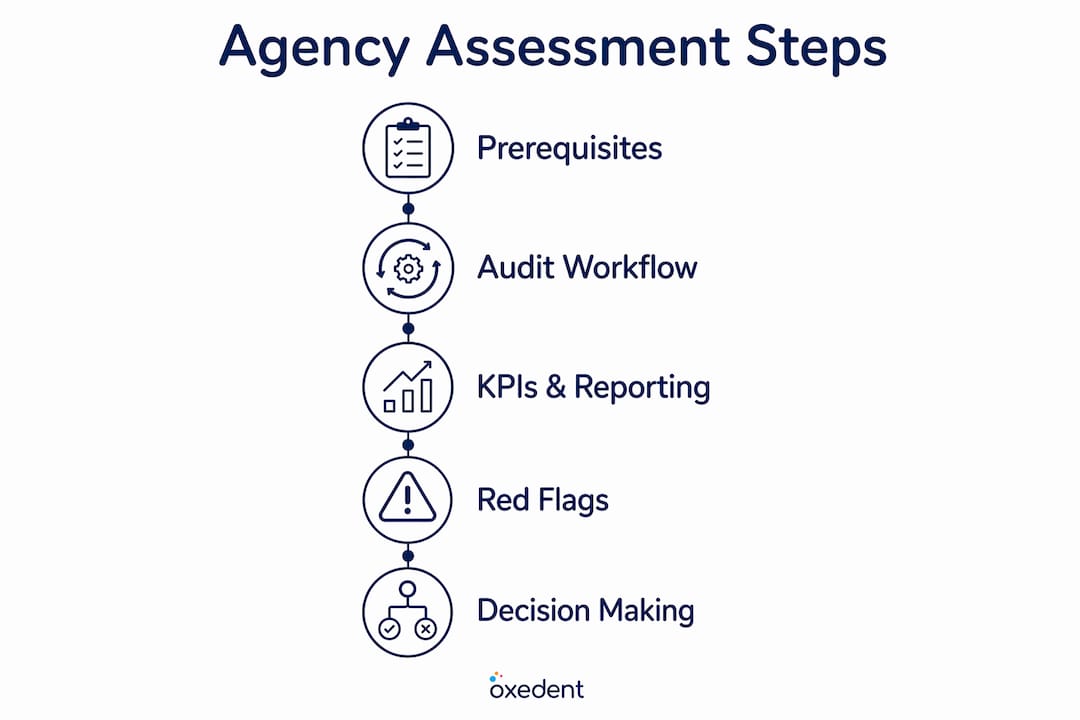
Use a structured agency audit to review conversion tracking, feed quality, campaign structure, bidding, reporting and commercial results. Record the evidence for each finding and prioritise issues by their likely impact. The time needed depends on account size and the quality of the data available.
Here is how to work through the core audit steps:
-
Check account hygiene. Log into the Google Ads account directly. Look for duplicate campaigns, overlapping ad groups, and unconverted conversion actions still active. Messy accounts signal poor ongoing management.
-
Verify account ownership. Confirm that your business holds owner-level access to both Google Ads and Google Merchant Center. An agency refusing to grant this is a critical red flag. Account ownership refusal is a form of hostage-taking that puts your entire campaign history at risk if you ever want to leave.
-
Audit bidding strategy. Check whether the agency is still relying on manual bid adjustments. Smart Bidding has made manual bid management obsolete. Agency value now lives in data orchestration and creative asset quality, not in tweaking bids by hand.
-
Assess feed data accuracy. Pull the product feed directly from Google Merchant Center. Check title structures, GTIN completeness, custom label usage, and image quality. Titles should front-load the most searchable product attributes. Missing GTINs reduce Shopping ad eligibility significantly.
-
Examine feed update frequency. A well-managed feed updates at least daily, ideally via API. API-first feed workflows allow scalable, error-resistant management by integrating ecommerce platform data directly into Google Merchant Center. Manual CSV uploads are a warning sign of an agency operating below the technical standard required in 2026.
-
Review creative refresh cadence. In 2026, agencies must deliver at least 10 new asset variations weekly for sustained Performance Max success. Ask for evidence of this. Set-it-and-forget-it management is one of the fastest ways to watch campaign performance decay.
Pro Tip: Ask the agency to walk you through their feed update workflow on a live screen share. The difference between an API-driven process and a manual CSV upload becomes obvious within two minutes.
What KPIs and reporting features reveal real agency competence
Vanity metrics in agency reporting conceal real performance problems. Clicks and impressions tell you very little about whether your ad spend is generating profitable revenue. The KPIs that actually matter are different.
KPIs to demand from any agency:
- Customer acquisition cost (CAC) broken down by new versus returning customers
- Search impression share to understand how much of the available market you are capturing
- Quality score distribution across your top-spending ad groups
- New customer acquisition cost separately from blended ROAS, which can hide unprofitable segments
- Marketing efficiency ratio (MER) which measures total revenue against total ad spend across all channels
Blended ROAS is the most common reporting trick in the industry. An agency reports a 6x ROAS across the account, but that figure includes returning customers who would have purchased anyway. When you separate new customer acquisition, the true ROAS on incremental revenue is often far lower. Learning to evaluate agency reporting quality is one of the highest-value skills you can develop as an ecommerce business owner.
Relying purely on star ratings or case study ROI figures is a flawed hiring approach. Anonymised client reports provide a far more reliable evaluation than polished testimonials. Ask for weekly and monthly reporting templates with the KPIs listed above already built in.

Pro Tip: Request a raw data export of product-level spend and margin from the last 60 days. Agency-produced dashboards often obscure problematic spend patterns. A product-level breakdown reveals exactly where budget is being wasted.
Red flags and common mistakes when evaluating agencies
Some agency behaviours are not just suboptimal. They are deal-breakers. Knowing these before you start your evaluation saves you from expensive mistakes.
| Practice | Good agency | Poor agency |
|---|---|---|
| Account ownership | Grants full owner-level access from day one | Retains ownership via their MCC, limits your access |
| Feed management | API-driven, daily updates, error monitoring | Manual CSV uploads, infrequent updates |
| Bidding approach | Smart Bidding with first-party data signals | Manual bid adjustments presented as expertise |
| Reporting | Product-level spend, CAC, MER, impression share | Clicks, impressions, blended ROAS only |
| Creative management | Weekly asset refresh cycles, structured testing | Static assets unchanged for months |
| Data integration | CRM and GA4 event data wired into Smart Bidding | No first-party data integration |
The account ownership issue deserves particular attention. When an agency manages your campaigns through their own Manager Account (MCC) and refuses to grant you owner-level access, you lose your campaign history the moment you leave. This is not a minor administrative detail. It is a structural risk to your business.
Watch for agencies that position manual bid adjustments as a premium service. Smart Bidding has absorbed that function. The agencies adding real value in 2026 are those wiring CRM data and GA4 event signals into Smart Bidding via enhanced conversions and audience signals. That is where the performance gap between good and average agencies actually lives.
The best agencies also act as an agile experimental layer, enriching your product data without disrupting your core ecommerce systems. If an agency cannot explain how they enrich feed data beyond your raw product catalogue, that is a gap worth probing.
Key takeaways
Effective Google Ads feed management agency assessment requires verifying account ownership, auditing feed architecture, and demanding product-level performance data before committing to any partnership.
| Point | Details |
|---|---|
| Secure account ownership first | Confirm owner-level access to Google Ads and Merchant Center before any work begins. |
| Use a scored audit framework | Apply the 15-flag scoring system; agencies below 60/100 need replacing, 80+ are worth keeping. |
| Reject vanity metric reporting | Demand CAC, MER, and impression share data rather than clicks and blended ROAS. |
| Verify API-driven feed management | Manual CSV uploads signal technical underinvestment; API-first workflows are the 2026 standard. |
| Test creative refresh cadence | Ask for evidence of weekly asset variations; static creatives undermine Performance Max results. |
Why feed-first thinking changes everything you look for in an agency
I have reviewed dozens of Google Ads accounts over the years, and the pattern is consistent. The businesses with the strongest ROAS are almost never the ones with the cleverest bidding strategies. They are the ones with the cleanest, most complete product feeds.
This matters when you are assessing an agency because most agencies still lead with campaign structure and bidding as their primary value proposition. That framing is outdated. Google’s automation has absorbed most of the bidding complexity. What it cannot do is fix a feed with missing GTINs, vague product titles, or no custom labels. That work requires human expertise, technical discipline, and a genuine understanding of how Google’s product matching algorithms work.
The agencies I trust are the ones who ask about your feed before they ask about your budget. They want to know your Merchant Center error rate, your feed update frequency, and whether you have custom labels mapped to margin tiers. Those questions tell you they understand where the real leverage is.
I am also cautious about agencies that present Performance Max as a hands-off solution. It is not. Performance Max campaigns require constant asset management, audience signal refinement, and feed quality maintenance to perform well. An agency treating it as a set-and-forget campaign type will cost you money quietly, month after month.
The shift happening right now is from agencies as media buyers to agencies as data orchestrators. The ones worth hiring in 2026 are those who can wire your first-party data into Smart Bidding, manage creative testing at scale, and treat your product feed as a governed data asset rather than a spreadsheet. That is the standard to hold them to.
— Biplab
How Oxedent approaches feed management and campaign performance
If you are ready to move beyond generic agency assessments and work with a team that treats feed quality and data architecture as the foundation of every campaign, Oxedent is built for exactly that.

Oxedent is a specialist ecommerce PPC agency focused exclusively on paid media for online retail brands. Every engagement starts with a thorough audit of your feed, account structure, and conversion tracking before a single pound of budget is touched. The focus is always on profitable revenue growth, not vanity metrics. Explore Oxedent’s ecommerce PPC management services to see how a feed-first approach translates into measurable ROAS improvement for established ecommerce businesses.
FAQ
What does a Google Ads feed management agency actually do?
A Google Ads feed management agency maintains and optimises your product data feed in Google Merchant Center to improve Shopping and Performance Max campaign performance. Their core work includes feed structure, title optimisation, GTIN accuracy, custom label mapping, and API-driven feed updates.
How long does a proper Google Ads agency audit take?
A professional agency audit takes 8–15 hours across 3–5 days for accurate results. A self-conducted version using a structured scoring framework can be completed in approximately 90 minutes.
What score should a good agency achieve on an audit?
Agencies scoring 80 or above out of 100 on a structured audit framework are strong partners. Scores below 60 indicate deficiencies serious enough to warrant replacing the agency.
Why do Google Ads agencies use data feeds?
Google Ads agencies use data feeds because feed quality directly determines which products appear in Shopping and Performance Max auctions, at what match quality, and with what relevance signals. A well-structured feed is the single largest lever for improving Shopping campaign performance.
What is the biggest red flag when hiring a feed management agency?
The biggest red flag is an agency that refuses to grant you owner-level access to your Google Ads account and Google Merchant Center. This structure puts your campaign history and data at risk if you ever need to change providers.