


Choosing a Google Shopping specialist agency is the process of selecting a partner who manages your product feed, bidding strategy, and campaign structure to improve return on ad spend and drive ecommerce growth. The industry term for this service is Google Shopping management, and it sits within the broader discipline of ecommerce PPC. The right agency does far more than place ads. It restructures your feed, aligns your campaign architecture with your margin targets, and treats profitability as the primary measure of success. This guide gives you a practical framework to evaluate, select, and work with the best Google Shopping agency for your business.
What does a Google Shopping specialist agency actually do?
A Google Shopping specialist agency manages three interconnected layers: product feed quality, campaign structure, and bidding strategy. Most ecommerce businesses underestimate how much the feed drives results. Poor feed data quality is the primary reason Shopping campaigns underperform. Think of your product feed as organic SEO for Shopping ads. Weak titles, missing attributes, and incorrect categories reduce Google’s ability to match your products to high-intent buyers.
A specialist agency also manages Google Merchant Center, handles Performance Max migrations, and monitors conversion tracking accuracy. The Google Premier Partner badge is awarded to only the top 3% of Google Ads agencies globally. That status matters because it signals verified expertise and grants early access to new platform features. When you hire a Google Shopping expert, you are not just buying ad management. You are buying technical depth across feed, platform, and site-side performance.


Are you ready to work with a Google Shopping agency?
Before you engage any agency, your own setup needs to be in order. Agencies can only perform well when the technical foundations are solid on your side.
| Readiness factor | What to check |
|---|---|
| Google Merchant Center | Account active, no policy violations, feed approved |
| Product feed | Titles, descriptions, GTINs, and categories complete |
| Conversion tracking | Purchases tracked accurately in Google Ads and GA4 |
| Ecommerce platform | Shopify, WooCommerce, or Magento integrated with feed tool |
| Budget clarity | Monthly ad spend defined, margin targets understood |
| Landing pages | Product pages load quickly and match feed data |
Minimum effective Shopping campaign budgets in the UK start at £500–£1,000 per month for smaller catalogues. Larger, competitive stores require significantly more. Knowing your budget ceiling before you approach agencies prevents wasted conversations and helps you find a partner suited to your scale.
Conversion tracking is the most commonly overlooked prerequisite. If purchases are not tracked accurately, no agency can measure real return on ad spend. Fix this before any campaign goes live. A well-structured product feed setup is equally non-negotiable. Agencies that inherit broken feeds spend the first weeks fixing your data rather than growing your revenue.
How to choose the right Google Shopping specialist agency
The selection process has five clear stages. Work through each one before signing any agreement.
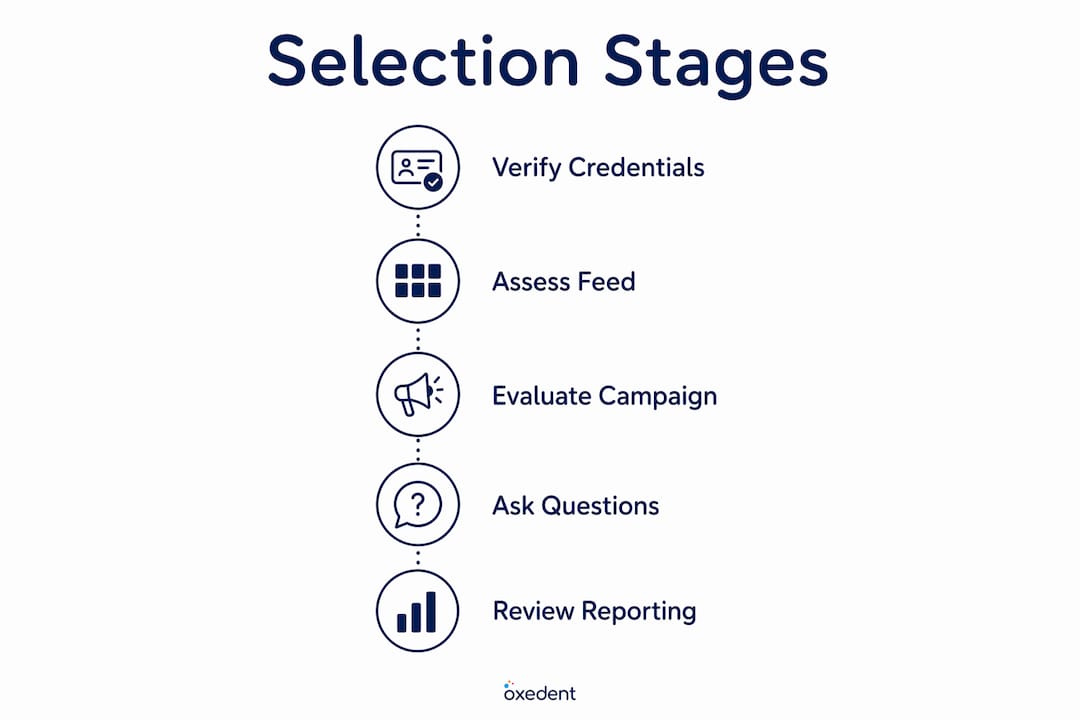

1. Verify credentials and ecommerce experience
Google Premier Partner status is the baseline credential to look for. Beyond that, ask for case studies from ecommerce clients in your sector. An agency that has managed Shopping campaigns for fashion retailers will understand margin pressure and seasonal demand differently from one that has only worked with B2B lead generation. Sector experience is not a bonus. It is a prerequisite.
2. Assess feed optimisation capability
Feed management is where most agencies either prove or expose themselves. Ask directly: how do you structure product titles for high-intent queries? Which feed management tools do you use? How do you handle variant products and out-of-stock items? A strong Google Shopping consultant will answer these questions with specifics, not generalities. You can benchmark their answers against feed optimisation best practice to gauge their depth.
3. Evaluate campaign structure and bidding approach
Ask how the agency structures campaigns across product categories and margin tiers. The best Google Shopping management services separate high-margin products from low-margin ones and apply different bidding strategies accordingly. Ask whether they use Standard Shopping alongside Performance Max or rely solely on one campaign type. An agency that cannot explain its campaign architecture clearly is unlikely to manage yours well.
4. Ask the right questions
Use these questions in every agency conversation:
- How do you measure ROI, and what KPIs do you report on monthly?
- Can you show a before-and-after feed restructure from a previous client?
- How do you handle Merchant Center disapprovals?
- What is your process when ROAS drops unexpectedly?
- Do you audit landing pages and site speed as part of your service?
That last question matters more than most business owners realise. Top agencies audit landing page alignment, conversion tracking precision, and site speed because these site-side factors directly bottleneck campaign performance. An agency that only looks at the ad account is missing half the picture.
5. Review reporting transparency
Transparent monthly reporting of KPIs including ROAS, CPA, and conversions is a hallmark of top-performing agencies. Ask to see a sample report before you commit. If the report is full of impressions and click data but light on revenue and profit metrics, that agency is optimising for the wrong outcomes.
Pro Tip: Request a sample monthly report from every agency you shortlist. The metrics they choose to highlight tell you exactly what they prioritise.
| Evaluation category | What to look for | Why it matters |
|---|---|---|
| Credentials | Google Premier Partner status | Verified expertise, platform access |
| Feed expertise | Title structure, attribute completeness | Drives algorithm matching and visibility |
| Campaign architecture | Margin-based segmentation | Protects profitability at scale |
| Reporting | Revenue and ROAS focus | Confirms performance accountability |
| Site-side awareness | Landing page and tracking audits | Removes conversion bottlenecks |
Common mistakes when hiring a Google Shopping agency
Most selection errors come from focusing on price or presentation rather than technical capability. These are the pitfalls that cost ecommerce businesses the most.
Ignoring feed quality. Many business owners assume the agency will fix everything. The reality is that feed optimisation requires your cooperation. You own the product data. If your catalogue has missing GTINs, vague titles, or incorrect categories, no amount of bidding expertise will compensate.
Overlooking site-side performance. Campaign performance bottlenecks often originate from landing page mismatches, slow loading times, and inaccurate conversion tracking. Even the best ad management cannot overcome a product page that loads in six seconds or a checkout that leaks conversions. When evaluating a Google Shopping advertising agency, confirm they assess your site as part of onboarding.
Choosing on price alone. Google Shopping management services typically start at around £800 per month for setup and ongoing optimisation. Agencies priced significantly below this are almost always cutting corners on feed management, reporting depth, or account oversight. Cheap management costs more in wasted ad spend than it saves in fees.
Skipping the free audit. Specialist agencies often provide free audits covering Merchant Center health and campaign structure. These 15–30 minute reviews reveal technical constraints you may not know exist. Use them as a stress test of the agency’s diagnostic capability, not just as a sales conversation.
“Your product feed is your organic SEO for Shopping. Poor feed quality limits Google’s algorithm from matching your products to high-intent buyers. No bidding strategy compensates for weak data at the source.”
Pro Tip: Book free audits with two or three agencies before deciding. Compare the depth of their findings. The agency that identifies the most specific, actionable issues is usually the one with the strongest technical team.
Also consider whether the agency has a clear qualification process. Agencies that accept every client regardless of budget or readiness often lack the focus to deliver consistent results. Oxedent, for example, filters out early-stage or price-driven clients specifically to maintain the quality of its work for established ecommerce businesses.
How to measure success with your chosen agency
Once you have selected a partner, the work of managing the relationship begins. Clear performance measurement keeps both sides accountable.
- Set ROAS and CPA targets before launch. Agree on specific numbers, not ranges. “We aim for 6x ROAS on core products” is a target. “We aim for good ROAS” is not.
- Schedule monthly review meetings. Use these to review KPI trends, not just snapshots. A single month of data is noise. Three months of data is a pattern.
- Track conversion rate alongside ad metrics. If your conversion rate drops while ad spend holds steady, the problem is on your site, not in the campaign. Your agency should flag this proactively.
- Review feed health monthly. Disapproved products, missing attributes, and price mismatches erode performance silently. Ask for a feed health summary in every report.
- Align campaign goals with business cycles. Seasonal peaks, new product launches, and margin changes all require campaign adjustments. Brief your agency in advance, not after the fact.
- Assess scaling readiness quarterly. Scaling Shopping campaigns profitably requires budget increases to be matched by feed improvements and landing page readiness. Growth without these foundations wastes spend.
Transparent reporting is the foundation of a productive partnership. If your agency cannot explain why ROAS moved in a given month, that is a problem. The best agencies connect performance changes to specific actions: a feed update, a bid adjustment, a landing page change, or a competitor shift. That level of accountability is what separates a genuine specialist from a generalist account manager.
For context on how a well-structured retail checkout process supports conversion rates and reduces drop-off, the streamlined checkout guide for apparel from Sensepass offers useful retail-specific insight.
Key takeaways
Choosing the right Google Shopping specialist agency requires verifying credentials, assessing feed expertise, auditing site-side readiness, and committing to transparent performance measurement from day one.
| Point | Details |
|---|---|
| Feed quality drives results | Poor feed data is the primary reason Shopping campaigns underperform; fix it before engaging an agency. |
| Premier Partner status matters | Only the top 3% of Google Ads agencies globally hold this credential; use it as a baseline filter. |
| Site-side factors bottleneck campaigns | Landing page speed, tracking accuracy, and page relevance limit performance regardless of ad quality. |
| Free audits reveal agency depth | Use 15–30 minute audits to stress test technical capability before signing any agreement. |
| Reporting must focus on revenue | Agencies that lead with impressions and clicks rather than ROAS and CPA are optimising for the wrong metrics. |
Why most agency relationships fail before they start
I have seen ecommerce businesses spend months with the wrong agency and attribute poor results to Google Shopping itself, when the real problem was the selection process. The most common mistake is treating agency selection like a procurement exercise: gather three quotes, pick the middle one, and hope for the best.
The businesses that get the best results treat it differently. They go into conversations knowing their own numbers: current ROAS, average order value, margin by product category, and conversion rate. That preparation forces a more honest dialogue. An agency that cannot engage with those specifics is not ready to manage your account.
The second thing I have noticed is that the businesses most reluctant to share access, data, or honest performance history are also the ones that get the least from their agency. A specialist needs full visibility to do good work. Holding back Merchant Center access or conversion data to “protect” your business actually protects underperformance.
Finally, the agencies worth working with will tell you when you are not ready. That is not a rejection. It is a sign of integrity. If an agency qualifies you before taking your money, they are far more likely to deliver results once the work begins.
— Biplab
Oxedent’s Google Shopping management services
Oxedent specialises exclusively in ecommerce PPC, with Google Shopping and Performance Max at the centre of its service offering.

If your Shopping campaigns are underperforming or you are preparing to scale, Oxedent’s ecommerce PPC management service covers feed optimisation, campaign architecture, Merchant Center management, and transparent monthly reporting focused on ROAS and profit. There are no long-term contracts and no vanity metrics. Oxedent works with established ecommerce businesses that have meaningful ad budgets and a genuine appetite for growth. You can also explore Oxedent’s approach to Performance Max for ecommerce if you are considering a migration or want to understand how AI-driven campaigns fit alongside Standard Shopping.
FAQ
What is a Google Shopping specialist agency?
A Google Shopping specialist agency manages product feed optimisation, Merchant Center, campaign structure, and bidding strategy to improve ecommerce return on ad spend. Unlike generalist agencies, specialists treat feed quality and campaign architecture as core disciplines rather than secondary tasks.
How much does Google Shopping management cost in the UK?
Google Shopping management services typically start at around £800 per month, covering Merchant Center management, feed optimisation, and monthly ROAS reporting. Minimum effective ad spend starts at £500–£1,000 per month for smaller catalogues.
What credentials should a Google Shopping agency have?
Google Premier Partner status is the primary credential to verify. It is awarded to only the top 3% of Google Ads agencies globally and confirms expert account management alongside direct platform support.
How do I know if my business is ready to hire a Google Shopping expert?
Your Merchant Center account should be active and approved, conversion tracking should be accurate, and your product feed should have complete titles, GTINs, and categories. Without these foundations, an agency will spend its first weeks fixing your data rather than growing your revenue.
How long does it take to see results from a Google Shopping agency?
Results vary by catalogue size, feed quality, and budget, but professional feed restructuring and Performance Max migration have delivered measurable ROAS improvements within 90 days for UK ecommerce retailers. Set clear KPI targets before launch and review performance monthly rather than week by week.