



Meta advertising for online stores is the practice of running paid campaigns across Facebook, Instagram, Messenger, and the Audience Network to drive product sales and measurable return on ad spend. When you run Meta ads for ecommerce in the US, you are not simply boosting posts. You are building a data-driven acquisition system that feeds Meta’s algorithm with purchase signals, product catalogues, and first-party customer data. The Advantage+ Shopping Campaign (ASC) is now Meta’s recommended campaign type for ecommerce, and it accounts for over 60% of ecommerce conversion spend on the platform. Getting this right requires clean data infrastructure, a consolidated campaign structure, and a disciplined creative testing cadence.
What tools and data infrastructure do you need before running Meta ads for ecommerce?
The Meta Pixel and the Conversions API (CAPI) are the two non-negotiable foundations of any ecommerce Meta ads setup. The Pixel fires browser-side events such as ViewContent, AddToCart, and Purchase. CAPI sends the same events server-side, which restores the signal loss caused by iOS privacy changes and browser ad blockers.
Your CAPI event match quality score must sit above 7.0 for Meta’s algorithm to receive strong targeting signals. Scores below that threshold mean poor audience matching and wasted spend. Check this score inside Events Manager before you touch creatives or audiences.


For Shopify stores, the native Meta integration handles both Pixel and CAPI setup with minimal technical work. WooCommerce and BigCommerce stores typically need a third-party connector or a developer to implement server-side events correctly. Either way, your product catalogue must be synced via a Meta Commerce Manager feed so that dynamic ads can pull live pricing and inventory.
Here is what your data infrastructure checklist should include before launch:
- Meta Pixel installed on every page, firing standard events accurately
- Conversions API set up server-side with deduplication enabled to avoid double-counting events
- Product catalogue synced with correct titles, prices, images, and availability
- Commerce Manager account linked to your ad account and catalogue
- Custom audiences built from website visitors, add-to-cart events, and past purchasers
Pro Tip: Run the Meta Pixel Helper Chrome extension and the Events Manager test tool simultaneously. If your Purchase event fires on the confirmation page but not in Events Manager within 30 seconds, your CAPI deduplication is broken.
How to structure and launch effective Meta ads campaigns for US ecommerce
Campaign architecture is where most US ecommerce brands lose money before a single ad is seen. Fragmented campaign structures with 12–15 micro-segmented ad sets produce 15–25% higher cost per acquisition than consolidated structures with 3–5 campaigns. The reason is simple: each ad set needs at least 50 optimisation events weekly to exit the learning phase and perform reliably.
The recommended structure for a mature US ecommerce brand looks like this:
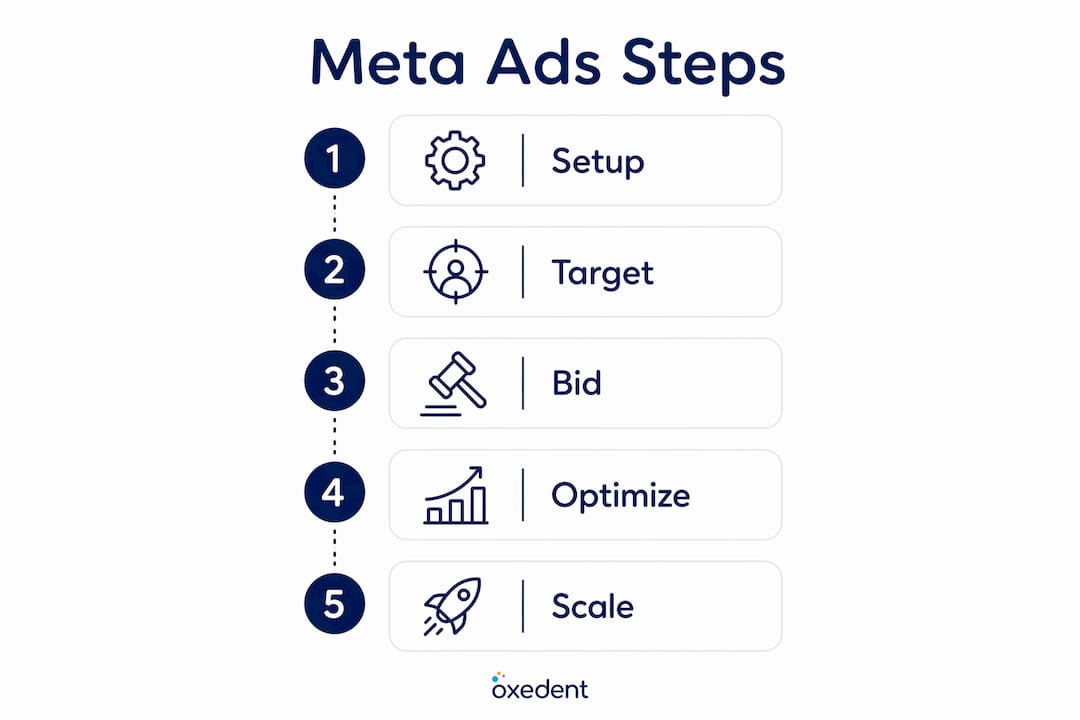
- Advantage+ Shopping Campaign (70–80% of total budget). This is your primary acquisition engine. ASC averages a 4.52x ROAS versus 3.70x for manual campaigns, a 22% improvement with a 17% reduction in cost per purchase. Let Meta’s algorithm find buyers without manual interest stacks.
- Prospecting and creative testing campaign (10–20% of budget). Use broad targeting with a single ad set. This is where you test new creatives, new audiences, and new offers before promoting winners into ASC.
- Retargeting and retention campaign (10% of budget). Target website visitors from the past 30 days, add-to-cart abandoners, and past purchasers with upsell or replenishment offers.
Broad targeting with Meta’s AI-driven Advantage+ campaigns efficiently finds buyers without requiring complex manual interest stacks. Granular interest-based targeting is now largely deprecated for ecommerce in 2026. Trust the algorithm and give it clean data to work with.
For bidding, start with Highest Volume to accumulate purchase data quickly. Once you have 500 or more purchases recorded, shift to Cost Cap or a minimum ROAS target to control profitability. Use a consistent campaign naming convention such as [Objective] | [Audience Type] | [Creative Format] | [Date] to keep your account readable as it grows.

Pro Tip: Set your ASC existing customer budget cap to 10–15% of total ASC spend. This prevents Meta from over-indexing on retargeting your existing customers and inflating your apparent ROAS.
What creative strategies keep Meta ads fresh and effective for ecommerce brands?
Creative fatigue is the single biggest silent killer of Meta ecommerce performance. Fashion and beauty products experience creative fatigue within 5–7 days. Home goods and health products last 10–14 days before performance degrades. Most brands discover this too late, after their cost per purchase has already climbed.
The solution is a structured testing cadence rather than reactive creative swaps. Top-performing ecommerce brands test 15–20 new creative variations monthly. That volume sounds high, but it does not mean producing 20 entirely different concepts. It means testing variations of hooks, headlines, product angles, and formats against a core winning concept.
Watch for these signals that a creative needs replacing:
- CTR drops more than 20% week over week. This is the clearest early warning sign.
- Frequency climbs above 3.0 for cold audiences within a single week.
- Cost per purchase increases by 30% or more without a corresponding change in product price or offer.
- Add-to-cart rate falls while impressions hold steady, suggesting the creative is attracting the wrong audience.
The formats that consistently perform for US ecommerce brands are user-generated content (UGC) style videos, short-form video reels under 15 seconds, static product images with bold benefit-led headlines, and carousel ads for multi-product catalogues. Use Meta’s Advantage+ creative feature to let the algorithm test headline, description, and image combinations automatically within your winning ad sets.
How to optimise and scale Meta ads campaigns for sustained ecommerce success
Scaling Meta ads requires patience and a clear understanding of how the algorithm responds to budget changes. Increasing a budget by more than 20% in 24 hours triggers a learning phase reset, which destabilises performance for several days. The correct method for rapid scaling is to duplicate the winning campaign at a higher budget rather than editing the existing one.
The table below shows the two main scaling approaches and when to use each:
| Scaling method | When to use it | Risk level |
|---|---|---|
| Gradual budget increase (up to 20% per day) | Steady growth with stable ROAS | Low |
| Campaign duplication at higher budget | Rapid scaling after a proven winner | Medium |
| New ASC campaign with higher budget cap | Testing new creative angles at scale | Medium |
For measurement, the standard 30-day ROAS window misleads brands that sell subscription products or consumables with high repeat purchase rates. Evaluate campaign profitability using a 120-day cohort ROAS instead. This accounts for the full customer lifetime value generated by a single acquisition campaign and gives you a far more accurate picture of true profitability.
Audit your CAPI event match quality score regularly. If it drops below 7.0, fix the data issue before adjusting creatives or audiences. Poor data signals are the root cause of most unexplained performance drops. For a deeper look at improving your ROAS, the principles of clean data and campaign consolidation apply across every paid channel.
Pro Tip: When duplicating a campaign for scaling, wait 48 hours before comparing performance. The duplicated campaign needs time to exit the learning phase before you draw any conclusions.
Key takeaways
Running Meta ads for ecommerce in the US requires clean first-party data via CAPI and Meta Pixel, a consolidated 3–5 campaign structure built around Advantage+ Shopping Campaigns, and a disciplined monthly creative testing cadence of 15–20 variations.
| Point | Details |
|---|---|
| Data infrastructure first | Install Meta Pixel and CAPI with a match quality score above 7.0 before launching any campaign. |
| Consolidate campaigns | Use 3–5 campaigns maximum; fragmented structures raise cost per acquisition by 15–25%. |
| Advantage+ Shopping leads | ASC delivers a 4.52x ROAS on average, outperforming manual campaigns by 22%. |
| Creative refresh cadence | Replace creatives when CTR drops more than 20% week over week; test 15–20 variations monthly. |
| Scale carefully | Never increase a budget by more than 20% in 24 hours; duplicate winning campaigns instead. |
Why Meta ads success is a data discipline, not just a creative endeavour
I have worked with enough ecommerce brands to say this clearly: the ones who struggle with Meta ads are almost always under-investing in data infrastructure and over-investing in creative production. They build beautiful ads, then wonder why performance is inconsistent. The answer is usually a broken CAPI setup or a fragmented campaign structure that starves the algorithm of purchase signals.
Campaign consolidation changed everything for the brands I work with. Moving from 12 micro-segmented campaigns to 4 consolidated ones is not a minor tweak. It is a structural shift that gives Meta’s algorithm the volume of events it needs to learn properly. Brands with systematic creative testing and clean data pipelines consistently outperform those relying on intuition, and I have seen this play out repeatedly.
The misconception I encounter most often is that manual targeting gives you control. In 2026, it does the opposite. It restricts the algorithm’s ability to find buyers you have not thought of yet. Broad targeting with clean first-party data signals is the actual control mechanism. You are telling the algorithm what a good customer looks like, not where to find them.
Creative testing cadence matters more than creative quality in isolation. A good creative that runs for three weeks without a refresh will underperform a decent creative that is replaced on schedule. The discipline is in the calendar, not just the production brief.
The Meta ecosystem changes every year. What worked in 2023 with detailed interest stacking does not work in 2026. The brands that adapt quickly are the ones treating their ad accounts as living systems, not set-and-forget machines. For a useful comparison of how Meta and Google work together for ecommerce growth, the Google Ads vs Meta Ads breakdown is worth reading alongside this.
— Biplab
How Oxedent can help you get more from your Meta ads
Running a profitable Meta ads account for your ecommerce store takes more than a good campaign structure. It takes correct CAPI implementation, a tested creative pipeline, and the experience to read performance data accurately and act on it quickly.

Oxedent specialises exclusively in ecommerce PPC management, including Meta ads campaign builds, CAPI setup, Advantage+ Shopping Campaign management, and ongoing creative strategy support. If your current account is underperforming or you are starting from scratch, Oxedent offers a free audit to identify exactly what needs fixing. Book a no-obligation strategy call and get a clear picture of where your Meta ads budget is going and how to make it work harder.
FAQ
What is an Advantage+ Shopping Campaign on Meta?
An Advantage+ Shopping Campaign (ASC) is Meta’s AI-driven campaign type designed for ecommerce, which uses broad targeting and automated placements to find buyers across Facebook and Instagram. ASC averages a 4.52x ROAS, outperforming manual campaigns by 22%.
How much budget do I need to run Meta ads for ecommerce?
Each ad set needs enough budget to generate at least 50 purchase events weekly to exit the learning phase. A starting budget of $50–$100 per day per campaign is a practical minimum for US ecommerce brands.
Why is the Conversions API important for Meta ecommerce ads?
The Conversions API sends purchase and event data server-side, restoring signal loss caused by iOS privacy changes and browser blockers. A CAPI event match quality score above 7.0 is required for Meta’s algorithm to target and optimise effectively.
How often should I refresh my Meta ad creatives?
Refresh creatives when CTR drops more than 20% week over week. Fashion and beauty brands typically need new creatives every 5–7 days, while home goods and health brands can run creatives for 10–14 days before fatigue sets in.
How do I scale Meta ads without losing performance?
Never increase a campaign budget by more than 20% in a 24-hour period, as this resets the learning phase. Duplicate the winning campaign at a higher budget instead, and wait 48 hours before comparing performance between the original and the duplicate.