


Scaling ecommerce revenue with paid ads is defined as increasing your ad investment in a controlled, optimised manner that improves return on ad spend rather than simply inflating spend. Platforms like Meta Advantage+ Shopping and Google Ads now run on AI bidding, which means the variables you control above the auction — budget discipline, creative volume, conversion tracking, and data signal quality — determine whether your revenue grows or your ROAS collapses. This guide covers every layer of that process: from foundational setup through budget scaling rules, creative frameworks, platform optimisation, and troubleshooting the pitfalls that derail most brands before they reach meaningful scale.
What you must have in place before scaling paid ads
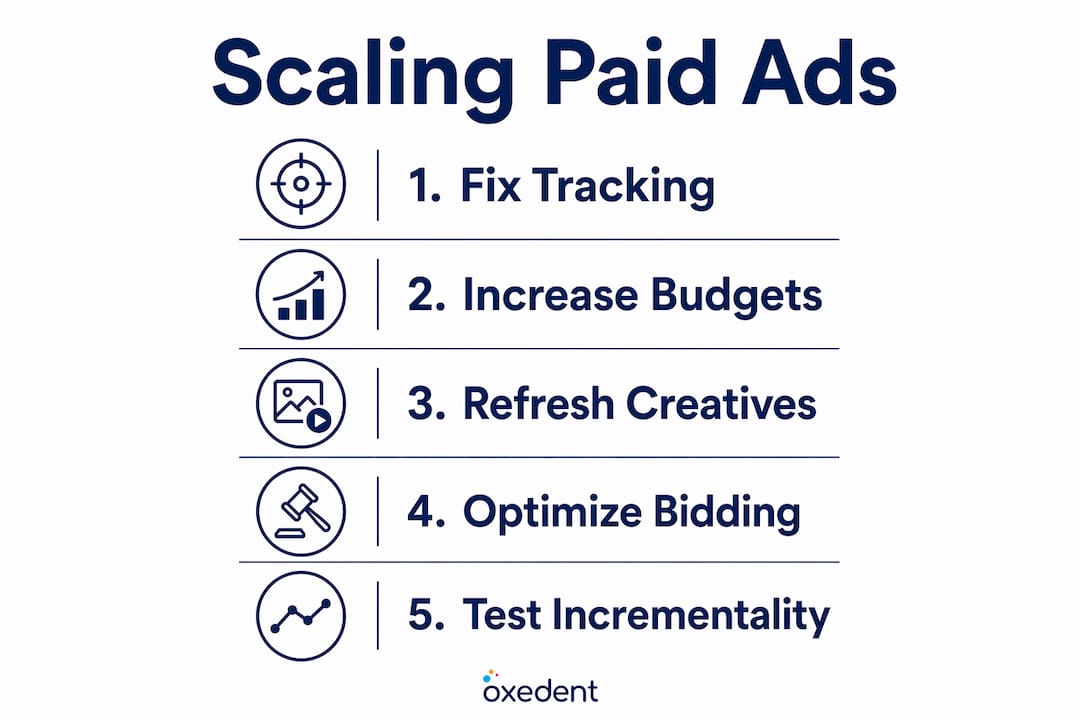
Scaling without a solid foundation is the fastest way to waste budget. Before you increase spend on any platform, three technical and strategic pillars must be in place.
Conversion tracking accuracy is non-negotiable. Server-side conversion tracking and enhanced conversions can recover 15–30% of lost data that client-side tracking misses due to ad blockers and privacy restrictions. That recovered data feeds directly into your bidding algorithms, and better input means better optimisation decisions at scale.


Margin-based ROAS targets are your financial guardrails. The target ROAS should be calculated from contribution margins at the product level, not from platform suggestions. If your platform recommends a target ROAS that ignores fulfilment costs and returns, you will hit the number and still lose money. Build your break-even ROAS for each product category before you touch a budget slider.
Creative pipeline and landing page readiness complete the foundation. Top-performing ecommerce stores achieve conversion rates between 3.2% and 4.7% against an industry average of 1.4%. Simple friction reductions and trust badges can lift revenue by 5–15%. Sending paid traffic to a poorly converting landing page is the equivalent of filling a leaking bucket. Fix the page first.
- Implement server-side tracking, enhanced conversions, and consent mode across all platforms
- Calculate break-even and target ROAS at product or category level using contribution margins
- Set up a multi-touch attribution model or blended measurement stack to understand true ROI
- Audit landing pages for load speed, social proof, and add-to-cart friction before scaling spend
Pro Tip: Run a holdout test on your current tracking setup by comparing platform-reported conversions against your CRM or Shopify order data. A gap of more than 15% signals a tracking problem that will compound as you scale.
How to increase ad budgets without disrupting algorithm performance
Budget scaling is not about how much you spend. It is about how fast you increase spend relative to what the algorithm can absorb.
-
Follow the 20% rule. Increase Meta Advantage+ Shopping Campaign budgets by no more than 20% every five to seven days. Larger jumps force the algorithm back into a learning phase, which resets optimisation progress and compresses ROAS temporarily. The same principle applies to Google Ads campaigns using Target ROAS or Target CPA bidding.
-
Maintain minimum spend thresholds. Brands should maintain £150–£300 per day on Meta Advantage+ Shopping to reach at least 50 purchase events weekly. Below that threshold, the algorithm lacks sufficient data to optimise reliably. Underspending is as damaging as overspending too quickly.
-
Monitor learning phase status actively. Every time you make a significant change to budget, bid strategy, or audience, a campaign re-enters the learning phase. Frequent resets prevent the algorithm from ever reaching stable performance. Batch your changes and allow at least one full week of data before evaluating results.
-
Diversify across platforms to reduce concentration risk. Effective scaling requires gradual budget increases, portfolio-level bid strategies, and diversified channels. Relying entirely on Meta or Google creates single-point-of-failure risk. Coordinating spend across both platforms also expands your addressable audience.
| Budget increase | Expected outcome | Risk level |
|---|---|---|
| Up to 20% every 5–7 days | Stable algorithm learning, gradual ROAS improvement | Low |
| 21–50% in one adjustment | Temporary learning phase reset, short-term ROAS dip | Medium |
| Over 50% in one adjustment | Significant ROAS collapse, algorithm instability | High |
Pro Tip: Schedule budget increases for Monday mornings. Algorithms have a full trading week to absorb the change, and you have five days of data to assess impact before the weekend, when ecommerce conversion rates typically shift.

Which creative strategies sustain performance at scale?
Creative is the single largest variable you control once targeting becomes automated. Creative quality drives 50–70% of Meta Ads performance, and brands consistently testing 21 or more new creative concepts monthly see measurable ROAS improvements. That is not a minor lever. It is the primary lever.
Creative cadence — refreshing four to six new concepts per month at minimum — is the largest driver of sustained paid social performance. Audience targeting is now largely automated on Meta and Google, which means creative has become the critical human variable. If you are not producing new assets regularly, you are ceding your most important competitive advantage to inertia.
Creative fatigue occurs within seven to fourteen days at scale. At higher spend levels, your ads reach the same people more frequently, and engagement drops sharply once an audience has seen the same creative three or more times. Rotating assets every ten to fourteen days prevents frequency-driven ROAS decline.
- Prioritise user-generated content and native-feel video over high-production brand films. UGC converts because it reads as authentic social content rather than advertising.
- Test new angles, offers, and formats in manual prospecting campaigns before pushing winning concepts into broad automated campaigns.
- Produce creative in batches: shoot multiple concepts in one session to maintain output without proportionally increasing production costs.
- Use your product feed as a creative asset. Dynamic product ads and Google Shopping creatives built from well-optimised feeds consistently outperform static image ads for retargeting.
Pro Tip: When a creative starts to fatigue, do not simply replace it. Analyse which hook, format, or offer drove its initial performance, then build the next batch around those specific elements. You are not starting from scratch. You are iterating on proven signals.
How to optimise targeting, bidding, and platform selection for revenue scale
The role of paid media managers in 2026 is managing above-the-auction variables — strategy, creative volume, landing page quality, and data signals — while AI handles bidding. That shift changes where your time and expertise should go.
Feeding AI bidding algorithms with enhanced conversion data that reflects customer lifetime value outperforms count-based optimisation. When Google or Meta optimises purely for purchase events, it finds buyers. When you upload CRM data that identifies your highest-value customers, it finds profitable buyers. That distinction compounds significantly at scale.
For platform allocation, companies with documented cross-channel strategies achieve 3.2 times higher conversion rates with 40% lower acquisition costs than brands running ad hoc campaigns. The 70-20-10 framework is a practical starting point: allocate 70% of budget to established, proven channels, 20% to growth channels showing early promise, and 10% to experimental formats or platforms.
| Platform | Best use case | Scaling consideration |
|---|---|---|
| Google Performance Max | High-intent purchase capture, Shopping | Segment by margin tier or product category |
| Meta Advantage+ Shopping | Broad prospecting and retargeting | Maintain minimum spend for purchase event volume |
| Google Search | Brand and category keyword defence | Use portfolio bid strategies across ad groups |
| Meta manual campaigns | Creative testing before broad rollout | Keep budgets modest until a concept proves itself |
For Google Performance Max, segment campaigns by product margin or category rather than running a single catch-all campaign. This gives you control over where budget concentrates and prevents low-margin products from consuming spend that should go to your most profitable lines. Oxedent’s approach to Google Shopping at scale consistently uses feed segmentation as the primary lever for improving campaign-level ROAS.
What are the common pitfalls when scaling paid ads?
ROAS compression during scaling is normal. As campaigns move from high-intent audiences to broader ones, average conversion rates fall and cost per acquisition rises. That is expected. What is not expected, and what signals a real problem, is a sudden ROAS collapse.
Sudden ROAS drops during scaling typically indicate failures in creative quality, targeting signal quality, or attribution accuracy rather than market saturation. Before cutting budget, audit these three areas in that order.
- Over-segmentation starves the algorithm of data. Splitting audiences into too many small ad sets prevents any single campaign from accumulating the purchase events needed for stable optimisation. Consolidate where possible.
- Attribution drift creates misinformed decisions. Platform-reported ROAS and your CRM data will never match exactly, but a growing gap signals a tracking problem. Audit regularly and reconcile the two data sources monthly.
- Chasing short-term spikes undermines long-term growth. A single high-ROAS week after a creative launch is not a signal to triple the budget. Sustained performance over three to four weeks is the correct threshold for confident scaling.
“Use holdout testing and incrementality studies to confirm that your ad spend is generating true incremental revenue, not just claiming credit for purchases that would have happened anyway.”
Incrementality testing is underused by most ecommerce brands. Running a geographic or audience holdout test for two to four weeks gives you a reliable read on the actual revenue contribution of your paid activity, which is the only number that matters when making scaling decisions.
Key takeaways
Scaling ecommerce paid ad revenue requires accurate tracking, disciplined budget increases, consistent creative output, and AI bidding fed with lifetime value signals rather than raw purchase counts.
| Point | Details |
|---|---|
| Fix tracking before scaling | Server-side tracking recovers 15–30% of lost conversion data, improving algorithm input quality. |
| Scale budgets gradually | Increase spend by no more than 20% every five to seven days to avoid algorithm resets. |
| Treat creative as your primary lever | Produce at least four to six new concepts monthly; fatigue sets in within seven to fourteen days at scale. |
| Feed AI with LTV signals | Upload CRM data to optimise for high-value customers, not just purchase volume. |
| Diagnose ROAS drops correctly | Sudden collapses point to creative, targeting, or attribution failures, not market saturation. |
Scaling paid ads: what I have learned after years in ecommerce PPC
Most brands approach scaling as a budget problem. They assume that if they spend more, they will earn more, and they look for permission to increase spend rather than a framework for doing it safely. That framing is the root cause of most scaling failures I have seen.
The brands that scale well treat paid advertising as a system with interdependent parts. Budget, creative, tracking, and landing page performance are not separate workstreams. They are inputs into the same machine. When one input degrades, the whole system underperforms, and the temptation is to blame the platform rather than diagnose the actual fault.
The other pattern I consistently see is underinvestment in measurement. Brands will spend tens of thousands per month on ads and resist spending a fraction of that on proper attribution infrastructure. The result is decisions made on platform-reported data that overstates performance by 20–40%, which leads to misallocated budget and misplaced confidence.
Creative cadence is the discipline that separates scaling brands from stagnating ones. Producing four to six new concepts monthly sounds manageable until you are also running a business. The brands that do it consistently build a structural advantage that compounds over time. Those that do not find themselves in a cycle of creative fatigue, ROAS decline, and reactive budget cuts.
Cross-channel coordination matters more than most brands realise. Running Google and Meta independently, with separate strategies and no shared measurement framework, means you are almost certainly double-counting conversions and misattributing revenue. A blended measurement approach that reconciles platform data against CRM actuals is not optional at scale. It is the foundation everything else rests on.
— Biplab
Ready to scale your ecommerce ad revenue with expert support?
If you have the tracking, the creative pipeline, and the budget discipline in place but want a specialist team to manage execution at scale, Oxedent works exclusively with ecommerce brands on paid media. The focus is always on profitability and ROAS, not vanity metrics.

Oxedent manages seven-figure ad spends across Google Ads, Meta, Google Shopping, and Performance Max, with a data-led approach to budget scaling, feed optimisation, and creative testing. If you are an established ecommerce business ready to grow paid ad revenue without guesswork, explore Oxedent’s ecommerce PPC management services or learn how Oxedent approaches Performance Max at scale. No long-term contracts. No generic strategies. Just focused, profitable growth.
FAQ
What does scaling ecommerce revenue with paid ads actually mean?
Scaling ecommerce revenue with paid ads means increasing ad investment in a controlled, optimised way that improves or maintains ROAS rather than simply spending more. It requires disciplined budget increases, strong creative output, and accurate conversion data.
How often should I increase my Meta Ads budget when scaling?
Increase Meta Advantage+ Shopping Campaign budgets by no more than 20% every five to seven days. Larger increases force the algorithm back into a learning phase and typically cause a temporary ROAS collapse.
Why does ROAS drop when I scale my ad spend?
Some ROAS compression is normal as campaigns reach broader, lower-intent audiences. However, sudden drops usually indicate a problem with creative quality, targeting signal quality, or attribution accuracy rather than market saturation.
How many new creatives do I need to produce each month?
Producing at least four to six new creative concepts monthly is the minimum for sustaining paid social performance. At higher spend levels, creative fatigue sets in within seven to fourteen days, so consistent output is critical.
Which platforms are best for scaling ecommerce paid ad revenue?
Google Performance Max and Meta Advantage+ Shopping are the primary platforms for scaling ecommerce revenue in 2026. Google Search defends high-intent brand and category terms, while Meta manual campaigns serve as a testing ground before broader rollout.