


Switching your ecommerce PPC agency smoothly requires a clear, methodical process built around ownership transfer, data continuity, and performance protection. A poorly managed agency transition is one of the fastest ways to lose revenue momentum, with attribution errors, access disputes, and knowledge gaps all threatening your campaigns. The good news is that a structured approach, using tools like Google Ads MCC, Google Ads Editor, and CRM platforms such as HubSpot or Salesforce, makes the process predictable. This guide gives you the exact framework to change PPC agency without losing a single week of performance data or campaign history.
How to switch PPC agency smoothly for ecommerce
Before you send a single email to your current agency, you need to get your house in order. The most common cause of a rocky transition is not the new agency. It is the outgoing one holding assets you should have owned from day one.
Start with these prerequisites:
- Verify account ownership. Confirm you hold admin access to your Google Ads account, not just a user role granted by the agency. If the account sits inside the agency’s Google Ads MCC, demand full transfer of the MCC ID to your direct ownership immediately.
- Review your contract. Most agency agreements require a 30-day termination notice. Read the termination clauses carefully before you notify anyone.
- Export your campaign assets. Use Google Ads Editor to download your full campaign history, ad copy, audience lists, and creative assets. This data belongs to you.
- Gather billing information. Set up direct billing between your Google Ads account and your own payment method. This prevents the agency from pausing your campaigns as leverage during a dispute.
- Brief your stakeholders. Finance, marketing, and operations teams all need to know a transition is coming. Governance gaps cause decision bottlenecks that slow everything down.
Pro Tip: Request a full data export covering the past 6–12 months of campaign performance before you serve notice. Historical PPC data is critical for your new agency to avoid repeating strategies that did not work.
Align your internal team on a transition timeline before the outgoing agency is formally notified. This keeps you in control of the narrative and the process.


What are the exact steps to execute a smooth agency switch?
A standard ecommerce PPC agency switch takes 2–4 weeks when you follow a structured seven-step process. That timeline assumes clean account ownership and no contract disputes. Here is the framework:
- Verify account ownership. Confirm admin access and MCC status before anything else.
- Serve termination notice. Issue formal written notice per your contract terms. Most contracts require 30 days.
- Notify the incumbent agency. Communicate professionally and request a structured handover document covering active campaigns, experiment logs, and audience data.
- Invite the new agency. Grant access using their Google Ads MCC ID. Set permissions at the account level, not the campaign level, so they can see the full picture.
- Migrate billing. Switch billing to direct client payments so your campaigns are never held hostage by an agency relationship breakdown.
- Export and transfer data. Move campaign history, creative assets, audience segments, and conversion data to shared storage your new agency can access.
- Conduct a performance audit. Establish a clear baseline of current KPIs before the new agency touches anything. This is your reference point for measuring progress.
| Step | Action | Owner | Timeline |
|---|---|---|---|
| 1 | Verify account ownership | Client | Day 1 |
| 2 | Serve termination notice | Client | Day 1–2 |
| 3 | Request handover document | Client | Day 3–5 |
| 4 | Grant new agency access | Client + New Agency | Day 7–10 |
| 5 | Migrate billing | Client | Day 7–10 |
| 6 | Export campaign data | Outgoing Agency | Day 10–14 |
| 7 | Audit and baseline | New Agency | Day 14–28 |
Pro Tip: Freeze your conversion tracking and measurement setups before the switch begins. Changing GA4 or server-side tracking mid-transition introduces data noise that makes it impossible to tell whether performance changes are real or just measurement errors.
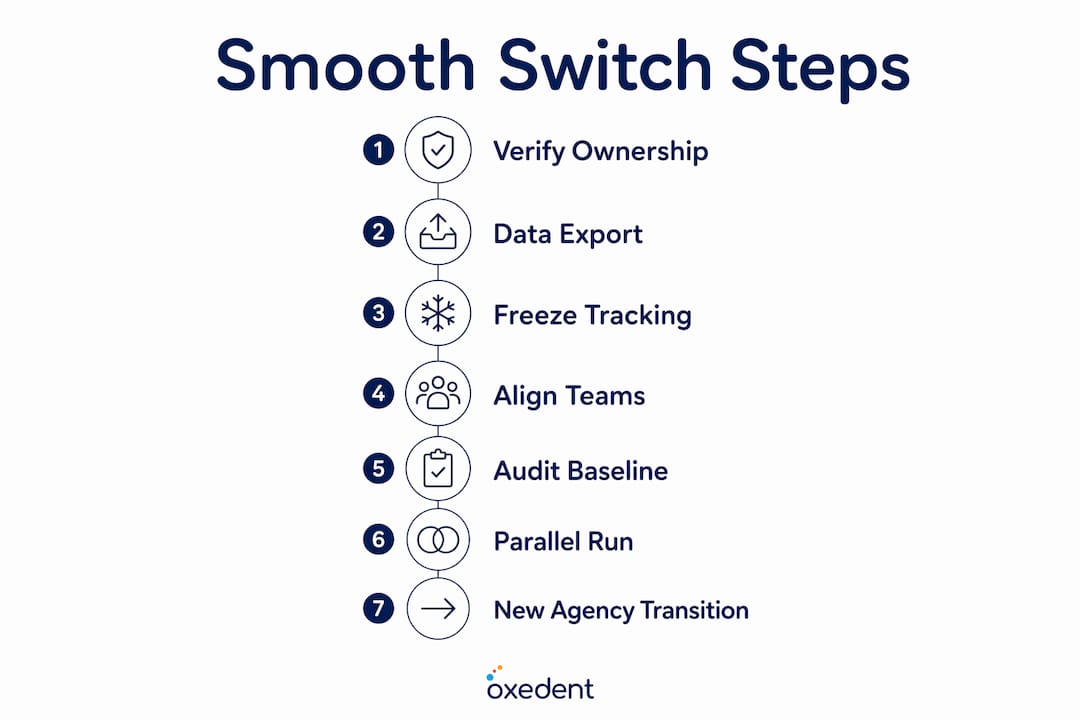

The audit in step seven is not optional. Without a documented baseline, you have no way to hold your new agency accountable for the results they promised.
How do you protect campaign performance during the transition?
Performance dips during agency transitions are common. They are not inevitable. Five specific measures determine whether your revenue holds steady or slides.
“Five critical pillars ensure smooth momentum during an agency switch: governance, data continuity, measurement integrity, experiment backlogs, and stakeholder communication.” — Upraw Media
Each pillar addresses a real failure mode. Governance gaps cause slow decisions. Data gaps cause repeated mistakes. Measurement errors hide real performance. Undocumented experiments get run twice. Poor communication creates internal confusion that delays approvals.
Here is how to protect each one:
- Site speed. A 1-second delay in site speed reduces conversions by 7%. Do not allow any technical changes to your site during the transition window.
- Parallel run. A 30-day overlap period with both agencies active reduces the handover gap. The outgoing agency shares documented learnings; the new agency absorbs them before taking full control.
- Frozen KPIs. Lock your key performance indicators before the switch. Do not change what you measure mid-transition or you will lose the ability to compare before and after.
- Pricing model review. Agencies paid on a percentage-of-spend basis have a financial incentive to grow your budget, not your profit. Flat-fee retainers with performance bonuses tied to revenue benchmarks align incentives correctly. You can explore the differences in detail through this PPC pricing model guide.
- Communication cadence. Set weekly check-ins with your new agency from day one. Decisions that take a week to approve cost you campaign performance.
Expect a short-term dip in performance during weeks two and three. This is normal as the new agency learns your account. Recovery typically follows within four to six weeks when the process above is followed correctly.
What ecommerce advertising strategies should you adopt during the switch?
An agency switch is the best time to re-evaluate your entire advertising system. Most ecommerce brands arrive at this moment because ROAS targets were not being hit. The smarter move is to question whether ROAS was the right goal in the first place.
| Metric | Old Approach | 2026 Approach |
|---|---|---|
| Primary goal | Return on ad spend (ROAS) | Lifetime value (LTV) and contribution margin |
| Budget allocation | Spend-led | Profitability-led |
| Retention integration | Separate from paid media | Loyalty programmes and SMS/email stacks integrated |
| Creative strategy | Reactive | Historical data-led, avoiding past failures |
| Channel coordination | Siloed | Owned data coordinated with paid channels |
Successful 2026 ecommerce advertising strategies focus on lifetime value and retention before scale. Shifting from ROAS to LTV unlocks higher profitable ad spend ceilings because you understand what a customer is actually worth over time, not just on the first purchase.
Integrate your paid media with loyalty programmes and SMS and email stacks. When paid channels and owned data work together, the compounding effect on revenue is significant. Your new agency should be building campaigns that feed your retention system, not just driving one-off conversions.
Use the historical data you exported during the transition to brief your new agency on what has already been tested. This is one of the most underused assets in any ecommerce PPC management handover. Knowing what failed saves months of wasted budget.
Pro Tip: Ask your new agency to present a scalable budget plan within the first 30 days that maps ad spend to contribution margin targets, not just ROAS. This single document will tell you whether they understand your business model.
Performance creative and retail media placements are the two areas where specialist ecommerce agencies deliver the clearest competitive advantage in 2026. Make sure your new partner has a documented process for both.
Key takeaways
A smooth ecommerce PPC agency switch depends on account ownership, frozen measurement, a structured handover, and a shift to profitability-focused advertising goals.
| Point | Details |
|---|---|
| Secure account ownership first | Verify admin access and transfer the Google Ads MCC ID before serving notice. |
| Freeze measurement before switching | Lock conversion tracking and KPIs to prevent data noise during the handover. |
| Use a 30-day parallel run | Overlap both agencies to close the handover gap and preserve campaign learnings. |
| Reject percentage-of-spend pricing | Choose flat-fee retainers with revenue-linked bonuses to align agency incentives with profit. |
| Shift from ROAS to LTV goals | Use the transition to adopt lifetime value and contribution margin as your primary advertising targets. |
Why agency switches reward the prepared, not the impatient
From my experience working with ecommerce brands through agency transitions, the businesses that come out stronger are not the ones with the biggest budgets. They are the ones who treated the switch as a governance exercise, not just a supplier change.
The single biggest mistake I see is brands serving notice before they have secured account ownership. Once an agency knows they are being replaced, the incentive to cooperate drops sharply. Get your admin access, billing migration, and data exports sorted before that conversation happens.
I also think the industry undervalues the parallel run. A 30-day overlap feels expensive, but the cost of the new agency repeating six months of failed experiments is far higher. Document everything your outgoing agency tested. Make them hand it over as a condition of a clean exit.
On pricing, I would always push for a flat retainer with a performance bonus tied to a revenue or margin threshold. The percentage-of-spend model is structurally misaligned with your interests as an ecommerce owner. An agency that earns more when you spend more has no reason to cut waste.
Finally, view this moment as a genuine growth opportunity. The transition forces you to audit your measurement, clarify your goals, and reset your expectations. Brands that approach it that way consistently outperform those who just want the disruption to end quickly.
— Biplab
Ready to switch to a PPC agency built for ecommerce?
Oxedent specialises exclusively in ecommerce PPC management, covering Google Ads, Google Shopping, Facebook Ads, and Performance Max campaigns. Every transition Oxedent manages includes a structured handover process, direct billing setup, and full data ownership guarantees so you never lose control of your account.

If you are ready to move to an agency that treats your profitability as the primary metric, not your ad spend, Oxedent is built for exactly that. Explore ecommerce PPC management from Oxedent and find out how a structured transition can become the foundation for your next stage of growth. There are no long-term contracts and no percentage-of-spend pricing. Just focused, data-led paid media management for established ecommerce brands.
FAQ
How long does an ecommerce PPC agency switch take?
A standard switch takes 2–4 weeks when account ownership is clear and both agencies cooperate. Disputes over access or data can extend this to six weeks or more.
Will my campaigns drop during the agency transition?
A short-term dip in weeks two and three is common but not guaranteed. A 30-day parallel run and frozen KPIs significantly reduce performance loss during the handover period.
What data should i export before switching PPC agencies?
Export 6–12 months of campaign history, including ad copy, audience lists, creative assets, and conversion data. This prevents your new agency from repeating strategies that have already been tested and failed.
Should i tell my current agency before securing account access?
No. Secure admin access, billing migration, and data exports before notifying your outgoing agency. This protects you from account access being used as leverage during the exit process.
What is the best pricing model when hiring a new PPC agency?
Flat-fee retainers with performance bonuses tied to revenue benchmarks are the most aligned model for ecommerce businesses. Percentage-of-spend pricing creates a conflict of interest that incentivises budget inflation over profit growth.