


Transitioning Google Ads to a new agency is defined as the process of transferring paid search management while retaining full ownership of your existing account, campaign history, and audience data. Most ecommerce owners assume switching agencies means starting from scratch. It does not. Your Google Ads account, Quality Scores, and conversion history all stay intact, provided the account is registered to your business email and not your agency’s. Get this right and you protect months of machine learning. Get it wrong and you pay for it twice.
What are the essential prerequisites before you transition Google Ads to a new agency?
Account ownership is the single most important factor in any agency transition. Campaign history and audience learnings persist only if the Google Ads account is owned by the advertiser, not the agency. If your current agency created the account under their own email, you do not legally own that data. A new agency would need to rebuild campaigns from zero, costing you time, budget, and performance momentum.
Check your account access before you do anything else. Log in to Google Ads directly at ads.google.com using your business email. If you cannot access the account independently, contact Google Ads support to claim ownership before proceeding. This step protects everything that follows.


Once you have confirmed ownership, document your current performance benchmarks. You need these figures to evaluate your new agency fairly.
Gather the following before making any move:
- Current monthly ad spend and budget allocation by campaign
- Return on ad spend (ROAS) and cost per lead (CPL) for the past 90 days
- Campaign structure: Search, Shopping, Performance Max, and Display breakdowns
- Audience lists, remarketing segments, and conversion tracking setup
- Existing contract terms with your current agency, including notice periods and termination clauses
Termination penalties can range from 50% to 100% of the remaining contract value. Terminating a 12-month contract at £3,000 per month after just four months could cost between £12,000 and £24,000 in penalties. Read your contract carefully before you notify anyone.
| Prerequisite | Tool or document needed |
|---|---|
| Account ownership confirmation | Google Ads admin access via business email |
| Performance benchmarks | Google Ads reports, Google Analytics 4 |
| Campaign structure documentation | Exported campaign settings and ad group data |
| Contract review | Signed agency agreement |
| Billing details | Google Ads billing section |
Pro Tip: Never use your agency’s MCC (Manager Account) login as your primary access point. Always verify you have standalone admin rights to the account itself.
How do you manage the step-by-step handover to a new Google Ads agency?
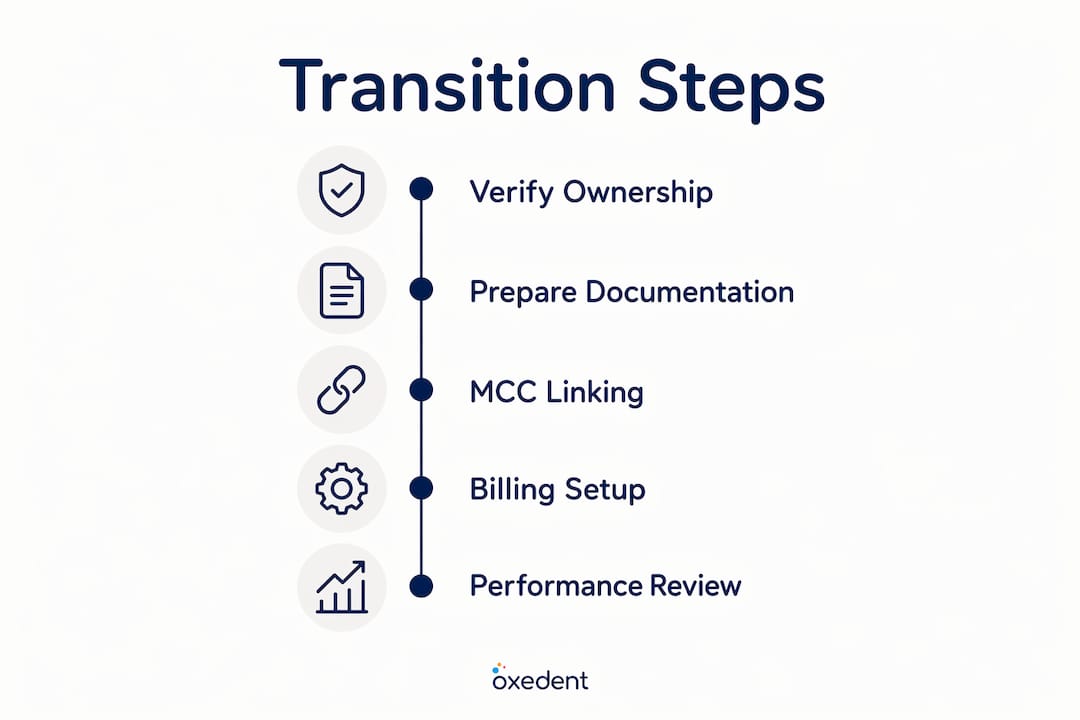
The handover process follows a clear sequence. Skipping steps or rushing the order creates gaps in campaign coverage and risks performance drops. Professional Google Ads agency transitions typically complete within 2–4 weeks, covering ownership verification through to full onboarding.
- Confirm admin access. Verify your standalone access to the Google Ads account before contacting either agency.
- Document everything. Export campaign settings, budgets, audience lists, and the last 90 days of performance data.
- Review your contract. Identify your notice period and any financial penalties for early termination.
- Select your new agency. Use your benchmarks to brief candidates properly. Oxedent’s guide on choosing a Google Ads agency for retailers covers what to look for in an ecommerce-specific partner.
- Invite the new agency via MCC linking. Your new agency connects to your existing account through Google’s Manager Account system. You do not create a new account. This preserves all historical data.
- Migrate billing to direct payment. Move billing to your own payment method so you retain full financial control regardless of agency changes.
- Notify your current agency. Only do this after steps 1–6 are complete. Premature notification can provoke account sabotage or sudden unresponsiveness from the outgoing agency.
- Run overlapping management for 1–2 weeks. Keep the current agency active on a reduced budget while the new agency gets up to speed. This protects campaign continuity.
| Approach | Ideal handover | Poor handover |
|---|---|---|
| Account ownership | Client owns account | Agency owns account |
| Notification timing | After securing access | Before securing access |
| Campaign continuity | Overlapping management | Campaigns paused entirely |
| Billing control | Client-direct payment | Agency controls billing |
| Timeline | 2–4 weeks phased | Rushed in under a week |
Pro Tip: Ask your new agency to confirm they will link via MCC rather than request account transfer. MCC linking keeps you in control and avoids any risk of ownership disputes.

What common mistakes should you avoid when switching Google Ads agencies?
Most transition problems are avoidable. They stem from poor sequencing, not technical complexity. Knowing the pitfalls in advance saves you money and campaign performance.
- Pausing or deleting active campaigns. Google’s machine learning resets when campaigns go dark. Never pause campaigns entirely during a transition. Overlapping management with reduced budgets preserves account learnings and prevents performance drops.
- Letting the agency own the account. This is the most costly mistake in PPC management. If the agency holds ownership, you lose all historical data when you leave. Always retain admin rights.
- Notifying your current agency too early. Some agencies respond to notice by making sudden changes, removing assets, or becoming unresponsive. Secure your access and documentation first.
- Ignoring contract termination clauses. Month-to-month contracts and flat fees reduce switching risks significantly. Percentage-of-spend fee structures create cost unpredictability during transitions.
- Rushing the timeline. A transition completed in under a week almost always causes a performance dip. Allow the full 2–4 week window for a proper handover.
Pro Tip: Before signing with any new agency, ask directly: “Will the account be registered to my business email?” If they hesitate or suggest otherwise, walk away.
How do you evaluate new agency performance after migrating Google Ads?
The 90-day evaluation framework is the industry standard for assessing a new Google Ads agency. A 90-day period breaks into three distinct phases: data collection in days 0–30, active optimisation in days 30–60, and directional trend assessment in days 60–90. Judging performance at 30 days is premature. The data is simply not mature enough.
- Days 0–30: Data collection and audit. The new agency reviews your account structure, identifies wasted spend, checks for missing negative keywords, and audits conversion tracking. A thorough 14-day audit at this stage prevents costly errors later.
- Days 30–60: Active optimisation. Bid adjustments, audience refinements, feed improvements for Google Shopping, and ad copy testing all happen here. Expect incremental changes rather than dramatic shifts.
- Days 60–90: Trend assessment. By this point, you have enough data to see whether ROAS is recovering, CPL is improving, and revenue is trending in the right direction.
Short-term ROAS declines of 20–50% can occur in the first 30 days as the new agency restructures campaigns. This is normal, provided recovery begins by day 60. The key red flag is an agency that reports clicks and impressions rather than revenue and ROAS. Vanity metrics signal a misaligned agency.
| Evaluation phase | Days | Key focus |
|---|---|---|
| Data collection | 0–30 | Account audit, conversion tracking, benchmark setting |
| Optimisation | 30–60 | Bid strategy, feed quality, audience refinement |
| Trend assessment | 60–90 | ROAS recovery, CPL improvement, revenue alignment |
Set a weekly reporting cadence from day one. Ask for revenue-aligned reports, not click dashboards. The role of PPC in ecommerce growth is measured in profit, not traffic volume.
Key takeaways
Retaining account ownership and following a phased 2–4 week handover process are the two factors that determine whether your Google Ads transition succeeds or costs you months of lost performance.
| Point | Details |
|---|---|
| Confirm account ownership first | Verify your business email holds admin rights before contacting any agency. |
| Document performance benchmarks | Record ROAS, CPL, and campaign structure before the handover begins. |
| Notify current agency last | Secure access and documentation before telling your current agency you are leaving. |
| Use overlapping management | Keep both agencies active briefly to protect campaign continuity and machine learning. |
| Apply the 90-day framework | Assess new agency performance across three phases before drawing conclusions. |
Why account ownership is the decision that changes everything
The most common mistake I see ecommerce owners make is not the transition itself. It is the years they spent before the transition, never checking whether they actually owned their Google Ads account. By the time they decide to switch agencies, they discover the account sits under the agency’s email. All the campaign history, audience data, and conversion signals belong to someone else. Starting over is not just inconvenient. It is genuinely expensive, both in rebuild costs and in the months of machine learning you lose.
The second thing I would stress is contract structure. Percentage-of-spend fee models create a quiet conflict of interest. An agency earning 15–20% of your ad spend has a financial incentive to increase your budget, not your profitability. Flat-fee arrangements align the agency’s income with your results rather than your spend. When you are evaluating a new partner, ask how they charge before you ask what they charge.
Finally, resist the urge to judge a new agency in the first month. The 90-day framework exists for good reason. Campaign restructuring temporarily disrupts machine learning signals. A ROAS dip in week three does not mean the agency is failing. It means the account is adjusting. What you should watch for is transparency: are they showing you revenue data, or are they hiding behind impressions and click-through rates? An agency that reports honestly during a difficult period is worth far more than one that only calls when the numbers look good.
— Biplab
How Oxedent supports your Google Ads agency transition

Oxedent specialises exclusively in ecommerce PPC management, which means every transition framework, audit process, and optimisation plan is built around one thing: your revenue. The agency operates on a flat-fee pricing model, removing the cost unpredictability that comes with percentage-of-spend structures. Onboarding includes a full campaign audit within the first 14 days, covering wasted spend, feed quality, and conversion tracking accuracy. There are no long-term contracts, so you retain full control from day one. If you are ready to make the switch with confidence, explore Oxedent’s ecommerce PPC management services and see how a structured transition can protect and grow your ad performance.
FAQ
Does switching Google Ads agencies mean starting a new account?
No. You keep your existing Google Ads account and all its history. The new agency connects via MCC linking, which preserves campaign data as long as the account is registered to your business email.
How long does a Google Ads agency transition take?
A properly managed transition takes 2–4 weeks. This covers ownership verification, documentation, MCC linking, billing migration, and the overlapping management period.
What KPIs should I track after changing Google Ads agency?
Track ROAS, CPL, and revenue directly attributed to paid campaigns. Avoid judging performance on clicks or impressions alone, as these are vanity metrics that do not reflect business results.
Can my current agency delete my campaigns when I leave?
If you hold admin ownership of the account, they cannot delete campaigns without your authorisation. This is why securing admin access before notifying your current agency is non-negotiable.
How do I choose the right new Google Ads agency for ecommerce?
Look for an agency that specialises in ecommerce PPC, reports on revenue rather than vanity metrics, and offers a flat-fee or transparent pricing model. Oxedent’s guide on how to choose the right Google Ads agency covers the full evaluation process.