


Smart Bidding wins once your campaign clears roughly 30 conversions a month and your tracking is clean. Below that line, manual bidding gives you more control while the algorithm has too little data to learn from. Either way, budget a short migration and a tracking audit before you switch, because the transition itself carries risk you can manage but not skip.
TL;DR:
- Manual bidding is preferable for accounts with fewer than 30 conversions per month, as Smart Bidding cannot learn effectively below this threshold.
- Transitioning to Smart Bidding requires a thorough conversion tracking audit, conservative target setting, and patience during the learning phase to minimize volatility.
- Setting unrealistic CPA or ROAS targets can cause campaigns to underperform or trigger frequent resets in the learning process, especially in low-volume or seasonal accounts.
- Manual bidding offers precise control but demands ongoing effort, while Smart Bidding trades control for scale but relies heavily on clean, accurate data.
- For smooth adoption, pool data across campaigns when possible and ensure account structure and conversion data are tidy before switching.
Table of Contents
- What is manual bidding and when it still wins?
- What is smart bidding and how does auction-time bidding work?
- Manual vs smart bidding: what are the real trade-offs?
- When should you choose manual or smart bidding?
- How do you switch to smart bidding safely?
- What common mistakes break smart bidding campaigns?
- Oxedent’s take: treat this as a data-readiness decision
- Where to check the details yourself
- Sources
What is manual bidding and when it still wins?
Manual CPC bidding means you set a fixed maximum cost-per-click for a keyword, ad group, or campaign, then adjust that ceiling yourself based on performance data. There’s no algorithm recalculating in real time. You raise bids on strong performers, cut them on wasteful ones, and layer on device or location adjustments by hand.
It still earns its place in several situations:
- New accounts with no conversion history to learn from
- Under 30 conversions a month, where Smart Bidding simply lacks fuel
- Brand campaigns where you want tight control over cost-per-click regardless of auction dynamics
- Strict per-click budget caps set by finance or client contracts
- Long sales cycles where conversion data lags too far behind spend to guide an algorithm sensibly
The trade-off is transparency. You always know exactly why a bid moved, because you moved it. That clarity comes at the cost of your time.
What is smart bidding and how does auction-time bidding work?
Smart Bidding sets a unique bid for every single auction, using contextual signals unavailable to a human adjusting bids by hand. This is auction-time bidding: the system evaluates device, location, time of day, audience, browser, and dozens of other signals in the milliseconds before an ad shows, then prices that specific impression accordingly.
The main strategies you’ll choose between are:
- Maximise Conversions – spends your budget to get as many conversions as possible
- Target CPA – holds average cost-per-conversion near a target you set
- Target ROAS – optimises for a target return on ad spend, useful when order values vary
- Maximise Conversion Value – spends to generate the highest total value, uncapped by a specific target
Smart Bidding can also pool query-level data across your account, which lets it bid sensibly on low-volume keywords by borrowing signal from similar search terms elsewhere. That’s a structural advantage manual bidding has no way to replicate; a human simply cannot process thousands of auction-level signals in real time.
Manual vs smart bidding: what are the real trade-offs?
The decision comes down to what you’re willing to trade for what. Manual bidding hands you granular control at every level, but that control has a labour cost. Someone has to check dashboards, adjust bids, and catch underperformance before it burns budget, day after day.
Smart Bidding trades that manual effort for scale, but it also gives up some transparency. When a Target ROAS campaign underperforms, you can’t point to a single bid change that caused it. You’re troubleshooting a model, not reversing a decision.
A few concrete trade-offs to weigh:
- Control vs scale: manual gives precise per-keyword authority; Smart Bidding trades that for account-wide optimisation across thousands of auctions daily
- Transparency: manual bid changes are traceable; Smart Bidding decisions are inferred from signals you can’t fully audit
- Volatility: Smart Bidding goes through a learning period after launch or a target change, during which cost-per-conversion can swing before settling
- Sensitivity to bad data: dirty conversion tracking wrecks Smart Bidding fast, while manual bidding is more forgiving of imperfect tracking because a human is filtering decisions
- Resource cost: manual optimisation demands consistent hands-on time; Smart Bidding demands upfront setup rigour, then far less ongoing intervention
Neither approach is free. You’re either paying in hours or paying in a temporary drop in predictability.
When should you choose manual or smart bidding?
Treat these as working rules, not laws carved in stone.
- Below 30 conversions a month, stay on manual CPC. Smart Bidding strategies like Target CPA need that volume as a baseline before they can learn reliably, and testing below it usually wastes budget rather than teaching the algorithm anything useful.
- For Target ROAS specifically, aim closer to 50 conversions a month before switching. Value-based strategies need more data than CPA-based ones, because the model has to learn both conversion likelihood and conversion value.
- Run a readiness checklist first: clean, deduplicated conversion tracking; a tidy account structure without overlapping ad groups; a clearly defined campaign objective; and the internal buy-in to wait through a learning phase without panicking.
- Match approach to campaign type. Brand campaigns with tight cost control often stay manual. Ecommerce campaigns with steady order volume and accurate revenue tracking are strong Target ROAS candidates. Lead generation campaigns sit in between, and usually need Target CPA once monthly conversions climb past the threshold.
Enhanced CPC used to be the safe middle ground between these two extremes, but Google has retired it for Search and Display campaigns, so the practical choice today really is manual CPC or a full Smart Bidding strategy. There’s no soft landing between them anymore.
Pro Tip: If your account sits just under the 30-conversion line, check whether a portfolio bid strategy across similar campaigns can pool enough data to hit the threshold faster than waiting it out campaign by campaign.
How do you switch to smart bidding safely?
Rushing the switch is where most accounts come unstuck. Follow this order and you reduce the risk considerably.
- Audit conversion tracking first. Deduplicate conversion actions, check that values reflect real revenue rather than flat placeholder numbers, and remove any test or junk conversions polluting the data.
- Set a conservative starting target. For Target CPA, a common approach is setting it at 110% to 130% of your current cost-per-conversion, giving the algorithm room to find efficiency without starving spend immediately.
- Hold your nerve through the learning period. Expect two to four weeks of volatility before performance stabilises. Resist the urge to adjust targets every few days; frequent changes reset the learning clock each time.
- Evaluate only after the model settles, then reduce targets gradually, in 5 to 10% steps every couple of weeks, rather than making one large cut.
- Know your rollback criteria before you start. If cost-per-conversion is still climbing well beyond your ceiling after the learning window closes, revert to manual CPC. Historical performance data stays intact in the account either way, so reverting doesn’t cost you your reporting history.
What common mistakes break smart bidding campaigns?
Most Smart Bidding failures trace back to one root cause: the algorithm is only as good as what it’s told to optimise for. Feed it noisy or mixed-value conversions, and it chases the wrong outcomes, spending on cheap, low-value actions because that’s what looks like success in the data.
Unrealistic targets cause a different failure. Set a Target CPA far below what your account has historically achieved, and the system starves impressions trying to hit an unreachable number rather than learning normally. Frequent target changes compound this, because each adjustment restarts the learning phase.
Seasonal or low-volume accounts face a data scarcity problem. Portfolio bid strategies that pool conversions across similar campaigns, or aggregating smaller campaigns into fewer, larger ones, both help the model see enough signal to work with.


Pro Tip: Prioritise conversion-value accuracy over target aggression. A Smart Bidding strategy fed honest revenue data will consistently outperform one chasing an artificially low CPA on messy tracking.
Oxedent’s take: treat this as a data-readiness decision
Working across managed ecommerce accounts, Oxedent applies a consistent filter before recommending Smart Bidding: is the conversion data clean, is the account structure tidy enough for the algorithm to read signal clearly, and is the client’s goal genuinely tied to ROAS rather than raw click volume? When those three line up, the switch tends to go smoothly, with a bounded learning window and conservative target steps rather than a jarring performance dip.
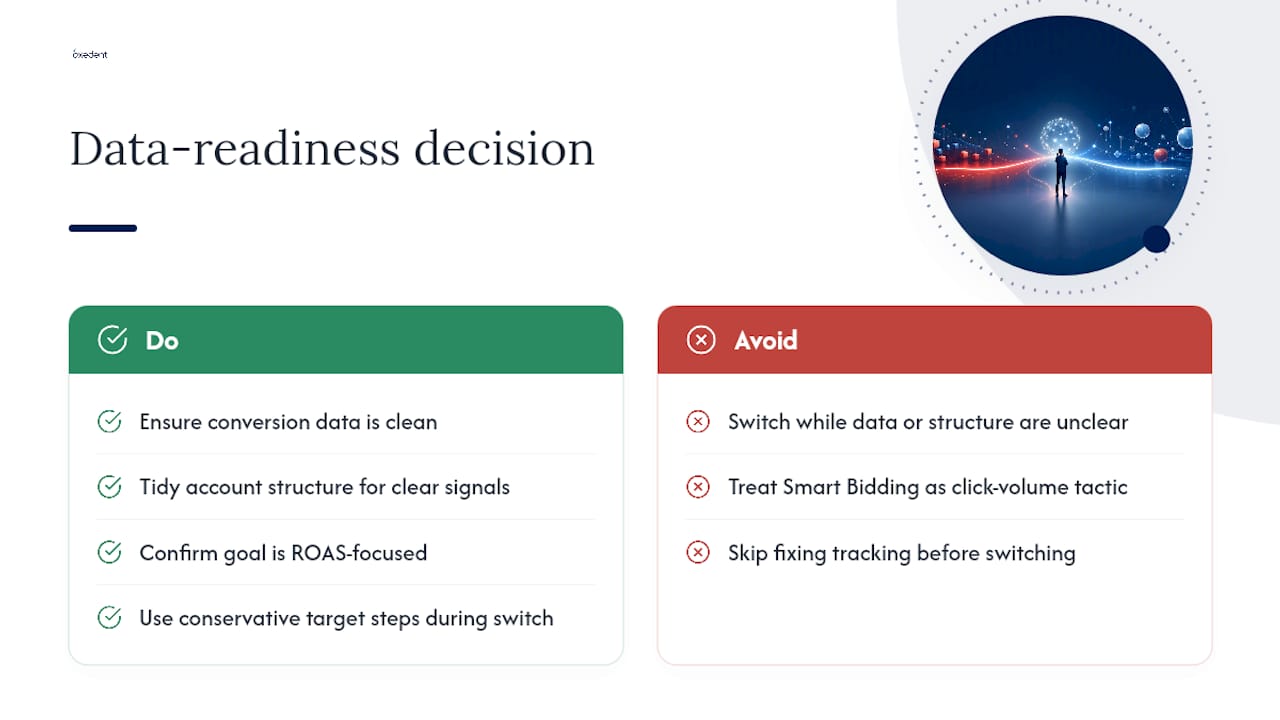

When they don’t, the agency stays on manual CPC or fixes tracking first. Readers weighing the same decision on their own accounts can review Oxedent’s Smart Bidding breakdown or its ecommerce bidding strategy guide for a closer look at account structure prerequisites.
For brands with genuine ad spend ready to scale, eCommerce PPC management from Oxedent handles the audit, migration, and ongoing target management without locking you into a long-term contract.
— Biplab
Where to check the details yourself
Google’s own documentation is the definitive word on automated bidding and Smart Bidding thresholds. Beginners setting up their first account may also find this AdWords primer useful for foundational setup steps.
For a broader view of how bidding fits into wider ecommerce paid media strategy, Oxedent’s PPC management guide covers the account structure and budgeting questions that sit around this decision.