


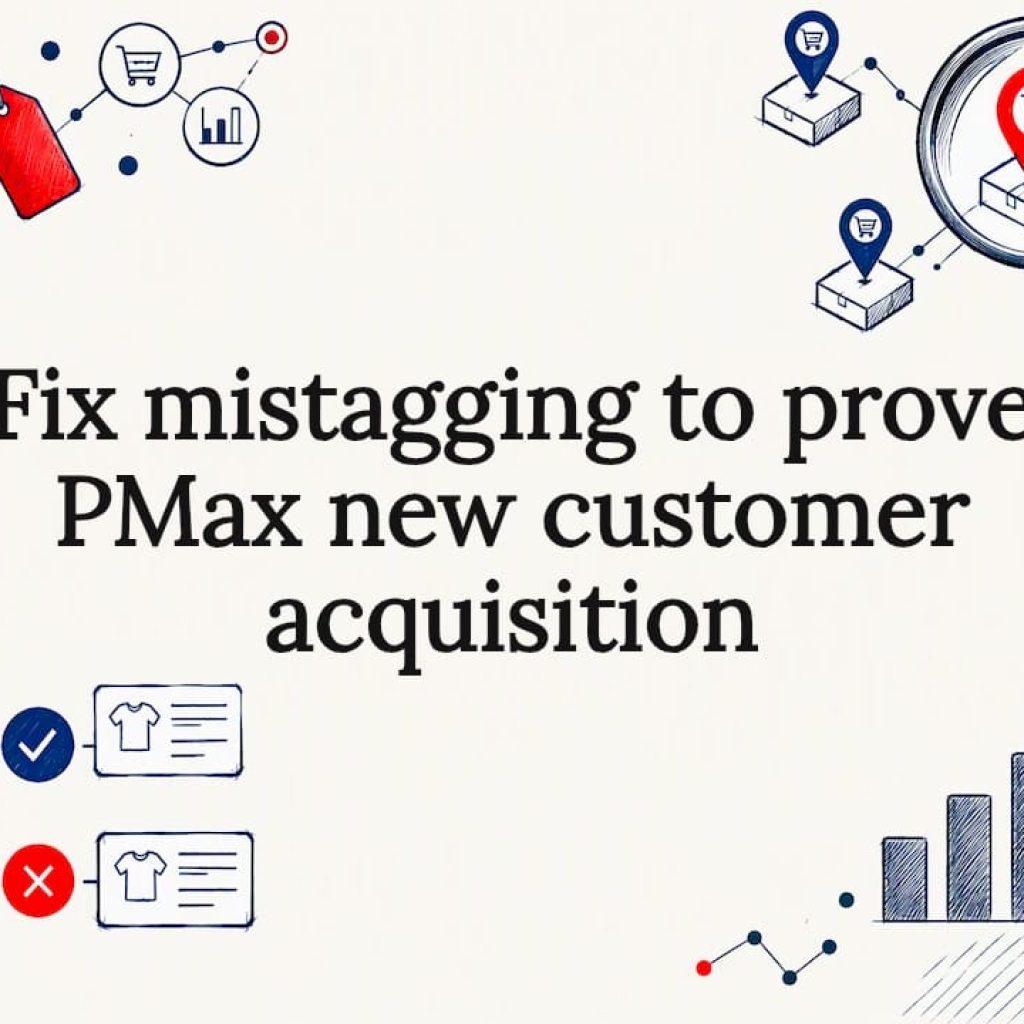
Performance Max’s new customer acquisition (NCA) goal tells Google’s bidding algorithm to chase first-time buyers, either by prioritising them or bidding for them exclusively. For most ecommerce advertisers, New Customer Value mode is the right starting point because it grows your new-buyer base without abandoning revenue from existing customers. Before you touch bidding settings, check that your conversion tag carries accurate new-customer data, because everything downstream depends on it.
TL;DR:
- Properly sized and regularly refreshed Customer Match lists above 1,000 members improve the reliability of new customer targeting and activation.
- Using accurate
new_customerandcustomer_typetag parameters in GA4 or Tag Manager is essential to ensure Google correctly distinguishes first-time buyers from repeat customers.- Starting with New Customer Value mode is recommended for most campaigns, but switching to New Customer Only mode requires a dedicated budget and clean data to avoid inflated acquisition figures.
- Incrementality tests should run for at least six to eight weeks to accurately measure genuine new customer growth and avoid misinterpreting reported data.
- Effective NCA optimization depends on clean tagging, proper audience signals, and structured asset groups focused on product categories rather than broad or branded search terms.
Table of Contents
- What is the new customer acquisition goal, and which mode fits you?
- How does Google know who’s a new customer?
- How do you enable NCA in a Performance Max campaign?
- Optimisation checklist for PMax acquisition campaigns
- How do you measure new-customer growth accurately?
- Common pitfalls and quick fixes
- An agency practitioner’s priorities for auditing NCA campaigns
- When should you run NCA in PMax versus other channels?
- Get NCA set up right with Oxedent
- Sources
- FAQ
What is the new customer acquisition goal, and which mode fits you?
The NCA goal changes how Performance Max values a conversion based on whether the buyer has purchased from you before. Instead of treating every sale as equal, PMax can lift bids for first-time purchasers, cap spend if a returning customer converts, or ignore returning-customer conversions altogether. Three modes control how aggressively it does this.
- New Customer Value mode: bids higher for new customers while still counting returning-customer sales at a lower value. This is the mode Google recommends for most advertisers running a purchase conversion goal, since it grows acquisition without starving your remarketing revenue.
- New Customer Only mode: bids exclusively for new customers and ignores returning-customer conversions in optimisation. It suits a strict acquisition budget, a launch push, or a non-purchase conversion goal, but Google notes it works best on a separate campaign from your core sales activity, and it carries compatibility caveats around offline conversions and store goals.
- High-value new customer mode: available when you’re feeding PMax purchase value data, and it weights bidding toward higher-spending new customers rather than simply the largest volume of first orders.
The trade-off is straightforward: New Customer Value mode protects scale and keeps your cost per acquisition steadier, while New Customer Only mode narrows your funnel and typically pushes CPA higher in exchange for cleaner acquisition reporting. If you’re unsure, start with New Customer Value mode on your main sales campaign, then test New Customer Only mode separately once you’ve got a dedicated acquisition budget and reliable list hygiene behind it.
How does Google know who’s a new customer?
Google’s default method, autodetection, scans up to 540 days of a shopper’s purchase history to decide whether they count as new or returning. It works out of the box, but it has real blind spots: shoppers who cleared cookies, used a different device, or opted out of tracking can get mislabelled as new when they’re not, which quietly inflates your reported acquisition numbers.
Three methods close that gap:
- Customer Match lists — upload your existing customer emails or phone numbers so Google can positively identify returning buyers rather than guessing from browsing signals.
- GA4 audiences — feed purchaser segments from Google Analytics 4 into Google Ads to reinforce who’s already bought.
- Conversion tag parameters — add the
new_customerandcustomer_typevalues directly to your tracking tag, Google Tag Manager container, or platform integration so every conversion arrives pre-labelled.
For Shopify stores, the Google & YouTube app for Shopify handles the tag parameters automatically, which removes most of the manual GTM configuration. Businesses with offline sales, such as phone or in-store orders tied to online ad clicks, can also import that data via offline conversion imports so it feeds the same new-versus-returning logic.
Pro Tip: Run autodetection and tag parameters side by side for two to three weeks before switching modes. If the gap between Google’s autodetected new-customer count and your CRM’s actual first-time-buyer count is wide, fix your tagging before you scale spend on it.
How do you enable NCA in a Performance Max campaign?
Setting up NCA takes minutes, but getting the inputs right beforehand determines whether it works.
- Set your conversion goal first. NCA sits on top of a purchase or lead conversion action, so confirm that action is your primary goal before touching NCA settings.
- Open campaign settings and locate the customer acquisition section. Inside your Performance Max campaign, under Goals, select “New customer acquisition” and choose your mode, New Customer Value, New Customer Only, or High-value.
- Attach your Customer Match list. Upload existing customers as an exclusion or lifecycle input so PMax has a clean baseline of who’s already bought.
- Add audience signals for acquisition. Layer in website visitors, similar-audience segments, and any competitor or category interest signals to speed up learning.
- Confirm your tag parameters are live. Check that
new_customerandcustomer_typevalues are firing correctly using Google Tag Assistant or the GA4 DebugView before you launch. - Test with the conversions diagnostics page. Google Ads flags tagging issues here, catching problems before they cost you a learning phase.
Store goals and offline conversion setups carry specific compatibility notes, so if you’re running Local or Store Sales goals alongside NCA, check that combination works before launch rather than after. Expect a short adjustment period once you switch modes. Bidding recalibrates over roughly one to two weeks, and CPA often rises briefly as the algorithm relearns who counts as a new customer.
Optimisation checklist for PMax acquisition campaigns
Turning NCA on is the easy part. Getting it to perform takes deliberate structure, and this is where most accounts either scale profitably or bleed budget chasing volume that never converts.
- Size your Customer Match lists properly. Lists under 1,000 members can limit how reliably PMax activates new customer acquisition, so audit and refresh yours regularly rather than uploading once and forgetting it.
- Feed audience signals, not guesses. Website visitors, cart abandoners, and category-interest segments all speed up how quickly PMax learns who a genuine prospect looks like.
- Build asset groups feed-first. For ecommerce, get your product feed and Shopping-driven asset groups stable before layering in creative-heavy assets. Most well-structured acquisition campaigns run three to seven asset groups, split by product category or margin tier rather than by audience.
- Set a CPA floor, not just a ceiling. New customer acquisition typically costs more per conversion than blended PMax, so agree an acceptable CPA range with finance before you scale, and scale in modest increments (10 to 20% budget increases) rather than doubling spend overnight.
- Exclude your existing customers. Use negative audience lists and brand exclusions to stop PMax quietly serving ads to people who’d have bought anyway, which is the single biggest driver of inflated “acquisition” numbers that aren’t real acquisition at all.
- Steer search themes deliberately. Feed PMax search themes around non-branded, category-level terms to reduce the chance it leans on branded search demand to hit its targets.
Practitioner guidance from campaign structuring specialists backs this sequencing: separate acquisition from remarketing, and don’t let one campaign do both jobs at once. Combining them tends to blur your reporting and your bidding logic in the same move.
Pro Tip: If your acquisition CPA spikes in week one after enabling NCA, resist the urge to pause it. Google’s own case studies, including Dime Beauty’s results after adopting NCA features, showed the biggest gains after the algorithm had a full learning cycle, not on day one.
How do you measure new-customer growth accurately?
Google Ads reporting now includes dedicated new-customer acquisition cost columns and diagnostics designed to shrink the number of conversions labelled “Unknown”, which used to make new-versus-returning reporting frustratingly unreliable.
Add these to your reporting view:
- New customer acquisition cost — your CPA specifically for first-time buyers, tracked separately from blended CPA.
- New customer ratio — the share of total conversions coming from new versus returning buyers, which tells you whether NCA mode changes are actually shifting your customer mix.
- Unknown conversion rate — watch this closely; a high proportion signals your tagging needs fixing, not your bidding.
Reported metrics only tell you what Google claims happened, not what would have happened anyway. That’s why conversion lift and geo holdout tests remain the most defensible way to prove genuine incrementality: split comparable regions or account segments, run one with NCA active and one without, and compare actual new-customer volume rather than platform-reported numbers.
Test length matters more than most advertisers assume. Run incrementality tests for six to eight weeks minimum, long enough for PMax’s bidding to exit its learning phase and for seasonal noise to average out. Shorter tests routinely produce misleading swings in either direction.
Keep one primary conversion action feeding your bidding, and push secondary or micro-conversions (newsletter signups, add-to-carts) to secondary status. Mixing them muddies both your NCA reporting and the signal PMax bids against.
Common pitfalls and quick fixes
Most NCA underperformance traces back to a handful of repeat offenders, and they’re usually fixable within a day once you know what to look for.
- Undersized or stale Customer Match lists — refresh monthly and keep lists above the 1,000-member threshold where possible to avoid unreliable activation.
- Micro-conversions set as primary — audit your conversion actions and demote anything that isn’t a genuine sale or lead to secondary status.
- Rising blended CPA with flat new-customer ratio — a classic cannibalisation sign; tighten exclusion lists and check your search themes aren’t leaning on branded terms.
- Tag parameters missing or misfiring — verify
new_customerandcustomer_typevalues in GA4 DebugView before blaming the bidding algorithm.
An agency practitioner’s priorities for auditing NCA campaigns
At Oxedent, every NCA audit starts with the same three questions: is the data feeding PMax trustworthy, is acquisition genuinely separated from remarketing, and is the product feed clean enough to support feed-first asset groups. Feed hygiene comes before creative, every time, because Shopping performance underpins whatever PMax builds on top.
A practical audit checklist covers: audience signal quality and freshness, tag parameter verification against GA4 events, asset group count relative to catalogue size, and exclusion list completeness against your CRM. Clients qualify for deeper PMax work once they’re running meaningful ad budgets with dependable purchase tracking already in place, since NCA optimisation without clean data just accelerates wasted spend.


When should you run NCA in PMax versus other channels?
NCA in Performance Max works best when your purchase tracking is solid and you’re ready to scale new-buyer volume, not when you’re still fixing tagging basics. Search and Demand Gen campaigns play complementary roles, capturing intent PMax can’t reach through its automated inventory. Bringing in an agency partner makes sense once budget, catalogue size, or internal bandwidth make manual list hygiene and testing hard to sustain properly.
— Biplab
Get NCA set up right with Oxedent
Getting PMax’s new customer acquisition goal to actually deliver profitable growth, rather than just a shifted reporting label, depends on the groundwork most advertisers skip: clean tagging, properly sized Customer Match lists, and asset groups built around a healthy feed. Oxedent is built exclusively around eCommerce PPC, which means auditing that groundwork and fixing it is the entire job, not a side task squeezed between other channels.

If you’re unsure whether your account is ready to scale acquisition spend, Oxedent’s free Google and Facebook Ads audit reviews your tagging, list hygiene, and campaign structure before you commit further budget. For ongoing management, PPC Management starts from £350 per month with no long-term contract, covering Performance Max, Google Shopping, and the acquisition setup work covered in this guide. Request your audit or get in touch through the pricing page to see where your account currently stands.
Sources
This guide draws on Google’s own Performance Max and customer lifecycle documentation, its tagging setup guide, and practitioner insight from Oxedent’s PMax audience signals checklist.
- Multiply conversions with Performance Max – Google Ads Help
- About customer lifecycle goals – Google Ads Help
- New features to grow your business with Performance Max
FAQ
What does PMax mean in marketing?
PMax is shorthand for Performance Max, a Google Ads campaign type that automatically places ads across Search, Shopping, Display, YouTube, and Gmail from a single campaign. It’s built to find conversions across all of Google’s inventory using automated bidding rather than manual channel selection.
What does “new customer acquisition” mean in Google Ads?
New customer acquisition (NCA) is a Performance Max goal that identifies whether a conversion came from a first-time buyer or a returning one, then adjusts bidding accordingly. It uses autodetection alongside first-party data sources like Customer Match to make that distinction.
Which PMax goal mode should you use to get new customers?
New Customer Value mode is the mode Google recommends for most advertisers with a purchase conversion goal, since it prioritises new buyers while still crediting returning-customer sales. New Customer Only mode suits a stricter acquisition budget, but works best run on a separate campaign.
Are Performance Max campaigns worth running for new customer growth?
They can be, provided your conversion tracking and Customer Match lists are accurate before you switch on NCA. Google’s own case studies, including results reported from Dime Beauty and Luxury Escapes, show measurable new-customer gains, though results depend heavily on tagging quality and list hygiene going in.
How much does managed PMax acquisition support cost?
Oxedent’s PPC Management service starts from £350 per month, covering Performance Max, Google Shopping, and new customer acquisition setup with no long-term contract required. A free Google and Facebook Ads audit is also available before committing to ongoing management.