


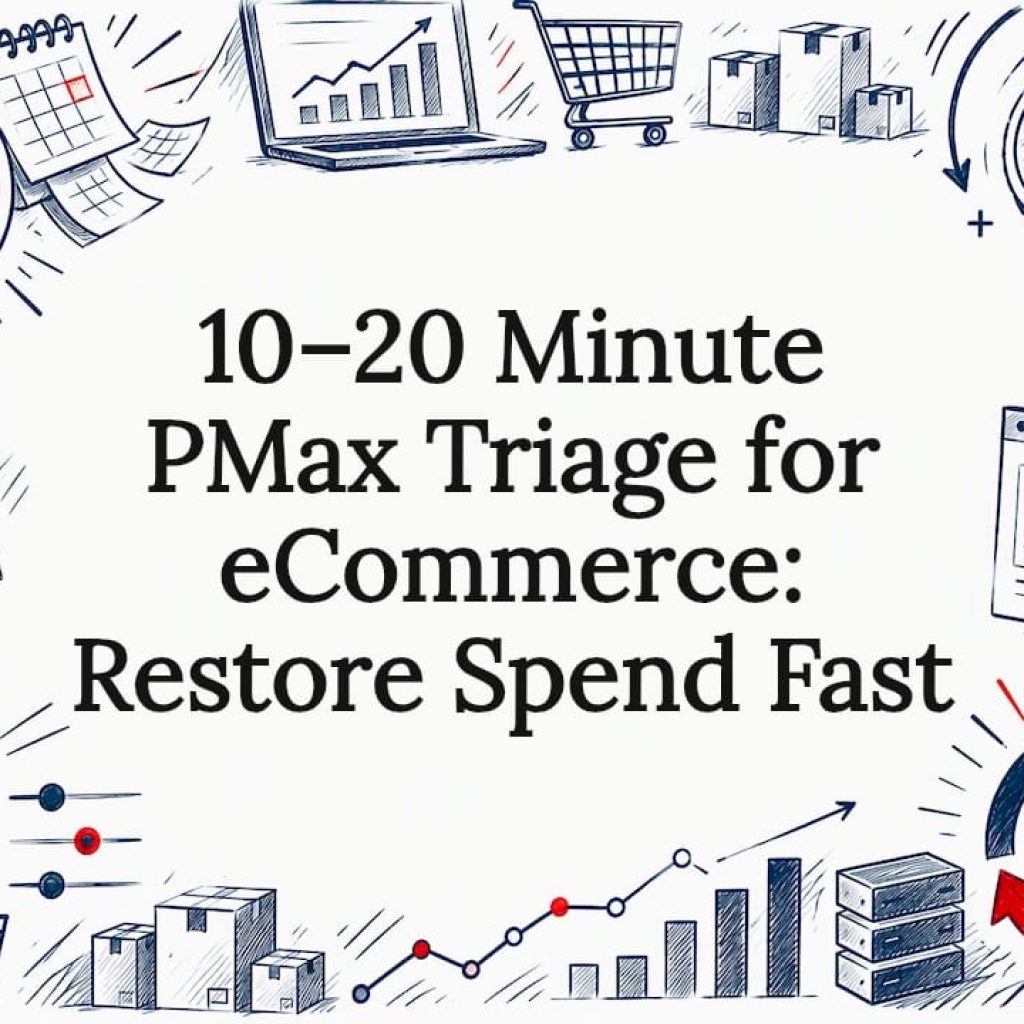
If your Performance Max campaign is not spending, the cause is usually one of a handful of things: weak conversion signals, an incomplete learning phase, gaps in your asset groups or feed, or a billing and policy hold. Start by checking campaign status and confirming your conversion tracking is firing correctly. That single check rules out the most common blocker in minutes.
TL;DR:
- Weak conversion signals, policy issues, or incomplete assets are the most common reasons for a Performance Max campaign not spending.
- Verifying campaign status, billing, and recent conversions typically resolves the majority of underspend issues within minutes.
- Ensuring asset groups have diverse, high-quality creatives and attached audience signals can significantly improve ad delivery.
- Small, incremental budget increases and avoiding structural changes help maintain the campaign’s learning phase and spending consistency.
- Addressing tracking, feed hygiene, and creative gaps usually restores spend more effectively than bid adjustments alone.
Table of Contents
- Quick diagnostic checklist (10 to 20 minute triage)
- Technical checks: conversion tracking, events and attribution
- Assets, asset groups and Ad Strength: fixing creative gaps that block serving
- Budget and bidding behaviour: why PMax might still not spend
- Channel performance report: diagnose which inventory is being suppressed
- Timing and the learning phase: what to wait for and what restarts learning
- Step-by-step remediation plan: ordered playbook to restore spend
- Our practical stance on diagnosing and fixing PMax underspend
- How we can help with a Performance Max audit and remediation
- FAQ
- Sources
Quick diagnostic checklist (10 to 20 minute triage)
Before you touch bids or budgets, run through this list. Most underspend cases resolve once you spot the actual blocker rather than guessing at fixes.
- Confirm the campaign status, start and end dates, and that your asset groups are active rather than paused or limited.
- Check billing details and payment methods, and scan the account for policy holds or disapprovals.
- Compare your daily budget against typical traffic for your category, and check whether a shared budget is capping delivery.
- Open your conversion actions in Google Ads and confirm recent conversions are recording with correct attribution.
- Inspect your Merchant Centre feed status and the “Ads using product data” metric if you are running retail campaigns.
- Review each asset group for missing images, videos or text assets, and check for a low Ad Strength rating.
- Make sure audience signals, including remarketing lists and Customer Match, are attached to help speed up learning.
Pro Tip: Work through this list in order. Billing and status issues take seconds to rule out, so clear those first before investigating anything more technical.
Technical checks: conversion tracking, events and attribution
Performance Max relies entirely on Smart Bidding, and Smart Bidding needs a steady flow of reliable conversion data to know who to target. When conversions are missing, miscounted or delayed, the algorithm has nothing solid to optimise towards, and it often pulls back spend rather than risk wasting budget on the wrong audience.
- Check your conversion actions in Google Ads over the last 30 days and confirm each one shows “Recording conversions” rather than “No recent conversions” or “Needs attention”.
- Validate your tags in Google Tag Manager or via gtag, watching for duplicate firing, missing parameters or consent-mode blocks that silently suppress data.
- If you run server-side tagging, confirm events are still passing through with the correct conversion value and currency.
- As a short-term workaround, add a broader signal such as add-to-cart alongside purchase, giving the algorithm more training data while you resolve the main tracking issue.
Assets, asset groups and Ad Strength: fixing creative gaps that block serving
Performance Max pulls from whatever assets you give it, so a thin asset group genuinely limits how much of your budget Google can spend. Aim for a strong spread of headlines, descriptions, images and at least one video per asset group, and target an Ad Strength of “Excellent” wherever possible.
- Check the Ad Strength indicator on each asset group and treat anything below “Good” as a priority fix.
- If you have not uploaded your own video, Google will often generate one automatically, which can skew spend heavily towards YouTube inventory you did not intend to prioritise.
- Review the asset-level performance report and replace anything marked “low” with fresh creative.
- Split asset groups by product line, landing page or audience when a single group is trying to serve too many different messages at once.
Pro Tip: Uploading your own video, even a simple 15-second product clip, gives you far more control over how YouTube inventory is used within your budget.
Budget and bidding behaviour: why PMax might still not spend
On any given day, Google may spend up to twice your daily average, though your billed costs will not exceed your monthly limit over the billing cycle, as Google’s own guidance explains.
- A budget that is too low relative to your average order value or typical cost per conversion will constrain serving, since the algorithm has little room to find efficient auctions.
- As a general guide, Google recommends setting your initial budget high enough to cover several conversions a week during the learning phase.
- Your bidding goal, whether maximise conversions, target CPA or target ROAS, interacts directly with how much conversion volume you have: a tight target with thin data will suppress spend further.
- Make budget changes incrementally rather than in large jumps, since sudden increases can trigger a fresh learning period.
Channel performance report: diagnose which inventory is being suppressed
The channel performance report shows exactly where your budget is and is not landing, and the status column flags why.
- Open the channel performance report from your campaign and check the status column for each channel, which will flag issues such as limited eligibility or feed problems.
- Look for low Shopping impressions, which often point to feed overlap with a separate standard Shopping campaign competing for the same products.
- Check for disproportionately high YouTube spend, which can result from engaged-view conversions being counted generously in your attribution.
- If Search investment looks thin, review your Search-eligible assets and landing page relevance, since Performance Max weighs marginal return across channels when deciding where to push budget.
Pausing an overlapping Shopping campaign is often the single fastest fix here, since it allows Performance Max to capture that inventory without competing against itself.
Timing and the learning phase: what to wait for and what restarts learning
New Performance Max campaigns typically need four to six weeks to ramp up properly, and after a significant change you should expect one to two weeks, or roughly one full conversion cycle, before judging the results. Attaching audience signals such as remarketing lists or Customer Match from day one can shorten this window considerably.


Large bid adjustments, substantial budget increases and structural edits to asset groups all reset the learning phase, so resist the urge to rebuild a group every few days just because early spend looks slow.
Step-by-step remediation plan: ordered playbook to restore spend
Work through these stages in order rather than jumping straight to budget increases.
- Immediate triage (10 minutes): confirm campaign status is active, billing is clear, recent conversions are recording, and no asset groups are paused.
- 48 to 72 hour fixes: add any missing assets, including at least one native video, resolve Merchant Centre feed errors, attach remarketing lists, and pause overlapping Shopping listings.
- 7 to 21 day actions: scale budgets gradually in small increments, test adjusted bidding targets, and monitor the channel performance report and asset report weekly for improvement.
- Escalation point: if conversion gaps persist beyond three weeks, or feed and tagging issues prove too complex to resolve internally, that is the point to bring in technical help or commission an audit.
Pro Tip: Fix assets and conversion signals before touching bid strategy. In our experience, creative and tracking gaps hold back far more spend than bidding ever does.
Our practical stance on diagnosing and fixing PMax underspend
We consistently find that conversion tracking, feed hygiene and asset strength are the real levers behind underspend, not bid strategy tweaks. A quick remediation suits accounts with one obvious gap, such as a missing video or a disapproved feed item. Persistent, layered issues across tracking, feed and structure usually call for a full audit rather than piecemeal fixes.
— Biplab
How we can help with a Performance Max audit and remediation
If you have worked through the checks above and spend is still stuck, we offer a structured path to fix it. Our Performance Max audits and PPC management focus specifically on the conversion signals, feed health and asset strength issues that cause underspend, rather than generic account tinkering.

- A diagnostic report pinpointing exactly which signals, assets or feed issues are holding your campaign back.
- A remediation plan with a clear order of operations, so you fix the highest-impact issues first.
- Monitored ramp support through the learning phase, with regular performance checks as spend recovers.
For retailers also reviewing in-store or point-of-sale data alongside online campaigns, retail analytics metrics are worth a look when connecting offline and online performance. We offer PPC management starting from £350 per month, with no long-term contract, or you can start with a free Google and Facebook Ads audit to see exactly what is holding your account back.
FAQ
Why is my ad active but not spending?
An active status does not guarantee spend. The usual causes are a budget too low for your category, weak or missing conversion data, incomplete asset groups, or a feed and policy issue flagged in the channel performance report.
Are Performance Max campaigns worth it?
For most eCommerce brands with solid conversion tracking and a reasonable budget, Performance Max can be a strong addition to a wider paid media mix. Whether it suits your specific store depends on your margins, feed quality and goals, which we cover in more detail in our piece on whether Performance Max is worth it.
What assets do you need for Performance Max?
You need a spread of headlines, long and short descriptions, images in multiple aspect ratios, and at least one video to reach a strong Ad Strength rating. Skipping video is one of the most common reasons advertisers end up with unpredictable, auto-generated creative instead.
Why is my boosted social ad not spending money?
Boosted posts on platforms like Instagram face similar blockers to Performance Max: thin audience targeting, payment issues, or a budget too small to clear the auction for your category. Checking payment status and audience size first will rule out most cases quickly.