


If you’re spending money on paid ads and wondering why results feel inconsistent, the answer is often hiding in plain sight. Understanding what is a PPC campaign structure, formally called a paid search account hierarchy, is one of the most consequential things you can do before touching a bid or writing a single ad. This is not about tidying up a spreadsheet. It is about building a control system that governs where every pound goes, which audiences see which ads, and how much signal your bidding algorithms actually have to work with. Get it right, and everything from budget pacing to Quality Score improves. Get it wrong, and you are essentially pouring water into a cracked bucket.
Table of Contents
- Key takeaways
- What is a PPC campaign structure and its core components
- Best practices for your PPC campaign framework
- Common pitfalls in PPC campaign structuring
- Applying PPC structure to ecommerce scenarios
- My honest take on PPC structure after years of ecommerce campaigns
- How Oxedent can help you build the right PPC structure
- FAQ
Key takeaways
| Point | Details |
|---|---|
| Structure is a control system | Campaign hierarchy governs budget, targeting, and optimisation, not just organisation. |
| Platform hierarchies differ | Google Ads has four levels; Meta has three; Amazon uses layered campaign types with distinct purposes. |
| Ad groups need tight themes | Keep 5 to 15 closely related keywords per ad group to protect ad relevance and Quality Score. |
| Split campaigns with purpose | Only create separate campaigns when budget, geo, bid strategy, or landing page story genuinely differs. |
| Fragmentation costs you money | Over-splitting dilutes data signals, slows algorithmic learning, and wastes ad spend unnecessarily. |
What is a PPC campaign structure and its core components
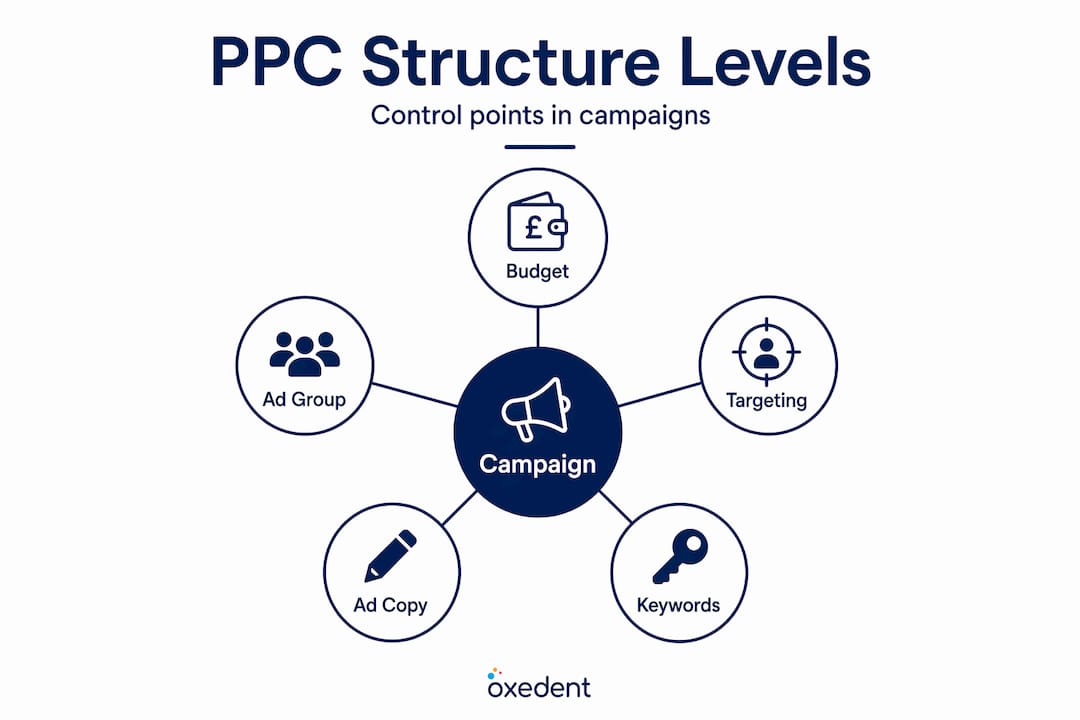
The PPC campaign framework is not a single thing. It is a layered hierarchy, and each layer controls something different. Understanding those layers is the foundation of every good PPC campaign setup.
Google Ads: four levels of control
Google Ads follows a four-level hierarchy: Account, Campaign, Ad Group (or Asset Group in Performance Max), and Keywords or Ads. At the campaign level, you set budget, network, bid strategy, geographic targeting, and ad scheduling. Ad groups sit inside campaigns and hold related keywords and ads grouped by theme, with one dedicated landing page per ad group. This matters because ad relevance flows from keyword to ad copy to landing page. Break that chain anywhere, and your Quality Score drops.


Meta Ads: three tiers, one critical decision
Meta Ads uses a three-tier structure: Campaign, Ad Set, and Ad. The Campaign level sets your objective and budget mode. The Ad Set controls audience targeting, bidding, placements, and scheduling. The Ad is your creative. Settings cascade downward, which means your campaign objective shapes everything that follows. Critically, the campaign objective cannot be changed after creation. Picking the wrong one requires building an entirely new campaign, not just editing a setting.

Amazon PPC: layered by purpose
Amazon PPC takes a different approach. Sellers typically run layered campaign structures with distinct campaign types: automatic campaigns for discovery, manual broad or phrase for research, manual exact for conversion control, and product targeting campaigns for competitive and category coverage. Negative keywords tie the whole system together, preventing the same search from triggering multiple campaigns and cannibalising budget.
Here is a quick comparison across the three platforms:
| Platform | Structure levels | Budget set at | Key distinction |
|---|---|---|---|
| Google Ads | Account, Campaign, Ad Group, Ad | Campaign | Quality Score tied to keyword and ad relevance |
| Meta Ads | Campaign, Ad Set, Ad | Campaign or Ad Set | Objective is immutable post-creation |
| Amazon PPC | Campaign types (auto, manual, exact) | Campaign | Layered purposes with negative keyword hygiene |
Best practices for your PPC campaign framework
A well-designed campaign framework is not about having the most campaigns. It is about having the right ones, organised with intention.
- Keep ad groups tightly themed. Aim for 5 to 15 keywords per ad group, all sharing a single clear intent. One ad group should represent one topic, one product type, or one stage of buying intent. Cramming 40 loosely related keywords into a single ad group is one of the most common reasons Quality Scores suffer.
- Split campaigns only when you have a genuine reason. Campaign-level splitting is warranted when you need different budget caps, bid strategies, geographic settings, compliance rules, primary conversion goals, or distinct landing page messaging. Otherwise, use ad groups and labels to segment.
- Separate brand from non-brand campaigns. Brand and non-brand campaigns need separate budgets and performance targets. Brand searches convert at a much higher rate and cost far less per click. Mixing them with non-brand terms makes it almost impossible to read performance accurately or allocate budget rationally.
- Use naming conventions from day one. A naming convention like "Market][Campaign Type][Product Category]_[Match Type]` takes five minutes to set up and saves hours of confusion later. [Standardised naming and conversion tracking makes debugging, reporting, and scaling significantly easier.
- Set one primary conversion goal per campaign. Campaigns optimising towards multiple conversion types simultaneously receive conflicting signals. Pick one goal, usually purchase or add-to-cart for ecommerce, and assign it clearly.
Pro Tip: When you are unsure whether to create a new campaign or a new ad group, ask yourself one question: does this require a different budget or a different bid strategy? If the answer is no, it belongs in an ad group, not a new campaign.
Common pitfalls in PPC campaign structuring
Knowing the elements of PPC structure is one thing. Avoiding the traps that undermine that structure is another matter entirely.
The most damaging mistake on Meta Ads is choosing the wrong campaign objective and not realising until spend has been wasted. Mixing conflicting objectives in one Meta campaign produces inconsistent signals and poor results. There is no edit button for this. You build a new campaign or you live with the consequences.
Ad set fragmentation on Meta is similarly costly. Running eight highly specific ad sets in one campaign, each targeting a narrow audience slice, means each ad set receives too few optimisation events to exit the learning phase. The algorithm never gets enough data to perform. Two to four broad ad sets per campaign with Campaign Budget Optimisation tends to outperform over-segmented structures consistently.
On Google Ads, the equivalent mistake is loading an ad group with loosely connected keywords. Consider an ecommerce brand selling running shoes. Putting “mens trail running shoes”, “cheap running trainers”, and “best marathon footwear” into the same ad group produces generic ads that satisfy none of those searches particularly well. Tightly themed ad groups support better ad copy and landing page relevance, which directly lifts Quality Score.
The real cost of a fragmented PPC structure is not just wasted clicks. It is that you lose the ability to read what is actually happening. When your data is noisy, every decision you make is less reliable.
For Amazon sellers, the equivalent danger is budget cannibalisation. Without disciplined negative keyword hygiene across layered campaigns, the same shopper search can trigger your automatic discovery campaign, your manual phrase campaign, and your exact match campaign simultaneously. You end up competing against yourself, inflating your own costs.
Automated bidding algorithms also suffer when campaigns are fragmented without reason. Consolidated match types enable more efficient automated bidding because the algorithm has more conversion data to learn from. Over-segmenting the account fragments that data and undermines performance.
Applying PPC structure to ecommerce scenarios
Understanding PPC organisation in theory is useful. Seeing it applied to real ecommerce situations is where it becomes genuinely practical.
Here is how to approach campaign structuring for a typical ecommerce store:
- Organise campaigns by product category first. A fashion retailer might have separate campaigns for Women’s Dresses, Men’s Footwear, and Accessories. Each has its own budget, its own landing page experience, and its own performance benchmarks. This is the foundation.
- Layer intent within each category using ad groups. Within Women’s Dresses, you might have ad groups for “occasion wear”, “summer dresses”, and “plus size dresses”. Each ad group gets tightly themed keywords and ad copy that speaks directly to that intent.
- Create a brand defence campaign separately. Your brand name campaign should sit apart from all other activity with its own budget floor. Do not let non-brand campaigns cannibalise it, and do not let brand performance mask non-brand weaknesses.
- Build seasonal campaigns as overlays, not replacements. For events like Black Friday or a Summer Sale, create dedicated campaigns with their own budgets and landing pages rather than editing existing campaigns. This preserves your historical data and makes performance comparison straightforward.
- Audit negative keywords on a set schedule. For Google Shopping and search campaigns, weekly or fortnightly reviews of search term reports are non-negotiable. For Amazon, negative keyword hygiene between campaign layers is what keeps your data clean. Without it, you cannot trust what you are reading.
Pro Tip: When managing PPC across Google, Meta, and Amazon simultaneously, keep a master naming document that maps each campaign to its purpose, budget, and primary conversion goal. Multi-channel PPC management without this reference document becomes genuinely difficult to audit at scale. The role of PPC in ecommerce growth only compounds when your structure is coherent across channels.
My honest take on PPC structure after years of ecommerce campaigns
I have reviewed hundreds of ecommerce PPC accounts, and the pattern is almost always the same. Accounts that struggle are not underfunded. They are over-fragmented. Somewhere along the way, the person managing the account created a new campaign every time a new question arose, rather than asking whether an ad group or label would have done the job with a fraction of the operational overhead.
The appeal of fragmentation is real. More campaigns feel like more control. More ad groups feel like more precision. But in practice, fragmenting campaigns without justification dilutes your data, slows your algorithms, and creates a management burden that grows faster than your results.
What I have found actually works is this: start consolidated, split deliberately, and review structure on a quarterly basis. A campaign should only exist if it needs its own budget or its own bid strategy. An ad group should only exist if it has a genuinely distinct keyword intent. Everything else is noise.
Naming conventions and consistent conversion tracking are not glamorous topics, but they are what make a campaign scalable. I have seen accounts where nobody could tell which campaign was responsible for which revenue because the naming was inconsistent and conversion goals had been added and changed without documentation. That is not a data problem. It is a structure problem.
The best ecommerce PPC accounts I have worked with are not the most elaborate. They are the most deliberate.
— Biplab
How Oxedent can help you build the right PPC structure
If reading this has made you realise your current account structure needs attention, you are not alone. Most established ecommerce businesses we speak to have accounts that grew organically rather than strategically, and the compounding effect on wasted spend is significant.

Oxedent specialises exclusively in ecommerce PPC management, covering Google Ads, Google Shopping, Performance Max, and Facebook Ads. Every engagement starts with a thorough audit of your campaign structure, budget allocation, and conversion tracking before any optimisation work begins. The focus is always on profitability and return on ad spend, not on impression share or click volume. If you are ready to build a PPC account that actually scales, get in touch with Oxedent for a consultation.
FAQ
What is a PPC campaign structure?
A PPC campaign structure is the hierarchical organisation of your paid advertising account, covering levels such as account, campaign, ad group, and individual ads or keywords. It governs how budget is allocated, how targeting is applied, and how performance data is segmented.
How many keywords should be in one ad group?
Most guidelines recommend 5 to 15 tightly related keywords per ad group, all sharing a single search intent. Exceeding this tends to dilute ad relevance and reduce Quality Score on Google Ads.
When should you split a PPC campaign?
Split a campaign only when you need a genuinely different budget cap, bid strategy, geographic setting, compliance rule, or landing page experience. Otherwise, use ad groups and labels to segment your activity.
Why does Meta Ads campaign objective matter so much?
The campaign objective on Meta Ads cannot be changed after the campaign is created, and it shapes audience targeting and bidding strategy throughout. Choosing the wrong objective from the outset requires building an entirely new campaign.
What is the biggest mistake in PPC campaign structuring?
Over-fragmentation. Creating too many campaigns or ad sets dilutes data signals, prevents algorithms from exiting the learning phase, and inflates management time without improving results.