


Product feed management is the process of structuring, enriching, and maintaining the product data that powers your Shopping and Performance Max campaigns. The role of a PPC agency in feed management goes far beyond uploading a spreadsheet to Google Merchant Center. A specialist agency audits feed quality, applies rule-based optimisations across titles and attributes, and ensures your product data meets platform standards before a single bid is placed. Tools like DataFeedWatch, Productsup, and Feedonomics are central to this work. Without clean, well-structured feed data, even the most carefully planned bidding strategy will underperform.
How do PPC agencies optimise product feeds to improve ecommerce campaign performance?
Feed optimisation is the process of making your product data as relevant and complete as possible so that Google can match it accurately to buyer searches. A PPC agency applies structured methods to achieve this at scale.
The most impactful techniques include:
- Rule-based title construction: Agencies build title templates that front-load the most search-relevant terms. Brand, product type, key specification, and colour are arranged in a consistent order across thousands of SKUs.
- Category mapping: Products are mapped to the most specific Google product taxonomy category available. Accurate category mapping improves auction eligibility and ad placement.
- Performance filtering: Low-performing products are identified and either excluded or restructured. This prevents wasted budget on SKUs that generate impressions but no conversions.
- Attribute enrichment: Missing GTINs, MPNs, and product descriptions are filled in. Complete attributes reduce ad rejection rates and improve auction competitiveness.
The results of applying these methods are significant. Automated feed optimisation techniques like rule-based titles and category mapping increase clicks by 34%, raise ROAS by 41%, and reduce ad rejections by 88%. Those numbers reflect what happens when product data is treated as a campaign asset rather than an afterthought.
Specialist agencies also follow a structured audit process. A comprehensive feed audit prioritises issues by their impact on impression share and AI-driven discovery, so the highest-value fixes happen first. This is not a one-time exercise. Continuous feed auditing is what separates agencies that maintain performance from those that simply launch campaigns and wait.


Pro Tip: Prioritise feed issues by impression share impact, not by how easy they are to fix. A missing GTIN on your top 20 products will cost you far more than a formatting error across 500 low-volume SKUs.
What distinguishes a specialist PPC agency’s approach to feed management?
General PPC management lacks the detailed feed hygiene and attribute-level optimisation that ecommerce Shopping campaigns require. A generalist agency manages ads. A specialist agency manages the data that makes those ads work.
The table below shows where the two approaches diverge in practice.
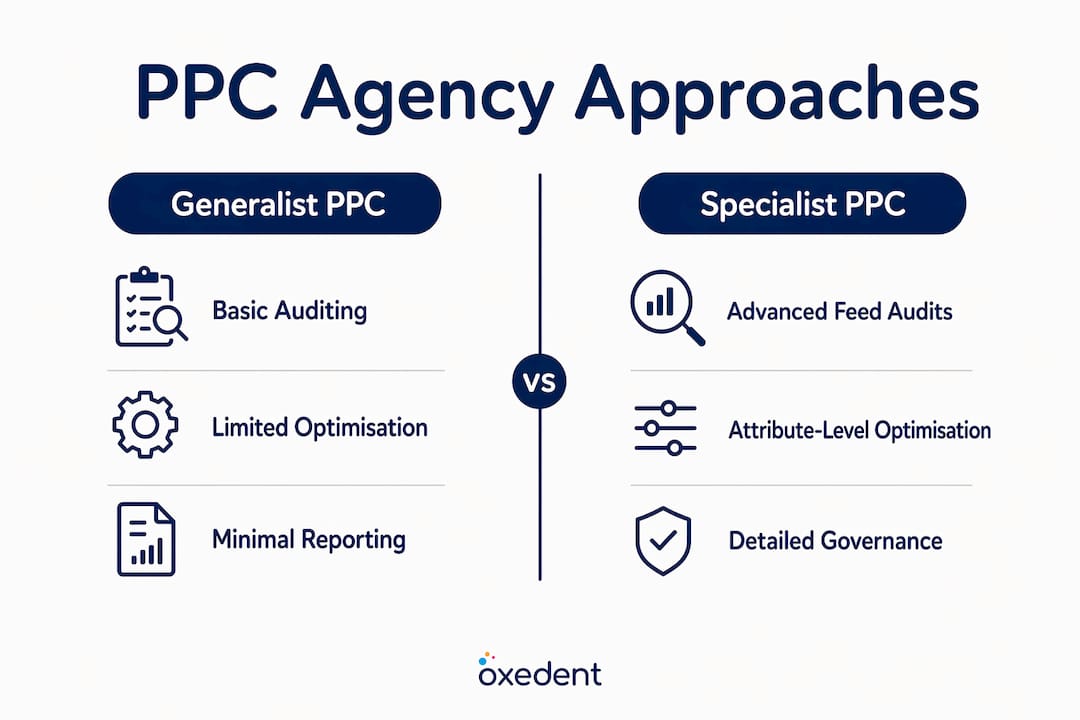

| Service area | Generalist PPC agency | Specialist ecommerce PPC agency |
|---|---|---|
| Feed auditing | Basic Merchant Center review | Full attribute audit prioritised by impression share |
| Title optimisation | Manual edits on request | Rule-based templates applied across all SKUs |
| Attribute enrichment | Limited to required fields | GTIN, MPN, product type, and custom labels all populated |
| Category mapping | Broad category selection | Most specific taxonomy node selected per product |
| Feed governance | Reactive, when errors appear | Proactive monitoring with scheduled quality checks |
| Campaign automation | Standard bid strategies | Feed data structured to feed directly into asset groups |
Specialist ecommerce PPC agencies offer superior feed hygiene, title optimisation, and attribute enrichment compared to generalist agencies. That depth of feed focus is what enables better campaign automation, because Google’s algorithms rely on feed data to decide where and when your ads appear.
The distinction also extends to how agencies think about their role. A specialist does not treat feed management as a setup task. It is an ongoing service that shapes every campaign decision, from budget allocation to asset group structure.
Pro Tip: When evaluating a PPC agency, ask specifically how they handle feed governance between campaigns. If the answer is vague, that is a clear signal they treat the feed as a one-time task rather than a live performance lever. You can also review our ecommerce PPC agency checklist to know exactly what to look for.
Which strategies do PPC agencies use to scale feed optimisation?
Scaling feed management across a large product catalogue, or across multiple client accounts, requires systems rather than manual effort. Agencies that do this well build reusable logic that applies consistently and updates automatically.
-
Rule-box frameworks: Platforms like Productsup use reusable transformation logic called rule boxes. An agency builds a rule once, such as appending colour and size to every title in a specific category, and applies it across thousands of products instantly. This removes the manual bottleneck that slows most in-house teams.
-
Taxonomy alignment: Different markets and platforms use different category structures. Agencies map products to the correct taxonomy for each destination feed, whether that is Google, Meta, or a comparison shopping engine. Getting this wrong means products appear in the wrong auctions or not at all.
-
Regional feed variants: A product sold in the UK and Germany needs different titles, descriptions, and sometimes different GTINs. Agencies manage these variants within a single feed management system, reducing duplication and error.
-
AI-powered attribute enrichment: Where product descriptions are thin or missing, agencies use AI tools to generate compliant titles and descriptions at scale. This is particularly valuable for brands with large catalogues where manual copywriting is not feasible.
The underlying principle is consistent: rule-based feed optimisation systems give agencies the ability to standardise and automate feed improvements, enabling faster turnarounds and consistent data quality across clients.
Proactive monitoring sits alongside these systems. Agencies set up automated alerts for feed errors, disapprovals, and drops in approved product count. Catching a feed issue on day one prevents the silent revenue loss that builds up when a product category quietly falls out of auction eligibility.
Key monitoring priorities include:
- Approved product count by category, checked daily
- Disapproval reasons tracked and resolved within 24 hours
- Price and availability discrepancies between the feed and the live website
- Custom label accuracy, particularly for seasonal or promotional segments
How does an optimised feed directly impact Performance Max and Shopping campaigns?
Fixing the product feed is more impactful than adjusting bids in Google’s Performance Max campaigns. Feed quality drives auction eligibility and impressions. That is the single most important thing to understand about Performance Max.
Google matches user queries primarily against title, description, product type, category, and GTIN in the feed. These attributes determine whether your product enters the auction at all. A well-structured title that includes the right keywords will appear for relevant searches. A vague or incomplete title will not.
The practical implications for your campaigns are direct:
- Missing attributes cause silent losses. A product without a GTIN may be excluded from Shopping auctions entirely, with no error message to alert you. You simply lose impressions and sales without knowing why.
- Titles drive relevance, not bids. Google uses your title as a primary relevance signal. A title that matches how buyers search will outperform a higher bid attached to a weak title.
- Custom labels enable budget control. Custom labels help segment products for Performance Max asset groups, allowing you to control budget allocation by margin, season, or stock level. Without them, your budget spreads indiscriminately across your entire catalogue.
- Avoid embedding attributes in titles. Hardcoding product attributes like size or material directly in titles reduces keyword focus and disrupts algorithmic classification. Use dedicated feed attributes for those details instead.
Pro Tip: Before touching your Performance Max bids, run a full Google Ads feed audit to identify which products are missing from auctions entirely. Recovering those products will deliver more revenue than any bid adjustment.
The feed is the foundation. Bidding strategies, asset groups, and audience signals all perform better when the underlying product data is accurate, complete, and well-structured. Agencies that understand this sequence fix the feed first and adjust bids second.
Key takeaways
A specialist PPC agency’s primary contribution to ecommerce performance is feed quality: the accuracy, completeness, and structure of your product data determines auction eligibility, impression share, and ultimately revenue.
| Point | Details |
|---|---|
| Feed quality drives auctions | Google matches queries against feed attributes, so incomplete data silently excludes products from auctions. |
| Specialist agencies outperform generalists | Specialists apply rule-based title templates, attribute enrichment, and proactive monitoring that generalists do not. |
| Fix the feed before adjusting bids | Improving feed quality delivers more campaign impact than bid changes in Performance Max. |
| Custom labels enable budget control | Segmenting products by margin or season through custom labels gives you precise control over where budget goes. |
| Scalable systems sustain quality | Rule-box frameworks and automated monitoring allow agencies to maintain feed accuracy across large catalogues. |
Feed management is the work most agencies skip
I have reviewed dozens of ecommerce ad accounts over the years, and the pattern is consistent. Brands come in frustrated with Performance Max results, convinced the bidding strategy is wrong or the budget is too low. Nine times out of ten, the feed is the problem. Products are missing GTINs. Titles are vague. Categories are mapped two levels too broad. The campaign is doing its best with poor raw material.
What I have found is that clients who see the fastest improvement are not those who increase budgets. They are the ones who agree to fix the feed first. Once the product data is clean and complete, the same budget that was producing mediocre results starts generating meaningful returns. The algorithm has what it needs to work properly.
The agencies that become genuine long-term partners for ecommerce brands are the ones that treat feed data governance as a core service, not a setup task. They monitor feed health weekly, catch disapprovals before they compound, and build title logic that keeps pace with how buyers search. That is where the real value sits. Bidding is table stakes. Feed management is where campaigns are won or lost.
If you are evaluating a PPC agency and they cannot articulate their feed audit process in specific terms, that tells you everything. The role of PPC in ecommerce growth is inseparable from the quality of the product data behind every campaign.
— Biplab
How Oxedent approaches feed management for ecommerce brands
Oxedent works exclusively with ecommerce brands on paid media, and feed management sits at the centre of that work.

Every new client engagement begins with a structured feed audit that identifies disapprovals, missing attributes, and title weaknesses ranked by their impact on impression share. From there, Oxedent applies rule-based optimisations across titles, categories, and custom labels, building the feed infrastructure that makes Google Shopping and Performance Max campaigns perform as they should. This is not a one-time fix. Feed quality is monitored and refined continuously as part of ongoing ecommerce PPC management. If you are ready to treat your product feed as the performance asset it is, Oxedent is built for exactly that.
FAQ
What is feed management in PPC?
Feed management in PPC is the process of structuring, enriching, and maintaining the product data that powers Shopping and Performance Max campaigns. It covers titles, attributes, categories, GTINs, and custom labels within Google Merchant Center.
Why does feed quality matter more than bidding in Performance Max?
Google uses feed attributes like title, description, and GTIN to determine auction eligibility. A weak feed excludes products from auctions entirely, which no bid adjustment can fix.
What tools do PPC agencies use for feed optimisation?
Agencies commonly use DataFeedWatch, Productsup, and Feedonomics to apply rule-based transformations, manage feed variants, and monitor data quality across large product catalogues.
How often should a product feed be audited?
A full feed audit should be completed at the start of any new campaign engagement, with ongoing monitoring of approved product counts, disapprovals, and price discrepancies on at least a weekly basis.
What is a custom label in a product feed?
A custom label is a field in your product feed that you define yourself, used to segment products by attributes like margin, season, or stock level. Custom labels feed directly into Performance Max asset group structure and budget allocation.