


White-label feed management prepares, enriches, and continuously operates your product data so Google Shopping and Performance Max campaigns perform reliably at scale, while your agency retains full ownership of the client relationship. The practical outcomes are faster campaign launches, fewer Merchant Center disapprovals, higher product coverage across asset groups, and better Performance Max machine learning signals. Oxedent delivers this as a managed service for UK agencies and established retail brands, handling the technical feed operations so you can focus on strategy and growth.
Key takeaways
White-label feed management is the most direct lever agencies have for improving Performance Max performance before touching bids or budgets.
| Point | Details |
|---|---|
| Prioritise feed health first | Fix disapprovals and attribute gaps before adjusting PMax bids or audience signals. |
| Use custom labels for budget control | Segment products by margin, season, or stock level to apply targeted bidding within asset groups. |
| Insist on written SLAs | Require defined remediation windows: critical disapprovals resolved within 24 hours as a baseline. |
| Measure feed attribute completeness | Track completeness and disapproval rate as standing KPIs in every account review. |
| Oxedent for white-label delivery | Oxedent manages feed ops end-to-end for UK agencies and brands, with rebrandable reporting and no long-term contract. |
Use the evaluation criteria in the partner vetting section to shortlist candidates and run a pilot on your longest-tail products first.
Table of Contents
- What does white-label feed management actually cover?
- Core technical capabilities to expect from a white-label feed partner
- Why feed health changes your Performance Max results
- Pre-launch feed audit: an 8-step implementation checklist
- How to evaluate a white-label feed management partner
- Typical pricing models and cost drivers for white-label feed management
- How Oxedent delivers white-label feed management
- Why feed ops should be a strategic capability, not a maintenance task
- Oxedent’s white-label feed service for UK agencies and brands
- Sources
What does white-label feed management actually cover?
This is product data operations for Google Shopping and Performance Max, not white-label manufacturing or app reselling. The service covers the full lifecycle of a product feed: ingestion, mapping, enrichment, validation, syndication, and ongoing governance.
Under a white-label arrangement, the delivery is rebrandable. Your clients see your agency’s name on dashboards, reports, and communications. The feed partner operates behind the scenes.
Key service components include:
- Feed ingestion and mapping from multiple data sources (Shopify, Magento, WooCommerce, CSV, API)
- Rule-based attribute enrichment to fill gaps, standardise values, and meet channel specifications
- Validation and error remediation against Google Merchant Center requirements
- Scheduled feed pushes to Google Merchant Center and Performance Max asset groups
- Rebrandable client dashboards with SLA-backed reporting and disapproval tracking
- Governance cadence: weekly diagnostics, update frequency agreements, and sign-off workflows
Channels in scope for this piece are Google Merchant Center and Performance Max. Marketplaces such as Amazon or Meta Catalogue feeds may be offered by some partners but sit outside this discussion.
Core technical capabilities to expect from a white-label feed partner
The tangible deliverables matter more than the marketing language. When you evaluate a partner, look for these specific capabilities.
Feed ingestion and transformation should handle multiple source formats and platform connectors without manual intervention. Rule-based transforms let you apply consistent logic across a client’s catalogue: reformat titles, append missing attributes, remap category hierarchies, and handle GTIN or MPN identifiers correctly.
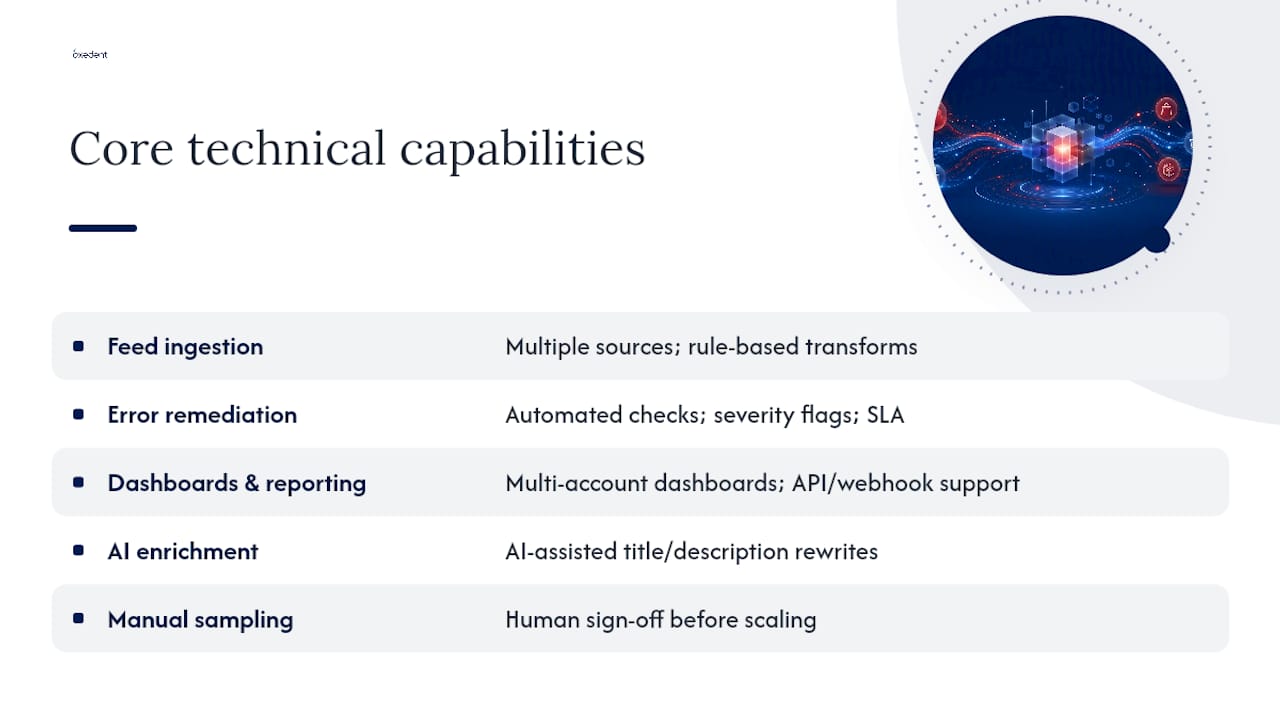

Error remediation and automated QA are where most agencies underestimate complexity. A capable partner runs automated checks against Merchant Center policies before each feed push, flags issues by severity, and resolves the highest-impact errors within an agreed SLA window. Scheduled syncs keep pricing and availability current, which directly affects auction eligibility.
Multi-client dashboards and reporting give you visibility across all accounts from a single interface. API and webhook support matters if your clients use custom platforms or need real-time inventory updates. Some partners also offer AI-assisted title and description rewrites to lift attribute quality at scale, which feed management platforms describe as the foundation for AI-ready discovery.
Sample the outputs manually before applying rules catalogue-wide. Brand tone, policy compliance, and character limits all need human sign-off before scaling.*
Why feed health changes your Performance Max results
PMax and Google Shopping match user search intent to product attributes. Weak or missing fields reduce the number of auctions a product can enter. Industry analysis confirms that many Performance Max failures attributed to bidding are actually caused by poor product data, and the fix starts with a Merchant Center audit, not a bid adjustment.


According to MagicFeedPro’s attribute priority guide, the five highest-impact attributes for Performance Max are title, description, product_type, custom labels, and google_product_category. Each affects matching and bidding differently.
| Attribute | Primary impact | Direction of effect |
|---|---|---|
| Title | Query matching, relevance scoring | Fixing weak titles increases auction eligibility |
| Description | Long-tail matching, asset generation | Richer descriptions improve PMax creative signals |
| product_type | Internal segmentation, bidding logic | Accurate hierarchy improves budget allocation |
| — | Asset group segmentation, budget control | Enables margin-based or seasonal bidding splits |
| google_product_category | Channel taxonomy, Shopping tab placement | Correct category reduces disapprovals and mismatches |
Feed quality is the single most controllable variable in a Performance Max account. Google’s own guidance stresses that rich product data and strong conversion measurement are prerequisites for the system to learn and serve effectively across placements.
Custom labels deserve particular attention. They let you segment products by margin tier, seasonality, clearance status, or bestseller rank, then apply different bidding strategies to each group within Performance Max. Without them, PMax treats a £5 accessory and a £500 hero product identically.
Channel readiness checks to monitor regularly: item disapproval rate, Feed Attribute Quality Score in Merchant Center, and impression share by product group. A rising disapproval rate almost always precedes a drop in impression share within two to three weeks.
Pre-launch feed audit: an 8-step implementation checklist
Use this before onboarding any client to a white-label feed service. Small catalogues (under 1,000 SKUs) can complete steps 1–6 in roughly three to five days; large catalogues (10,000+ SKUs) typically need two to three weeks.
- Source data audit — map all data sources, identify missing fields, and document the gap between what exists and what Merchant Center requires.
- Identifier and GTIN checks — validate GTINs, MPNs, and brand values. Missing or incorrect identifiers cause disapprovals and reduce Shopping eligibility.
- Title and description optimisation — apply title templates that front-load brand, product type, and key attributes within the first 70 characters.
- Taxonomy and product_type hierarchy — build a consistent product_type tree and map every SKU to the correct google_product_category.
- Image and pricing checks — confirm images meet Merchant Center size and quality requirements; verify that prices match the landing page exactly.
- Custom labels setup — define label logic (margin band, season, stock level) and apply values across the catalogue before campaign launch.
- Merchant Center diagnostics and disapproval fixes — run a full diagnostic, prioritise disapprovals by volume, and resolve critical errors before going live.
- Final QA and scheduled syncs — confirm feed update frequency (daily minimum for most retailers), set remediation SLA, and agree on who approves feed rule changes.
Governance note: update cadence and remediation SLA should be written into the service agreement. A 24-hour SLA for critical disapprovals and a 72-hour SLA for attribute warnings are reasonable starting benchmarks. Feed rule changes should require sign-off from both the agency and the client before deployment.
How to evaluate a white-label feed management partner
The right partner makes your agency look sharper. The wrong one creates client escalations you cannot explain. Use these criteria when shortlisting.
Technical connectors — does the platform connect natively to your clients’ ecommerce platforms? Manual CSV uploads are a red flag for anything above a few hundred SKUs.
Rule engine and AI options — rule-based transforms are non-negotiable. AI enrichment is a bonus, but only if the partner can demonstrate guardrails and sampling controls.
Multi-client dashboard — you need a single view across all accounts, with per-client feed health scores, disapproval counts, and attribute completeness metrics. Agency feed solutions typically offer branding control, API access, and scheduled exports as standard white-label features.
SLA and remediation times — ask for written SLAs, not verbal commitments. Acceptable benchmarks: critical disapprovals resolved within 24 hours, attribute warnings within 72 hours.
Reporting granularity — can you export feed health data at SKU level? Can you white-label the reports with your agency branding?
Red flags to watch for:
- Opaque SLAs with no defined remediation windows
- No sample dashboards available during the sales process
- Limited channel templates (Google Merchant Center only, no Performance Max asset group configuration)
- Inability to show real examples of PMax readiness improvements
Typical pricing models and cost drivers for white-label feed management
Pricing varies widely, but the structure usually follows one of these models:
- Per-SKU pricing — a monthly rate per active product in the feed. Suits agencies with clients across different catalogue sizes.
- Tiered monthly retainer — flat fee bands based on SKU count or channel count. Predictable for budgeting and easy to resell.
- Project or onboarding fee plus retainer — a one-off setup charge covering initial mapping and QA, then a lower ongoing monthly fee.
- Percentage of media spend — common in fully managed services where feed ops is bundled with campaign management.
The main cost drivers are catalogue size, update frequency, number of channels, degree of enrichment (AI versus rules-only), SLA requirements, and the complexity of integrations. A client with 500 SKUs, daily syncs, and standard Merchant Center mapping costs far less to service than one with 50,000 SKUs, hourly updates, and custom API integrations.
For agencies building a resale margin, tiered retainers are generally the most straightforward model. You buy at a wholesale rate and bill clients at a marked-up retail rate. Managed service options that bundle rule-based automation with optional human oversight give you flexibility to offer different service tiers to different clients. Reliable feed pipelines also depend on stable ecommerce infrastructure; scalable hosting and DevOps support can prevent feed sync failures caused by platform downtime.
How Oxedent delivers white-label feed management
Oxedent’s white-label feed service is built for UK ecommerce agencies and established retail brands running Google Shopping and Performance Max. The delivery model is rebrandable: your clients see your branding on reports and communications throughout.
What the engagement covers:
- Onboarding (weeks 1–2): source data audit, GTIN validation, title and description optimisation, custom label architecture, and Merchant Center diagnostic review
- Weekly operations: scheduled feed pushes, automated QA, disapproval monitoring, and remediation within agreed SLA windows
- Monthly optimisation: attribute completeness review, custom label refinement, feed health reporting, and recommendations for campaign structure changes driven by feed data
Agencies that treat feed optimisation as a prerequisite for Performance Max consistently uncover the largest untapped inventory in their accounts. Feed quality is where the real performance gap lives, not in bid strategy.
Oxedent’s ecommerce PPC management service integrates feed ops directly into campaign management, so feed improvements translate immediately into campaign structure and bidding decisions. For agencies deciding between a feed-only build and a full Performance Max asset build, the feed-only versus full build guide sets out the trade-offs clearly.
Why feed ops should be a strategic capability, not a maintenance task
Most agencies price feed work as a one-off setup or bury it in a campaign management retainer. That framing undersells what feed operations actually deliver and leaves margin on the table.
Feed ops is where you shift from execution vendor to strategic partner. When you bring feed health KPIs into every monthly account review, you give clients a measurable signal they cannot get from campaign dashboards alone. Disapproval rate, attribute completeness, and custom label coverage tell a clearer story about growth potential than click-through rate ever will.
The practical advice for agency leadership: price feed optimisation as a named, premium line item. Build a feed health score into your reporting template. Make enrichment continuous rather than a launch-week activity. Clients who understand feed quality as a revenue lever are far easier to retain and far more likely to increase budget.
One caution worth stating plainly: Performance Max is not a set-and-forget product. Without ongoing feed governance, catalogue drift, price changes, and new disapprovals quietly erode performance over weeks. The agencies that understand why outsourcing PPC management makes commercial sense are the same ones building feed ops into their core service stack.
Oxedent’s white-label feed service for UK agencies and brands
Oxedent gives UK ecommerce agencies a done-for-you feed management service that slots directly into your existing client delivery. You keep the client relationship; Oxedent handles the technical operations, from initial audit through to weekly syncs and monthly optimisation reviews.

A first engagement typically looks like this: a feed audit within the first week, a prioritised fix list with estimated impact, and a live feed with Merchant Center and Performance Max ready within two to three weeks. No long-term contract required.
For agencies ready to add feed management as a white-label service, or retail brands that want their feed professionally managed alongside their Performance Max campaigns, book a discovery call with Oxedent to discuss your catalogue size, current feed health, and what a managed engagement would look like for your account.
Sources
These sources underpin the technical claims in this article and are worth bookmarking for ongoing reference.
- Performance Max best practices – Google Ads Help
- Why Performance Max fails: it’s your feed, not your bids – PPC News Feed
- Product feed optimisation for Performance Max: the 2026 attribute priority guide | MagicFeedPro Blog