


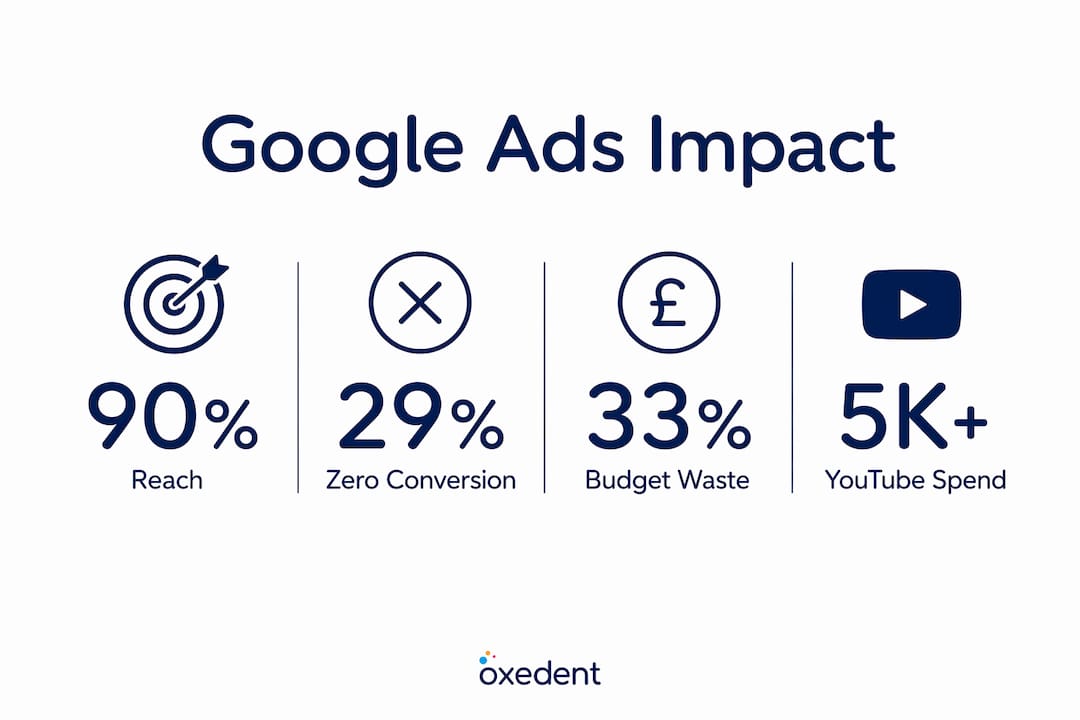
Google Ads is the most direct paid channel for building brand visibility at scale, placing your products and messaging in front of high-intent audiences across Search, Display, and YouTube simultaneously. For eCommerce brand managers, understanding the role of Google Ads in brand growth means going beyond click metrics and treating paid media as a financial lever that shapes long-term brand equity. Google’s Display Network reaches approximately 90% of internet users, and YouTube serves over 2 billion logged-in users monthly. That scale is simply not replicable through any other single paid channel.
How does Google Ads increase brand visibility and awareness?
Google Ads builds brand awareness through three distinct mechanisms: mass reach via Display, intent capture via Search, and sustained recall via YouTube video campaigns. Each mechanism serves a different stage of the customer journey, and together they create a compounding visibility effect that organic search alone cannot match.


Display Network campaigns place your brand in front of audiences while they browse news sites, blogs, and apps. You bid on a cost-per-thousand-impressions (CPM) basis, which means you pay for exposure rather than clicks. This is the correct model when your goal is brand recall rather than immediate conversion.
YouTube video campaigns use cost-per-view (CPV) bidding, so you only pay when a viewer watches a meaningful portion of your ad. Frequency capping controls how often the same person sees your ad, preventing fatigue while maintaining recall. Google’s own measurement tools, including Brand Lift surveys and Ad Recall Lift metrics, let you quantify how many additional people remember your ad after exposure.
- Use in-market and affinity audiences to reach people whose browsing behaviour signals purchase intent in your category.
- Layer custom intent audiences built from competitor search terms to intercept buyers actively comparing options.
- Apply frequency caps of 3–5 impressions per user per week on Display to maintain recall without overexposure.
- Test responsive display ads with multiple headlines and images; Google’s system identifies the highest-performing combinations automatically.
- Track branded search lift as a secondary KPI: if Display and YouTube spend increases searches for your brand name, your awareness investment is working.
Pro Tip: Run a Brand Lift study on YouTube campaigns spending above £5,000 per month. The data on ad recall and brand consideration gives you proof points that justify upper-funnel budget to stakeholders who only trust conversion data.
What impact do Google Ads have on acquisition costs and conversion rates?
Brand awareness via Google Ads directly reduces your customer acquisition cost over time. Research across 575 brands and over $264 billion in ad spend confirms that brand awareness investment improves click-through rates, conversion rates, and lowers overall acquisition costs. The mechanism is straightforward: when buyers already recognise your brand, they click your ads more readily and convert at a higher rate.
Higher click-through rates improve your Quality Score in Google Ads. A better Quality Score reduces your cost-per-click (CPC) because Google rewards ads that users find relevant. This creates a virtuous cycle: brand investment feeds awareness, awareness feeds CTR, CTR feeds Quality Score, and Quality Score reduces the cost of every future click.
The risks of ignoring this cycle are measurable. A 29% zero-conversion rate across Google Ads accounts means nearly one in three campaigns generate traffic with no measurable return. That figure reflects accounts where brand signals are weak and campaign hygiene is poor.

| Factor | Effect on brand growth |
|---|---|
| Strong brand recognition | Higher CTR on paid search ads, lower CPC via Quality Score |
| Poor campaign hygiene | Wasted budget on irrelevant traffic, zero conversions |
| Negative keyword management | Reduced wasted spend, improved conversion rate |
| Upper-funnel awareness spend | Lower customer acquisition cost over 90-day attribution window |
Pro Tip: Audit your search terms report weekly, not monthly. Manual search term exclusions outperform bidding strategy changes alone for reducing wasted spend. One account review can save thousands in misallocated budget.
How to build a Google Ads strategy for eCommerce brand growth
A Google Ads strategy for eCommerce brand growth requires deliberate budget allocation across campaign types, not a single-funnel approach. Most brand managers under-invest in upper-funnel campaigns because the return is harder to attribute. That is a costly mistake.
-
Audit your impression share first. Advertisers miss an average of $39 in potential revenue per $100 earned from paid Search due to lost impression share caused by budget and Ad Rank limitations. Check your Search Lost IS (Budget) and Search Lost IS (Rank) columns in Google Ads before adjusting anything else.
-
Allocate budget across three campaign types. For eCommerce, the core Google Ads campaign types are Search (for high-intent buyers), Google Shopping (for product-level visibility), and YouTube or Display (for brand awareness). Each serves a distinct purpose and should have its own budget line.
-
Set brand awareness KPIs separately from performance KPIs. Measure Display and YouTube campaigns on Ad Recall Lift, branded search volume growth, and impression share. Measure Search and Shopping on return on ad spend (ROAS) and conversion rate. Mixing these metrics leads to poor decisions.
-
Use Search impression share data to inform bidding. If your impression share is below 60% on branded terms, increase bids before expanding to new audiences. Losing branded impressions to competitors is a direct threat to brand equity.
-
Test creative systematically. Run at least two ad variants per campaign and rotate them evenly for a minimum of four weeks before drawing conclusions. Creative fatigue is a real and measurable drag on brand recall.
-
Review and prune monthly. Increasing ad budget and improving Ad Rank together can increase incremental revenue potential by up to $139 per $100 baseline. That uplift is only accessible when your account is clean and your bids are competitive.
How does Google Ads work alongside other marketing channels?
Google Ads is highly effective at capturing existing demand. It is less effective at creating demand from scratch. Paid search alone has clear limits for sustained brand growth, which is why the most successful eCommerce brands treat it as one part of a broader commercial strategy.
The relationship between Google Ads and other channels is mutually reinforcing:
- Organic search and SEO benefit when Display and YouTube campaigns increase branded search volume. More branded searches signal authority to Google’s organic ranking algorithm.
- Social media advertising on Meta or TikTok builds awareness with audiences who are not yet searching. Those audiences then search for your brand and convert via Google Search, making your paid search spend more efficient.
- Email marketing reactivates existing customers who can be excluded from acquisition campaigns, reducing wasted spend and improving ROAS.
- Offline advertising such as TV or out-of-home generates branded search spikes that Google Ads captures. Without paid search coverage during those spikes, competitors intercept your demand.
Brands that rely solely on Google Ads for growth hit a ceiling quickly. The channel captures intent but does not manufacture it. Feeding Google Ads with demand generated elsewhere is what makes scaling Google Ads for online stores genuinely sustainable rather than a short-term revenue spike.
The average Google Ads account wastes $1,127.54 monthly, representing over 33% of median search ad budgets. That waste compounds when paid search operates in isolation, without the brand signals from other channels that improve CTR and Quality Score. Integration is not optional for brands serious about growth.
Key takeaways
Google Ads drives brand growth most effectively when upper-funnel awareness campaigns, technical hygiene, and cross-channel integration work together rather than in isolation.
| Point | Details |
|---|---|
| Scale of reach | Google’s Display Network and YouTube give brands access to over 90% of internet users monthly. |
| Awareness reduces acquisition cost | Brand recognition lifts CTR and Quality Score, cutting cost-per-click over time. |
| Campaign hygiene is non-negotiable | Nearly one in three Google Ads campaigns generates zero conversions; regular pruning fixes this. |
| Impression share reveals hidden revenue | Brands lose an average of $39 per $100 earned due to budget and Ad Rank gaps. |
| Integration multiplies returns | Google Ads captures demand; other channels create it. Both are needed for sustained growth. |
What I have learned about Google Ads and brand building
Most brand managers I speak with treat Google Ads as a performance channel first and a brand channel second, or not at all. That ordering is backwards. The brands that grow fastest are the ones that invest in awareness early, before their competitors own the category in buyers’ minds.
The uncomfortable truth is that the majority of Google Ads accounts are technically broken in ways that prevent brand growth regardless of budget. Routine search term exclusions and negative keyword hygiene are unglamorous tasks, but they consistently outperform bidding strategy changes for improving efficiency. I have seen accounts save tens of thousands in wasted spend simply by conducting a thorough monthly review.
Platform automation is advancing rapidly. Performance Max campaigns now make decisions that were previously manual. My advice is to retain control of your brand terms, your audience exclusions, and your creative strategy. Automation handles bidding well. It does not understand your brand positioning.
The brands that win with Google Ads are not the ones with the largest budgets. They are the ones that treat paid media as a financial investment with measurable downstream effects on acquisition cost, not just a line item in a marketing plan.
— Biplab
How Oxedent supports eCommerce brands with Google Ads growth
If you are managing meaningful ad budgets and not seeing the brand growth your spend should deliver, the issue is almost always structural rather than budgetary.

Oxedent specialises exclusively in eCommerce PPC management for established online retail brands. The focus is on reducing wasted spend, improving ROAS, and building campaigns that grow brand visibility without sacrificing profitability. From Google Shopping feed optimisation to Performance Max structuring and brand awareness campaign design, Oxedent manages the full paid media picture. If you want to understand exactly where your current Google Ads account is losing money and brand equity, an audit with Oxedent is the right starting point. You can also read more about the role of PPC in eCommerce growth to see how paid media fits your broader commercial strategy.
FAQ
What is the role of Google Ads in brand growth?
Google Ads builds brand growth by placing your messaging in front of high-intent audiences across Search, Display, and YouTube at scale. It captures existing demand and, when combined with awareness campaigns, reduces customer acquisition costs over time.
How does Google Ads improve brand awareness?
Google’s Display Network and YouTube campaigns use CPM and CPV bidding to maximise impressions and recall. Google’s Display Network reaches 90% of internet users, making it one of the most efficient channels for mass brand exposure.
Why do so many Google Ads campaigns fail to drive growth?
Poor campaign hygiene is the primary cause. A 29% zero-conversion rate across accounts shows that nearly one in three campaigns waste budget entirely. Regular search term exclusions and negative keyword reviews resolve most of this waste.
Does Google Ads work better alongside other marketing channels?
Google Ads captures demand but does not create it. Brands that combine paid search with social media, email, and organic SEO see stronger long-term growth because other channels generate the branded search volume that Google Ads then converts efficiently.
How do I measure the impact of Google Ads on brand growth?
Track branded search volume growth, Ad Recall Lift from Brand Lift studies, impression share on branded terms, and the downstream effect on conversion rate and customer acquisition cost across a 90-day attribution window.