


What does Target ROAS bidding actually do in Google Ads?
Target ROAS bidding is Google’s AI-driven Smart Bidding strategy that automatically adjusts your bids to achieve a specific return on ad spend across every auction you enter. Rather than setting a fixed bid and hoping for the best, you tell Google the revenue you want for every pound you spend, and its machine learning does the rest. Google’s AI analyses signals at auction time, including device, browser, location, time of day, and remarketing list membership, to predict the conversion value of each search and bid accordingly.
The role of ROAS targets in Google Ads goes well beyond a simple number. It acts as the guardrail that keeps your automated bidding profitable, not just active. Without a defined target, Google will chase volume. With one, it chases value.
Here is what Target ROAS bidding does in practice:
- Predicts conversion value for every auction using your historical conversion data and real-time signals
- Raises bids on searches likely to generate high-value conversions and lowers them on low-value ones
- Averages out across the campaign over time, so some conversions come in above target and some below, but the overall return meets your goal
- Replaces manual bid adjustments for device, location, and audience, since the algorithm handles these automatically (with the exception of a -100% device exclusion)
- Works as a standard strategy for a single campaign or as a portfolio strategy across multiple campaigns
- Requires conversion value tracking to function, meaning every conversion action must have a revenue value assigned
Starting in June 2026, Google updated its bidding strategy labels. “Maximise conversion value with a Target ROAS” is now simply called “Target ROAS,” though the underlying bidding behaviour is unchanged.
How Target ROAS bidding works and how to set it up

The mechanics are worth understanding properly, because misreading them is one of the most common reasons campaigns underperform.


Google predicts future conversions and their associated values using the conversion data you report through your tracking setup. It then sets maximum cost-per-click bids to maximise conversion value while targeting your specified average return. The algorithm does not hit your target on every single click. Some conversions will come in at 8x your target, others at 1.5x. The goal is to average out to your target across the campaign over time.
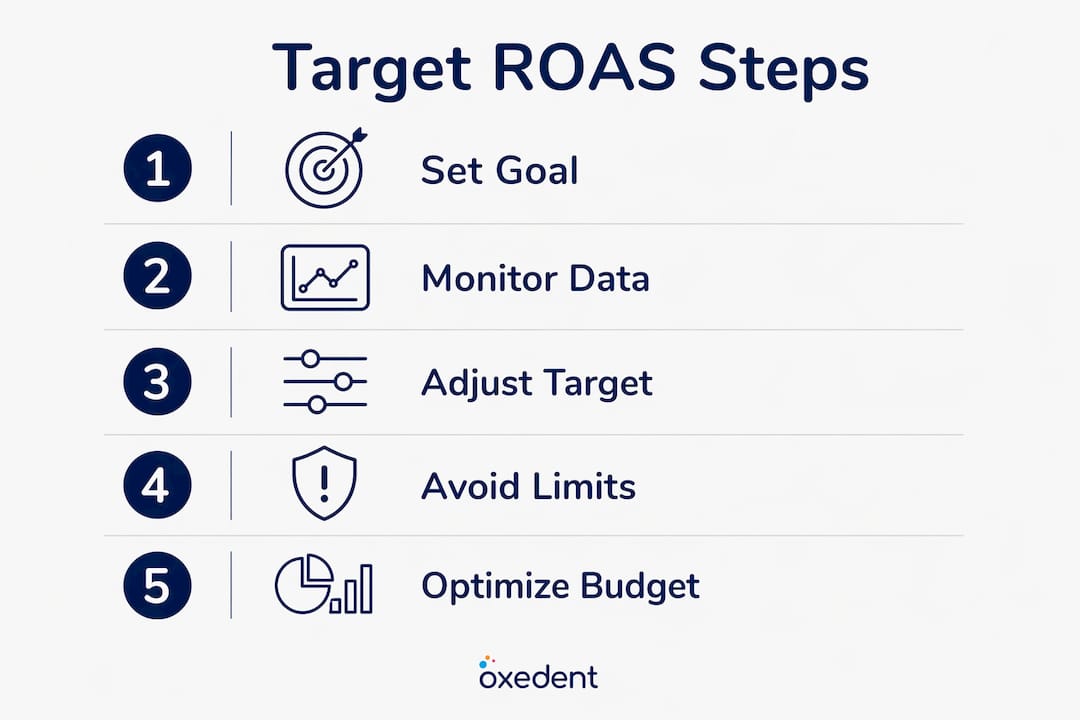
Setting up Target ROAS in Google Ads: step by step
-
Confirm your conversion tracking is recording values. Every conversion action must have a revenue value attached. If you are tracking leads without values, Target ROAS will not work. Use Target CPA instead until values are in place.
-
Build a conversion history first. Google recommends at least 15 conversions in the last 30 days per campaign before enabling Target ROAS. Fifty or more conversions produces far more stable results.
-
Calculate your break-even ROAS. Divide 1 by your gross margin. If your margin is 40%, your break-even ROAS is 2.5x (250%).
-
Set your initial target below your true profitability threshold. Starting 10–20% below your break-even ROAS gives the algorithm room to learn and find volume without immediately strangling delivery.
-
Navigate to your campaign settings in Google Ads, select “Bidding,” choose “Maximise conversion value,” and then tick the option to set a Target ROAS. Enter your target as a percentage (e.g., 400% means £4 returned for every £1 spent).
-
Allow a learning period of around four weeks before judging performance. The algorithm needs time to stabilise after any significant change.
-
Use the Bid Target Adjustment Tool (available from july 2026) if your campaign is limited by budget, as Google’s august 2026 update introduced this specifically to deliver more consistent performance in budget-constrained campaigns.
The Target ROAS field accepts values from 0.01 to 1000, giving you granular control across a wide range of business models. For portfolio strategies, you can also set a tolerance percentage, which allows the algorithm to accept a defined degree of ROAS variation in exchange for greater traffic diversity and conversion volume.
One thing to note: setting bid limits alongside Target ROAS is not recommended. Bid limits restrict Google’s ability to optimise at auction level and can prevent the algorithm from bidding the amount that would actually meet your target.
Who should and shouldn’t use Target ROAS bidding?
Target ROAS is not a universal solution. Getting this assessment right before you switch bidding strategies saves a great deal of wasted spend.
Target ROAS works well for you if:
- You run an ecommerce store where conversions have direct, measurable revenue values (product sales, order values)
- Your campaign generates more than 30 conversions per month, with higher volumes producing more stable and reliable performance.
- Your conversion tracking is accurate and consistently records revenue values
- You sell products at varied price points and want the algorithm to prioritise higher-value orders
- You are running Shopping campaigns, Performance Max with product feeds, or high-intent search campaigns
- You have already been running a Maximise Conversions or Maximise Conversion Value strategy and have built a solid data foundation
Target ROAS is the wrong choice if:
- Your conversions do not generate a direct financial return, such as ebook downloads, free tool sign-ups, or newsletter subscriptions
- Your campaign has fewer than 30 conversions per month, as the algorithm has too little data to learn reliable patterns
- You are still testing audiences or creatives and have not yet stabilised your campaign structure
- Your conversion values vary wildly within a single campaign, for example a £20 product and a £2,000 product in the same ad group, which can confuse the optimiser
- You have a long sales cycle where conversions happen days or weeks after the click, making real-time bidding less effective
- Your conversion tracking has gaps or inaccuracies, since campaigns without specific values on conversions should not use Target ROAS at all
The typical progression that works well: start with Maximise Conversions to build data, move to Maximise Conversion Value once you have volume, then add a ROAS target once the algorithm understands your value distribution.
Best practices for running Target ROAS campaigns effectively
Getting Target ROAS set up is one thing. Getting it to perform consistently is another. These are the practices that make the difference between a campaign that drifts and one that compounds.

Set your initial target conservatively. Starting 10–20% below your true target gives the algorithm room to explore and find volume. If your true target is 4.0x, start at 3.2x–3.6x. A target set too high tells the algorithm to only bid on the highest-intent impressions, which results in low volume and a campaign that barely spends its budget.
Tighten gradually after stabilisation. Once performance has been consistent for two to four weeks, increase your target in 10–20% increments. Monitor conversion volume at each step. At some point, raising the target further will cause spend to drop sharply. That is the cliff. Back off slightly and hold.
Never change multiple things at once. If you adjust your target, restructure ad groups, and update creative simultaneously, you will not know which change caused any shift in performance. Run structured tests with one variable at a time.
Keep your budget generous enough for the algorithm to work. A campaign limited by budget cannot explore the auction landscape properly. Your daily budget should comfortably accommodate your target conversion volume.
Monitor the “average target ROAS” column, not just the target you set. This traffic-weighted average reflects what the algorithm actually optimised for across the period, accounting for any target changes you made.
Pro Tip: Before switching to Target ROAS, report conversion values across all relevant campaigns for at least four weeks or three conversion cycles, whichever is longer. This gives Google enough data to set a reliable recommended target and reduces the risk of a rocky learning period.
Additional practices worth building into your workflow:
- Exclude irrelevant conversion actions from your “Conversions” column so the algorithm only optimises for the actions that matter to your business
- Use conversion value rules to prioritise higher-margin products within Performance Max and Shopping campaigns
- Review the bid simulator regularly to understand how changes to your target would affect volume and spend
- Avoid pausing and restarting campaigns frequently, as each restart triggers a new learning period
- For scaling Google Shopping and Performance Max campaigns profitably, Target ROAS works best when paired with a clean, well-structured product feed
How does Target ROAS compare to other Google Ads Smart Bidding strategies?
Target ROAS sits within a family of automated bidding options, and knowing when to use each one is as important as knowing how to configure them.
The four main Smart Bidding strategies compared:
- Maximise Conversions: Spends your entire budget to get as many conversions as possible, with no specific return target. All conversions are treated equally regardless of value. Best for building data volume in early campaign stages.
- Target CPA: Maximises conversions at a specific cost per acquisition. Like Target ROAS, it sets a return constraint, but it treats all conversions as equal in value. Use this when your conversion values are uniform or when you are optimising for leads rather than revenue.
- Maximise Conversion Value: Spends your entire budget to maximise total conversion value, with no ROAS constraint. Good for campaigns where you want to push revenue hard without a profitability floor.
- Target ROAS: Maximises conversion value while maintaining a specific return on ad spend. The right choice when conversions have different values for your business and you have a clear profitability target to hit.
Key metrics to track alongside your Target ROAS:
- Cost per acquisition (CPA): Tells you what each conversion costs, regardless of its value. Useful for volume planning alongside ROAS efficiency assessment.
- Conversion value per cost: The direct output of Target ROAS bidding. This is the metric the algorithm is optimising, so track it at campaign and account level.
- Profit margin per campaign: ROAS alone does not account for product costs, fulfilment, or overheads. A 5x ROAS on a 15% margin product may still be unprofitable.
- Blended ROAS: Total revenue divided by total ad spend across all channels. This gives you the big picture and is a useful sanity check against platform-reported figures. Oxedent’s guide to blended ROAS for ecommerce covers how to calculate and use this metric effectively.
For businesses with varied conversion values, value-based bidding typically outperforms Target CPA, because the algorithm can distinguish between a £30 order and a £300 order and bid accordingly.
Common pitfalls and advanced insights for UK advertisers
The most dangerous assumption in Target ROAS campaigns is that the number Google reports is the number your business actually earned. It is not, and understanding why matters enormously for UK advertisers making budget decisions.
Platform-reported ROAS generally overstates true business ROAS. Brands that run incrementality tests consistently find that reported ROAS overstates true performance by 30–60%, and for branded search and retargeting, the gap can exceed 80%. Google counts conversions within its attribution window, including people who would have converted anyway.
This is not a reason to abandon Target ROAS. It is a reason to build a measurement framework that goes beyond the platform dashboard.
Common pitfalls to avoid:
- Setting targets based on platform ROAS alone. If your Google Ads dashboard shows 6x but your actual revenue uplift is closer to 3x, your target is calibrated against a fiction. Validate with media mix modelling or incrementality testing to understand true business impact.
- Misaligned targets across campaign types. Prospecting and retargeting campaigns have different break-even points. A single global ROAS target either overspends on retargeting or underspends on prospecting. Set tiered targets by funnel stage.
- Ignoring the learning period. Panic-adjusting targets within the first two weeks of a new strategy is one of the most common ways to derail performance. Allow around four weeks before drawing conclusions.
- Applying Target ROAS to experimental campaigns. The algorithm requires stable data. Testing new audiences or creatives while running Target ROAS produces unreliable results and a confused optimiser.
- Treating ROAS as a proxy for profit. A campaign returning 4x ROAS on products with a 20% gross margin is losing money. Always anchor your target to your actual unit economics, not a benchmark figure.
For UK advertisers specifically, attribution challenges are compounded by multi-device behaviour and longer consideration cycles in certain retail categories. A clear measurement framework connecting ad data to real revenue, beyond clicks and impressions, is what separates accounts that scale confidently from those that optimise toward a misleading number.
The brands getting the most from their ad spend in 2026 combine platform ROAS for daily monitoring, media mix modelling for budget allocation, and incrementality testing for validation. That combination gives you the directional speed of automated bidding without the blind spots that come from trusting platform attribution alone.
If you want to understand why your ROAS figures might be shifting unexpectedly, Oxedent’s breakdown of why ROAS drops covers the real causes in detail.
Ready to get more from your Google Ads spend?

Target ROAS bidding is one of the most powerful tools available to ecommerce advertisers, but it rewards those who set it up correctly and manage it with discipline. If your campaigns have the conversion volume, the tracking accuracy, and the right targets in place, the algorithm can do a great deal of the heavy lifting.
Oxedent works exclusively with ecommerce brands on paid media, with a focus on profitability and scalable revenue growth. If you want expert management of your ecommerce PPC campaigns, including Target ROAS strategy, feed optimisation, and Performance Max, get in touch to find out how Oxedent can help your brand scale.
Key takeaways
Target ROAS bidding works best when conversion tracking is accurate, campaign volume exceeds 30 conversions per month, and initial targets are set conservatively below your true break-even ROAS.
| Point | Details |
|---|---|
| Conversion tracking is non-negotiable | Every conversion action must have a revenue value assigned before Target ROAS can function correctly. |
| Volume threshold matters | Campaigns need enough conversions per month for stable and reliable performance, with higher volumes generally producing better stability. |
| Start targets conservatively | Set your initial target 10–20% below your true profitability threshold to give the algorithm room to learn. |
| Platform ROAS overstates reality | Reported ROAS overstates true performance by 30–60%; validate with incrementality testing or media mix modelling. |
| Allow four weeks before judging | The algorithm needs around four weeks to stabilise after enabling Target ROAS or making significant changes. |