


If you need long-term, compounding organic growth, hire a specialist SEO agency. If you need visible results within days because you have a launch, a sales peak, or a tight revenue target, paid media is the faster route. Most established UK businesses eventually need both, but they rarely need both from day one.
Your practical shortlist looks like this:
- Specialist SEO agencies — technical, content and link-building expertise for sustained organic visibility.
- Full-service digital agencies — broader marketing support with SEO as one channel among several.
- Freelance SEO consultants — lower cost, hands-on delivery, best for smaller or single-site projects.
- In-house SEO resource — works if you have the budget for a dedicated hire and the patience to build capability internally.
- Paid media specialists like Oxedent — the adjacent option when speed matters more than compounding organic equity, particularly for eCommerce brands.
Before you sign anything, ask for a site audit or traffic audit first. It tells you more about a provider’s competence than any sales call.
Key Takeaways
The right growth channel depends on your timeline: SEO compounds over months, paid media delivers measurable results within days.
| Point | Details |
|---|---|
| Match the channel to your timeline | Choose SEO for 12-month organic growth and paid media for results within days or weeks. |
| Demand a methodology, not a promise | Ask for a sample audit process and named link-building tactics before signing anything. |
| Check independent proof | Verify case studies with real numbers and check Trustpilot or Clutch reviews, not just the agency’s own site. |
| Get contract terms in writing | Confirm deliverables, reporting cadence, exit clauses, and content ownership before you pay a retainer. |
| Consider Oxedent for speed | For eCommerce brands needing fast, measurable acquisition, Oxedent’s PPC and Shopping management offers a rapid alternative to SEO’s longer timeline. |
Table of Contents
- What services should you expect from a UK SEO provider?
- How do you choose the right SEO agency?
- SEO or paid media: which delivers faster for UK businesses?
- How do you check an agency’s track record with UK clients?
- What legal and compliance rules apply to SEO in the UK?
- What should an SEO contract actually include?
- What experience shows works for UK sites
- When speed matters more than patience: the paid media route
- Frequently asked questions
- Sources
What services should you expect from a UK SEO provider?
A serious SEO engagement covers four pillars: technical health, on-page optimisation, content, and link acquisition, tied together by reporting that connects rankings to revenue rather than vanity metrics. Screaming Frog describes this as combining technical audits, content strategy, digital PR for link building, and measured reporting that ties activity to business outcomes.
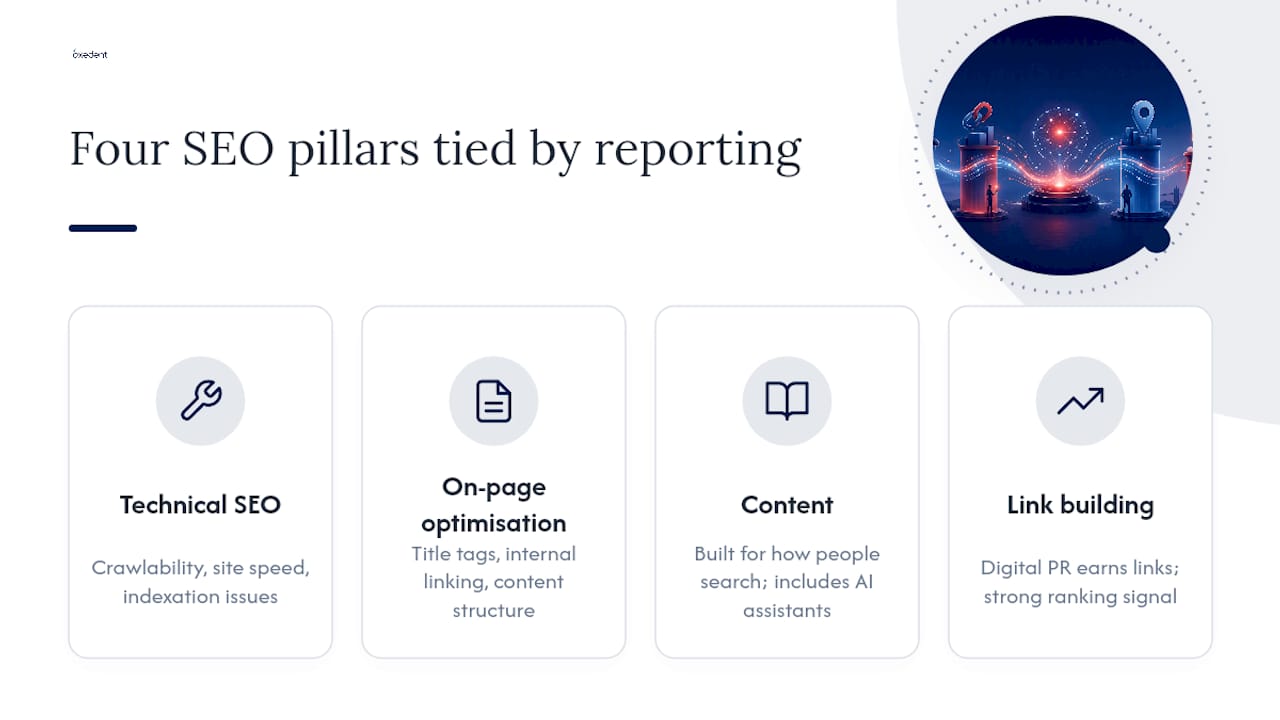

Technical SEO covers crawlability, site speed, structured data, indexation issues and mobile usability. Skip this and everything built on top of it wobbles.
On-page optimisation means title tags, internal linking, content structure and search intent matching for your highest-value pages.
Content is no longer just blog output. Providers increasingly build for how people actually search, which now includes AI assistants. Some London-based agencies have started folding answer-engine optimisation and generative engine optimisation into standard packages, aiming to secure visibility in AI-generated search overviews as well as traditional results.


Link building through genuine digital PR remains one of the strongest ranking signals, though it is also the most commonly faked deliverable in the industry. Ask exactly how links get earned, not bought.
Reporting should show rankings, organic traffic, and conversions monthly, not just a spreadsheet of keyword positions nobody asked about.
How do you choose the right SEO agency?
Start with the questions, not the pitch. A provider worth hiring should answer each of these without hedging:
- What does your audit process cover, and can I see a sample? Vague answers here predict vague delivery later.
- How do you build links, specifically? “Outreach” and “partnerships” are not answers. Ask for named tactics.
- What KPIs will you report monthly, and how do they map to revenue? Traffic without conversions is a hollow number.
- Can you show a case study with a UK client in a comparable sector?
- What’s the contract length, and what happens if I want to leave?
Red flags worth walking away from: guaranteed rankings (“page one in 30 days”), pricing so low it implies templated, undifferentiated work, reluctance to name past clients, and any agency that cannot explain its own methodology in plain terms. Transparent monthly reporting, genuine case studies and rolling engagements without long lock-in periods are increasingly standard trust signals among credible UK providers, so treat their absence as a warning rather than an oversight.
SEO or paid media: which delivers faster for UK businesses?
SEO builds an asset on the right infrastructure like AWS for Ecommerce. Paid media buys a moment. That’s the honest trade-off, and it shapes almost every decision that follows.
Organic rankings compound over months and, once established, keep delivering traffic without a per-click cost. But they take time to build, and competitive terms can take longer still. Paid channels like Google Ads, Google Shopping, and Performance Max can put your business in front of buyers within days, and every pound spent is directly measurable against revenue generated, which makes budget decisions far easier to justify to a finance director.
Social media advertising sits somewhere in between: fast to launch, useful for brand awareness and retargeting, but generally weaker than search-based paid media for direct-response eCommerce sales because it targets intent less precisely.
For product-led retailers specifically, Google Shopping and feed optimisation frequently outperform plain search listings, because shoppers see price, image and reviews before they even click.
The strongest UK agencies rarely present SEO and paid media as rivals. They position SEO as the sustainable, cost-effective long-term channel and recommend running paid media alongside it to cover the gap while organic authority builds. If you’re choosing one to start, match it to your timeline: SEO for a 12 month horizon, paid media for anything you need proof of within a quarter.
How do you check an agency’s track record with UK clients?
Ask for case studies with numbers, not adjectives.
Look for references from businesses in a comparable sector and of a comparable size to yours. An agency that transformed a national retailer’s rankings may have no relevant experience with a 12-page local services site, and the tactics that work at each scale are genuinely different.
Independent verification matters more than anything on the agency’s own site. Check Trustpilot, Clutch, and Google reviews, and read the specific comments, not just the star average. Look for detail: clients describing communication style, reporting cadence and how the agency handled a ranking drop, not generic praise.
Pro Tip: Ask a shortlisted agency for one client reference you can actually call. Genuine providers say yes without hesitation; the ones stalling usually don’t have anyone willing to vouch for them.
Recognised certifications, such as Google Partner status, add a layer of credibility but aren’t proof of skill on their own. Treat them as one signal among several, alongside methodology transparency and the quality of the case studies they can actually show you.
What legal and compliance rules apply to SEO in the UK?
Two frameworks matter most: data privacy and advertising standards.
Any SEO work touching analytics, cookies, or on-site tracking must comply with UK GDPR and the Privacy and Electronic Communications Regulations. That means your provider’s tagging and tracking setup needs a lawful basis for data collection, and consent banners need to function correctly, not just exist for show.
Content and outreach work also falls under Advertising Standards Authority principles where claims are made publicly, particularly around health, finance, or comparative statements (“the UK’s leading provider of X”). An agency writing content on your behalf should understand these boundaries, especially if you operate in a regulated sector like finance, healthcare or legal services.
Link-building carries its own compliance risk. Paid links that aren’t disclosed as sponsored, or link schemes built purely to manipulate rankings, breach Google’s own guidelines and can trigger manual penalties that take months to recover from. A provider who dismisses this risk as unimportant is not one to hire.
What should an SEO contract actually include?
A proper UK SEO contract should specify scope, deliverables, reporting cadence, and exit terms, in writing, before you pay anything.
Pricing models vary because effort scales with site complexity and competitive difficulty. Screaming Frog notes that agencies commonly avoid fixed packages for complex work, instead pricing by consultancy days, bespoke audits, or scoped retainers rather than one-size pricing.
Expect to see:
- Defined deliverables — number of audits, content pieces, or link targets per month, not vague “ongoing optimisation.”
- Reporting frequency and format — monthly, at minimum, with rankings, traffic and conversions.
- Contract length — many credible providers now offer rolling monthly terms rather than 12 month lock-ins.
- Exit clause — notice period and what happens to work already completed (content, links) if you leave.
- Ownership — who owns the content, backlinks and any custom tools built during the engagement.
Avoid providers who resist putting deliverables in writing. A vague scope is how “ongoing SEO” quietly becomes 18 months of invoices with nothing measurable to show for it.
What experience shows works for UK sites
The agencies that deliver consistently share three habits: they show their audit methodology before you sign anything, they report against revenue rather than rankings alone, and they’re honest about timelines rather than promising quick wins. SEO earns its place when you’re building for the next 12 months. When you need proof this quarter, pair it with paid media instead of waiting.
When speed matters more than patience: the paid media route
SEO and paid media solve different problems, and confusing them wastes budget. SEO builds compounding organic authority over months; paid media buys measurable visibility within days. If you’re launching a new product line, riding a seasonal sales peak, or under pressure to hit an acquisition number this quarter, paid media is usually the more sensible first move, not a fallback.

Oxedent runs exclusively as an eCommerce PPC specialist, managing Google Ads, Facebook Ads, Google Shopping, and Performance Max for established online retailers who need scalable, profitable growth rather than clicks for their own sake. That single-channel focus means every campaign decision is judged against return on ad spend, not vanity traffic. For product-led retailers specifically, well-built Google Shopping feeds tend to convert better than standard search listings, because buyers see price and reviews before they click.
Oxedent typically works with brands spending at least £2,000 a month on ads, running audits and campaign management without locking clients into long contracts. If your traffic needs are urgent rather than strategic, start with a PPC audit or proposal and see what a properly structured account could return this month, not next year.
Frequently asked questions
How much does SEO cost in the UK?
Starter retainers from UK agencies often begin around £299–£300 a month for basic packages, with bespoke pricing for larger or more competitive sites based on scope and complexity.
How long does SEO take to show results?
Most UK businesses see measurable movement within three to six months, with significant compounding growth typically taking nine to twelve months for competitive sectors.
Is SEO worth it for a small UK business?
Yes, when treated as a long-term investment rather than a quick fix. It delivers the strongest return for businesses with the patience to build authority over months rather than weeks.
Should I choose SEO or PPC first?
If you need visibility now, start with PPC. If you’re building for sustained, lower-cost traffic over the next year, start with SEO, and add paid media once budget allows.
What questions should I ask an SEO agency before hiring?
Ask how they build links, what their audit covers, how they report against revenue, what the contract length is, and whether they can share a genuine client reference.
Sources
- Search Engine Optimisation (SEO) | Screaming Frog
- SEO Services UK — Technical & Measurable | Beacon