


Scaling revenue with a Google Ads managed service is defined as the structured process of using professional campaign management, smart bidding, and accurate conversion data to grow eCommerce sales profitably. The industry term for this discipline is managed PPC (pay-per-click) services, and it covers everything from account architecture to bid strategy transitions. Most top-performing Google Ads accounts achieve a 4:1 ROAS or higher, well above the median 2:1 industry benchmark. That gap exists because of operational discipline, not bigger budgets. This guide gives eCommerce business owners and marketing managers a clear, step-by-step framework to close that gap and grow revenue without sacrificing margin.
What foundations do you need to scale Google Ads revenue?
The single most important prerequisite for scaling Google Ads revenue is accurate conversion tracking. Without it, every bidding decision your account makes is based on incomplete or misleading data. Before you increase spend, you need to know exactly which clicks are generating real revenue, not just sessions or add-to-cart events.
CRM data integrated with Google Ads bidding systems allows campaigns to optimise towards qualified sales, not just clicks. This closed-loop feedback improves pipeline quality and reduces customer acquisition cost payback time. For eCommerce businesses, this means feeding confirmed purchase data, average order values, and even return rates back into the platform.


Meeting the minimum conversion threshold is non-negotiable before activating advanced automation. Google’s smart bidding requires sufficient signal volume to function reliably. The table below outlines the core tools and data structures you need in place before scaling.
| Foundation element | Why it matters | Minimum standard |
|---|---|---|
| Conversion tracking | Feeds bidding algorithms with real revenue data | All purchase events firing accurately |
| CRM or sales data integration | Closes the feedback loop between ad clicks and actual sales | Weekly or real-time data sync |
| Conversion volume | Enables smart bidding to exit the learning phase | 30+ conversions per month |
| Product feed quality | Drives Shopping and Performance Max performance | No disapprovals, accurate pricing |
| Budget segmentation | Allows spend to flow to best-performing segments | Separate campaigns by margin or category |
Pro Tip: Before scaling spend, audit your conversion tracking setup to confirm every purchase event is firing once and only once. Duplicate conversions inflate your reported ROAS and cause smart bidding to overspend.
The foundations above are not optional extras. They are the infrastructure that makes every subsequent scaling decision reliable. Skipping them is the single fastest way to burn budget without growing revenue.
How do you scale revenue step by step with managed PPC services?
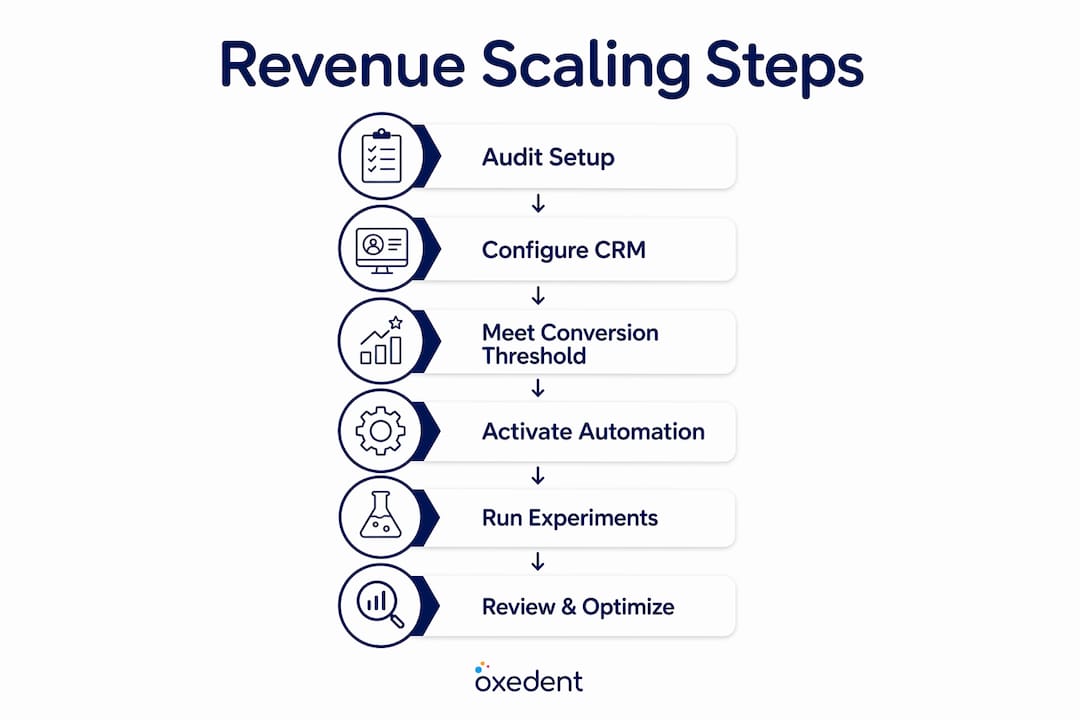
Scaling Google Ads revenue follows a defined progression. Jumping ahead without completing each stage causes volatility and wasted spend. Follow these steps in order.
-
Start with Maximise Conversion Value bidding. This strategy tells Google to find the highest-value purchases within your budget. It works well in the early data-gathering phase because it does not require a fixed ROAS target. Give it at least four weeks to collect clean data before drawing conclusions.
-
Hit 30 conversions per month before switching strategies. Transition to Target ROAS only after achieving 30 or more conversions per month with stable values. Below this threshold, the algorithm lacks enough signal to bid accurately, and performance becomes erratic.
-
Set your initial Target ROAS conservatively. Start at a level close to your current actual ROAS. Setting it too high immediately restricts impressions and starves the campaign of data. A conservative starting point keeps volume flowing while the algorithm adjusts.
-
Move targets in increments of 15–20%. Adjust tROAS targets by only 15–20% at a time to avoid volatile performance. Larger jumps force the algorithm into a new learning phase and can cause spend to collapse or spike unpredictably.
-
Test bid strategy changes with experiments. Google Ads Experiments lets you run a controlled split test between your current strategy and a new one. This removes guesswork and gives you statistically valid data before committing to a change across the full account.
-
Rebalance budgets weekly based on performance. Weekly budget rebalancing based on marginal ROAS is standard practice in mature accounts scaling beyond £5,000 monthly. Spend flows to segments delivering the best incremental efficiency, and underperformers receive cuts before budget is exhausted.
-
Invest in Shopping campaigns for high-volume eCommerce. Shopping campaign investment with Target ROAS bidding focused on revenue rather than conversion count is the preferred approach for established eCommerce brands. Use Performance Planner for scenario modelling and monthly strategy reviews to keep targets realistic.
Pro Tip: Use Google Ads Experiments for every major bid strategy change. Running a 50/50 split for three to four weeks gives you real performance data rather than assumptions. Check out Google Ads for online stores for campaign structures that support clean experiment design.
The numbered process above is not a one-time exercise. Each step feeds the next, and the cycle repeats as your account grows and market conditions shift.

How do automation and human expertise work together in managed services?
Automation handles the volume of decisions no human team can match. AI platforms make micro-adjustments every 15 minutes across thousands of keywords, responding to auction dynamics, device signals, and audience behaviour in real time. That speed and scale is genuinely beyond manual management.
Human expertise fills the gaps that automation cannot cover. Creative testing, feed optimisation, audience strategy, and account restructuring all require judgement that machine learning does not provide. The most effective managed services combine both: automation runs the bids, and experienced managers set the strategy, review performance, and make structural decisions.
The risks of over-automation are real. Campaigns left entirely to algorithms without human review drift towards volume over profitability. Broad match keywords expand into irrelevant territory, Performance Max assets serve the wrong audiences, and budgets shift to brand terms that would have converted anyway. Regular human review prevents these patterns from compounding.
The risks of under-management are equally damaging. Effective account optimisation requires at least 5–15 hours weekly per account. Businesses managing this in-house alongside other responsibilities rarely hit that standard consistently. A managed service resolves this by making expert attention a fixed part of the engagement.
- Automation handles: bid adjustments, budget pacing, audience signal processing, and real-time auction responses
- Human oversight handles: creative testing, feed quality, campaign architecture, negative keyword management, and ROAS target setting
- Review cadence: weekly performance checks, monthly strategy reviews, and quarterly account audits
Pro Tip: If you are running multi-channel paid advertising, ensure your Google Ads manager has visibility of Meta spend. Overlapping audiences and attribution conflicts between channels can distort ROAS figures and lead to poor bidding decisions.
What mistakes cause Google Ads scaling to fail?
The most common scaling failure is activating Target ROAS before the account has enough conversion data. Premature use of advanced strategies without sufficient data causes account volatility and wasted spend. The algorithm cannot learn from a thin data set, and performance becomes unpredictable.
A second major error is using tactics suited to much smaller budgets as spend grows. Accounts spending beyond £25,000 monthly require evolved strategy and investment in infrastructure. Applying a £2,000-per-month account structure to a £30,000-per-month budget creates bottlenecks and inefficiency that no amount of bid adjustment can fix.
The following mistakes appear consistently in accounts that fail to scale:
- Ignoring conversion tracking inaccuracies. Duplicate tags, missing purchase events, or misconfigured values corrupt every bidding decision downstream.
- Making aggressive ROAS target changes. Moving targets by 30–50% at once forces a full learning phase restart and can collapse impression share overnight.
- Over-segmenting campaigns. Splitting campaigns too granularly fragments conversion data across too many buckets, preventing any single campaign from hitting the 30-conversion threshold needed for smart bidding.
- Failing to feed sales data back into Google Ads. Without CRM integration, the algorithm optimises for clicks that look like conversions but may not generate real revenue.
- Neglecting the improve ROAS process as budgets grow. What works at £5,000 per month rarely works unchanged at £50,000 per month. Strategy must evolve with scale.
Managed services should be evaluated by their ability to link ad spend to bottom-line metrics like CAC payback, pipeline velocity, and sales acceptance, not clicks or impressions alone. If your agency reports on clicks and impressions as primary KPIs, that is a signal the account is not being managed for profitability.
Key takeaways
Scaling Google Ads revenue profitably requires accurate conversion data, a disciplined bid strategy progression, and the combination of automation with consistent human oversight.
| Point | Details |
|---|---|
| Conversion tracking first | Accurate purchase tracking is the foundation of every scaling decision. |
| Hit 30 conversions before Target ROAS | Smart bidding needs sufficient data volume to function reliably. |
| Move ROAS targets in 15–20% increments | Gradual changes prevent learning phase restarts and performance volatility. |
| Combine automation with human review | Algorithms handle bids; managers handle strategy, creative, and structure. |
| Evolve strategy as budgets grow | Tactics suited to small accounts create bottlenecks at higher spend levels. |
What I have learned from scaling eCommerce Google Ads accounts
The most consistent pattern I see in accounts that fail to scale is not a bidding problem. It is a data problem. Business owners push to increase spend before their tracking is clean, and then wonder why ROAS deteriorates as budgets grow. The algorithm is only as good as the data it receives. Fix the data first, and scaling becomes far more predictable.
The second thing I have observed is that patience with bid strategy transitions is genuinely rare. The instinct to chase a higher ROAS target immediately is understandable, but it almost always backfires. The accounts that scale most reliably are the ones that move incrementally, test with experiments, and resist the urge to make dramatic changes when performance dips for a week.
Automation is not a replacement for strategy. I have reviewed accounts where smart bidding was running efficiently at a technical level, but the campaign structure was so fragmented that no individual campaign had enough data to learn properly. The fix was consolidation, not more automation. Human judgement about account architecture matters enormously, and no algorithm makes that decision for you.
The businesses that get the most from managed PPC services are the ones that treat the relationship as a genuine partnership. They share sales data, flag seasonal changes, and engage with strategy reviews. The ones that hand over access and disappear tend to see mediocre results, regardless of how good the management is.
— Biplab
How Oxedent helps eCommerce brands scale Google Ads profitably
Oxedent works exclusively with eCommerce brands that are ready to scale. The agency’s entire focus is paid media management for online retail, which means every process, from conversion tracking setup to bid strategy transitions, is built around eCommerce profitability rather than generic account management.

If you are spending on Google Ads and not seeing revenue growth that matches your investment, the issue is almost always structural. Oxedent’s eCommerce PPC management service covers campaign architecture, feed optimisation, smart bidding management, and CRM integration, all without long-term contracts. The agency qualifies clients carefully, which means every brand it works with gets genuine attention rather than a templated approach. If scaling Google Ads revenue is your priority, Oxedent is built for exactly that.
FAQ
What is a Google Ads managed service for eCommerce?
A Google Ads managed service is a professional agency or specialist that handles campaign setup, bidding strategy, tracking, and ongoing optimisation on behalf of an eCommerce business. The goal is profitable revenue growth, not just traffic volume.
How many conversions do I need before using Target ROAS?
You need at least 30 conversions per month with stable values before switching to Target ROAS bidding. Below this threshold, the algorithm lacks sufficient data and performance becomes unreliable.
How quickly can I increase my ROAS targets?
Adjust Target ROAS by no more than 15–20% at a time. Larger changes force the algorithm into a new learning phase, which can cause impression share and revenue to drop sharply.
What does a managed PPC service actually do each week?
Effective Google Ads management requires 5–15 hours weekly per account, covering bid adjustments, budget rebalancing, negative keyword management, creative testing, and performance analysis. Automation handles real-time bid decisions; human managers handle strategy and structure.
How do I know if my managed service is performing well?
Evaluate performance by revenue growth, ROAS trends, and customer acquisition cost, not clicks or impressions. A well-managed account links ad spend directly to bottom-line metrics like pipeline quality and sales conversion rate.