


Search intent is defined as the underlying purpose a user has when typing a query into Google, and the role of search intent in Google Ads is to connect what users want with what your ads offer. When your ads match that purpose, Google rewards you with higher Quality Scores, lower cost-per-click, and better conversion rates. When they do not, you pay more and convert less. Aligning campaigns with user intent improves ad relevance and Quality Scores while lowering CPC. Google’s auction system in 2026 no longer triggers purely on keyword matches. It reads inferred intent, meaning your messaging must speak to what users actually want, not just the words they typed.
What is the role of search intent in Google Ads?
Search intent sits at the centre of every Google Ads auction. Google Ads auctions now trigger on inferred intent rather than exact keyword matches, which fundamentally changes how you build and manage campaigns. The platform reads contextual signals, browsing behaviour, and query patterns to determine what a user is trying to accomplish. Your ad wins the auction not by matching a keyword perfectly, but by satisfying the intent behind it.
This shift has real consequences for ecommerce advertisers. A shopper typing “best running shoes for flat feet” is not ready to buy. They are researching. Serving them a direct purchase ad wastes budget. Serving them a comparison guide or a curated collection page earns trust and keeps them in your funnel. Understanding this distinction is the foundation of every effective Google Ads campaign structure.


Google’s Quality Rater Guidelines confirm that intent satisfaction outranks keyword matching as a quality signal. That means your ad copy, landing page, and keyword selection must all point toward the same user goal. When they do, your Quality Score rises, your CPC falls, and your conversion rate climbs.
What are the different types of search intent?
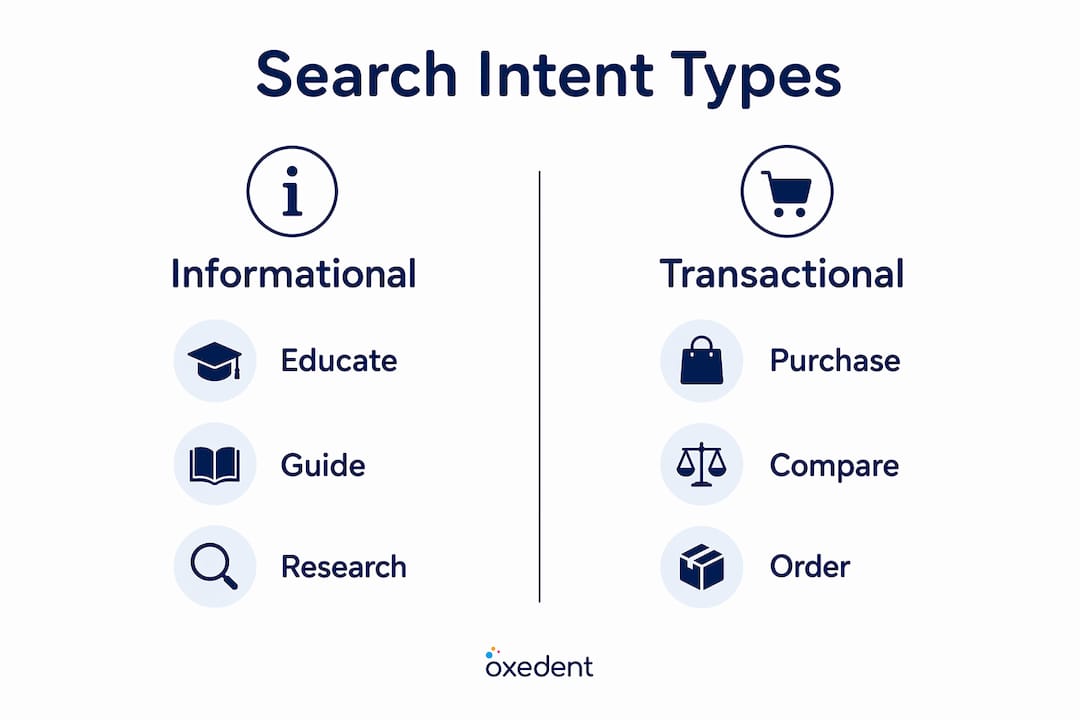
Four main search intent types shape how Google Ads auctions work: informational, navigational, commercial investigation, and transactional. Each maps to a different stage of the buyer’s journey and demands a different ad response.
- Informational intent: The user wants to learn. Queries like “how to choose a protein powder” signal curiosity, not purchase readiness. Ads targeting this intent perform best when they lead to educational content, buying guides, or blog posts rather than product pages.
- Navigational intent: The user wants to reach a specific brand or website. Bidding on your own brand terms captures this intent. Bidding on a competitor’s brand terms here is expensive and rarely converts well.
- Commercial investigation intent: The user is comparing options before buying. Queries like “best noise-cancelling headphones under £200” sit here. These users respond well to comparison content, review pages, and ads that highlight key differentiators.
- Transactional intent: The user is ready to act. Queries like “buy Sony WH-1000XM5” or “order protein powder online” signal imminent purchase. These are your highest-value ad targets and deserve your strongest bids and most direct landing pages.
Ignoring these distinctions costs you money. Sending a transactional ad to an informational query burns budget on clicks that will not convert. Sending an educational ad to a transactional query loses sales to competitors who match the moment better.
Pro Tip: Map every ad group to a single intent type before writing a single line of copy. This one step prevents the most common and costly form of budget waste in Google Ads.

How does intent alignment improve Google Ads performance?
Intent alignment directly raises your Quality Score, which is Google’s rating of how relevant your ad and landing page are to the user’s query. A higher Quality Score means you pay less per click for the same ad position. Landing pages aligned to the user’s intent type significantly improve conversion rates. That is not a marginal gain. It is the difference between a campaign that scales and one that drains budget.
The relationship between keywords, ad copy, and landing pages must be tight. If a user searches “vegan protein powder,” your ad should mention vegan protein, and your landing page should open with vegan protein products. Any gap in that chain signals an intent mismatch to both the user and Google’s algorithm.
Google’s AI models now infer commercial intent from informational queries by detecting problem-solving needs. This expands your auction eligibility beyond explicit purchase terms. A user searching “how to fix slow metabolism” may trigger ads for meal plans or supplements if Google’s AI detects a commercial need beneath the informational surface.
| Intent signal | Ad copy focus | Landing page type | Bid priority |
|---|---|---|---|
| Informational | Educate, guide, inform | Blog post, buying guide | Low |
| Commercial investigation | Compare, highlight benefits | Category or comparison page | Medium |
| Transactional | Buy now, clear CTA | Product or checkout page | High |
| Navigational | Brand recognition | Brand homepage or landing page | Medium |
Pro Tip: Use your Search Terms report weekly to identify intent mismatches. Queries triggering transactional ads but generating zero conversions are a clear sign of intent drift. Add them as negative keywords immediately.
What is the difference between search intent and buying intent?
Search intent describes what a user wants from their query. Buying intent describes how close they are to making a purchase. The two overlap but are not the same, and confusing them costs campaigns dearly.
A user with informational intent might eventually buy from you, but not today. A user with transactional intent is ready now. Buying intent is a subset of search intent, concentrated in the transactional and late-stage commercial investigation categories. Recognising this distinction lets you allocate bids where they generate the most return.
Certain query modifiers signal strong buying intent. Words like “buy,” “order,” “discount,” “deal,” “free delivery,” and “in stock” indicate a user who is ready to act. Queries containing model numbers, sizes, or specific product names also carry high buying intent. These are the queries where your bids should be highest and your landing pages most direct.
Transactional bid clusters yield significantly higher conversion rates than commercial or informational clusters. Budget allocation should reflect this reality. Informational queries rarely justify paid spend unless you are building a remarketing audience. Commercial investigation queries deserve moderate bids. Transactional queries deserve your maximum bids and tightest ad-to-page alignment.
The practical recommendation is to separate campaigns by intent tier. Run a transactional campaign with high bids and direct product landing pages. Run a separate commercial investigation campaign with moderate bids and comparison or category pages. Keep informational queries out of paid campaigns unless you are feeding a remarketing funnel deliberately.
How to apply search intent strategies to your Google Ads campaigns
Translating intent understanding into campaign structure requires a repeatable process. These steps give you a framework you can apply immediately.
-
Audit your current keyword list by intent type. Sort every keyword into one of the four intent categories. Any keyword that does not fit a clear category needs closer examination. Ambiguous keywords often generate mixed-intent traffic that is hard to convert.
-
Group keywords by intent, not match type. Traditional campaign structures group keywords by theme or match type. Intent-based grouping is more effective. Put all transactional keywords for a product category in one ad group. Put all commercial investigation keywords in another. This lets you write copy and choose landing pages that match the intent precisely.
-
Write ad copy for the intent stage, not just the product. Transactional copy leads with price, availability, and a direct call to action. Commercial investigation copy leads with comparisons, reviews, or key benefits. Informational copy leads with the answer to the question. Mixing these tones within a single ad group confuses users and lowers click-through rates.
-
Match landing pages to intent. Transactional queries need action-oriented landing pages with clear calls to action, product images, and pricing. Commercial investigation queries need category pages or comparison content. Sending every user to your homepage is one of the most common and damaging mistakes in ecommerce PPC. You can also apply contextual product information principles to make landing pages more persuasive at each intent stage.
-
Apply the 3 C’s framework to decode SERPs. The 3 C’s framework examines content type, content format, and content angle for any given query. Look at what Google ranks organically for your target keywords. If the top results are product pages, users want to buy. If they are guides, users want to learn. Your ads and landing pages should mirror the dominant content type Google surfaces.
-
Use audience signals alongside keywords. Keywords serve as anchors within an intent-driven strategy layered with user behaviour and contextual signals. In Performance Max and broad match campaigns, pair your keywords with audience signals that reflect your ideal buyer’s behaviour. This helps Google’s AI serve your ads to users whose intent matches your offer, even when their exact query does not contain your target keyword.
-
Monitor and refine continuously. Search intent is not static. Seasonal shifts, product launches, and market changes alter what users mean when they type the same query. Review your Search Terms report monthly and adjust negative keywords, bids, and landing pages to stay aligned with current intent patterns. A well-structured smart bidding approach reinforces intent signals at the bid level, ensuring your budget flows toward the highest-value queries.
Pro Tip: When testing broad match or Performance Max campaigns, set up intent-based audience signals from the start. Without them, Google’s AI optimises for volume rather than intent quality, which inflates spend without improving conversion rates.
Key takeaways
Aligning Google Ads campaigns to search intent is the single most effective way to raise Quality Scores, reduce wasted spend, and increase conversion rates across every campaign type.
| Point | Details |
|---|---|
| Intent drives auctions | Google Ads triggers on inferred intent, not just keyword matches, so messaging must satisfy user goals. |
| Four intent types matter | Informational, navigational, commercial investigation, and transactional each require different copy and landing pages. |
| Buying intent deserves highest bids | Transactional queries signal purchase readiness and should receive your strongest bids and most direct pages. |
| Landing page alignment is non-negotiable | Mismatched landing pages lower Quality Scores and conversion rates regardless of how good your ad copy is. |
| Intent-based grouping outperforms keyword grouping | Structuring ad groups by intent type produces tighter relevance and better campaign performance. |
Why intent-based thinking changed how I approach every campaign
I spent years watching advertisers obsess over match types while ignoring the far more important question: what does this person actually want right now? The shift from keyword-centric to intent-centric thinking is not a subtle refinement. It is a complete change in how you evaluate campaign health.
The most common mistake I see is treating commercial investigation queries the same as transactional ones. Both look like “buying” behaviour on the surface. But a user searching “best running shoes for marathon training” is not the same as one searching “buy Brooks Ghost 16 size 10.” The first needs to be convinced. The second needs to be served quickly and clearly. Blending these into one campaign dilutes your message and wastes your budget on the wrong moment.
What actually works is building campaigns around intent tiers and accepting that not every click should lead to a purchase page. Some clicks should lead to content that builds trust and feeds your remarketing lists. The brands that do this well treat their Google Ads account as a full-funnel system, not a collection of isolated keyword bids. If you want to understand how paid search fits into the broader growth picture, the role of PPC in ecommerce growth is worth reading before you restructure anything.
The other warning I would give is about over-segmentation. You do not need a separate campaign for every intent micro-category. You need clear intent tiers, clean negative keyword lists, and landing pages that match the moment. Keep it structured but not rigid. Google’s AI does a lot of the heavy lifting now, provided you give it the right signals to work with.
— Biplab
How Oxedent helps you get intent-based Google Ads right
Getting intent alignment right across a full ecommerce account takes time, data, and experience. Most advertisers know the theory but struggle to execute it consistently at scale.

Oxedent specialises exclusively in ecommerce PPC, which means every campaign we manage is built around intent-driven structures, not generic keyword lists. We audit your current account to identify intent mismatches, restructure ad groups by intent tier, and align landing pages to the queries that actually convert. If you are ready to stop paying for clicks that do not convert, our ecommerce PPC management service is built for exactly this kind of work. Talk to us about your account and we will show you where intent is costing you money.
FAQ
What is search intent in Google Ads?
Search intent is the purpose behind a user’s query. In Google Ads, it determines which ads are relevant to show, with Google’s auction system now prioritising intent alignment over exact keyword matching.
How does search intent affect Quality Score?
Ads and landing pages that match the user’s intent receive higher Quality Scores from Google. Higher Quality Scores lower your cost-per-click and improve your ad position without increasing your bid.
What is the difference between commercial and transactional intent?
Commercial investigation intent signals a user who is researching before buying. Transactional intent signals a user who is ready to purchase now. Transactional queries deserve higher bids and direct product landing pages.
Should I bid on informational keywords in Google Ads?
Informational keywords rarely convert directly to sales, so they do not justify high bids in most ecommerce campaigns. They are most useful for building remarketing audiences rather than driving immediate purchases.
How do I find the search intent behind my keywords?
Search the keyword in Google and examine the organic results. If product pages dominate, the intent is transactional. If guides or articles dominate, the intent is informational. Your ads and landing pages should mirror what Google already surfaces organically.