


A PPC agency’s core role in scaling is to connect ad spend with measurable business outcomes, managing campaigns so that every pound invested drives profitable customer acquisition rather than empty clicks. For established eCommerce businesses, paid media management is not simply about increasing budgets. It is about diagnosing what limits growth, applying the right strategic levers, and building a campaign structure that holds up as spend increases. The role of a PPC agency in scaling spans Google Ads, Google Shopping, Performance Max, and Facebook Ads, with success measured through cost per acquisition (CPA), return on ad spend (ROAS), and conversion quality rather than impressions or click-through rates.


How do PPC agencies diagnose and overcome common scaling challenges?
Scaling PPC is frequently a measurement or landing page problem masquerading as a bidding problem. This distinction matters enormously. When growth stalls, the instinctive reaction is to lower bids or cut spend. A specialist agency does the opposite: it investigates the structural foundation before touching a single bid.
The diagnostic process typically uncovers several recurring issues that block profitable growth:
- Conversion rate problems. A campaign can generate strong click volume but fail to convert because the product page, checkout flow, or pricing is misaligned with buyer intent. Fixing the conversion rate multiplies the value of every pound already being spent.
- Catalogue allocation errors. Budget is often concentrated on a handful of products while high-margin or high-velocity items receive little or no investment. Agencies audit catalogue performance to redistribute spend where it generates the best return.
- Organic rank oversight. Bidding aggressively on terms where you already rank organically wastes budget. Agencies cross-reference paid and organic performance to avoid cannibalisation.
- Misaligned KPIs. Reporting on clicks or cost per lead alone obscures whether campaigns are generating revenue. Strong PPC agencies optimise against CPA and ROAS, linking every pound of ad spend to actual revenue outcomes.
Effective scaling also requires setting performance targets at product or campaign segment level rather than applying uniform account-wide goals. A new product launch has different maturity and margin dynamics than a best-selling line, and treating them identically produces distorted results.
Pro Tip: Before requesting a budget increase from your agency, ask for a segment-level performance breakdown. If CPA varies significantly across product categories, the opportunity is in reallocation, not additional spend.
What strategic levers do PPC agencies use to scale campaigns profitably?
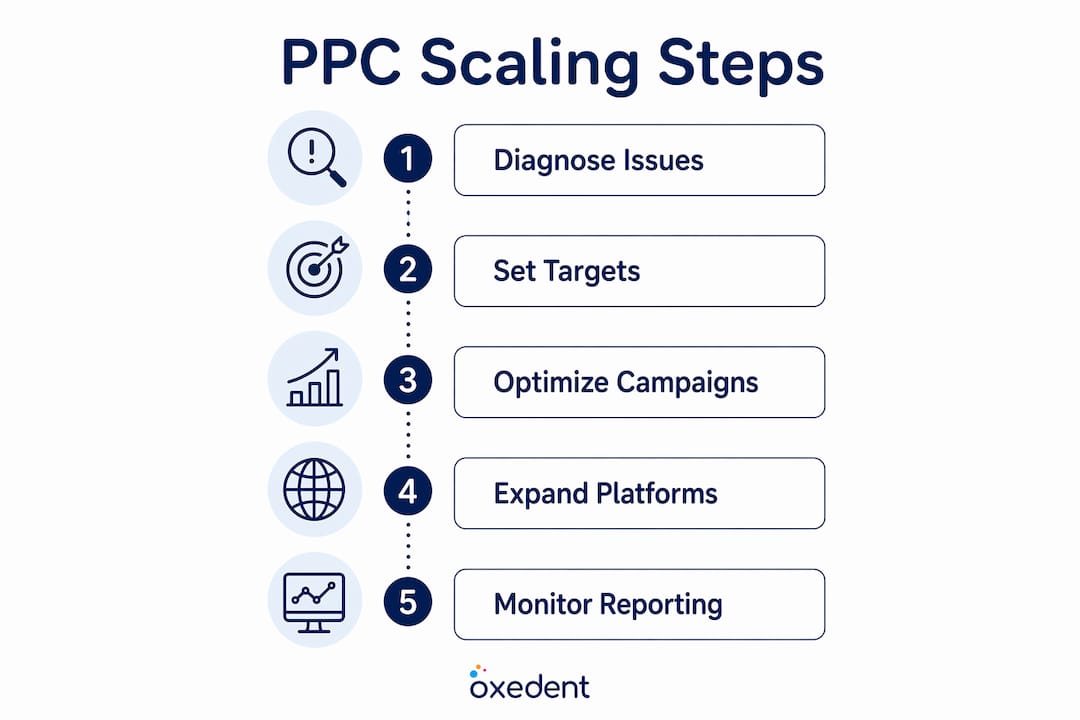
Scaling is not a single action. It is a sequence of decisions made in the right order, with each step informed by data from the previous one. Experienced agencies follow a structured approach to scaling business with PPC that avoids the margin erosion that comes from simply pushing more budget into underperforming structures.
-
Establish the right KPIs first. Customer acquisition cost (CAC) and ROAS are the primary scaling metrics. Agencies that report on clicks or impressions without tying them to revenue are not managing for growth. Every scaling decision should be anchored to a profitability threshold.
-
Find the first ceiling before increasing budget. Experienced PPC practitioners identify diminishing returns early and pivot strategies before margin erodes. This means identifying the point at which incremental spend produces declining ROAS, then addressing the underlying constraint rather than pushing through it.
-
Prioritise conversion rate optimisation. Agencies use diagnostics to find the first ceiling in ROI and then focus on CRO, website improvements, or landing page restructuring. A 10% improvement in conversion rate effectively reduces CPA by the same proportion without touching bids.
-
Expand to new platforms strategically. Scaling campaign reach across multiple channels allows for greater audience access and reduces the risk of over-reliance on a single platform. Moving from Google Shopping into Performance Max, or from search into Facebook Ads, opens incremental revenue streams that a single-channel approach cannot access.
-
Implement rule-based bid automation. Bid automation should be transparent and editable, with clear decision logic that can be audited. Black-box automation breaks at scale because no one can explain why bids moved or how to correct course when performance shifts.
Pro Tip: When expanding to a new platform, treat it as a separate scaling exercise with its own baseline period. Blending new channel data into existing account reporting obscures whether the expansion is genuinely additive.
How do PPC agencies enable scalable workflows for growing eCommerce businesses?

One of the less-discussed PPC agency advantages is operational capacity. As campaigns grow in complexity, the internal resource required to manage them grows proportionally. Keyword research, bid adjustments, feed optimisation, audience segmentation, and performance reporting each demand specialist attention. For most eCommerce marketing teams, absorbing that workload while managing broader business priorities is not realistic.
PPC agencies enable scalability without burdening internal resources by handling campaign launches, optimisations, and reporting workflows directly. This frees your internal team to focus on product development, customer experience, and commercial strategy rather than campaign administration.
The workflow benefits compound as campaigns scale:
- Faster campaign launches. Agencies with established processes can build and launch new campaigns, ad groups, or product feeds significantly faster than an internal team building from scratch.
- Consistent bid management. Agencies monitor performance daily and adjust bids in response to auction dynamics, competitor activity, and seasonal demand shifts. This consistency is difficult to maintain internally without dedicated resource.
- Structured reporting cadence. Regular, margin-aware reporting keeps decision-makers informed without requiring them to interrogate the platform directly. Flexible PPC budget control allows businesses to adjust quickly to demand changes or market conditions while maintaining ROI focus.
- Inventory-aware pacing. Scaling agencies pace campaign increases based on restock cycles and unit economics to avoid overextension. Spending aggressively on a product that is about to go out of stock wastes budget and damages account quality scores.
The result is a campaign operation that scales in capability without requiring proportional growth in your internal headcount. For eCommerce businesses managing hundreds or thousands of SKUs across Google Shopping and Performance Max, this operational leverage is a direct commercial advantage. You can explore how specialist PPC partners structure these workflows for growing retail brands.
What role does transparent reporting play in profitable PPC scaling?
Reporting is where most scaling efforts either gain traction or quietly fail. Vanity metrics, such as raw click volume, cost per click, or impression share, tell you nothing about whether your campaigns are generating profitable revenue. Accurate attribution and connecting spend to sales is the foundation of any scaling decision worth making.
A well-structured agency reporting framework tracks the full conversion path: from the search query that triggered an ad, through the click, to the purchase, the order value, and the margin on that order. Top PPC partners optimise full customer journey tracking, linking paid search queries to conversions and revenue to avoid misleading metrics. This matters because a campaign with a low CPA but a high proportion of low-margin products may be less profitable than one with a higher CPA but stronger average order values.
The table below illustrates the difference between vanity metrics and the revenue-linked data points that actually inform scaling decisions:
| Vanity metric | Revenue-linked alternative |
|---|---|
| Click-through rate | Conversion rate by product category |
| Cost per click | Cost per acquisition by margin tier |
| Impression share | Revenue attributed per campaign segment |
| Total ad spend | ROAS by channel and audience segment |
Granular data at this level allows agencies to identify which segments are genuinely scalable and which are consuming budget without contributing proportionally to revenue. First-party data, platform diagnostics, and feed-level performance reporting all feed into this picture.
Pro Tip: Ask your agency to segment ROAS reporting by product category and traffic source, not just at account level. Account-level ROAS can look healthy while individual segments quietly erode margin.
Key takeaways
A PPC agency’s role in scaling is to diagnose structural constraints, apply revenue-linked optimisation, and expand campaign reach without sacrificing profitability or overburdening internal teams.
| Point | Details |
|---|---|
| Diagnose before adjusting bids | Scaling failures are often conversion or catalogue problems, not bidding problems. |
| Use revenue-linked KPIs | Optimise against CPA and ROAS, not clicks or impressions, to measure genuine growth. |
| Scale platforms incrementally | Expand to new channels only after identifying diminishing returns on the current one. |
| Automate with transparency | Rule-based, auditable bid automation prevents black-box decisions that break at scale. |
| Free internal resource strategically | Agencies absorb operational complexity so your team can focus on commercial priorities. |
Why I think most eCommerce brands scale PPC in the wrong order
Most brands I speak with arrive at the scaling conversation having already increased their budget. They have pushed more spend into campaigns that were not yet ready for it, watched ROAS decline, and concluded that PPC does not work at scale. The problem is almost never the channel. It is the sequence.
The brands that scale profitably do one thing differently: they fix the foundation before they fund the growth. They audit conversion rates at product level, clean up their feed, and identify which segments actually generate margin before they ask the agency to spend more. The agency’s job at that point is not to find new audiences. It is to make the existing structure perform well enough to justify expansion.
The other pattern I see consistently is over-reliance on a single platform. Google Shopping is powerful, but it has a ceiling. Once you have captured the available demand at a profitable CPA, the only way to grow is to find incremental audiences elsewhere, whether that is Performance Max, Facebook Ads, or a combination. Agencies that specialise in eCommerce PPC understand this ceiling instinctively. Generalist agencies often push more budget into the same channel instead.
If you are evaluating whether your current campaigns are ready to scale, the question to ask is not “how much more should we spend?” It is “what is the conversion rate on our top ten products, and what would a 15% improvement in that rate do to our CPA?” That answer tells you where the real opportunity sits. You can read more about how PPC drives eCommerce growth in a way that is built to last.
— Biplab
How Oxedent supports eCommerce brands ready to scale
Oxedent is a specialist eCommerce PPC agency with a single operational focus: scaling paid media for online retail brands profitably. The team manages Google Ads, Google Shopping, Performance Max, and Facebook Ads with a strict emphasis on ROAS, CPA, and margin rather than vanity metrics.

If your campaigns have reached a growth ceiling, or if you are spending without a clear picture of which segments are generating revenue, Oxedent’s diagnostic approach identifies exactly where the constraint sits. From feed optimisation and catalogue allocation to multi-channel expansion and bid automation, the agency handles the operational complexity so your team does not have to. Explore Oxedent’s eCommerce PPC management service to see how the process works and whether it fits your current stage of growth.
FAQ
What is the role of a PPC agency in scaling eCommerce campaigns?
A PPC agency diagnoses structural constraints, optimises campaigns against revenue-linked KPIs such as ROAS and CPA, and expands reach across channels to drive profitable growth. Its role goes beyond bid management to include conversion rate analysis, catalogue optimisation, and transparent performance reporting.
Why does scaling PPC often fail without agency support?
Scaling without specialist support frequently leads to budget increases in underperforming structures, producing declining ROAS and wasted spend. Agencies identify the root cause, whether a conversion rate problem, a catalogue allocation issue, or a platform ceiling, before recommending any increase in spend.
How do PPC agencies decide when to expand to new platforms?
Agencies identify the point at which incremental spend on the current platform produces diminishing returns, then evaluate new channels for incremental audience access. Expanding to Performance Max, Facebook Ads, or Amazon PPC is a data-led decision based on platform-specific ROI diagnostics, not a default response to growth targets.
What KPIs should eCommerce businesses use to measure PPC scaling success?
The primary KPIs for scaling are ROAS, CPA, and revenue per campaign segment. Metrics such as click-through rate or impression share do not indicate whether campaigns are generating profitable revenue and should not drive scaling decisions.
How quickly can a PPC agency scale an eCommerce account?
Scaling pace depends on inventory levels, conversion rate baseline, and current campaign structure. Agencies that pace increases based on restock cycles and unit economics avoid margin-eroding overextension, which means sustainable scaling typically takes weeks to months rather than days.