


Campaign testing in PPC is the practice of running controlled experiments on ads, audiences, and landing pages to identify what genuinely improves performance rather than what merely looks promising. The industry term for this discipline is A/B testing or split testing, and its role in PPC campaign optimisation is not optional for brands serious about profitability. Google Ads offers built-in experimentation features, and platforms like GrowthBook provide structured frameworks for running statistically sound tests. The data is clear: sustained rigorous testing can produce cumulative conversion improvements of 30%–49% over time. That figure alone makes the case for treating testing as a core function, not an afterthought.
How does campaign testing optimise PPC performance?
The direct impact of disciplined A/B testing on PPC performance is measurable and compounding. The typical win rate for PPC A/B tests sits at 20%–30%, meaning you need to run 4–5 tests to find one winning variation. Teams running five tests per month typically identify one to two winners. That cadence matters because each winner builds on the last.


The median conversion uplift from a single winning test is 1.88%, and 36.3% of tests yield statistically significant lifts. Those numbers sound modest in isolation. Compounded across 12 months of consistent testing, they translate into the 30%–49% cumulative gains referenced above.
Testing velocity matters as much as individual results. Testing momentum and sustained frequency produce more value than chasing a single breakthrough test. A team that runs two tests per month consistently will outperform a team that runs one perfect test per quarter.
Isolating one variable per test is what makes results interpretable. If you change a headline and a call-to-action simultaneously, you cannot know which change drove the result. That ambiguity wastes budget and produces misleading conclusions. Google Ads’ Experiments feature is built precisely to enforce this discipline, letting you split traffic cleanly between a control and a single variant.
Pro Tip: Set a minimum statistical significance threshold of 95% before declaring any test a winner. Anything below that is directional data, not a decision.
What are the common pitfalls in PPC testing?
Most PPC testing programmes fail not because of bad ideas but because of poor process. The mistakes are predictable, and knowing them in advance saves significant budget.
The most frequent errors include:
- Testing multiple variables at once. Changing several elements simultaneously causes wasted media spend because you cannot isolate what drove the result. Every test must have a single independent variable.
- Shifting goalposts after the test starts. Deciding mid-experiment that you now care about click-through rate instead of conversion rate is a form of bias. It produces data that confirms what you wanted to believe.
- Running underpowered tests. A test with insufficient traffic volume will never reach statistical significance. You end up with noise, not insight.
- Shipping flat results. Deploying non-significant test results is a costly and common error. If a test does not reach significance, treat it as a failed test. Deploying it anyway creates hidden maintenance costs with zero performance benefit.
- Ignoring secondary metrics. A test that improves click-through rate while degrading conversion rate is not a win. You need guardrails on supporting metrics.
The solution to most of these errors is defining an Overall Evaluation Criterion before any test begins. Pre-defining your OEC prevents teams from reinterpreting results after the fact. Agree on the primary success metric, the minimum detectable effect, and the decision rules before you launch. Write them down. Commit to them.
Knowing which PPC agency red flags to watch for can also help you identify whether your current testing approach is being managed with the rigour it requires.
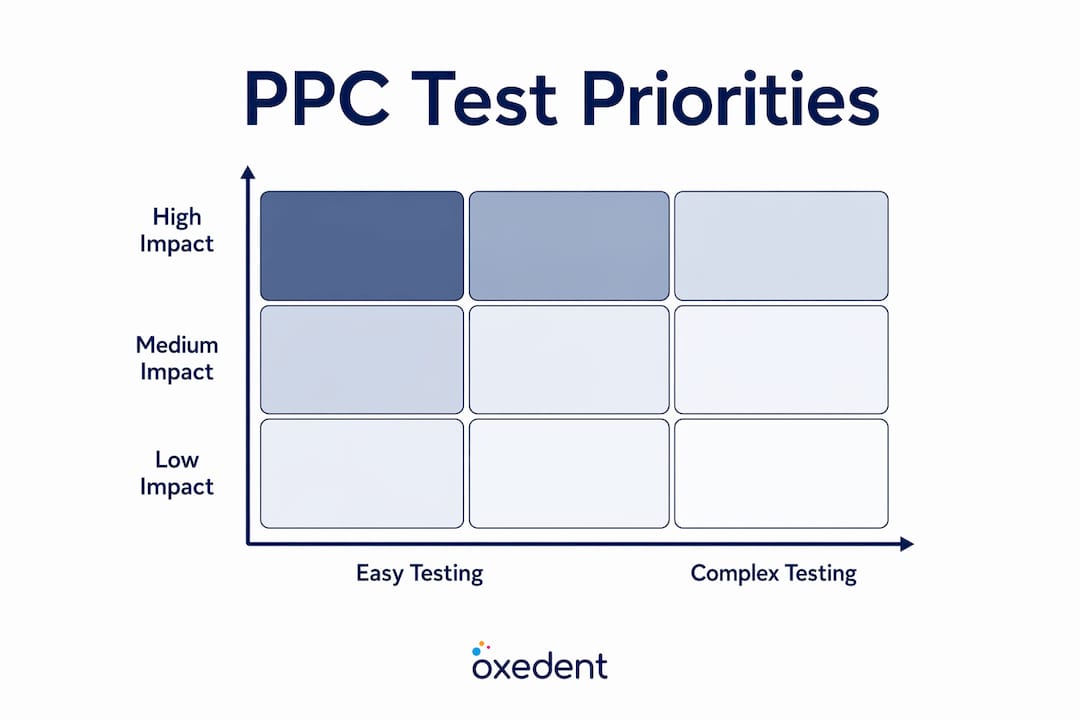
Pro Tip: Prioritise tests by potential impact multiplied by ease of implementation. High-impact, low-effort tests should run first to build momentum and generate early learnings.
Which PPC elements should you test first?
Not all campaign elements carry equal testing value. Prioritising the right variables in the right sequence produces faster, cleaner results. Testing should follow a sequential order, isolating each element before moving to the next.
Here is the recommended testing sequence for most eCommerce PPC campaigns:
- Ad headlines. Headlines carry the most weight in determining click-through rate. Test value propositions, urgency, and specificity against each other.
- Ad descriptions. Once you have a winning headline, test descriptions for conversion intent. Focus on benefits, social proof, and calls-to-action.
- Calls-to-action. “Shop Now” versus “Get 20% Off Today” can produce meaningfully different results depending on your audience and category.
- Audience segments. Test remarketing lists, customer match audiences, and in-market segments against each other to find the most profitable targeting.
- Landing pages. Landing page tests often produce the largest uplifts. Test page layout, headline copy, product imagery, and trust signals. Your landing page checklist before activating Google Ads is a good starting point.
- Bidding strategies. Test Target CPA against Target ROAS, or manual bidding against smart bidding, once you have sufficient conversion data.
| Element | Impact Potential | Testing Complexity |
|---|---|---|
| Ad headlines | High | Low |
| Ad descriptions | Medium | Low |
| Calls-to-action | Medium | Low |
| Audience segments | High | Medium |
| Landing pages | Very high | Medium to high |
| Bidding strategies | High | High |
Use automatic ad rotation set to “Do not optimise” during tests so Google does not skew impressions towards one variant before you have enough data. Statistical significance requires patience. Bi-weekly or monthly testing cycles work well for most eCommerce accounts with moderate traffic volumes.

How does testing feed into PPC campaign optimisation and scaling?
Test results are only valuable if they inform decisions. The connection between testing and PPC campaign structure is direct: winning variants should be deployed, budgets should shift towards proven performers, and losing variants should be retired without sentiment.
Test-informed budget reallocation and gradual scaling reduce risk and maximise campaign efficiency. The key metric to watch during scaling is marginal CPA. As you increase spend on a winning ad set, monitor whether cost per acquisition rises. If it does, you have found the efficiency ceiling for that configuration. Scale gradually and retest at each new spend level.
The risks of ignoring test data are concrete:
- Budget continues flowing to underperforming ads, inflating cost per acquisition.
- Directional metrics such as impressions and clicks create false confidence.
- Scaling without validated creative or audience data amplifies existing inefficiencies rather than correcting them.
- Teams make decisions based on intuition rather than evidence, which produces inconsistent results.
Consider a practical scenario. An eCommerce brand running Google Shopping campaigns tests two product feed titles: one using the manufacturer’s default title and one rewritten with high-intent search terms. The rewritten title produces a 22% higher click-through rate and a 14% lower cost per conversion. Reallocating budget to the winning feed configuration and applying the same rewrite logic across the catalogue compounds that gain across hundreds of products. That is how Google Shopping strategy scales through testing rather than through spend alone.
Ongoing audits sustain performance. Test wins degrade over time as audiences shift, competitors respond, and platform algorithms change. Schedule quarterly reviews of your top-performing variants to confirm they are still outperforming alternatives.
How do you measure PPC testing programme success?
Measuring the success of a testing programme requires looking beyond individual test results. The goal is to build a system that produces reliable, compounding gains over time.
Key metrics to track at programme level:
- Conversion rate uplift across the account, measured quarter over quarter.
- Return on ad spend (ROAS) as the primary efficiency indicator for eCommerce campaigns.
- Cost per acquisition (CPA) to confirm that scaling does not erode profitability.
- Test velocity: the number of completed, statistically significant tests per month.
- Win rate: the percentage of tests that produce a statistically significant positive result.
Only 17% of marketers routinely run landing page A/B tests. That figure reveals how much competitive advantage is available to teams willing to test systematically. The majority of your competitors are not doing this consistently.
Setting guardrails on secondary metrics prevents primary metric improvements from degrading overall campaign health. If your primary metric is conversion rate but your guardrail metric is average order value, a test that lifts conversions while reducing order value may not be a net positive. Explicit guardrails on secondary metrics protect you from optimising one number at the expense of the business.
Document every test, including the ones that fail. Failed tests are learnings. They tell you what your audience does not respond to, which is equally valuable. Share results across your team to build collective knowledge and avoid repeating the same experiments.
Pro Tip: Integrate your testing results into a shared log with columns for hypothesis, variable tested, result, significance level, and decision taken. Review this log monthly to spot patterns and inform your next testing cycle.
Key takeaways
Disciplined, high-velocity PPC testing is the most reliable path to compounding conversion gains and sustainable return on ad spend.
| Point | Details |
|---|---|
| Test one variable at a time | Isolating a single variable per test produces clear, actionable results and prevents wasted budget. |
| Define success before you start | Pre-agreeing your OEC and decision rules prevents bias and ensures tests produce reliable outcomes. |
| Prioritise headlines and landing pages | These two elements carry the highest impact potential and should anchor your testing schedule. |
| Never deploy flat results | Non-significant test outcomes should be retired, not deployed, to avoid hidden costs and false gains. |
| Measure programme velocity, not just wins | Sustained testing frequency compounds gains over time and outperforms sporadic single-test approaches. |
Testing discipline is what separates good PPC from great PPC
I have reviewed dozens of PPC accounts over the years, and the pattern is consistent. Brands that struggle to scale are rarely short of ideas. They are short of discipline. They test three things at once, declare a winner after five days, and move on before the data is meaningful. Then they wonder why their cost per acquisition creeps up every quarter.
The most impactful shift I have seen in any account is not a clever new bidding strategy or a creative breakthrough. It is the moment a team commits to one variable, one test, one decision rule, and sticks to it. That commitment changes the quality of every decision that follows.
The uncomfortable truth about PPC testing is that most of your tests will not produce a winner. A 20%–30% win rate means 70%–80% of your tests will teach you what does not work. That is not failure. That is the process. The teams that accept this and maintain their testing cadence are the ones that accumulate the compounding gains. The teams that stop testing after a few flat results are the ones that plateau.
Organisational momentum is real. When a team shares test results openly, celebrates disciplined process over lucky outcomes, and treats every failed test as a data point rather than a setback, the culture shifts. Decisions become faster, more confident, and more accurate. Budget stops flowing to gut-feel choices and starts following evidence.
If you are running eCommerce PPC campaigns and you are not running at least two structured tests per month, you are leaving performance on the table. The data exists. The tools exist. The only missing ingredient is the commitment to use them properly.
— Biplab
Ready to scale your PPC campaigns with disciplined testing?
If you want your PPC campaigns to grow efficiently rather than expensively, testing cannot be an occasional exercise. At Oxedent, we build testing frameworks into every campaign we manage, from Google Ads and Google Shopping to Performance Max. Every budget decision we make is backed by test data, not assumptions.

Oxedent works exclusively with eCommerce brands that are ready to scale. Our approach to eCommerce PPC management is built around continuous experimentation, waste reduction, and profitability. If your current campaigns are running without a structured testing programme, we would be glad to show you what a disciplined approach looks like in practice.
FAQ
What is the role of campaign testing in PPC?
Campaign testing in PPC is the process of running controlled experiments on ad variables to identify what genuinely improves performance. It replaces guesswork with evidence, enabling data-driven decisions on creative, targeting, and bidding.
How many PPC tests do you need to find a winner?
The typical win rate for PPC A/B tests is 20%–30%, meaning you need to run 4–5 tests to find one winning variation. Teams running five tests per month typically identify one to two winners.
What is the biggest mistake in PPC a/b testing?
Testing multiple variables simultaneously is the most common and costly error. It makes it impossible to isolate what drove the result, wasting media spend and producing misleading conclusions.
How long should a PPC test run before you evaluate results?
A test should run until it reaches at least 95% statistical significance, regardless of how promising early results look. Ending tests prematurely based on directional data is a leading cause of false positives.
Which PPC elements produce the highest testing returns?
Landing pages and ad headlines consistently produce the highest impact when tested. Landing page experiments in particular are underused, with only 17% of marketers running them routinely, making them a significant source of competitive advantage.