


Many ecommerce businesses treat Google Ads as a brand awareness tool and wonder why their revenue growth stalls. The role of Google Ads in ecommerce revenue is far more direct than that. When built correctly, Google Ads connects your products to buyers who are actively searching, compares, and ready to purchase. The average ecommerce ROAS across 18,000+ brands settled near 2.87:1 in 2025 to 2026, with top performers reaching 4x to 7x through careful management. This guide covers how each campaign type drives sales, what metrics actually matter, and what separates the brands scaling profitably from those burning budget.
Table of Contents
- Key takeaways
- The role of Google Ads in ecommerce revenue
- Measuring performance: ROAS, conversion rates, and campaign phases
- Strategies for maximising Google Ads revenue
- Challenges that quietly drain ecommerce ad budgets
- My honest take on Google Ads for ecommerce
- Ready to make your Google Ads work harder?
- FAQ
Key takeaways
| Point | Details |
|---|---|
| Google Ads drives direct revenue | When structured correctly, Google Ads captures high-intent buyers at the moment they are ready to purchase. |
| ROAS benchmarks vary widely | Average ecommerce ROAS sits near 2.87:1, but the median is lower, meaning half of accounts operate below 2:1. |
| Campaign type determines your role | Search and Shopping capture demand; Performance Max and Demand Gen build it — both are needed. |
| Feed quality is foundational | Your Google Merchant Center feed directly determines Shopping ad relevance and revenue potential. |
| Attribution shapes decisions | Last-click attribution undervalues upper-funnel channels and distorts where you allocate budget. |
The role of Google Ads in ecommerce revenue
Google Ads is not a single tool. It is a collection of campaign types, each playing a different role in moving a shopper from awareness to purchase. Understanding which format does what is the foundation of any profitable ecommerce advertising strategy.
Search ads capture demand that already exists. When someone types “buy waterproof hiking boots size 10,” they are not browsing. They are ready to spend. Search ads place your store directly in front of that intent. The revenue impact is immediate and measurable, which is why search campaigns typically anchor most ecommerce Google Ads accounts.


Shopping ads take that intent one step further. They pull directly from your Google Merchant Center product feed, matching your catalogue to relevant search queries and showing product images, prices, and ratings within the search results. This format is particularly powerful for ecommerce because it pre-qualifies the click. A shopper who sees your product image, price, and reviews before clicking already knows what they are getting. That raises add-to-cart rates and reduces wasted spend.
Performance Max operates differently. It is a broad-reach campaign that uses Google’s machine learning to show ads across Search, Shopping, YouTube, Display, Gmail, and Maps from a single campaign. Used well, it surfaces your products to audiences you might not have reached otherwise. However, Performance Max works best as a supplement to well-structured Search and Shopping campaigns, not as a replacement for them. It trades control for reach. You need both.
- Display ads build visual brand recall across millions of websites. They rarely close a sale directly, but they keep your brand visible during a shopper’s research phase.
- YouTube ads are demand-generation tools. They introduce your product to audiences who did not know they needed it, creating warm traffic that converts more efficiently later.
- Demand Gen campaigns combine YouTube, Discover, and Gmail placements to build interest before purchase intent fully forms.
Pro Tip: Do not judge YouTube or Display campaigns by the same conversion metrics as Search. Use view-through attribution and blended ROAS to assess their true contribution to ecommerce revenue growth.
Measuring performance: ROAS, conversion rates, and campaign phases
Knowing your numbers is non-negotiable. Too many ecommerce owners expect immediate returns and shut down campaigns during the learning phase, which is the worst time to make that call.
Here is a realistic picture of how performance typically develops:
| Campaign phase | Typical timeframe | What to expect |
|---|---|---|
| Learning | Weeks 1 to 4 | High spend, low ROAS, algorithm gathering data |
| Stabilisation | Weeks 5 to 8 | ROAS begins to settle, conversion patterns emerge |
| Optimisation | Month 3 onwards | Steady ROAS growth with active bid and feed management |
| Scale | Month 6 onwards | Budget can increase without proportional ROAS decline |

The benchmark ROAS for ecommerce sits near 2.87:1 blended across the industry, with top performers hitting 4x to 7x. But here is what that average hides: the median ROAS is closer to 2.04:1, meaning half of all ecommerce accounts are returning less than 2:1. That gap between the average and the median tells you that a smaller group of well-managed accounts is pulling the average up significantly.
Conversion rates climbed to 8.18% in 2025 to 2026, which is encouraging. Average CPCs rose too, with Search ads averaging £0.92 (approximately $1.16) and Shopping ads around £0.52 (approximately $0.66). The CPC growth of 12.88% year-on-year sounds alarming, but when conversion rates rise in parallel, the cost per acquisition can stay stable or even fall. That is the dynamic worth tracking.
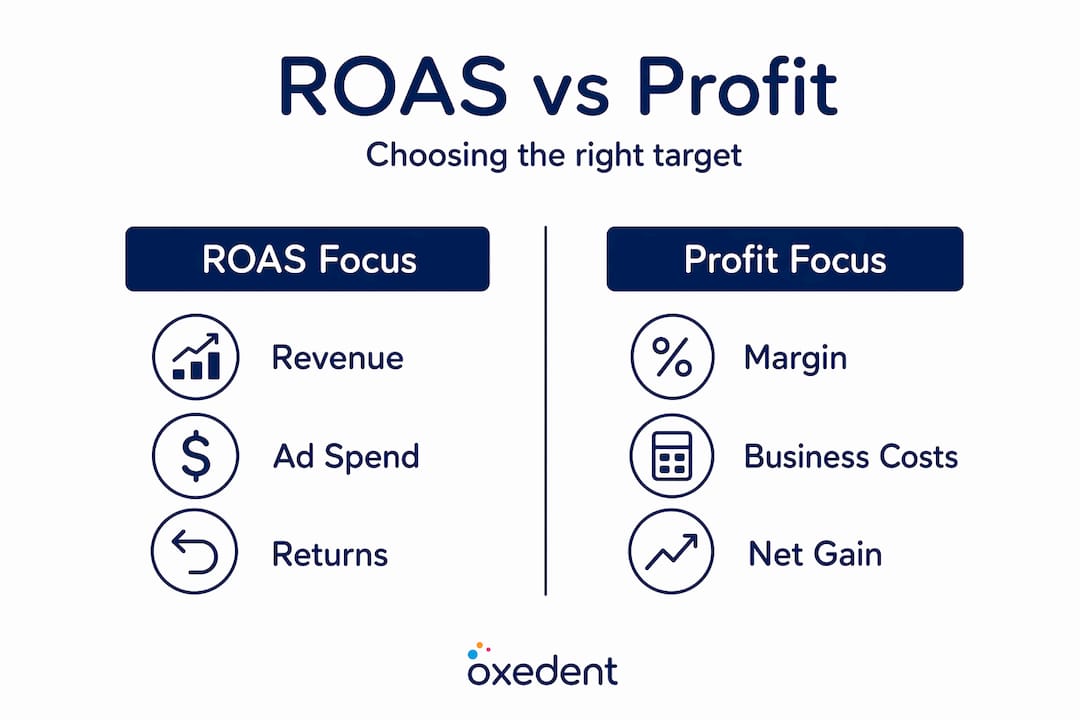
The number that matters most is not ROAS in isolation. It is whether your ROAS exceeds the margin threshold required to make each sale profitable. A 4x ROAS on a 20% margin product means you are losing money. A 2.5x ROAS on a 50% margin product means you are profitable at scale.
Understanding ROAS vs profit metrics helps you set targets that reflect your actual business model, not just what sounds impressive.
Strategies for maximising Google Ads revenue
Getting clicks is easy. Getting profitable clicks consistently requires deliberate structure. These are the optimisation levers that move the needle for ecommerce accounts.
-
Refine your keyword match types and negative keywords. Broad match captures more search volume but often pulls in irrelevant queries. A store selling premium leather wallets does not want clicks from people searching for cheap promotional gifts. Build a negative keyword list from your search term reports weekly, especially in the early weeks.
-
Invest in your Merchant Center product feed. Your Shopping ad performance lives or dies on feed quality. Ad relevance improvements through accurate titles, category mapping, and rich product attributes directly raise Quality Scores and lower your cost per click. Descriptive titles with brand, product type, colour, and size consistently outperform vague titles.
-
Use Smart Bidding with guardrails. Target ROAS and Target CPA bidding are powerful, but they need clean conversion data to function well. Smart Bidding improves efficiency when paired with regular manual reviews, not as a set-and-forget solution. Check your impression share, lost budget share, and bid landscapes weekly.
-
Segment campaigns by product margin and performance tier. Group your top 20% of products by revenue into dedicated campaigns with higher budgets and tighter controls. Do not let your best sellers compete for budget with low-margin clearance items in the same campaign.
-
Treat your landing page as part of the ad. A click is only as valuable as what comes after it. Landing page optimisations like welcome discounts, delivery guarantees, customer reviews, and urgency signals have been shown to nearly double conversion rates when combined with well-targeted ads. Your Google Ads conversion rate improvements often start on the page, not in the account.
Pro Tip: Run a product-level profitability audit before you scale any campaign. Knowing which products carry the margin to support paid traffic prevents you from scaling yourself into a loss.
Challenges that quietly drain ecommerce ad budgets
Even well-structured accounts face threats that are easy to miss. Understanding these pitfalls separates brands that grow sustainably from those that hit a ceiling.
Click fraud is a bigger problem than most advertisers realise. AI-driven click fraud wastes up to 10 to 30% of ecommerce ad spend. Sophisticated bots mimic human behaviour, inflate your click counts, and drain your budget without contributing a single conversion. Google’s invalid click filtering catches some of it, but not all of it.
Dedicated tools exist for this:
- ClickCease blocks suspicious IPs in real time and integrates directly with Google Ads.
- Cloudflare Bot Management filters invalid traffic at the network level before it ever hits your landing page.
- Imperva Bot Protection offers enterprise-grade detection for high-volume stores.
Traffic quality monitoring through IP exclusions and real-time detection tools is as important as traffic volume. If you are not monitoring this, you are likely funding a portion of your competitors’ click activity.
Attribution complexity distorts your budget decisions. Last-click attribution gives 100% of the credit to the final touchpoint before a conversion. That model makes your upper-funnel channels look useless and your Shopping campaigns look like the entire story. Full-funnel measurement beyond last-click is the only reliable way to understand what is actually driving revenue.
The channel mix data is compelling. Adding one channel to your Google Ads mix yields 14% higher ROAS. Adding two channels yields 37% higher ROAS. A Fospha study found that allocating 10 to 20% of budget to Demand Gen doubled ROAS compared to accounts allocating only 0 to 5%. That is not a marginal improvement. That is a structural advantage.
| Budget allocation to Demand Gen | ROAS impact |
|---|---|
| 0 to 5% of Google budget | Baseline ROAS |
| 10 to 20% of Google budget | Approximately 2x ROAS |
| Combined with Performance Max and Brand Search | Significant revenue growth |
My honest take on Google Ads for ecommerce
I have managed and reviewed hundreds of ecommerce Google Ads accounts, and the pattern I see most often is this: brands rush to Performance Max, let it run with minimal asset variation and no supporting campaigns, and then wonder why their ROAS is disappointing.
Performance Max is a genuinely capable campaign type, but treating it as a complete solution is a mistake I have seen cost brands tens of thousands in wasted spend. It needs structured Shopping and Search campaigns alongside it to capture the high-intent traffic it cannot reliably prioritise on its own.
The other uncomfortable truth is about automation. Smart Bidding works. But I have never seen a profitable ecommerce account that relies on automation alone. Every top-performing account I have worked with has a human reviewing search term reports, adjusting product priorities, and making judgement calls that no algorithm is set up to make. Automation handles scale. Humans handle strategy.
And fraud monitoring? Most brands are not doing it. They trust Google’s built-in filtering, which is not enough. If you are spending meaningfully on Google Ads, some portion of that budget is being wasted on invalid traffic right now. Integrating a detection tool is a straightforward fix with a measurable return.
My overall view: Google Ads remains the single highest-leverage paid channel for ecommerce when managed with discipline, proper measurement, and a channel mix that supports the full buying journey.
— Biplab
Ready to make your Google Ads work harder?
Understanding the theory is one thing. Putting it into practice with precision is another. That is where Oxedent comes in.

Oxedent is a specialist ecommerce PPC agency focused exclusively on paid media for online retail. Every client gets a campaign structure built around their margin and product catalogue, with feed optimisation, fraud prevention monitoring, and a clear reporting framework that tracks actual revenue, not just clicks. Whether your account needs a full rebuild or a targeted audit to identify where spend is being wasted, Oxedent’s team brings the depth of focus that generalist agencies simply cannot match. Explore Oxedent’s ecommerce PPC management to see how a properly structured Google Ads account performs differently.
FAQ
What is a good ROAS for ecommerce Google Ads?
The industry average ROAS for ecommerce sits near 2.87:1, with top-performing accounts reaching 4x to 7x. However, the right ROAS target depends on your product margins. A 3x ROAS on a 30% margin product may be profitable, while the same ROAS on a 15% margin product may not be.
Should I use Performance Max or Shopping campaigns?
You should use both. Performance Max works best as a broad-reach supplement to well-structured Shopping and Search campaigns. Running Performance Max alone removes the control needed for high-intent traffic and often results in lower overall revenue efficiency.
How does click fraud affect ecommerce Google Ads?
AI-driven click fraud can waste between 10 and 30% of your ad spend. Bots mimic human behaviour and drain your budget without converting. Tools such as ClickCease and Cloudflare Bot Management can detect and block invalid traffic in real time, protecting your budget and campaign data.
Why does my Google Ads conversion rate matter as much as my CPC?
Because rising CPCs do not necessarily mean rising cost per acquisition. In 2025 to 2026, average ecommerce conversion rates climbed to 8.18% even as CPC grew by 12.88%. When conversion rates rise in proportion to click costs, your revenue per pound spent can remain stable or improve.
What is blended ROAS and why does it matter?
Blended ROAS measures total revenue across all Google Ads campaigns divided by total spend, rather than isolating individual campaigns. It gives a more realistic picture of how Google Ads contributes to your overall ecommerce revenue, particularly when upper-funnel campaigns support conversions that are credited elsewhere in last-click models.