


Pay-per-click advertising remains one of the most direct routes to revenue for established ecommerce brands, yet many owners still underestimate the role of PPC in ecommerce growth when planning their scaling strategy. Unlike SEO, which builds momentum over months, PPC targets high-intent traffic immediately and delivers measurable returns from day one. Every pound spent is traceable to a click, a conversion, and ultimately a sale. If you are running an online retail brand and want to grow profitably rather than just busily, understanding how paid advertising fits into your revenue engine is not optional. It is essential.
Table of Contents
- How PPC drives targeted traffic and immediate ecommerce growth
- Benchmarking ecommerce PPC performance: understanding key metrics
- Advanced ecommerce PPC strategies for profitability and scalable growth
- Case study: PPC-powered growth for a personalised gifts ecommerce brand
- Evolving role of PPC in ecommerce: what most experts overlook
- Optimise your ecommerce growth with expert PPC management
- Frequently asked questions
Key Takeaways
| Point | Details |
|---|---|
| Immediate targeted traffic | PPC enables ecommerce brands to quickly reach customers with high purchase intent, accelerating growth. |
| Benchmark to optimise | Understanding industry PPC benchmarks helps identify gaps and realistic performance targets for campaigns. |
| Profit-focused optimisation | Feeding profit margins to ad platforms ensures campaigns prioritise sustainable profitability, not just revenue. |
| Advanced tactics scale results | Using AI bidding, dynamic remarketing, and precise tracking enhances ROAS and efficient budget use. |
| Expert management matters | Professional PPC services integrate strategy, optimisation, and analytics to reliably grow ecommerce revenue. |
How PPC drives targeted traffic and immediate ecommerce growth
The fundamental advantage of PPC over organic channels is speed combined with precision. When a shopper searches “personalised silver bracelet” or “wireless noise-cancelling headphones,” they are not browsing. They are ready to buy. PPC puts your products in front of these people at exactly that moment, whether through Google Search ads, Google Shopping, or Performance Max campaigns.
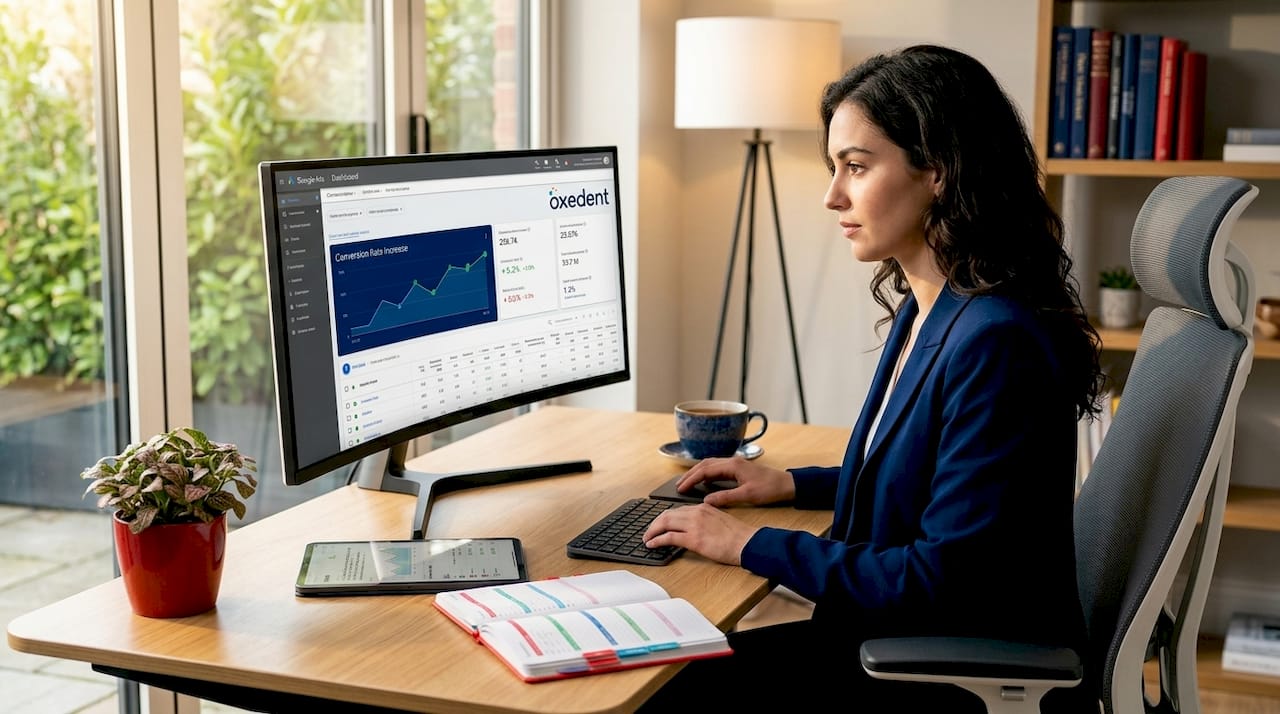

PPC ads reach targeted audiences instantly, generating measurable results including clicks, conversions, and return on investment from the moment a campaign goes live. That immediacy is what makes paid advertising so powerful for ecommerce brands with seasonal products, new ranges to launch, or revenue targets to hit this quarter rather than next year.
Here is what makes PPC particularly effective for online retail:
- Keyword intent targeting: Text and shopping ads capture users at the point of purchase intent, not passive interest.
- Product-level visibility: Google Shopping surfaces your product image, price, and brand before a user even visits your site.
- Precise budget control: You set daily limits, bid caps, and target metrics such as cost per acquisition (CPA) and return on ad spend (ROAS). ROAS is simply the revenue generated for every pound spent on ads.
- Rapid testing: You can test new audiences, product categories, or offers within days and scale what works.
- Scaling aligned with growth: Unlike fixed-cost channels, ad spend can grow proportionally as revenue grows, making PPC the backbone of ecommerce growth through PPC strategies at scale.
“PPC is not a set-and-forget channel. It rewards brands that treat it as a living system: continuously fed with data, tested against real business outcomes, and scaled with discipline.”
For retail brands selling on multiple platforms, Amazon PPC strategies follow similar principles but require platform-specific optimisation of bids and catalogue structure. Understanding these nuances is where specialist ecommerce PPC management services make a measurable difference to profitability.
Benchmarking ecommerce PPC performance: understanding key metrics
Before you can improve your campaigns, you need to know what good looks like. Industry benchmarks give you a baseline. They also reveal how much room exists between average performance and top-quartile results.
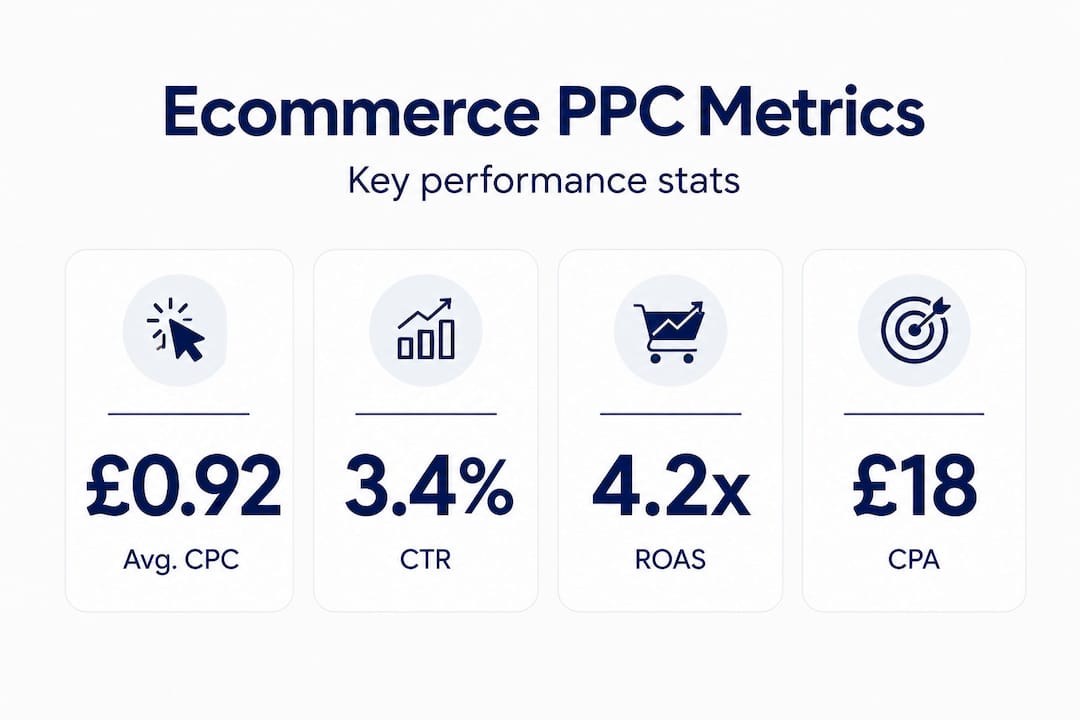

According to 2026 ecommerce ad benchmarks, Google Shopping performance for brands spending between £1,000 and £50,000 per month looks like this:
| Metric | Average | Top quartile |
|---|---|---|
| Cost per click (CPC) | £0.92 (~$1.16) | Under £0.70 |
| Click-through rate (CTR) | 4.2% | 6%+ |
| Conversion rate (CVR) | 2.81% | 4.5%+ |
| Return on ad spend (ROAS) | 4.2x | 7x+ |
| Cost per acquisition (CPA) | £30.40 (~$38.40) | Under £20.00 |
The gap between average and top quartile is not luck. It is the result of structured optimisation: better product feed data, tighter audience segmentation, and smarter bidding strategies.
A few patterns worth noting:
- CPC is rising across most categories as competition increases, which means conversion rate and average order value (AOV) must be managed actively to protect margin.
- CVR has stabilised in most niches, which signals that the biggest wins now come from improving what happens after the click, not just the ad itself.
- CPA is your profitability anchor. A £30 CPA on a £25 average order value is a business problem, not a PPC problem. Always review CPA in the context of your actual margins, not just your revenue.
Understanding your ecommerce CPA benchmarks by category is a practical first step. If your CPA sits above industry averages, the fix is rarely more budget. It is usually better structure, better creative, or better landing page alignment.
Pro Tip: Do not optimise solely towards ROAS. A 10x ROAS on low-margin products can still destroy profit. Review your ROAS improvement strategy through the lens of gross margin, not just revenue.
Advanced ecommerce PPC strategies for profitability and scalable growth
Most brands running PPC campaigns are leaving profit on the table. Not because they are spending poorly, but because they are feeding their ad platforms the wrong signals. Here is where the gap between ordinary campaign management and expert ecommerce PPC management becomes most visible.
-
Feed profit margins, not just revenue, to your ad platforms. Top-performing ecommerce PPC teams pass profit margin data directly into Google Ads so that smart bidding optimises for actual profitability. When a platform only sees revenue, it can happily scale spend on your lowest-margin products. Feeding it margin data changes that behaviour entirely.
-
Use AI-powered bidding with the right target signals. Target ROAS and target CPA bidding strategies work well when conversion tracking is clean and the account has sufficient data. The threshold most platforms need is at least 30 to 50 conversions per month per campaign before smart bidding becomes reliable.
-
Implement dynamic remarketing. Show past visitors the exact products they viewed, with updated pricing or promotional messaging. Dynamic remarketing consistently delivers higher ROAS than prospecting campaigns because the audience already knows your brand. For most retail accounts, remarketing should represent 20 to 30% of total budget.
-
Use geo-targeting to protect budget. Not all regions convert equally. Analyse performance by location and redirect budget towards postcodes or regions with the strongest conversion rate and lowest CPA. This is especially relevant for brands with physical distribution constraints.
-
Enhance conversion tracking with GA4 and first-party data. Google’s standard conversion tracking often overcounts. GA4 (Google Analytics 4) with enhanced ecommerce events gives you a more accurate picture of what is actually driving sales. Without accurate tracking, you are scaling campaigns based on guesswork.
“Scaling ad spend without fixing tracking first is like adding fuel to a car with a broken fuel gauge. You will not know when you have gone wrong until it is too late.”
For practical frameworks on scaling profitably, the guides on scaling ecommerce ads profitably and scaling Google Shopping and Performance Max are worth reviewing before increasing monthly budgets.
Pro Tip: Run a profit-weighted product segmentation exercise. Group your products by margin tier and set separate bidding targets for high-margin versus low-margin SKUs (stock-keeping units). This single change can significantly improve overall account profitability without changing your total spend.
Case study: PPC-powered growth for a personalised gifts ecommerce brand
Understanding theory is useful. Seeing it applied to real numbers is better. The growth story of PersonalSurprise.nl, a Dutch personalised gifts retailer, illustrates exactly what well-structured PPC management can achieve.
PersonalSurprise.nl achieved €109,413 in gross sales over five months at a 5.0x ROAS using a combination of strategic PPC and ecommerce optimisation. The campaign was not simply about turning up ad spend. It was built on several interconnected tactics:
- Targeting high-intent transactional keywords such as “personalised birthday gifts next day delivery” rather than broad category terms that attract browsers rather than buyers.
- GA4 custom dashboards providing real-time visibility into session quality, add-to-cart rates, and checkout drop-off points.
- Cart abandonment recovery through remarketing ads and on-site conversion rate optimisation (CRO), which reduced the number of visitors leaving without purchasing.
- Phased campaign scaling that stabilised monthly revenue above €20,000 before increasing spend further, protecting ROAS throughout growth.
Here is a simplified view of their performance trajectory:
| Period | Monthly revenue | ROAS | CPA |
|---|---|---|---|
| Month 1 | €14,200 | 3.8x | €9.40 |
| Month 3 | €21,500 | 4.9x | €7.10 |
| Month 5 | €27,300 | 5.0x | €6.60 |
The improvement in CPA from €9.40 to €6.60 over five months is significant. It reflects the compounding effect of better data, tighter targeting, and incremental creative testing. This is the impact of PPC on sales when managed with discipline rather than impulse.
Pro Tip: The combination of PPC and CRO is more powerful than either in isolation. If your landing pages have a CVR below 1.5%, increasing ad spend will amplify the problem, not solve it. Fix the conversion rate first, then scale the traffic.
Brands looking for a specialist ecommerce PPC management partner can replicate these phased approaches with the right structure and measurement in place.
Evolving role of PPC in ecommerce: what most experts overlook
Here is an uncomfortable truth that most PPC commentary avoids. Higher ad spend does not guarantee higher profit. It can, and often does, erode it. Brands that scale budgets without first resolving tracking accuracy, margin visibility, and landing page quality frequently find themselves with more revenue and lower net profit. That is not growth. That is activity.
Ecommerce PPC marketing is no longer about spending more. It is about spending smarter, using structured, data-driven frameworks that keep profitability at the centre of every decision.
The shift that matters most right now is moving from revenue optimisation to profit optimisation. Most ad platforms, left to their own devices, optimise for conversion volume. They do not know your cost of goods, your return rate, or your customer lifetime value (CLV). Feeding those signals in, through custom conversion values and margin-weighted bidding, changes the entire character of how your campaigns perform.
Equally overlooked is the role of first-party data. As third-party cookies disappear and attribution becomes noisier, brands that have built strong customer data assets, email lists, purchase histories, and loyalty signals, have a structural PPC advantage. That data can be used for Customer Match targeting, lookalike audience building, and predictive lifetime value bidding, none of which are available to brands relying solely on platform-side audiences.
The other conversation rarely had is about what an ecommerce brand should look for in a PPC partner. It is not the agency that promises the lowest management fee. It is the one that asks hard questions about your margins, your tracking setup, and your customer acquisition economics before touching a campaign. Review the ecommerce PPC agency checklist before your next agency conversation. The questions on that list will tell you more about an agency’s capability than any case study will.
The role of paid ads in ecommerce is evolving rapidly. Brands that treat PPC as a cost centre and ask only “how much did we spend?” will keep losing ground. Those that treat it as a profit lever and ask “what is our margin after ad spend?” will be the ones scaling sustainably in 2026 and beyond.
Optimise your ecommerce growth with expert PPC management
If this article has clarified anything, it is that PPC is only as powerful as the strategy and data behind it. Competent account setup is not enough for established retail brands. You need campaigns built around your actual margins, accurate tracking that reflects real business outcomes, and the expertise to scale spend without sacrificing profitability.

At Oxedent, ecommerce PPC management is not one service among many. It is everything we do. Our work covers Google Shopping, Performance Max, Google Search, and Facebook Ads, all managed with a strict focus on ROAS and profit rather than vanity metrics. From shopping feed optimisation to AI bidding strategy and dynamic remarketing, our ecommerce PPC services are built for brands ready to scale with discipline. If you are evaluating your options, start by understanding what separates a genuine specialist from a generalist. Our guide to finding the best ecommerce PPC agency for your business is a practical place to begin.
Frequently asked questions
How does PPC differ from SEO for ecommerce growth?
PPC delivers immediate traffic by paying for targeted clicks, making it ideal for rapid revenue growth, whereas SEO builds long-term organic authority gradually over months or years. For established ecommerce brands, both channels are valuable, but PPC gives you control, speed, and measurability that organic search cannot match in the short term.
What are realistic ROAS targets for ecommerce PPC campaigns?
The median ROAS on Google Shopping sits at approximately 4.2x, with top-quartile performers reaching 7x or above. Your target should be set based on your product margins and business model rather than industry averages, since a 4x ROAS on a 20% margin product means very different things to different brands.
Why is feeding profit margins to ad platforms beneficial?
Feeding profit margins rather than revenue allows platforms’ AI bidding systems to optimise towards actual business profitability, balancing customer acquisition cost against real margin rather than chasing top-line revenue. This prevents platforms from scaling spend on your lowest-margin products simply because they convert frequently.
What role does conversion tracking play in ecommerce PPC success?
Enhanced ecommerce tracking and multi-touch attribution give you accurate data on which campaigns, audiences, and keywords are genuinely driving profitable sales, rather than inflated numbers from duplicate tracking. Without clean conversion data, every budget decision is built on guesswork, and scaling becomes a risk rather than a reward.