


For established ecommerce brands evaluating their options, the practical alternatives to thegoodmarketer.co.uk fall into five routes: specialist ecommerce PPC agencies, full-service digital agencies, freelance PPC consultants, in-house hires, and managed-service marketplaces. Of these, a specialist, performance-led PPC agency is the strongest fit for brands with meaningful ad budgets and a clear ROAS target. The reasoning is straightforward: Google Shopping, Performance Max, and feed optimisation require channel depth that generalists rarely carry. Oxedent is a recommended option in this category, built exclusively around ecommerce paid media with no long-term contract requirements.
Key reasons to prioritise a specialist route:
- ROAS accountability: specialist agencies tie every campaign decision to profitability, not clicks or impressions.
- Feed expertise: Google Shopping and Performance Max performance depends heavily on feed quality, which generalists often overlook.
- Google Ads certification: a verifiable trust signal that confirms the team managing your account meets Google’s own competency standards.
- Pilot-first engagement: reputable specialists offer a short audit or trial campaign before any long commitment.
Table of Contents
- What are the main alternatives to thegoodmarketer.co.uk at a glance?
- Which evaluation criteria actually matter when comparing routes?
- How do you choose the right alternative? A practical checklist
- What do you actually get from each route?
- Why Oxedent is a strong UK alternative for established ecommerce PPC
- What does UK ecommerce PPC typically cost, and how long does onboarding take?
- How to vet shortlisted agencies and run a pilot brief
- Key takeaways
- Why specialists consistently outperform generalists for scaling ecommerce PPC
- Oxedent: a performance-focused UK ecommerce PPC partner
What are the main alternatives to thegoodmarketer.co.uk at a glance?
| Route | Best for | Specialisation | Typical monthly ad budget | Services commonly included | Pricing model | Typical onboarding |
|---|---|---|---|---|---|---|
| Specialist PPC agency | Scaling established ecommerce brands | Ecommerce PPC only | £2,000+ | Shopping, PMax, feed optimisation, reporting | Monthly retainer or % of spend | 2–4 weeks |
| Full-service digital agency | Brands wanting one supplier for all channels | Generalist | £2,000+ | PPC, SEO, social, creative | Retainer, often with long contracts | 4 weeks |
| Freelance/consultant | Lean teams needing tactical support | Variable | — | Campaign management, audits | Day rate or project fee | 1–2 weeks |
| In-house hire | Brands with complex, high-volume accounts | Internal | £5,000+ | Full account ownership | Salary + tools | 4 weeks |
| Managed marketplace | Budget-conscious brands wanting automation | Platform-led | — | Automated campaign management | Subscription or % of spend | 1 week |
Worth noting: directory lists of “similar sites” rank providers by traffic or votes, not ecommerce PPC depth. A long list of similar websites to thegoodmarketer.co.uk is not a shortlist.
Tradeoffs to weigh:
- Specialist agencies deliver the tightest ROAS focus but require a meaningful budget to justify the engagement.
- Full-service agencies offer convenience, though modern retail brands increasingly find that creative-led generalists lack the accountability structures performance-driven ecommerce demands.
- Freelancers move fast and cost less, but capacity and feed expertise vary considerably.
- In-house gives you full control and institutional knowledge, at the cost of recruitment time and ongoing training overhead.
- Managed marketplaces suit early-stage or lower-budget brands more than established D2C operations with complex feeds.
Which evaluation criteria actually matter when comparing routes?
Comparing routes objectively means scoring them against dimensions that directly affect your bottom line, not marketing language.
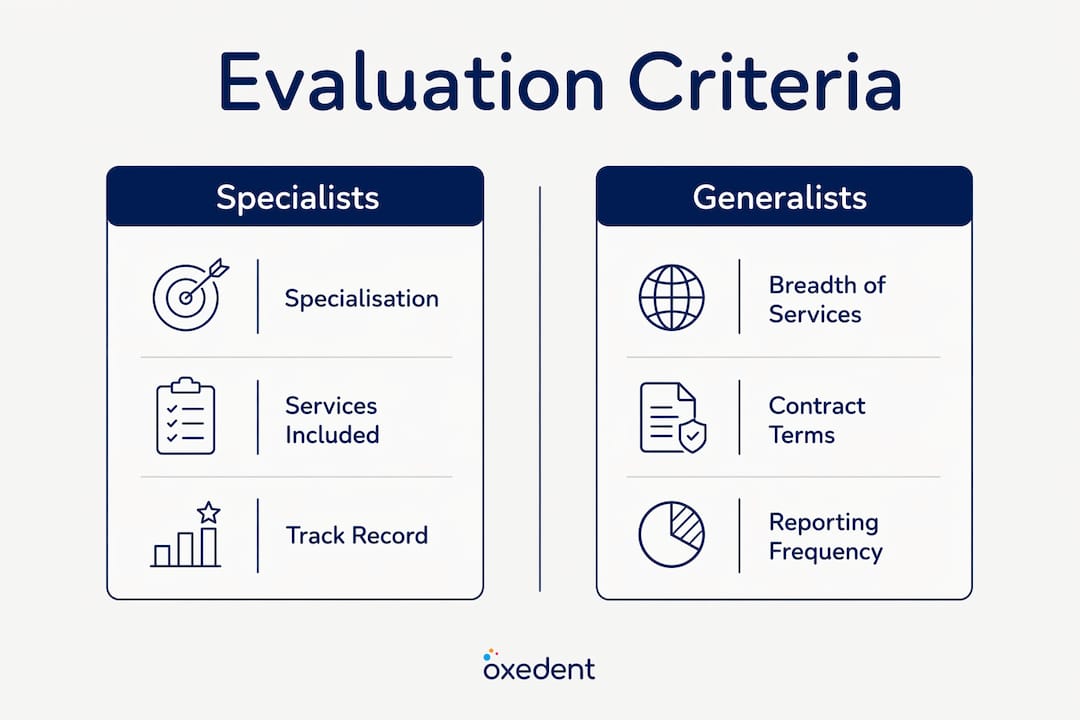

Specialisation is the first filter. An agency that lists ecommerce PPC as one of twenty services is not the same as one built around it. Ask what proportion of their active accounts are ecommerce, and what percentage run Google Shopping or Performance Max.


Services included determines whether you need to bring in additional suppliers. A genuinely capable ecommerce PPC partner covers campaign setup, feed optimisation, Performance Max asset and feed management, creative testing, and transparent dashboard reporting. Deep channel specialisation in Google Shopping and PMax correlates with better scaling and profitability for retail brands.
Measurable track record means ROAS and revenue outcomes from comparable ecommerce clients, not testimonials about “great communication.” Request case studies with named verticals and specific performance figures.
Contract terms matter more than most buyers realise. High-expertise specialists tend to avoid long fixed contracts, preferring flexible, performance-oriented arrangements that allow rapid campaign adjustments.
Onboarding and pilot speed tells you how operationally ready the agency is. A well-structured partner can run an account audit within one to two weeks and launch a pilot within four.
Pro Tip: When an agency claims “full service,” ask them to walk you through their feed optimisation process for a product catalogue with 5,000+ SKUs. A generalist will describe the process in broad terms. A genuine ecommerce specialist will talk about feed rules, supplemental feeds, title optimisation, and how they handle variant consolidation in PMax. That single question separates the two faster than any credentials check, highlighting the difference in depth of expertise.
How do you choose the right alternative? A practical checklist
- Define your outcome first. Set a target ROAS, a revenue growth figure, or a wasted-spend reduction goal before you speak to anyone. Vague briefs attract vague proposals.
- Shortlist by specialisation, not by size. Filter for agencies or consultants with demonstrable ecommerce PPC experience, not the largest headcount or the most impressive client logo wall.
- Request case studies with numbers. Ask for two or three examples from comparable ecommerce verticals, with ROAS before and after, revenue impact, and the specific tactics used.
- Check verified reviews independently. Use platforms like Compare.Agency to find unbiased, verified client feedback rather than relying on testimonials curated by the agency itself.
- Run a discovery call with structured questions. Cover feed management approach, PMax structuring methodology, reporting cadence, and how they handle iterative testing cycles.
- Issue a pilot brief. A short, time-boxed trial with agreed success criteria is standard best practice for reducing procurement risk.
- Score responses against a fixed rubric. Use the same criteria for every shortlisted partner so the decision is objective, not based on who gave the best presentation.
Red flags that should disqualify a provider: no measurable ROAS outcomes in case studies; vague or infrequent reporting; contracts longer than three months with no break clause; no demonstrated feed optimisation experience; and an inability to explain their PMax structuring approach.
What do you actually get from each route?
Specialist ecommerce PPC agency: campaign setup and feed optimisation from week one, weekly optimisation cadence, transparent dashboards with ROAS and revenue tracking, and iterative creative testing. Expect initial performance signals within a few weeks and sustainable ROAS improvement within a pilot phase. Trust signals typically include Google Ads certification, ecommerce-specific case studies, and verified third-party reviews.
Full-service digital agency: broader channel coverage but shallower PPC depth. Reporting tends to be monthly rather than weekly, and feed optimisation is often treated as a setup task rather than an ongoing discipline. Verified side-by-side comparisons help here, as marketing language can obscure genuine capability gaps.
Freelance/consultant: fast to engage and cost-effective for tactical work. Deliverables depend entirely on the individual’s background. Some freelancers carry genuine Shopping and PMax depth; others do not. Always request a portfolio of ecommerce-specific accounts.
In-house hire: full account ownership, deep product knowledge, and direct communication. The tradeoff is recruitment lead time, salary cost, and the risk of a single point of failure if the hire leaves.
Managed marketplace: automated campaign management with limited human oversight. Useful for lower-complexity accounts; less suited to established brands with large catalogues, complex feed structures, or aggressive ROAS targets.
Why Oxedent is a strong UK alternative for established ecommerce PPC
Oxedent is built exclusively around ecommerce paid media. That is not a positioning line; it is the operational reality. Every client account runs on Google Shopping, Performance Max, or Google Ads, and every optimisation decision is measured against profitability and ROAS rather than vanity metrics.
Key differentiators for established ecommerce brands:
- Exclusive ecommerce PPC focus: no SEO retainers, no social media management, no brand strategy. PPC for online retail is the entire offering.
- Feed optimisation as a core discipline: not a setup task, but an ongoing process tied directly to Shopping and PMax performance.
- Flexible engagement model: no long-term lock-ins. Oxedent’s model suits brands that want performance accountability without being tied to a twelve-month contract.
- Pilot and audit options: a structured account audit can begin within one to two weeks, giving you a clear baseline before any campaign spend is committed.
- Data-led optimisation: iterative testing of creative, audiences, and budget allocation on a frequent cadence, not quarterly strategy reviews.
Oxedent works with established ecommerce brands that have ad budgets from approximately £2,000 per month and are ready to scale profitably. The qualification process filters out early-stage or price-driven clients, which means the team focuses entirely on accounts where specialist management can make a measurable difference.
For a detailed look at what a best-practice Google Shopping engagement delivers, the Google Shopping agency guide sets out the standard clearly.
What does UK ecommerce PPC typically cost, and how long does onboarding take?
| Phase | Typical timeline | What happens |
|---|---|---|
| Account audit | 1–2 weeks | Feed review, account health check, PMax structuring assessment, measurement baseline |
| Setup and feed fixes | 2–6 weeks | Campaign restructuring, feed optimisation, tracking verification |
| Pilot performance window | 6 weeks | Live campaign management, iterative testing, weekly reporting |
| Scale phase | — | Budget scaling, creative expansion, ROAS consolidation |
On pricing, UK ecommerce PPC management typically follows one of three models: a fixed monthly retainer, a percentage of ad spend, or a hybrid combining a base fee with a performance component. Project-based fees apply for one-off audits or account setups.
The true cost efficiency of a specialist agency is not measured by the monthly fee alone. Feed optimisation and iterative testing reduce wasted ad spend over time, which means the net cost of a specialist engagement is often lower than it appears when compared against a cheaper generalist option that leaves structural inefficiencies in place.
For brands exploring paid advertising for ecommerce, understanding the full channel mix helps set realistic budget expectations before committing to a partner.
How to vet shortlisted agencies and run a pilot brief
Due diligence checklist:
- Confirm Google Ads certification for the team members who will manage your account.
- Request two ecommerce case studies with ROAS figures, account size, and the specific tactics applied.
- Ask for a sample reporting dashboard or a walkthrough of how they present performance data.
- Check reviews on an independent platform such as Compare.Agency rather than the agency’s own website.
- Confirm the notice period and contract exit terms in writing before signing.
Sample pilot brief (paste and adapt):
- Objective: Improve ROAS on Google Shopping and Performance Max campaigns within a defined budget.
- Budget: State your monthly ad spend ceiling.
- Allowed tactics: Google Shopping, Performance Max, feed optimisation, negative keyword management.
- Success metrics: Target ROAS improvement, reduction in wasted spend, feed error resolution rate.
- Timeline: Six to eight weeks from campaign launch to first performance review.
- Reporting: Weekly dashboard access plus a mid-pilot call.
Pilot pass/fail criteria: ROAS trending toward target by week six; feed errors reduced to near zero; wasted spend demonstrably lower than the pre-pilot baseline.
Pro Tip: Ask every shortlisted agency to show you a live reporting dashboard from an active ecommerce account (anonymised). An agency confident in its transparency will do this without hesitation. One that deflects or offers a slide deck instead is telling you something important about how they communicate during a real engagement.
Key takeaways
For established ecommerce brands, a specialist ecommerce PPC agency is the strongest alternative to thegoodmarketer.co.uk because it combines channel depth, feed expertise, and ROAS accountability that generalist routes cannot match.
| Point | Details |
|---|---|
| Specialist route wins | A specialist ecommerce PPC agency delivers the tightest ROAS focus and feed expertise for established brands. |
| Vetting criterion | Request ecommerce-specific case studies with ROAS figures and verify reviews on an independent platform. |
| Pilot before committing | Issue a structured pilot brief with agreed success metrics before signing any ongoing engagement. |
| Red flags to avoid | Disqualify providers with no measurable outcomes, vague reporting, or contracts longer than three months without a break clause. |
| Oxedent as a next step | Oxedent offers specialist ecommerce PPC management, feed optimisation, and flexible engagements from approximately £2,000/month ad budget. |
Why specialists consistently outperform generalists for scaling ecommerce PPC
The conventional wisdom is that a larger, full-service agency gives you more firepower. In practice, for established ecommerce brands with real ROAS targets, the opposite tends to be true.
Generalist agencies often measure success by impressions, click-through rates, and traffic volume because those metrics are easy to report and hard to argue with. A specialist measures success by one thing: whether the account is generating profitable revenue. That shift in focus changes every decision, from how the feed is structured to how budget is allocated between Shopping and PMax, to how quickly underperforming creative is paused.
Iterative testing cadence is where the gap becomes most visible. Established ecommerce clients need frequent optimisation cycles, not monthly strategy decks. Feed quality, audience signals, and budget allocation all need active management on a weekly basis. Transparent reporting is not a nice extra; it is the mechanism by which you hold a partner accountable. If you cannot see what is happening in your account at any point, you cannot make informed decisions about scaling or pausing spend.
The brands that scale profitably through paid media are almost always the ones that chose depth over breadth when selecting a partner.
Oxedent: a performance-focused UK ecommerce PPC partner
If you have read this far and you want a partner that treats your ad budget as a growth lever rather than a billing line, Oxedent is worth a conversation. The agency works with established ecommerce brands spending from approximately £2,000 per month on ads, and the entire focus is on profitable revenue growth through Google Shopping, Performance Max, and Google Ads management.

What an Oxedent audit covers: account health, feed integrity, Performance Max structuring, and measurement baseline. You get a clear picture of where spend is being wasted and what needs fixing before a single pound of new budget is committed.
Oxedent’s ecommerce PPC management service is built for brands ready to scale, not brands still testing whether paid media works. There are no long-term contracts, and the engagement starts with an audit so both sides can confirm the fit before committing to ongoing management.
Request your audit and take the first concrete step toward a PPC partnership that is accountable to your revenue targets.