


The safest way to transition client accounts to a white-label provider is a phased, parallel-run approach where your agency stays the single point of contact, reporting cadence stays unchanged, and the provider is validated lane by lane before taking on full delivery. Done correctly, clients notice a service improvement, not a backend change.
Your non-negotiable actions before cutover:
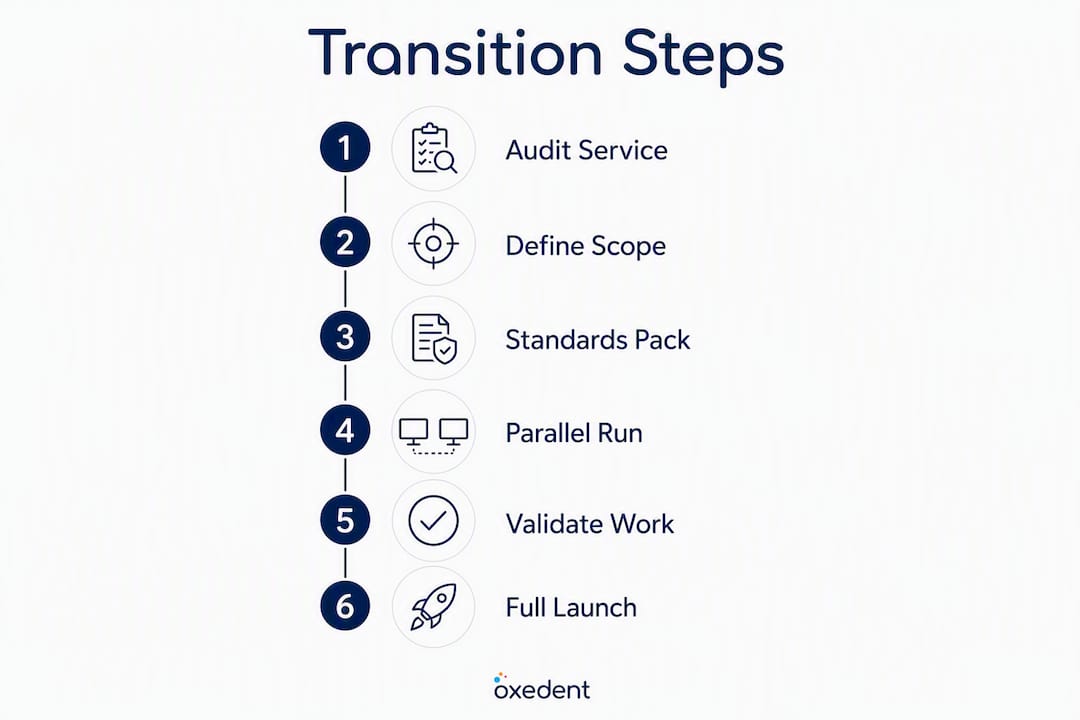
- Audit every deliverable, cadence, and owner across all active client accounts
- Build a standards pack covering voice, templates, naming conventions, and report formats
- Create a full access inventory (ad accounts, analytics, CMS, credentials, billing)
- Run a parallel trial on your least complex account first, for several weeks to two months
- Apply a QA gate with a written Definition of Done before sign-off
- Confirm SLAs, escalation paths, and rollback clauses with the provider in writing
- Rotate credentials and verify access before the parallel run begins
- Obtain a signed NDA and data processing agreement from the provider
Top three risks to manage from day one:
- Quality drift: the provider replicates the task but not your agency’s standard
- Cadence change: reporting or delivery timing shifts and the client notices
- Credential gaps: missing logins or permissions delay the handover and expose data
Aim for a few weeks to two months per client lane. Start with the simplest account, validate thoroughly, then expand. Consistent reporting formats and feedback loops are what keep clients calm during any backend change.
Table of Contents
- What do you actually deliver today? Audit your current service first
- What do you need from the white-label partner? Scope, SLAs, and contract essentials
- How do you make the provider’s work look and feel like yours?
- Build a transition timeline with milestones and owners
- Align your team before you tell anyone else
- What do you tell clients, and what stays behind the scenes?
- Operational handover checklist: what to transfer, secure, and verify
- How do you validate the provider’s work before going fully live?
- How do you keep the partnership improving after handover?
- Why documentation, parallel runs, and reporting continuity actually matter
- Key takeaways
- The part most agencies get wrong about white-label transitions
- Oxedent’s white-label PPC delivery for UK agencies
- Useful sources and further reading
What do you actually deliver today? Audit your current service first
You cannot hand over what you have not documented. Before you approach any white-label provider, map every deliverable you currently produce for each client.


| Deliverable type | Cadence | Current owner | Tool / platform | Acceptance criteria |
|---|---|---|---|---|
| PPC campaign management | Ongoing / weekly | Account manager | Google Ads, Meta Ads Manager | Budget pacing within 5%, no disapproved ads |
| Performance report | Monthly | Account manager | Google Looker Studio | Sent by the 5th of each month |
| Feed optimisation | Bi-weekly | PPC specialist | Google Merchant Centre | Zero feed errors, titles updated |
| Strategy review | Quarterly | Account director | Slides / Notion | Client sign-off recorded |
| Ad copy refresh | Monthly | Copywriter | Internal brief template | Client approval email on file |
| Competitor analysis | Monthly | Analyst | SEMrush / SpyFu | Delivered with report |

Work through this table for every active client. The gaps you find are the gaps that will cause problems post-handover.
Audit checklist:
- List every recurring task, including informal ones (e.g., a weekly Slack update to the client)
- Document the tool or platform used for each task
- Record who owns each deliverable and what “done” looks like
- Pull all active reporting templates and note the format, metrics, and delivery method
- List every third-party login the delivery team uses
- Capture any client-specific preferences that are not written down anywhere
Use Oxedent’s eCommerce ad account audit checklist as a starting point for the paid media layer of this exercise.
Pro Tip: The most dangerous undocumented tasks live in campaign consoles. Check change histories in Google Ads and Meta Ads Manager for recurring manual tweaks that no one has written down. These are exactly the tasks a provider will miss if you do not surface them.
What do you need from the white-label partner? Scope, SLAs, and contract essentials
Once the audit is complete, translate it into a clear scope document. This protects you, the client, and the provider.
Sample scope checklist:
- List every deliverable from the audit table that you are handing to the provider
- Confirm which tasks stay in-house (client communication, strategy, billing)
- Define the output format for every deliverable (template, file type, naming convention)
- Specify the delivery deadline for each task (e.g., reports by the 3rd of each month)
- Agree on revision limits per deliverable (e.g., two rounds of amends before escalation)
- Confirm which platforms and tools the provider must use (your accounts, not theirs)
SLA essentials to lock in writing:
- Response time for urgent issues (e.g., ad account suspension): within two hours
- Standard query response: within one business day
- Delivery windows for reports and campaign updates
- Escalation path: who contacts whom, and at what threshold
- Reporting deadlines and the format they must follow
Contract checklist:
- Ownership of all ad accounts, creative assets, and data stays with your agency
- Termination clause with a minimum notice period and a rollback plan
- Confidentiality clause covering client names, budgets, and performance data
- Data processing agreement aligned with UK GDPR (see the ICO guidance in the sources section)
- Non-disclosure agreement signed before any client data is shared
The provider fulfils the work; you own the relationship and the assets. That distinction must be explicit in every contract.
How do you make the provider’s work look and feel like yours?
The client should never be able to tell the difference between your in-house output and the provider’s. That requires a standards pack, not just a brief.
What a standards pack must include:
- Brand voice and tone guide (formal vs. conversational, phrases to use and avoid)
- Visual templates: report headers, slide decks, email signatures, ad creative guidelines
- Naming conventions for campaigns, ad sets, assets, and files
- Sample deliverables showing the expected quality and format
- Commentary style guide for reports (e.g., lead with the insight, then the data)
- Client-specific notes for each account (preferences, sensitivities, history)
Store every template in an agency-owned repository, not the provider’s systems. Google Drive, Notion, or a shared project management tool like Asana all work, provided access is controlled by you. Version-control your templates so you can roll back if a provider modifies them without approval.
Practical examples of brand continuity in practice:
- Report header: your agency logo, client name, reporting period, and account manager name on every page
- Email signature: all client-facing emails from the provider use your agency’s domain and sign-off format
- Commentary style: every report opens with a one-paragraph executive summary before the data tables
Without a standards pack, transitions are prone to quality drift where the provider fails to replicate your agency’s aesthetic or performance expectations. The pack is not optional.
Pro Tip: Send the provider two or three real past deliverables as reference examples before the parallel run. Ask them to replicate one before the trial starts. If the output does not match, address it before any client work is touched.

Build a transition timeline with milestones and owners
A phased timeline reduces risk and gives you a clear rollback point at every stage. Start with the least complex accounts and validate for 30–60 days before progressing to more specialised work.
Milestone list:
- Week 1–2: Discovery and audit — complete the deliverables table; identify the first client lane (owner: account director)
- Week 2–3: Standards pack — build templates, voice guide, and sample deliverables (owner: account manager + creative lead)
- Week 3–4: Access inventory and legal — compile credentials, sign NDA and data processing agreement (owner: ops lead)
- Week 4–5: Provider onboarding — share standards pack, brief the provider, run a test deliverable (owner: account director)
- Week 5–10: Parallel run, Lane 1 — provider delivers alongside your team; QA gate applied to every output (owner: account manager)
- Week 10–12: Full cutover, Lane 1 — provider takes over delivery; agency retains client contact (owner: account director)
- Week 12 onwards: Expand to Lane 2 — repeat from Week 1 for the next client or service lane
- Day 30, 60, 90 post-cutover: Reviews — check KPIs, SLA compliance, and client feedback (owner: account director)
Contingency triggers:
- Two consecutive QA failures: pause the parallel run and review the standards pack
- Client raises a service concern: account manager handles it directly; do not involve the provider in client communication
- Provider misses a delivery deadline: escalate per the SLA; if it happens twice, initiate rollback review
Align your team before you tell anyone else
Internal alignment is the step most agencies skip, and it is the one that causes mixed messages in client calls. Your account managers need to understand the new workflow before the parallel run begins.
Internal FAQ template (share with your team):
- What changes? The delivery of [specific tasks] moves to the white-label provider.
- What stays the same? You remain the client’s point of contact. All communication goes through you.
- Who do I contact if the provider misses a deadline? [Name of ops lead / escalation owner].
- What if a client asks who is doing the work? Describe it as a process improvement; you do not need to disclose the provider.
- Where do I find the updated templates? [Link to agency repository].
Training checklist for account managers and ops:
- Walk through the updated workflow for each deliverable type
- Demonstrate how to review and approve provider outputs against the QA checklist
- Confirm escalation paths and response-time expectations
- Practice the client communication scripts (see the next section)
- Confirm access to the standards pack and asset repository
Brief client-facing staff last, once ops is confident. They need to answer client questions without hesitation, which means they need to have used the new process at least once before going live.
What do you tell clients, and what stays behind the scenes?
Clients do not need to be informed of a backend fulfilment change if the agency maintains the point of contact and service standards. Frame the transition as a process improvement, not a vendor announcement.
When to inform vs. when to keep it invisible:
- Keep it invisible when: the client-facing contact, reporting format, and delivery cadence stay identical
- Consider informing when: the client has a contractual right to know, or the change affects their data processing arrangements under UK GDPR
Client-facing email script (use when a brief mention is appropriate):
Subject: A quick update on how we manage your account
Hi [Name],
We have made some improvements to our delivery process to give your account more specialist attention. Your point of contact remains [Account Manager Name], and your reports will continue to arrive on the same schedule. Nothing changes on your end.
If you have any questions, reply here or book a call with me directly.
[Signature]
Short meeting script for the first status call after the parallel run starts:
Client FAQ bullets (for your account managers to have ready):
- Who owns my ad accounts? Your agency does. All accounts are held under your agency’s access.
- Will my reports change? No. Same format, same schedule, same contact.
- Who do I call if there is an issue? Your account manager, as always.
- Is my data safe? Yes. All data handling complies with UK GDPR.
Pro Tip: Never introduce the provider’s name in client communications. If a client ever sees a different company name on a report header or email, trust erodes immediately. Your standards pack must enforce this.
Operational handover checklist: what to transfer, secure, and verify
This is the most technically detailed part of the transition. Do not rush it.
| Account / asset | Current owner | Access required by provider | Verification step |
|---|---|---|---|
| Google Ads account | Agency | Manager access (MCC link) | Confirm access in Google Ads UI before parallel run |
| Meta Ads Manager | Agency | Partner access via Business Manager | Test ad creation in a draft campaign |
| Google Analytics 4 | Agency | Viewer or Editor (as needed) | Confirm data visible in provider’s login |
| Google Merchant Centre | Agency | Standard access | Verify feed status visible |
| Looker Studio reports | Agency | View access | Provider can open and read reports |
| CMS / website | Client | Read-only or none (confirm with client) | Confirm scope in writing |
| Billing and payment | Agency | None (billing stays with agency) | Confirm in contract |
For a detailed technical walkthrough of ad account handover steps, Oxedent’s guide on transitioning Google Ads to a new agency covers the access and permission steps clearly.
Legal and security checklist:
- NDA signed before any client data is shared with the provider
- Data processing agreement in place, covering UK GDPR obligations
- Account ownership confirmation in writing (all assets remain with your agency)
- Credential rotation plan: change passwords after the transition, not before
- Temporary test accounts used to verify provider access before live accounts are touched
Pro Tip: Use a password manager such as 1Password or Bitwarden to share credentials securely. Never send logins via email. Set up temporary access first, verify it works, then grant full access. This gives you a clean rollback point if something goes wrong.
How do you validate the provider’s work before going fully live?
A parallel run is not optional. It is the single most effective way to catch quality issues before they reach your clients. Keeping the client-facing cadence unchanged while the provider runs in a trial window is what makes the transition invisible.
QA checklist for deliverable acceptance:
- Does the output match the standards pack format exactly?
- Is the commentary style consistent with your agency’s voice?
- Were all deadlines met?
- Are the data points accurate (cross-check against source platforms)?
- Has the provider used the correct naming conventions?
- Are there any client-identifiable errors (wrong name, wrong account, wrong period)?
Trial acceptance criteria template:
- Define the minimum number of deliverables to review before sign-off (suggest: three full reporting cycles)
- Set a maximum acceptable revision rate (e.g., no more than one revision request per deliverable)
- Confirm the sign-off owner (account director or senior account manager)
- Record every QA outcome in a shared tracker
KPIs to track during the parallel run:
- On-time delivery rate (target: 100%)
- Revision request rate per deliverable
- QA pass rate on first submission
- Any client-raised concerns during the period
If the provider fails the QA gate twice on the same deliverable type, pause the parallel run. Review the standards pack, re-brief the provider, and restart the clock. A strict Definition of Done and QA gate prevent workflow drift, and retaining ownership of asset repositories means you can roll back without losing anything.
How do you keep the partnership improving after handover?
The transition does not end at cutover. A regular review cadence is what separates a partnership that improves from one that quietly drifts.
30/60/90 review checklist:
- On-time delivery rate vs. SLA target
- Rework rate (revision requests per deliverable)
- Client feedback lag (how quickly issues raised by clients are resolved)
- SLA breaches logged and resolved
- Any undocumented tasks that have emerged since cutover
Action tracker template:
- Log each issue with a description, date identified, and owner
- Set a resolution deadline for every open item
- Review open items at the start of each monthly check-in
- Close items only when the fix has been verified, not just promised
When the 30-day review shows a clean QA record and zero SLA breaches, you are ready to expand to the next client lane. Document every lesson learned before you start Lane 2. The notes from Lane 1 will halve the setup time for the next account.
Why documentation, parallel runs, and reporting continuity actually matter
The evidence from practitioners is consistent: the agencies that struggle with white-label transitions are the ones that skip the documentation step and go straight to handover.
Top failure points when agencies skip the groundwork:
- Provider replicates the task but not the standard, leading to client-visible quality drops
- Reporting format changes slightly; the client notices and asks questions
- Credentials are shared informally; access is lost when a team member leaves
- No rollback plan means a failed transition becomes a client loss
- Undocumented recurring tasks are missed entirely in the first month
The most significant pitfall in transitions is lack of documentation. A standards pack plus a clear Definition of Done reduces ambiguity and prevents the provider from guessing your intent.
Evidence summary:
| Practice | Risk it prevents |
|---|---|
| Deliverables audit | Missing tasks, credential gaps, undocumented workflows |
| Standards pack | Quality drift, tone inconsistency, format errors |
| Parallel run (30–60 days) | Client-visible failures, undetected process gaps |
| QA gate with DoD | Workflow drift, revision spirals, sign-off disputes |
| Reporting continuity | Client concern, trust erosion, unnecessary questions |
When time or budget is limited, prioritise in this order: audit first, standards pack second, parallel run third. Skipping the audit to save a week is the single most common cause of a failed transition. Everything else can be compressed; the audit cannot.
Key takeaways
A phased, parallel-run transition with a documented standards pack and an unchanged client-facing cadence is the most reliable way to move client accounts to a white-label provider without disruption.
| Point | Details |
|---|---|
| Audit before anything else | Map every deliverable, cadence, and owner before approaching a provider. |
| Standards pack is non-negotiable | Voice, templates, naming conventions, and sample outputs prevent quality drift. |
| Parallel run for several weeks to two months | Validate provider output on the least complex account before full cutover. |
| Agency retains all assets | Ad accounts, data, and creative assets stay under your agency’s ownership throughout. |
| Oxedent as white-label PPC partner | Oxedent delivers Google Ads and Performance Max management under your agency’s brand, with no long-term contract. |
One-page transition checklist:
- [ ] Deliverables audit complete (table format, all clients)
- [ ] Standards pack built and shared with provider
- [ ] Access inventory compiled and credentials secured
- [ ] NDA and data processing agreement signed
- [ ] Parallel run completed on Lane 1 (minimum 30 days)
- [ ] QA gate passed (three reporting cycles, revision rate within target)
- [ ] SLAs and rollback clauses confirmed in writing
- [ ] Internal team briefed and trained
- [ ] 30/60/90 review schedule set
- [ ] Lessons from Lane 1 documented before Lane 2 begins
Top risks and immediate mitigations:
- Quality drift: enforce the standards pack and QA gate before cutover
- Cadence change: lock delivery deadlines in the SLA and check them weekly
- Credential gaps: complete the access inventory and verify every login before the parallel run
The part most agencies get wrong about white-label transitions
There is a tendency to treat the white-label transition as a procurement exercise: find a provider, agree a price, hand over the work. The agencies that do this consistently end up firefighting within 60 days.
The real work is internal. Before the provider touches a single client account, you need a documented picture of what you actually deliver, how you deliver it, and what “good” looks like. Most agencies discover during the audit that a significant portion of their delivery is undocumented, informal, or held in one person’s head. That is the real risk, not the provider’s capability.
The parallel run is where most agencies also cut corners. Thirty days feels like a long time when you are paying for both your team and the provider simultaneously. But the cost of a client-visible failure, even a minor one, is far higher than an extra month of overlap. A client who notices a change in report format or a missed deadline will ask questions. Once they are asking questions, you are managing perception rather than managing performance.
The other underestimated element is internal communication. Account managers who are not fully briefed on the new workflow will improvise in client calls, and improvisation creates inconsistency. Brief your team before the parallel run starts, not after.
The agencies that handle this well treat the transition as a product launch: documented, tested, and rolled out in stages with clear go/no-go criteria at every gate.
Oxedent’s white-label PPC delivery for UK agencies
If your agency manages eCommerce clients and you need a specialist PPC partner who works entirely under your brand, Oxedent delivers exactly that. Google Ads, Performance Max, Google Shopping, and Meta Ads management, all executed with your agency’s reporting format, your client’s name on the cover, and your account manager as the single point of contact.

The difference with Oxedent is the depth of channel focus. eCommerce PPC is not one service among many; it is the entire operational focus, which means feed optimisation, waste reduction, and ROAS-led campaign structures are built in, not bolted on. There are no long-term contracts, so you can start with a single client lane, validate the output, and expand at your own pace.
To discuss a scoped first-lane onboarding or a white-label PPC audit for an existing client, visit Oxedent’s white-label PPC service page or explore the eCommerce PPC management offer to see how the service is structured.
Useful sources and further reading
- ICO: UK GDPR guidance for organisations — the authoritative source for data processing agreements and consent requirements relevant to any UK agency sharing client data with a third-party provider.
- White-Label Partner Transition Checklist for Agencies — practitioner guidance on documentation, standards packs, and QA gates; directly relevant to the audit and parallel run steps.
- The White-Label Switch Plan: How to Transition Clients Without Disruption — covers the parallel run approach and Definition of Done in detail; useful for QA checklist design.
- How agencies transition clients to white label — practical framing guidance on client communication and when disclosure is and is not necessary.
- How Do You Transition Existing SEO Clients to a White Label Model Without Disruptions? — UK-based practitioner perspective on preserving reporting continuity and KPI handover.
- Oxedent: how to transition Google Ads to a new agency — technical checklist for ad account access, permissions, and handover steps specific to Google Ads.