


Use lowercase, dash-separated values with a small controlled vocabulary for source and medium, and a sortable campaign pattern (year, quarter, program) for utm_campaign. That single rule prevents most of the fragmentation you’ll ever see in an acquisition report.
For most teams under twenty active channels, a key-value model is the right starting point. It’s self-describing, which means anyone opening a raw link can understand it without a decoder, and it scales better than positional formats when new channels get added mid-year.
Your immediate next step:
- Build a one-page registry listing every approved value for utm_source and utm_medium
- Add a validation step (a picklist or URL-builder tool) to whoever creates links before campaigns go live
- Adopt the date-first campaign pattern now, even if only for new campaigns:
2026-q3-product-launch
Everything below explains why this works and how to operationalise it properly.
Key Takeaways
Consistent, lowercase, dash-separated UTM naming with a documented registry is what turns campaign tagging from a liability into a reliable attribution asset.
| Point | Details |
|---|---|
| Start with key-value naming | Self-describing values are easiest for teams of any size to read without a decoder table. |
| Lowercase is non-negotiable | Analytics platforms are case-sensitive, so mixed casing is the top cause of taxonomy fragmentation. |
| Use a date-first campaign pattern | Formats like 2026-q3-product-launch make campaigns sort chronologically and simplify year-over-year analysis. |
| Assign one registry owner | A single accountable owner with a lightweight approval process stops both drift and bypassing. |
| Get expert governance from Oxedent | Oxedent builds and enforces UTM registries as part of managed ecommerce PPC accounts. |
Table of Contents
- What are the five standard UTM parameters?
- Why does inconsistent UTM naming wreck your data?
- Which UTM naming model should your team use?
- Best practices checklist for naming UTM tags
- How do you govern UTM naming across teams?
- What do good UTM naming examples look like?
- What are the most common UTM tagging mistakes?
- How do you test and validate UTM tags before launch?
- Why clean UTMs matter more than they get credit for
- Get your UTM governance built by people who live in the data daily
- Sources
What are the five standard UTM parameters?
UTM parameters are five query string fields you append to a URL to tell your analytics platform where a visitor came from and which campaign sent them. Get the semantics wrong and every report built on top inherits the mistake.
Here’s what each one should actually capture:
- utm_source — the referring platform or publisher. Example:
google,newsletter,meta. - utm_medium — the marketing channel type. Example:
cpc,email,social. - utm_campaign — the specific initiative or promotion. Example:
2026-q3-summer-sale. - utm_term — paid search keyword or audience descriptor, when relevant. Example:
running-shoes-women. - utm_content — the specific creative, ad variant, or link placement. Example:
hero-banner-aoremail-cta-button.
Keep UTMs concise. Customer details, order values, and lead scoring belong in your CRM or ad platform, not stuffed into a query string that’s visible in every browser address bar and shared link. A UTM string bloated with unnecessary fields is harder to read, harder to validate, and more prone to typos.
Analytics platforms are case-sensitive, and that single fact causes more tracking damage than anything else on this list. GA4, Adobe Analytics, and most data warehouses treat Newsletter and newsletter as two separate values. Type the same source into a link builder twice with different capitalisation, and you’ve just split one channel’s performance across two rows in every dashboard downstream, permanently, unless someone notices and fixes it retroactively.
Why does inconsistent UTM naming wreck your data?
Data fragmentation is what happens when the same channel gets recorded under multiple names. Facebook, facebook, fb, and FB Ads might all represent the same paid social campaign, but your analytics platform sees four distinct sources. Nobody discovers this by accident. An analyst usually finds it while trying to explain why paid social ROAS looks worse than it should, then spends an afternoon reconciling rows that should have been one.


Case drift, separator inconsistency (underscores in one campaign, dashes in another), and casual aliasing compound over a single quarter. A team running twenty campaigns a month across five channels can easily generate sixty or more naming variants within a year if nobody enforces a standard. Each one is a row your attribution model has to either merge manually or, worse, silently ignore.
Lowercasing every value and locking in one separator across the organisation is the single highest-leverage fix available, according to practitioner consensus documented in the 2026 UTM tagging guide. It costs nothing to implement and pays back every time someone pulls a channel report.
The governance payoff compounds over time:
- Dashboards stay clean without quarterly clean-up projects
- Year-over-year comparisons become trivial because campaign names sort chronologically
- Reporting turnaround drops because analysts stop reconciling duplicate rows before they can answer a simple question
This is why Oxedent treats naming discipline as part of attribution strategy, not an afterthought bolted onto campaign setup. Messy tagging doesn’t just annoy analysts. It actively hides which channels are actually driving profitable revenue.
Which UTM naming model should your team use?
Three models dominate practitioner use, and the Improvado naming guide breaks them down clearly: cryptic, positional, and key-value. Each trades readability against length and parsing ease differently, and the right choice depends on your team’s size, tooling, and how many people create links.
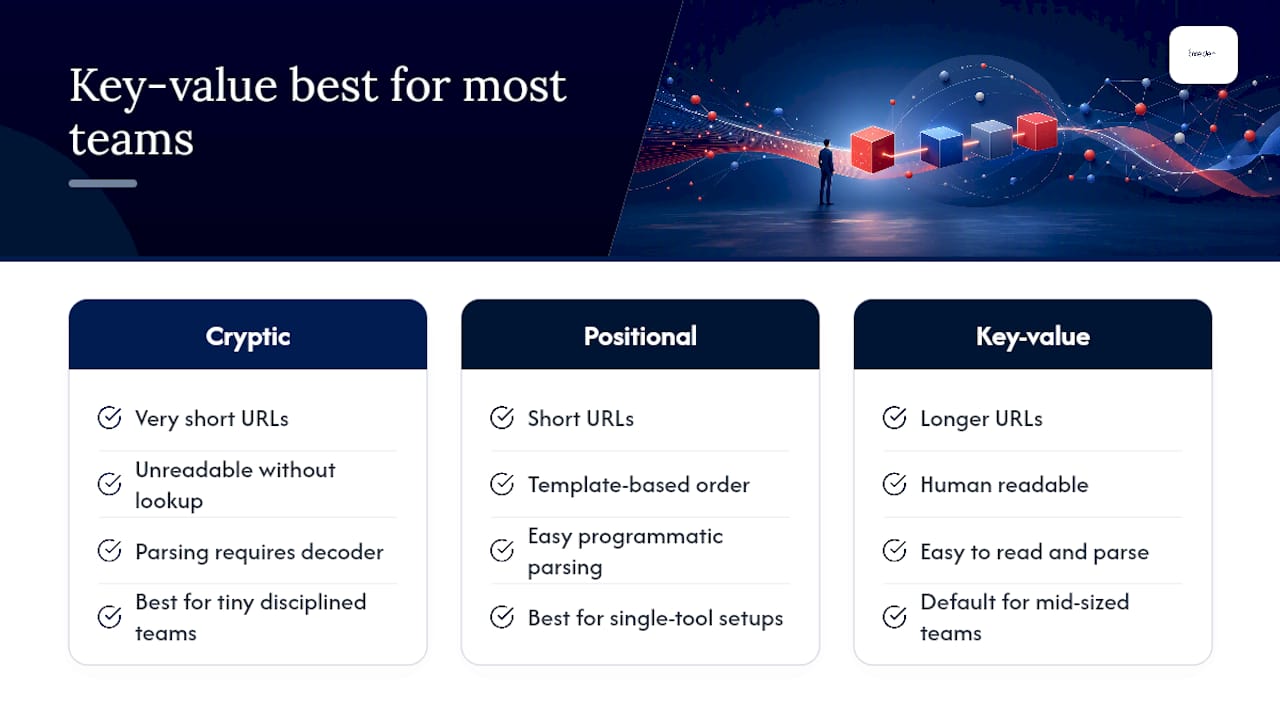

The cryptic model uses short, arbitrary IDs, something like utm_campaign=x7q2, mapped back to a meaning through a separate decoder table. It produces the shortest possible URLs, which matters for channels with character limits or platforms that penalise long strings. The trade-off is steep: nobody can read a cryptic tag and know what it means without opening the lookup table first. That’s fine for a two-person team with rigid discipline. It falls apart the moment a freelancer or a new hire starts building links without checking the reference sheet first.
The positional model fixes a strict field order, so a campaign name might follow a template like channel_program_tactic_date with values slotted into predetermined positions. It’s easy to parse programmatically because the structure never changes, and it works well when a single tool generates all your links. The weakness shows up across channels: a format that works cleanly for paid search often breaks down for affiliate or offline QR codes, where the available fields don’t map to the same positions. Once you’re maintaining multiple positional templates for different channels, you’ve lost the main benefit.
The key-value model is what most mid-sized teams should default to. Every field describes itself: utm_source=newsletter&utm_medium=email&utm_campaign=2026-q3-product-launch. Anyone, marketer, analyst, or a client reviewing a report, can read the string and understand it instantly, with no decoder and no lookup table. The cost is length (key-value strings run longer than cryptic or positional equivalents) and a marginally higher error surface, since typos in the value itself are easier to introduce than in a rigid template. Pairing key-value naming with picklists in your link builder closes most of that gap.
Recommendation: start with key-value for readability and low onboarding friction. Consider a hybrid, key-value structure with a shortened cryptic ID appended for internal tracking, only once you’re running high campaign volume across many contributors and character limits start to bite on specific channels like SMS or QR codes.
Best practices checklist for naming UTM tags
Lock these rules into your SOP or link-builder configuration. Every rule here should be non-negotiable, not a suggestion open to interpretation by whoever happens to be building the link that week.
- Lowercase everything, always. GA4 and most warehouses are case-sensitive, so
Emailandemailfragment into separate rows. Practitioners consistently point to case drift as the single most common cause of taxonomy fragmentation, and eliminating it is close to a free fix. - Pick one separator and document it. Dashes are the safer default over underscores, since some platforms and URL parsers treat underscores inconsistently, while dashes render cleanly everywhere and read naturally in a URL.
- Build a controlled vocabulary for utm_source and utm_medium. A documented registry with a limited, agreed list, something like
google,meta,newsletter,affiliatefor source, andcpc,email,social,organicfor medium, stops people inventing new labels on the fly. - Use a date-first, sortable campaign pattern. Something like
year-quarter-program-tactic(2026-q3-summer-sale-carousel) makes campaigns sort chronologically in any report and makes seasonal comparison trivial a year later. - Set clear rules for utm_content, utm_term, and utm_id. Use utm_content to distinguish creative variants when you’re running more than one ad against the same audience. Reserve utm_term for paid search keywords or defined audience segments, and leave utm_id empty unless your platform specifically requires it for internal campaign matching.
Pro Tip: Run a quick audit of your last ninety days of campaign data before rolling out a new convention. You’ll usually find the same channel logged under three or four spellings, and seeing that mess in your own dashboard is far more persuasive to stakeholders than any policy document.
How do you govern UTM naming across teams?
A convention without an owner decays within a quarter. Assign one person, usually a senior analyst or the paid media lead, as the registry owner responsible for approving new values and rejecting ad-hoc aliases before they enter production.
Each registry entry should record:
- The exact value (lowercase, correct separator)
- Who owns or requested it
- The date it was added
- Which platforms it applies to (Google Ads, Meta, email platform, affiliate network)
- The replacement or deprecation policy if the value ever needs retiring
For validation, a shared spreadsheet with dropdown picklists works for smaller teams. Larger organisations get more mileage from dedicated URL-builder tools, marketing platform tokens in Google Ads or Meta that auto-populate approved values, or a pre-publish check built into whatever tool creates campaign links. Any of these beats trusting individual marketers to type values correctly from memory.
Automation earns its keep once volume grows: normalisation scripts that lowercase and standardise incoming values at the point of ingestion, or a central tag-management layer that enforces the schema before a link ever goes live. Dynamic platform tokens reduce manual paste errors, but only if the platform-side campaign and ad set names already follow your convention. A token that pulls a messy Meta ad set name into your UTM string just replicates the mess automatically, faster.
Versioning matters more than most teams expect. Allow a lightweight request-and-approval process for adding genuinely new values, because a vocabulary that never evolves gets bypassed by frustrated marketers, but one that changes without review fragments just as badly as having no registry at all.
Pro Tip: Review the registry quarterly, not annually. Campaigns move faster than annual reviews can keep up with, and a stale registry gets ignored within weeks.
What do good UTM naming examples look like?
Templates make the abstract rules concrete. Here’s how the convention plays out across common channels, using the key-value model and date-first campaign pattern recommended above.
| Channel | Sample UTM string | What it tells you |
|---|---|---|
| Email newsletter | utm_source=newsletter&utm_medium=email&utm_campaign=2026-q3-product-launch |
Newsletter send promoting a Q3 product launch |
| Meta paid social | utm_source=meta&utm_medium=paid-social&utm_campaign=2026-q3-summer-sale&utm_content=carousel-a |
Meta ad, summer sale campaign, carousel creative variant A |
| Google Ads search | utm_source=google&utm_medium=cpc&utm_campaign=2026-q3-brand-terms&utm_term=running-shoes |
Paid search, brand campaign, keyword theme |
| Affiliate network | utm_source=affiliate&utm_medium=referral&utm_campaign=2026-q3-partner-x |
Referral traffic from a named affiliate partner |
| Offline QR code | utm_source=print-flyer&utm_medium=qr&utm_campaign=2026-q3-instore-promo |
Offline promotion tracked through a scanned code |
Meta and Google Ads both support dynamic tokens ({{campaign.name}}, {{adset.name}}) that auto-populate parts of a UTM string, which the Meta Ads UTM tracking guide covers in detail. These save time on manual tagging, but only pay off once your platform-side naming, your ad set and campaign names inside Meta or Google Ads itself, already follows the same convention. If you’re building out Shopping or Performance Max structures, align the campaign naming inside the platform first, then let the tokens carry that structure into your UTM strings automatically.
What are the most common UTM tagging mistakes?
Most tagging problems trace back to a handful of repeat offenders, and each has a specific fix.
- Case and separator drift in exports. Run a normalisation pass (a script or a spreadsheet formula) that lowercases every value and standardises the separator before analysis, rather than manually fixing each row.
- Duplicate source names for the same channel. Build an alias mapping table (
fb→meta,FB Ads→meta) inside your warehouse rather than trying to retrain everyone who’s already used the old value. - Broken query strings after a redirect. Some redirect tools strip parameters by default. Test every redirect chain before launch and re-tag immediately if the final landing URL doesn’t preserve the full string.
- The temptation to retag historical data. Resist it. Map old values to their correct meaning inside your data warehouse using a lookup table instead, and leave the original raw values untouched. Retroactive retagging in the source system usually creates more inconsistency than it solves.
How do you test and validate UTM tags before launch?
Run this checklist every time a new campaign goes live, not just when something looks wrong in a report.
- Click a sample link and confirm the final landing page URL still carries the full UTM string intact.
- Check that dynamic tokens resolve correctly if you’re using Meta or Google Ads auto-population, confirming the resulting value matches your controlled vocabulary.
- Review acquisition reports within 24 to 48 hours of launch and flag any unexpected new source or medium value appearing, since that usually signals a typo at the point of creation.
- Reconcile click counts between the ad platform and your analytics tool for a spot-check sample, catching redirect or tracking issues early.
- Consider lightweight automation, a script that flags any incoming UTM value not in your registry, or a webhook alert when GA4 logs an unrecognised source, so drift gets caught within days rather than during next quarter’s reporting cycle.
Why clean UTMs matter more than they get credit for
Clean tagging isn’t a housekeeping exercise. It’s the difference between knowing which ad set actually drove profitable revenue and guessing based on a dashboard full of duplicated, half-merged channel rows. We’ve seen ecommerce accounts where fixing naming consistency alone surfaced budget being wasted on a “channel” that was really three fragmented versions of the same underperforming campaign.
Enforcing this kind of governance across a client’s full account structure is standard practice at Oxedent, not a one-off audit item. If your registry needs a second look, ask us for a review.
— Biplab
Get your UTM governance built by people who live in the data daily
Building a registry is straightforward. Enforcing it across five ad platforms, a CRM, and three marketing team members who all build links slightly differently is where most in-house efforts stall. Oxedent runs UTM governance as a core part of every ecommerce PPC account it manages, not a bolt-on audit item you pay for once and forget.

Our eCommerce PPC management service builds the registry, sets validation into your link-creation workflow, and hands over a working system your team can maintain without a decoder table or a monthly clean-up project. That means every pound of spend gets attributed to the channel that actually earned it, not a fragmented mess of case-drifted duplicates. If your naming is already a headache and you want it fixed properly rather than patched, get in touch about a PPC audit and we’ll show you exactly where your current tagging is costing you clarity.
Sources
- A UTM naming convention your team can actually keep | utilkit
- An advanced guide to UTM naming conventions & best practices – Improvado