



If your orders vary in value, use Maximise conversion value, and layer on a target ROAS once you have a clear efficiency goal. Before switching, confirm you can feed Google Ads reliable, varied, non-zero conversion values, whether that’s revenue, profit, or predicted lifetime value, alongside enough conversion volume for the algorithm to learn. If either piece is missing, fix measurement first and run the checklist below.
TL;DR:
- Value-based bidding requires meaningful, varied, and non-zero conversion values, along with sufficient monthly conversions, typically 30 to 50, for reliable performance.
- Using profit-adjusted or predicted lifetime value signals can significantly improve campaign efficiency by aligning bidding with actual business profitability or customer retention potential.
- Proper setup involves technical steps such as GCLID capture, daily offline conversion imports, and cautious use of conversion value rules to avoid data noise and measurement errors.
- Running controlled experiment campaigns with carefully set target ROAS and sufficient testing duration helps determine whether value-based bidding outperforms existing strategies.
- Common pitfalls include zero-value conversions, mismatched value signals, unrealistic target ROAS, silent pipeline failures, and lack of a plan to revert to previous settings if needed.
Table of Contents
- What is value-based bidding for ecommerce?
- Is your store ready for value-based bidding?
- How to set up value signals and Smart Bidding for ecommerce
- Testing value-based bidding: what to watch while it learns
- Common failures and practical safeguards
- How Oxedent implements value-based bidding for ecommerce clients
- Aligning value-based bidding with customer lifetime value models
- Handling delayed conversions and offline sales data
- Segmenting by margin and customer value for sharper bids
- Budget allocation and pacing with value-based bidding
- What actually determines success here
- Let Oxedent handle your value-based bidding setup
- Sources
- FAQ
What is value-based bidding for ecommerce?
Value-based bidding is the practice of optimising Google Ads campaigns towards the actual monetary value of each conversion, rather than simply the number of conversions. In Google Ads, this happens through Smart Bidding strategies, principally Maximise conversion value, which spends your budget to generate the highest total conversion value it can, and Target ROAS, which does the same while holding to a return-on-ad-spend goal you set.
The distinction matters more than most advertisers realise. A campaign optimising for conversion count treats a £15 order the same as a £400 order. One optimising for value pushes budget towards the customers and products that generate the most revenue, or the most profit, depending on what you tell it to chase. Google’s own best practice guidance is explicit that this only works when you feed the algorithm meaningful, varied, non-zero values, an important detail we’ll come back to repeatedly, because it’s the single most common reason value-based bidding underperforms.
For UK ecommerce accounts, this is the natural evolution beyond target CPA or Maximise conversions. Once your catalogue spans different price points, margins, or repeat-purchase behaviour, chasing conversion count alone leaves money on the table.
Is your store ready for value-based bidding?
Run through this before you touch a bid strategy setting. Value-based bidding rewards accounts with the right data foundations and punishes those without them.
- Do your orders vary meaningfully in value? If your average order value swings between £20 and £300 depending on the customer or basket, value-based bidding has something to optimise towards. If every order is roughly the same price, the upside shrinks.
- Can you capture GCLID at landing and pass purchase values back reliably? This is non-negotiable. Without a working GCLID pipeline, enhanced conversions or offline conversion import simply won’t function.
- Is your account generating enough conversions? Practitioner guidance suggests building towards 30 to 50 conversions a month at account level before leaning on automated value strategies, with experiments needing more volume still to reach reliable conclusions.
- Can you produce at least two distinct, non-zero conversion values? A single flat value defeats the purpose. Google’s guidance is clear that the algorithm needs variation to learn what a valuable customer actually looks like.
If you tick most of these boxes, move to setup. If not, spend a few weeks fixing measurement before switching bid strategies.
How to set up value signals and Smart Bidding for ecommerce
Getting this right is mostly a data engineering exercise dressed up as a bidding decision. Here’s the sequence that works.
- Choose your strategy first. Use Maximise conversion value when the priority is growth and you’re comfortable letting Google spend your full budget to maximise total value. Layer on a target ROAS once you have a genuine efficiency goal, ideally based on several months of realised performance, not a number plucked from a boardroom slide.
- Decide which value to feed the algorithm. Raw revenue is the easiest to implement but ignores margin. Profit-adjusted value corrects for that, and is the better choice if some product lines carry thinner margins than others. Predicted lifetime value (pLTV) goes further still, rewarding the algorithm for acquiring customers likely to buy again, not just the ones who spend the most on their first order. Practitioners warn that feeding the wrong value, say, raw AOV when your business actually lives or dies on repeat purchase, sends Smart Bidding to chase the wrong objective entirely.
- Pick your technical path. There are three realistic options, and AdZeta’s breakdown of Smart Bidding with LTV signals covers all three well: enhanced conversions with server-side revenue tracking for straightforward setups; Customer Match combined with conversion value rules, which lets you apply segment-level multipliers (useful for rewarding known high-value cohorts); and Offline Conversion Import (OCI) using GCLID, which enables true per-customer pLTV but demands daily uploads and a working scoring model behind it.
- Lock down the operational basics. Capture GCLID on every landing page. Automate daily uploads rather than relying on manual exports. Eliminate 0-value conversions from your feed. Keep conversion action naming consistent across GA4, your CRM, and Google Ads, so nothing gets double-counted or lost in translation.
Pro Tip: Use conversion value rules sparingly, and only for signals Google genuinely cannot infer itself, such as a margin figure that lives exclusively in your ERP. Duplicating a signal the platform already has just adds noise.
Testing value-based bidding: what to watch while it learns
Don’t flip the switch account-wide and hope. Use Google Ads campaign experiments to run a controlled test, changing only the bidding variable while everything else, budgets, creative, targeting, stays identical between the control and trial arm.
Setting a fair target matters more than most advertisers expect. If you’re comparing a target ROAS strategy against an existing CPA approach, set the trial arm’s tROAS at or below your account’s realised ROAS from the prior four weeks. Set it too high and you starve the trial arm of volume, guaranteeing it looks worse than it is. Want to see whether value-based bidding can also unlock more traffic, not just efficiency? Lower the target deliberately during the test window.
Give the experiment time. Realistic guidance points to at least three conversion cycles, or four to eight weeks, with both arms needing adequate conversion volume, ideally in the region of 50 conversions in the trailing 30 days per arm, before you draw conclusions.
While it runs, monitor:
- Conversion value and cost per arm, tracked daily rather than checked once a week.
- Blended ROI across the account, not just the metric inside the experiment itself.
- OCI upload health, watching for broken pipelines or sudden drops in imported conversions.
- Enhanced conversion matching rates, which can stall silently if a tag update breaks tracking.
A test that looks like it’s failing is sometimes a measurement problem wearing a bidding problem’s clothes.
Common failures and practical safeguards
Most value-based bidding disappointments trace back to a handful of repeatable mistakes.
- Zero-value conversions. These give Smart Bidding no signal at all and should be excluded or corrected, never left in the feed, as Google itself warns.
- Feeding AOV when the business actually runs on LTV. If repeat purchase drives your margin, optimising for first-order revenue alone misdirects spend towards one-time bargain hunters.
- Unrealistic tROAS targets. Set too aggressively, they starve campaigns of volume; too loosely, they waste budget. Think in terms of blended ROAS across channels rather than one campaign in isolation, an idea we cover in more depth in our guide to mastering blended ROAS.
- Silent pipeline failures. Offline upload jobs fail quietly more often than advertisers assume. Build anomaly alerts for sudden falls in imported conversion counts or value, since a broken OCI pipeline is often invisible until performance has already dropped.
- No rollback plan. Document how to revert to Maximise conversions or enhanced CPC if an experiment underperforms, so a bad test doesn’t turn into a bad quarter.
Pro Tip: Schedule a weekly five-minute check on your OCI upload logs. Catching a broken pipeline on day two is a minor fix; catching it on day twenty is a lost month of learning.
How Oxedent implements value-based bidding for ecommerce clients
Oxedent starts every value-based bidding engagement with a readiness assessment: order value spread, existing conversion tracking health, and whether the client’s data supports revenue, profit, or predicted LTV as the primary signal. Getting this diagnosis right upfront saves weeks of misdirected optimisation later.
From there, the operational work follows a set sequence: a feed and tagging audit, GCLID capture verification, implementation of OCI or conversion value rules depending on the technical path chosen, and ongoing experiment governance with anomaly monitoring built in from day one rather than bolted on after something breaks.


This approach fits established ecommerce brands with meaningful, consistent ad budgets rather than accounts just starting out. Typical first deliverables are an account audit, a scoped pilot experiment, and an optimisation roadmap for the months that follow, informed by our broader view on profitable ecommerce growth through paid media.
Aligning value-based bidding with customer lifetime value models
Revenue-based bidding rewards the first sale. LTV-based bidding rewards the customer relationship. For ecommerce brands with meaningful repeat purchase rates, subscription components, or loyalty programmes, that difference changes which customers your ads chase.
Building a usable pLTV model doesn’t require a data science team, though it helps to have one. A workable starting point uses historical cohort data: average repeat purchase rate, average order frequency over 12 months, and gross margin by product category, blended into a score per customer or customer segment. That score then feeds Smart Bidding either through Customer Match audiences tagged with a value multiplier, or through OCI uploads carrying an individual pLTV figure against each customer’s GCLID.
The integration point that trips people up is refresh frequency. A pLTV model built once and left untouched for a year drifts as customer behaviour changes, particularly around seasonal buying patterns or after a pricing change. Treat the model as a living input, recalculated at least quarterly, and re-uploaded through whichever pipeline you’ve chosen.
Retailers with thinner repeat-purchase data (say, a single flagship product with low reorder rates) generally get more reliable results from profit-adjusted revenue than from a shaky early-stage pLTV model. Match the sophistication of your value signal to the maturity of your data, not to what sounds most advanced.
Handling delayed conversions and offline sales data
Ecommerce rarely converts in a straight line. Someone clicks an ad, browses for three days, then completes the purchase over the phone with customer service, or via a marketplace checkout that reports back to Google Ads hours later. Value-based bidding needs a way to reconcile that lag without corrupting the signal it’s learning from.
Offline Conversion Import is the mechanism built for exactly this. It requires the original GCLID captured at the moment of the ad click, and Google enforces a time window on how late that GCLID can be matched against a later conversion. Miss the window, or lose the GCLID somewhere in your checkout or CRM handoff, and the conversion simply won’t attribute back correctly, which quietly starves Smart Bidding of the exact data it needs most.
Practically, this means auditing your GCLID handling at every point it might get dropped: form submissions, phone order scripts, marketplace integrations, and any CRM system that doesn’t natively store ad click identifiers. Daily upload cadence matters too. A weekly batch upload might feel efficient, but it delays the signal reaching Smart Bidding by days, during which the algorithm is bidding partially blind.
For brands with a genuine offline sales channel, in-store, telephone, trade counter, this is where value-based bidding delivers its most underused benefit: it lets ad spend reflect revenue that never touched a website checkout at all, provided the attribution chain back to the original click stays intact.
Segmenting by margin and customer value for sharper bids
Not every product in your catalogue deserves the same bidding treatment, and not every customer segment should pull the same weight in your value signal.
Margin-based segmentation is the simpler starting point. If certain product categories carry materially thinner margins, feeding raw revenue as your conversion value tells Smart Bidding to chase them just as hard as your highest-margin lines. A profit-adjusted value, calculated per SKU or per category, corrects that distortion without needing separate campaigns for every margin band.
Customer segment multipliers go a step further. Conversion value rules let you apply a weighting to specific audiences, existing customers versus new, high-LTV cohorts identified through Customer Match, or geographic regions with historically higher repeat rates. This is genuinely useful when Google’s own signals can’t see something you know from your own data, such as a loyalty tier or a wholesale account flagged in your CRM.
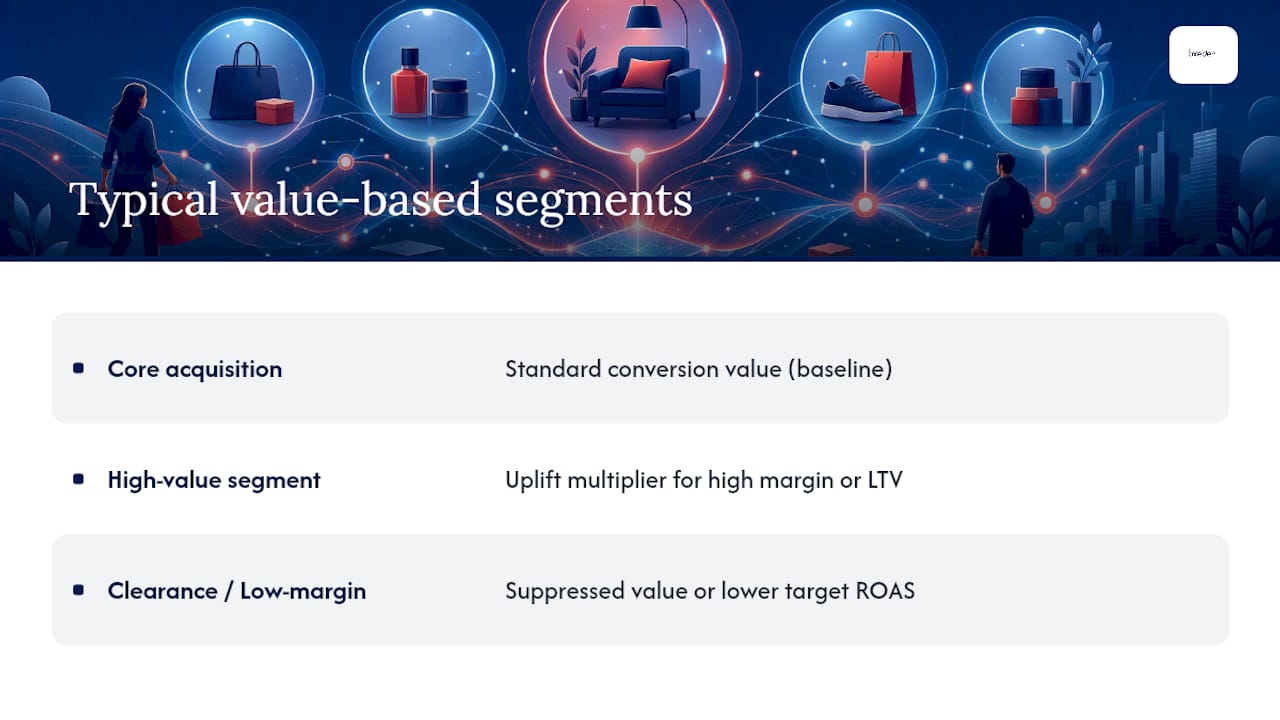
The mistake to avoid is over-segmenting before your conversion volume supports it. Splitting an account into a dozen micro-segments each chasing a different value signal spreads your conversion data too thin for any single campaign to learn effectively. A more workable structure typically runs two or three segments: a core acquisition segment on standard value, a high-margin or high-LTV segment with an uplift multiplier, and a clearance or low-margin segment on a suppressed value or a separate, lower target ROAS. Our guide to choosing bidding strategies for ecommerce brands covers how this structural thinking applies more broadly across campaign types.
Budget allocation and pacing with value-based bidding
Value-based bidding changes how you should think about budget caps, because a strict daily limit can cut off spend right when the algorithm has identified a high-value opportunity worth pursuing.
Google’s Smart Bidding systems pace spend across a campaign’s full budget window based on predicted auction value, not evenly across each day. That means a tight daily cap fights against the system’s own logic. Where possible, set budgets at the campaign level with enough headroom that a genuinely valuable day of traffic, a payday spike, a seasonal peak, doesn’t get artificially throttled.
Shopping and Performance Max campaigns using Maximise conversion value are particularly sensitive to this. Underfunding them relative to their learning needs tends to produce erratic value swings week to week, because the algorithm never gets a stable enough spend pattern to find its footing. If you’re running Performance Max on Maximise conversion value, our setup guide for scaling Performance Max covers budget pacing specific to that campaign type.
Reassess budget splits monthly rather than daily. Value-based bidding rewards patience; constant manual reallocation based on short-term fluctuations undermines the very stability the algorithm needs to optimise properly. Where you do need to intervene, adjust target ROAS incrementally, in steps of 5 to 10%, rather than making sharp jumps that force the system to relearn from scratch.
What actually determines success here
The conventional advice on value-based bidding treats it as a bidding decision. It isn’t. It’s a data quality decision wearing a bidding strategy’s name tag, and most of the guides that frame it otherwise are setting readers up to be disappointed by an algorithm doing exactly what it was told.
The bigger failure I see in how this gets discussed isn’t technical, it’s a fixation on revenue as the default value signal, simply because it’s the easiest one to implement. For a genuinely profit-aware retailer, that’s often the wrong axis entirely. A brand with strong repeat purchase behaviour that feeds Google raw AOV is training its own ad account to prize the wrong customer.
What should come first isn’t the bid strategy toggle. It’s an honest audit: does your measurement pipeline actually support the value you want to optimise for, and does that value match what the business genuinely needs to grow profitably? Get that right, and the bidding strategy choice becomes almost mechanical. Get it wrong, and no amount of target ROAS tweaking will save the campaign from optimising towards a number that never mattered in the first place.
— Biplab
Let Oxedent handle your value-based bidding setup
Specialist agencies can help you avoid common pitfalls like GCLID capture, OCI pipelines, and pLTV modelling, ensuring a solid technical foundation for a profitable value-based bidding rollout.

Specialist ecommerce PPC agencies focus on Google Ads, Shopping, and Performance Max campaigns built around profit and revenue rather than click volume. Engagements typically start with an audit of existing feed, tagging, and conversion measurement, followed by implementation of an appropriate value signal such as revenue, profit-adjusted, or predicted LTV, and a properly governed experiment before any account-wide rollout. This approach suits established ecommerce brands with meaningful, consistent ad budgets rather than early-stage accounts still finding their footing.
If you want a second opinion on whether your account is ready, start with Oxedent’s ecommerce PPC management service and request an audit.
Sources
FAQ
What Is Value-Based Bidding in Ecommerce?
It’s a Google Ads bidding approach that optimises campaigns towards the actual monetary value of each conversion, revenue, profit, or predicted LTV, rather than conversion count alone.
How Many Conversions Do I Need Before Enabling It?
Aim for roughly 30 to 50 conversions a month at account level before relying on automated value strategies, with experiments needing more volume per arm for reliable results.
Should I Use Revenue or Profit as My Conversion Value?
Use profit-adjusted value if margins vary significantly across your catalogue; raw revenue works only when margins are fairly uniform across what you sell.
What Causes Value-Based Bidding to Underperform?
Zero-value conversions, mismatched value signals like feeding AOV to a business that runs on repeat purchase, and broken offline conversion import pipelines are the most common causes.
Can Oxedent Help Set Up Value-Based Bidding?
Yes. Oxedent audits measurement readiness, implements the right value signal, and runs governed experiments for established ecommerce brands adopting value-based bidding on Google Ads.