


A Google Ads agency is a professional team that designs, manages, and optimises paid search campaigns on Google to drive targeted traffic, qualified leads, and measurable business results. The agency handles everything from campaign architecture and keyword research to bid management, conversion tracking, and performance reporting. For marketing managers and business owners, understanding what a Google Ads agency does is the difference between treating paid search as a cost centre and treating it as a growth engine. The role has evolved well beyond basic media buying. Today’s agencies function as technical and strategic partners, managing complexity that most in-house teams simply do not have the bandwidth or specialised knowledge to handle.
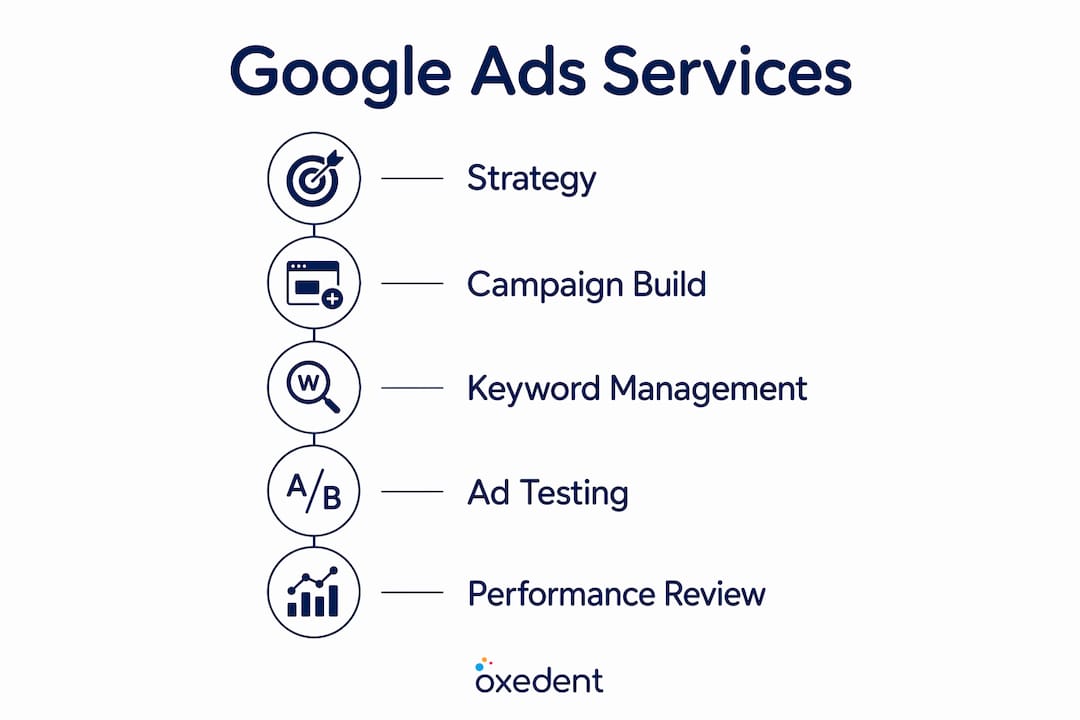

What does a Google Ads agency do across its core services?
A Google Ads agency, often referred to in the industry as a PPC (pay-per-click) management agency, takes ownership of the full paid search lifecycle. That scope is broader than most businesses expect when they first engage one.
Campaign architecture is the foundation. Agencies structure campaigns, ad groups, and keyword segmentation to match the way your customers actually search. Poor structure leads to wasted budget, low Quality Scores, and ads appearing for irrelevant queries. A well-built account separates branded from non-branded traffic, segments products or services logically, and creates clear pathways for budget allocation.


Keyword research and negative keyword management run in parallel. Improper negative keyword management can waste 20 to 30% of Google Ads spend, which means routine manual search-term reviews are not optional. Automation alone will not catch every irrelevant query. Agencies build and maintain negative keyword lists continuously, protecting your budget from haemorrhaging on searches that will never convert.
Ad creative development and testing covers Search ads, Display, YouTube, and Performance Max. Agencies write copy, test headlines, and analyse which creative combinations drive the best conversion rates. For ecommerce brands, this includes product feed optimisation and Shopping ad creative.
Bid management involves configuring Smart Bidding strategies such as Target CPA, Target ROAS, and Maximise Conversions. Selecting the wrong strategy for your account’s data maturity is a common and costly mistake. Agencies assess whether your account has sufficient conversion volume to support automated bidding before deploying it.
Conversion tracking and analytics setup is where many in-house teams fall short. Agencies implement GA4 integration, Enhanced Conversions, and server-side tagging to capture accurate data. Without reliable tracking, every optimisation decision is based on incomplete information.
Performance reporting should focus on business outcomes: cost per acquisition, return on ad spend, lead quality, and revenue. Effective agencies align reporting with business metrics rather than vanity metrics like impressions and clicks. This distinction matters enormously when you are justifying ad spend to a board or a finance team.
Pro Tip: Ask any prospective agency to show you a sample report. If it leads with impressions and click-through rate rather than CPA or ROAS, that tells you everything about their priorities.
How does agency management improve advertising efficiency?
The efficiency gains from professional Google Ads management are well-documented. Accounts managed by certified specialists achieve a 38% lower cost per acquisition compared to in-house teams, driven by proactive, data-led optimisation. That figure reflects the compounding advantage of expertise applied consistently over time.
One of the most underappreciated advantages is network knowledge. Agencies managing multiple accounts detect patterns across industries and campaign types that a single in-house team would never encounter. They recognise when a bidding anomaly is platform-wide rather than account-specific. They know which campaign structures tend to fail at scale before testing them on your budget.
“Companies with verified conversion tracking are 17 times more likely to see positive ROI from Google Ads. Tracking accuracy is not a technical nicety. It is the commercial foundation of every optimisation decision.”
Technical sophistication separates good agencies from average ones. Server-side tagging, Consent Mode v2, and Enhanced Conversions are not features most in-house marketers configure confidently. Yet server-side tagging and Consent Mode v2 can recover 15 to 25% of conversion tracking lost to privacy changes. For a business spending £20,000 per month on ads, that recovered data directly improves bidding accuracy and campaign performance.
Agencies also navigate platform automation more effectively. Broad match combined with Smart Bidding outperforms exact match for 70% of non-branded queries, yet many in-house teams default to exact match out of caution. Knowing when to trust automation and when to override it is a skill built through managing hundreds of accounts, not dozens. You can read more about reducing cost per conversion with the specific tactics agencies use to achieve these results.
What are typical Google Ads agency fees and pricing models?
Understanding the Google Ads agency fee structure helps you evaluate whether you are getting fair value and spot arrangements where incentives are misaligned.
| Fee model | How it works | Best suited for |
|---|---|---|
| Flat monthly retainer | Fixed fee regardless of ad spend | Businesses with stable, predictable budgets |
| Percentage of ad spend | Typically 10 to 20% of monthly spend | Businesses scaling ad budgets over time |
| Hybrid model | Base retainer plus performance share | Accounts where growth is the primary goal |
| Setup or onboarding fee | One-off charge for account build | New accounts or major restructures |
Google Ads management fees vary with account complexity, campaign types and the agency’s scope of work. Ask for a written breakdown of the monthly management fee, any setup charges and the advertising budget, so you can compare proposals on the same basis.
The percentage-of-spend model carries a structural risk worth understanding. An agency paid 15% of your ad spend has a financial incentive to increase your budget, regardless of whether that increase improves your return on ad spend. Always ask how the agency defines success and whether their fee structure aligns with your profitability goals rather than your spend volume.
Pro Tip: Request a clear written scope of work before signing any agreement. Agencies that bundle vague deliverables into a monthly retainer are harder to hold accountable than those who specify exactly what is included each month.
For a detailed breakdown of UK-specific pricing, the Google Ads PPC management fees guide covers the full range of models and what each typically includes.
What technical deliverables should a Google Ads agency provide in 2026?
The technical infrastructure an agency builds and maintains is what separates a well-run account from one that merely exists. In 2026, several technical disciplines are non-negotiable for any agency claiming to manage Google Ads professionally.
Conversion tracking accuracy is the starting point. Agencies must implement GA4-to-Google Ads integration, Enhanced Conversions, and server-side tagging via Google Tag Manager server-side containers. This setup transmits event data directly from servers to Google, bypassing browser-level restrictions from Safari’s Intelligent Tracking Prevention and ad blockers. Without it, your bidding algorithms are working with a fraction of the available signal.
Consent Mode v2 is now required for compliance with GDPR and the UK’s data protection framework. Agencies that have not implemented it are not just leaving conversion data on the table. They are exposing your account to policy risk. Proper implementation allows Google’s modelling to fill gaps in consented data, maintaining bidding performance even when users decline tracking.
Performance Max campaign management requires a distinct skill set. Performance Max consolidates Search, Shopping, Display, YouTube, and Gmail into a single campaign type, with Google’s automation controlling most placement decisions. The agency’s role shifts to providing high-quality creative assets, audience signals, and feed optimisation, then interpreting the limited reporting Google surfaces. Managing Performance Max well for ecommerce requires understanding how it scales for retail brands specifically.
Weekly performance reviews should include written commentary, not just dashboards. Weekly reports with detailed written notes explaining performance changes, flagged issues, and planned next steps are the mark of an agency that understands its accountability to your business. A dashboard without interpretation is just data. Interpretation is what you are paying for.
How should you evaluate and choose the right Google Ads agency?
Choosing the right agency requires asking the right questions before you commit. Here is a structured approach to vetting any agency you are considering.
- Ask how they define success for your account. If the answer centres on clicks, impressions, or traffic volume rather than CPA, ROAS, or revenue, that is a misalignment of priorities.
- Request a technical audit of your current account. A competent agency will identify specific structural issues, tracking gaps, and wasted spend within the first review. Vague observations suggest limited technical depth.
- Understand their optimisation cadence. How often do they review search terms? How frequently do they test new ad copy? What triggers a bid strategy change? Specific answers indicate a real process.
- Evaluate their reporting format. Ask to see a sample report from a current client (anonymised). Reports should connect campaign data to business outcomes, not just platform metrics.
- Clarify cross-team collaboration. Aligning paid ads with sales and product teams ensures campaigns drive real business value. Ask how the agency integrates with your wider marketing and sales operations.
- Check for contract flexibility. Agencies confident in their results do not need to lock you into 12-month contracts. Month-to-month or quarterly arrangements reflect genuine confidence in performance.
Agencies that focus on what good agency management looks like in practice will welcome these questions. Those that deflect or give generic answers are telling you something important.
Key takeaways
A Google Ads agency delivers measurable business results by combining technical infrastructure, strategic campaign management, and data-led optimisation that most in-house teams cannot replicate at the same level.
| Point | Details |
|---|---|
| Core service scope | Agencies handle architecture, keyword management, creative testing, bid strategy, and conversion tracking. |
| Efficiency advantage | Certified agency management achieves up to 38% lower cost per acquisition versus in-house teams. |
| Fee structures | Monthly fees range from £1,500 to £25,000; percentage-of-spend models carry misalignment risks. |
| Technical foundations | Server-side tagging and Consent Mode v2 recover 15 to 25% of lost conversion data. |
| Evaluation criteria | Assess agencies on reporting quality, optimisation cadence, and alignment with business outcomes. |
The agency relationship most businesses get wrong
From my experience working across ecommerce accounts at Oxedent, the most common mistake businesses make when hiring a Google Ads agency is treating the relationship as a handoff rather than a collaboration. They sign the contract, hand over account access, and wait for results. That approach consistently underperforms.
The agencies that deliver the best outcomes are the ones whose clients stay engaged. You know your customers, your margins, your seasonal patterns, and your product priorities better than any external team ever will. When that knowledge flows into the agency relationship, the campaigns reflect it. When it does not, the agency is optimising in a vacuum.
The second mistake I see regularly is hiring on price. A £500 per month management fee sounds attractive until you realise the agency is running automated reports and making no meaningful changes between invoices. The cost of underperformance on a £15,000 monthly ad budget dwarfs the saving on management fees. The role of Google Ads agencies has evolved into genuine strategic partnership. Treat it as such, and the returns follow.
— Biplab
How Oxedent manages Google Ads for ecommerce brands

Oxedent is a specialist ecommerce PPC agency that manages Google Ads exclusively for online retail brands. The focus is on profitability and return on ad spend, not vanity metrics. Every account receives campaign architecture built for ecommerce, Performance Max management with full feed optimisation, server-side tracking implementation, and weekly performance reports with written commentary tied to your business goals. If you are an established ecommerce brand with a meaningful ad budget and you want a partner focused on scalable revenue growth, explore ecommerce PPC management with Oxedent. You can also learn more about hiring a Google Ads agency specifically for ecommerce in 2026.
FAQ
What does a Google Ads agency actually do?
A Google Ads agency manages your paid search campaigns end to end, covering strategy, campaign build, keyword management, bid optimisation, conversion tracking, and performance reporting. The goal is to drive qualified traffic and measurable business outcomes such as leads, sales, and return on ad spend.
What is a typical Google Ads agency fee in the UK?
Monthly management fees range from £1,500 to £25,000 depending on account complexity and ad spend. For a £10,000 monthly budget, fees typically fall between £1,800 and £3,500, with one-off setup fees of £500 to £2,500.
How do I know if a Google Ads agency is performing well?
Performance should be measured against business metrics such as CPA, ROAS, and revenue, not clicks or impressions. A well-performing agency provides weekly reports with written commentary and demonstrates continuous optimisation activity.
Why is conversion tracking so important for Google Ads agencies?
Accurate conversion tracking is the data foundation for every bidding and optimisation decision. Companies with verified conversion tracking are 17 times more likely to see positive ROI, and server-side tagging can recover 15 to 25% of data lost to privacy restrictions.
Should I hire a specialist or a full-service agency for Google Ads?
A specialist PPC agency brings deeper expertise in campaign structure, automation, and technical tracking than a generalist agency managing multiple channels. For ecommerce brands with significant ad budgets, a specialist agency typically delivers better returns.