


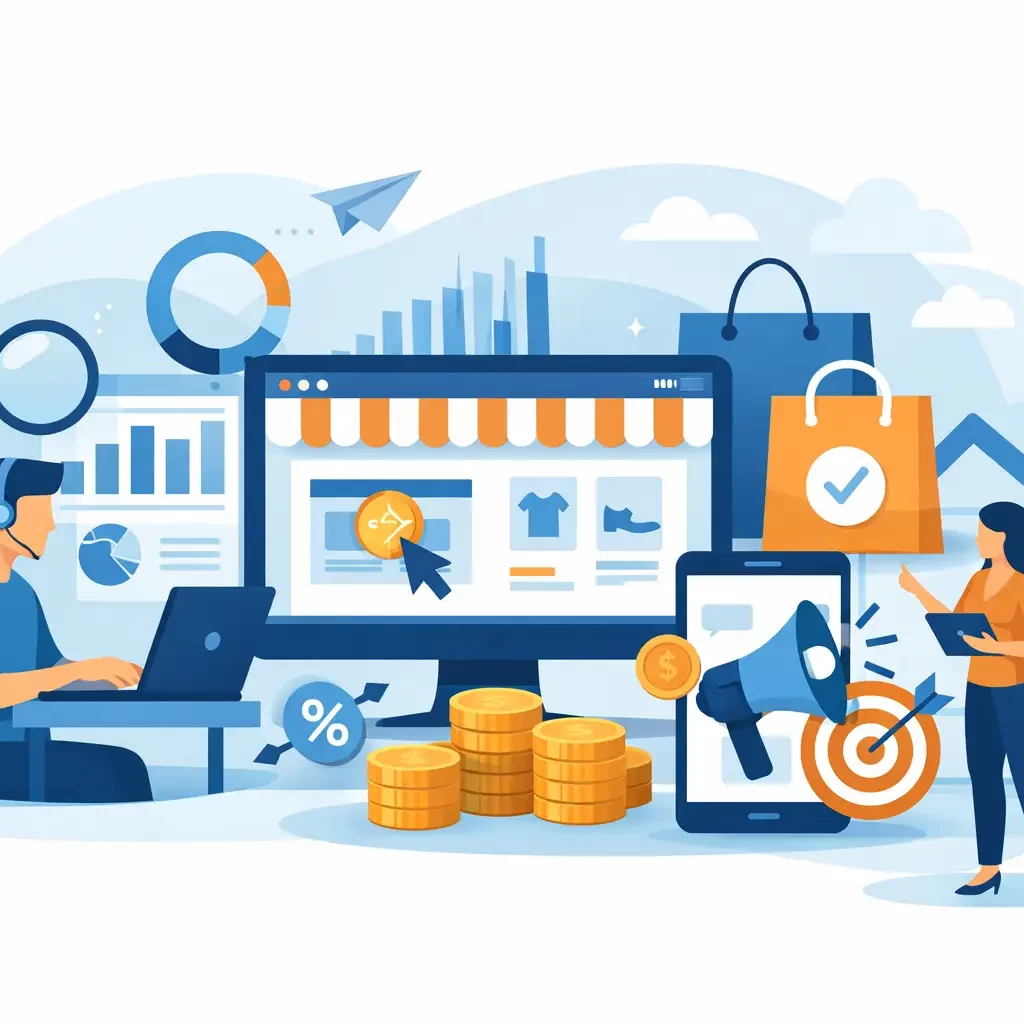
If you are asking what does a PPC agency do, you are probably not looking for a textbook definition. You want to know whether an agency will actually improve performance, reduce wasted spend, and help you scale profitably – or whether it will simply send prettier reports while your margins get thinner.
For established eCommerce brands, that distinction matters. Paid media can accelerate growth fast, but it can also burn through budget even faster when campaign structure, product feeds, tracking, and bidding are handled badly. A good PPC agency exists to make paid acquisition commercially viable. A weak one just buys traffic.
What does a PPC agency do in practice?
At a practical level, a PPC agency plans, builds, manages, and improves paid advertising campaigns across platforms such as Google Ads, Google Shopping, Performance Max, and Meta Ads. But that short definition misses the part that actually matters: the agency should be making decisions that improve return on ad spend, contribution margin, and revenue quality.
That means the real job is not pushing ads live. It is controlling the variables that affect profitability. Budget allocation, search intent, product segmentation, audience quality, creative testing, feed quality, bidding strategy, and conversion tracking all sit inside that remit.
For eCommerce businesses, this work is more technical than many founders expect. The challenge is not only generating sales. It is generating the right sales at an acceptable cost, while keeping enough control to scale without performance collapsing.
A PPC agency should start with the numbers
Any agency worth hiring should begin with commercial reality, not platform enthusiasm. Before discussing scale, it needs to understand your average order value, gross margin, repeat purchase behaviour, breakeven cost per acquisition, and target return on ad spend.
Without that context, campaign decisions are guesswork. More clicks are meaningless if the traffic does not convert. More conversions are not automatically a win if the margin is too weak to support the cost. This is where many generalist agencies fall down. They report on visibility metrics when the real question is whether paid media is creating profitable growth.
A serious PPC agency builds strategy around what your business can afford to pay for a sale. That sounds obvious, but in reality it is often skipped.
Campaign build is only one part of the job
Setting up campaigns is the visible part of PPC management, but it is not the whole service. Yes, an agency will structure search campaigns, shopping campaigns, retargeting, prospecting, and platform-specific activity. It will define goals, segment products, map search intent, write ad copy, and configure bidding.
But campaign build is just the starting point. Most performance gains happen after launch. That is when the agency sees what the market is actually doing with your budget.
Search terms start revealing intent gaps. Product groups begin showing where revenue is concentrated. Creative fatigue appears. Certain products absorb spend without producing enough return. New customer acquisition may look expensive until repeat rate is factored in. Or it may simply be too expensive full stop.
That is why experienced PPC management is less about setup and more about iteration.
What does a PPC agency do after launch?
After launch, the agency should move into continuous optimisation. This is where specialist skill earns its keep.
On Google Ads, that may involve tightening search query control, refining campaign segmentation, excluding poor traffic, testing bidding strategies, adjusting location settings, or restructuring around product categories and margin tiers. On Google Shopping and Performance Max, feed quality becomes critical. If your titles, attributes, categorisation, and product data are weak, the platform has less to work with and performance suffers.
On Meta, optimisation often centres on audience signals, creative rotation, offer clarity, landing page alignment, and how prospecting and remarketing budgets interact. The goal is not to make every platform look busy. It is to make the account commercially efficient.
A proper agency also watches for waste aggressively. Spend leakage usually hides in broad targeting, poor feed hygiene, weak exclusions, low-intent placements, and overfunded campaigns that have already peaked. Cutting waste is not glamorous, but it is often the fastest route to better returns.
Feed optimisation is a major part of eCommerce PPC
For online retail brands, feed optimisation is often one of the most overlooked parts of PPC performance. Many businesses assume Google Shopping results are driven mainly by bids. They are not. Product data quality has a huge impact on visibility, matching, and conversion quality.
A specialist agency will review titles, descriptions, product types, GTINs, images, variants, pricing signals, and custom labels. It may segment products by margin, bestseller status, seasonality, or stock levels so budget can be prioritised more intelligently.
This matters because not all products deserve equal spend. Some products are heroes. Some support average order value. Some should barely be advertised at all. If the feed is poorly structured, the platform cannot distinguish between them effectively, and your budget gets spread too thinly.
Reporting should explain decisions, not just results
One of the easiest ways to spot a weak PPC agency is by the way it reports. If reports are heavy on impressions, clicks, and vague commentary but light on profit context, that is a problem.
A useful agency report should show what changed, why it changed, and what the commercial effect was. It should connect platform activity to business outcomes. If spend rose, did efficiency hold? If revenue dipped, was it a conversion rate issue, a stock issue, a seasonality issue, or a traffic quality issue? If performance improved, which actions created the lift?
Good reporting creates accountability. It also helps founders and marketing leads make better decisions outside the ad account, whether that means reviewing pricing, improving landing pages, or pushing stronger product bundles.
Strategy matters more than platform access
Plenty of businesses still assume agencies offer some special platform advantage. They do not have a secret button that makes Google or Meta cheaper. What they should offer is better judgement.
That includes knowing when to scale and when not to. More spend is not always the answer. If your conversion rate is unstable, your feed is weak, or your margins are too tight on cold traffic, increasing budget may just amplify inefficiency. A disciplined agency will tell you that.
The same applies to channel choice. Not every brand should push hard on every platform at once. For some retailers, Google Shopping will carry the account. For others, Meta will be stronger for demand generation. Performance Max can work well, but only when the inputs, tracking, and structure are good enough to support it. It depends on the catalogue, the price point, the purchase cycle, and how demand already exists in the market.
What a specialist PPC agency does differently
A generalist marketing agency may offer PPC alongside SEO, email, web design, and social content. That model suits some businesses, but it often creates a depth problem. eCommerce paid media has too many moving parts for shallow execution.
A specialist PPC agency brings tighter operational focus. It is more likely to understand feed segmentation, shopping structures, first-party data use, blended return targets, and the relationship between platform performance and margin reality. It is also more likely to challenge bad assumptions quickly because it sees the same patterns across multiple retail accounts.
That specialisation matters when budgets are meaningful. Once a brand is spending several thousand pounds a month or more, small mistakes stop being small.
When hiring a PPC agency actually makes sense
Not every business should hire an agency. If your site is unproven, your offer is unclear, or your margins do not support paid acquisition, agency management will not solve the underlying issue. It may even speed up the damage.
The right time usually comes when you already have product-market fit, enough budget to test and optimise properly, and a clear view of your numbers. At that point, an agency can add leverage. It can bring structure, speed, technical expertise, and a level of discipline that is hard to maintain in-house unless you already have a strong performance team.
For serious eCommerce brands, the better question is not simply what does a PPC agency do. It is whether the agency can improve the economics of your acquisition.
That is the standard that matters. Not activity. Not jargon. Not slide decks.
If an agency can help you spend with more control, cut obvious waste, improve the quality of revenue, and scale without losing sight of profit, it is doing its job. If not, you do not need more meetings – you need a better operator.
The most useful agency relationship feels less like outsourced ad buying and more like having a commercially sharp growth partner who knows exactly where paid media helps, where it hurts, and where the next gain is likely to come from.