


A Google Ads growth plan is a structured, multi-month roadmap that aligns paid advertising campaigns with core business objectives such as revenue targets, cost per acquisition, and return on ad spend. Unlike a generic campaign setup, a growth plan is defined by phased progression: foundation work in the early weeks, followed by consolidation, then scaling. For eCommerce businesses, this distinction matters enormously. Running ads without a growth plan is like driving without a destination. You spend budget, generate clicks, and have no clear picture of whether the activity is building anything meaningful. This guide breaks down what a Google Ads growth plan actually contains, how to build one, and what separates plans that produce results from those that gather dust.
What is a Google Ads growth plan and why does it matter?
A Google Ads growth plan is a deliberate advertising strategy built around business outcomes, not platform activity. The industry term for this structured approach is a paid media growth framework, and it covers four core pillars: tracking accuracy, campaign architecture, budget pacing, and optimisation rhythm.
The importance of growth plans becomes clear when you look at what happens without one. Advertisers frequently switch campaign types, adjust bids daily, and split budgets across too many campaigns. Each of these habits disrupts the AI learning cycles that Google’s bidding algorithms depend on. Constant disruptive changes harm AI learning and produce unstable, unpredictable results.


A growth plan forces discipline. It sets the sequence of decisions, defines what success looks like at each phase, and gives your team a shared reference point. For eCommerce brands, that shared reference point is the difference between a profitable channel and a costly experiment.
What are the essential components of a successful Google Ads growth plan?
Four components define whether a Google Ads growth plan will work in practice.
- Conversion tracking. Accurate tracking is the foundation. This means implementing GA4, enabling enhanced conversions, and importing offline conversion data where relevant. If your tracking is broken or double-counting, every decision downstream is built on bad data.
- Creative asset library. Google’s AI-driven formats, particularly Performance Max, require a library of high-quality videos, images, headlines, and descriptions. Thin creative inputs produce thin results. Build the library before you launch, not after.
- Campaign consolidation. Campaigns need at least 50 conversions monthly to enable effective Smart Bidding. Splitting budget across too many campaigns starves each one of the data it needs to learn. Consolidation is not laziness. It is the correct structural decision.
- Weekly optimisation routine. A steady rhythm of search term audits, asset performance reviews, and budget reallocation keeps campaigns improving without disrupting AI learning cycles.
Pro Tip: Review campaigns weekly, not daily. Daily interventions reset the learning phase and prevent algorithms from stabilising. Set a fixed review day each week and stick to it.
How does campaign structure and segmentation impact Google Ads performance?
Campaign structure is where most eCommerce advertisers make their biggest mistakes. Splitting campaigns by product colour, supplier, or internal category codes creates what Google’s algorithm experiences as signal blurring. The AI receives fragmented conversion data across too many campaigns and cannot build reliable bidding models for any of them.
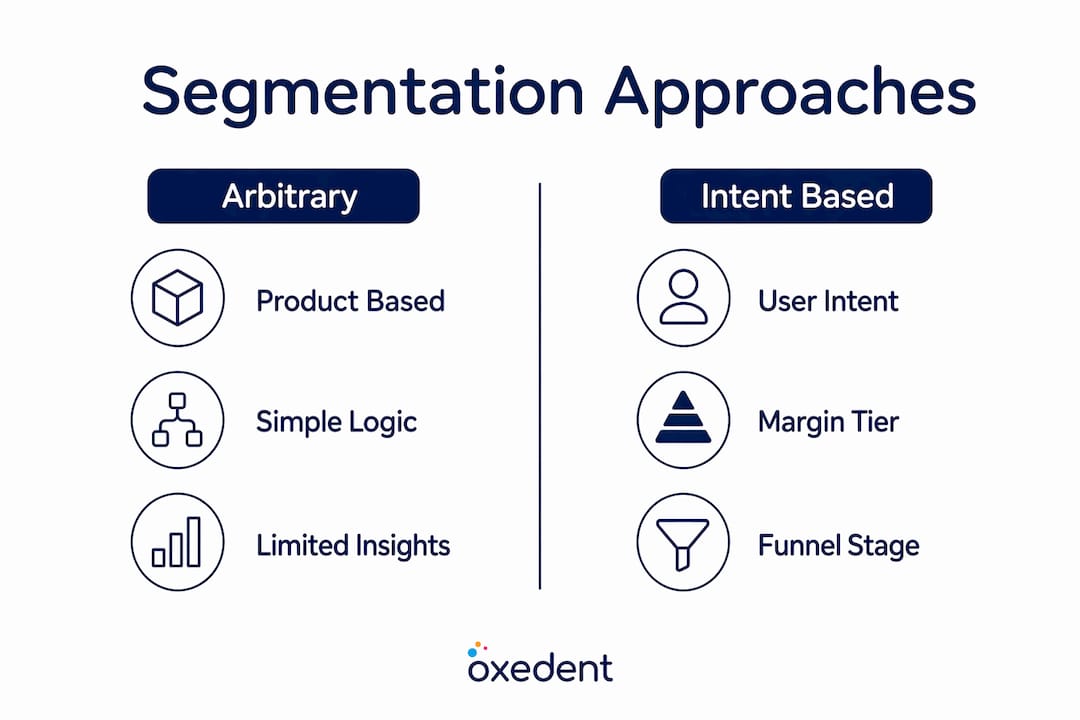

The correct approach is intent-based segmentation: organising campaigns by user intent, margin tier, and funnel stage. A user searching “buy running shoes size 10” sits at a different funnel stage than one searching “best running shoes for flat feet.” Treating them identically wastes budget on the wrong bid.
The table below shows how arbitrary and intent-based structures compare in practice.
| Criteria | Arbitrary segmentation | Intent-based segmentation |
|---|---|---|
| Campaign split logic | Product colour, supplier, SKU | Funnel stage, search intent, margin |
| AI learning quality | Fragmented, slow to stabilise | Consolidated, faster optimisation |
| Bidding efficiency | High wasted spend | Lower cost per acquisition |
| Scalability | Difficult to scale without chaos | Clear path to budget increases |
For a detailed breakdown of how to organise your account correctly, Oxedent’s guide to Google Ads account structure covers the 2026 approach in full. The best campaign structure for eCommerce follows the same intent-led logic at the campaign level.
How to set and manage budgets effectively within a Google Ads growth plan?
Budget management is where growth plans either hold together or fall apart. Companies allocate roughly 12% of their total marketing budget to PPC on average. That figure gives you a useful benchmark, but the more important question is how you distribute that budget across campaigns.
Effective budget management inside a growth plan follows these principles:
- Match budget to conversion goals. If your target CPA is £30, your daily campaign budget should be approximately £300. Smart Bidding requires daily budgets around 10x the target CPA to function correctly.
- Protect proven campaigns. Reserve the majority of your budget for campaigns with stable ROAS and cost per lead data. Do not cut these to fund experiments.
- Allocate a testing portion. Set aside a defined portion of budget for new campaign types, audiences, or creative formats. This keeps the account moving forward without risking core revenue.
- Scale cautiously. Rapid budget increases disrupt AI learning. Increase budgets in measured steps once performance metrics have stabilised.
Pro Tip: Before increasing a budget, check that ROAS and cost per lead have been stable for at least two consecutive weeks. Scaling into instability amplifies losses, not gains.
For a full breakdown of budget pacing strategies, Oxedent’s budget management guide for 2026 covers allocation models and scaling thresholds in detail.
What role do AI and automation play in a Google Ads growth plan in 2026?
Google’s AI now controls more of the advertising process than ever before. Understanding how to work with it, rather than against it, is central to any effective Google Ads campaign strategy in 2026.
- Performance Max requires rich inputs. Performance Max and Demand Gen campaigns depend on clean tracking data, high-quality creative assets, and first-party audience signals. Feed them poor inputs and they will spend budget inefficiently.
- Start with Maximise Conversions bidding. New campaigns lack the data history for Target CPA or Target ROAS to function well. Begin with Maximise Conversions, then transition once the campaign has accumulated sufficient conversion data.
- Use data-driven attribution. Last-click attribution undervalues upper-funnel activity. Data-driven attribution gives Google’s AI a more accurate picture of which touchpoints contribute to revenue.
- Apply value-based bidding for margin-aware growth. Passing revenue or margin values into your conversion tracking allows Smart Bidding to prioritise higher-value orders, not just volume.
- Maintain human strategic oversight. Manual segmentation is becoming less relevant, but human judgement remains the deciding factor in areas like audience strategy, creative direction, and budget allocation. Automation handles execution. Strategy remains yours.
The risk of over-relying on templated AI plans without human oversight is real. Google’s automated recommendations are built to increase spend, not necessarily to improve your profitability. A growth plan keeps human priorities in charge.
How can businesses implement and sustain a Google Ads growth plan over time?
Launching a growth plan is straightforward. Sustaining one requires deliberate habits and clear ownership.
- Start with tracking, not campaigns. Before a single ad goes live, verify that GA4 is recording conversions correctly, enhanced conversions are active, and offline imports are configured where applicable.
- Build creatives before launch. Assemble your full asset library first. Launching with placeholder images or generic headlines wastes the early learning phase.
- Consolidate before you expand. Resist the urge to create new campaigns for every product line. Consolidate existing campaigns to hit the 50 conversions monthly threshold before adding complexity.
- Establish a weekly review rhythm. Weekly optimisation reviews covering search terms, asset performance, and budget reallocation produce stable, improving results. Assign a named owner to this review.
- Align the plan with your wider team. Organisational alignment and dedicated ownership are what separate plans that drive revenue from plans that sit in a shared folder. Your growth plan should connect to your stock levels, promotional calendar, and margin targets.
A growth plan is a living framework integrated into daily operations, not a document you write once and revisit quarterly. The brands that grow consistently treat it as such.
Key takeaways
A Google Ads growth plan works because it combines accurate tracking, intent-based campaign structure, disciplined budget pacing, and a consistent weekly optimisation rhythm into a single, accountable framework.
| Point | Details |
|---|---|
| Define the plan correctly | A growth plan is a phased roadmap tied to revenue and CPA targets, not a generic campaign setup. |
| Consolidate campaigns first | Campaigns need 50+ monthly conversions to enable Smart Bidding; splitting budgets too thin prevents this. |
| Match budget to CPA targets | Daily budgets should be approximately 10x your target CPA for Smart Bidding to function correctly. |
| Feed AI with quality inputs | Performance Max and Demand Gen require clean tracking, rich creatives, and first-party audience data. |
| Treat the plan as a living tool | Weekly reviews, team ownership, and operational alignment keep the plan producing results over time. |
Why most Google Ads growth plans fail before they get started
The most common failure I see is not a technical one. It is an organisational one. A business invests time in building a growth plan, sets up the campaigns, and then the plan gets handed to whoever manages the ad account. That person makes weekly changes based on what looks good in the dashboard, not what the plan specifies. Within six weeks, the plan is irrelevant.
The second failure is treating the growth plan as a document rather than a discipline. Real digital advertising growth comes from repeating the right actions consistently: the weekly review, the creative refresh cycle, the budget reallocation based on actual ROAS data. These are habits, not tasks you complete once.
The third failure is misunderstanding what AI automation actually does. Google’s automated systems are excellent at execution within the parameters you set. They are not capable of deciding whether your business should prioritise margin or volume, which product lines deserve more budget, or whether your creative is aligned with your brand. Those decisions require human judgement. A growth plan is the document that captures those decisions and keeps automation pointed in the right direction.
My honest advice: treat your growth plan as a standing agenda item in your weekly team meeting. If it is not being reviewed and updated, it is not working.
— Biplab
How Oxedent supports your Google Ads growth plan
Building a Google Ads growth plan that actually drives eCommerce revenue requires more than a template. It requires deep knowledge of campaign architecture, Smart Bidding thresholds, and creative strategy working together.

Oxedent specialises exclusively in eCommerce PPC management, covering Google Ads, Google Shopping, and Performance Max for established online retail brands. The team builds bespoke growth plans grounded in tracking accuracy, intent-based campaign structure, and data-led budget pacing. If you are ready to move beyond generic recommendations and build a paid media framework that connects directly to your revenue targets, Oxedent’s Performance Max for eCommerce service is a strong starting point.
FAQ
What is a Google Ads growth plan?
A Google Ads growth plan is a structured, multi-month roadmap that aligns paid campaigns with business objectives such as revenue targets and cost per acquisition. It progresses through defined phases: foundation, consolidation, and scaling.
How many conversions does a campaign need for Smart Bidding to work?
Smart Bidding requires a minimum of 50 conversions per month per campaign to function effectively. Campaigns below this threshold cannot generate reliable bidding signals for Target CPA or Target ROAS strategies.
What percentage of marketing budget should go to Google Ads?
Companies allocate roughly 12% of their total marketing budget to PPC on average. The exact figure depends on your margin, revenue targets, and the maturity of your campaigns.
How often should I review a Google Ads growth plan?
Weekly optimisation reviews covering search terms, asset performance, and budget reallocation produce the most stable results. Daily changes disrupt AI learning and should be avoided except in cases of clear overspend.
What is the difference between a growth plan and a Google Ads campaign strategy?
A Google Ads campaign strategy defines how individual campaigns are structured and targeted. A growth plan sits above this: it sets the phased objectives, budget framework, and optimisation rhythm that the campaign strategy operates within.