


A Google Partner Agency is defined as a digital marketing agency formally recognised by Google for meeting specific standards in Google Ads expertise, ad spend management, and staff certification. The Google Partners programme operates across three tiers: Member, Partner, and Premier Partner. Premier Partner represents the top 3% of agencies in each country, making it a meaningful signal of scale and performance. The badge focuses exclusively on Google Ads competency. It does not cover SEO, web design, or broader digital marketing services. Understanding this distinction helps you evaluate agencies with far greater accuracy.
What is a Google Partner Agency and how does the programme work?
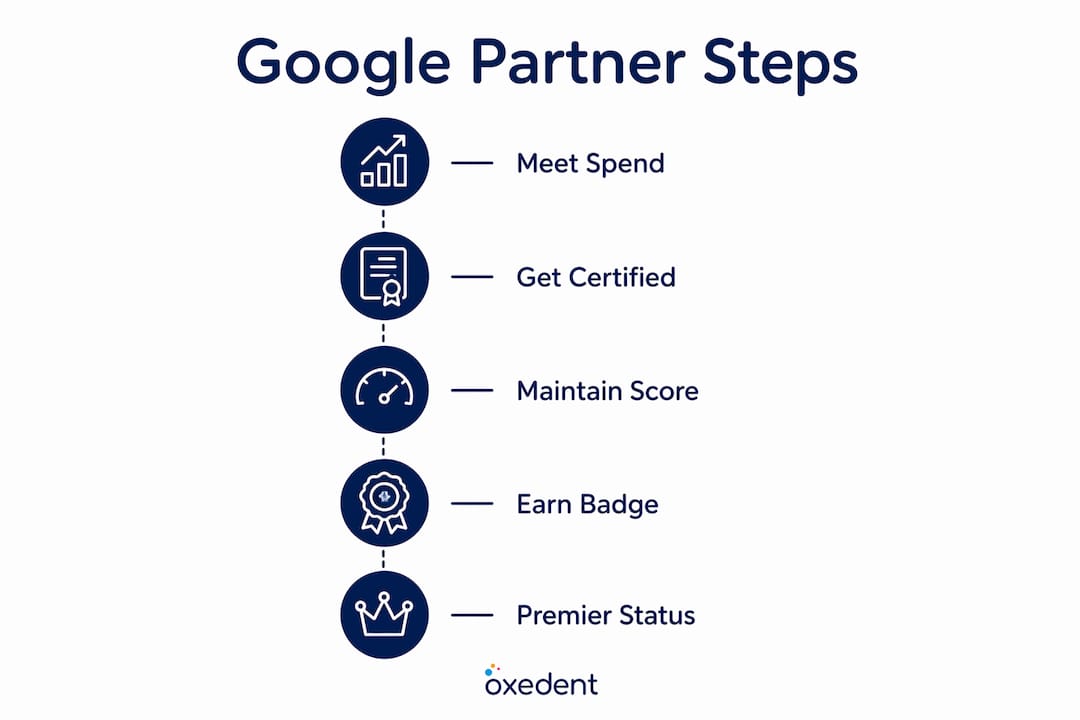
A Google Partner Agency earns its status by satisfying three measurable criteria set by Google. These are minimum ad spend, a minimum optimisation score, and a certified workforce. The three programme tiers are Member (entry level), Partner (demonstrates proven expertise), and Premier Partner (the top 3% of agencies per country).
To hold Partner status, an agency must manage a minimum of $10,000 USD in Google Ads spend across client accounts over any 90-day period. The agency must also maintain an optimisation score of at least 70% across its managed accounts. That score reflects how well the agency applies Google’s recommended campaign improvements. Falling below it triggers a review and risks badge removal.


Certification requirements apply to the people, not just the accounts. At least 50% of account strategists must hold current Google Ads certifications, which are renewed annually. This means the agency cannot rely on a single certified employee to carry the whole team. The requirement pushes consistent knowledge across the workforce.
Premier Partner status adds a further layer. These agencies receive exclusive access to advanced resources and recognition from Google, including early beta features and premium support channels. The top 3% threshold is recalculated per country, so Premier status in a competitive market like the UK is a genuinely high bar.
What are the benefits of working with a certified Google Partner Agency?
Clients of a certified Google Partner Agency gain access to resources that are not available through standard agency relationships. Priority Google support means your agency can escalate technical issues directly, reducing the time your campaigns sit with unresolved problems. For eCommerce brands running time-sensitive promotions, that speed matters.
The benefits extend beyond support tickets. Certified agencies receive:
- Early beta access to new Google Ads features before they are publicly released, giving clients a first-mover advantage in their market.
- Industry training and product updates that keep strategists current with algorithm changes and new campaign types such as Performance Max.
- Advanced product insights that inform smarter bidding strategies, audience segmentation, and feed structuring.
- Alignment with Google’s best practices, which reduces wasted spend caused by outdated campaign structures or deprecated match types.
- Faster problem resolution through direct escalation paths, bypassing standard support queues.
Pro Tip: Ask any agency you are evaluating whether they currently hold Partner or Premier Partner status, and verify it yourself via Google’s official Partner directory. Status can be revoked, so always check the live listing rather than relying on a badge image on their website.
The practical impact of these benefits shows up in campaign performance. An agency with early access to a new bidding feature can test and apply it weeks before the wider market. That gap compounds over time, particularly in competitive categories where marginal gains in conversion rate or return on ad spend determine profitability.

What criteria must agencies meet to earn and keep the badge?
Google evaluates Partner status on a daily basis. This is not a one-time achievement. Daily monitoring by Google means an agency must consistently perform across all three criteria to retain its badge. The practical effect is that the badge reflects current performance, not historical reputation.
The table below summarises the key requirements across the two main certified tiers.
| Requirement | Partner | Premier Partner |
|---|---|---|
| Minimum ad spend (90 days) | $10,000 USD | Higher threshold (not publicly listed) |
| Optimisation score | 70% minimum | Higher threshold |
| Certified strategists | 50% of account staff | 50% of account staff |
| Programme tier | Top performers | Top 3% per country |
| Additional benefits | Standard Partner resources | Beta access, premium support |
The badge represents aggregate performance across all client accounts managed through the agency’s manager account, not the results of any single campaign. An agency can hold Partner status while one individual client account underperforms. This is a critical nuance for business owners to understand.
Pro Tip: When reviewing an agency’s credentials, ask to see their manager account structure. A well-organised manager account with clear labelling and segmentation signals disciplined account management, which is a stronger indicator of quality than the badge alone.
Certification renewals happen annually. If a strategist’s certification lapses and the agency drops below the 50% threshold, badge revocation follows. This creates a genuine incentive for agencies to invest in ongoing staff development rather than treating certification as a box-ticking exercise.
Common misconceptions about the Google Partner badge
The Google Partner badge is a performance and volume metric for Google Ads management. It is not a general digital marketing quality seal. This distinction trips up many business owners who assume a badged agency is qualified across all digital channels.
The badge does not cover:
- SEO or organic search — a certified agency may have no meaningful SEO capability whatsoever.
- Web design or conversion rate optimisation — technical Google Ads competency does not transfer to UX or development skills.
- Business strategy or consulting — Google Partner status does not endorse an agency’s ability to advise on unit economics, customer lifetime value, or commercial strategy.
- Social media advertising — Facebook Ads, TikTok Ads, and other paid channels sit entirely outside the badge’s scope.
A second common misconception is that the badge guarantees results for your specific account. The badge confirms ad spend volume, optimisation score, and certified staff across all accounts in aggregate. It does not guarantee that your individual campaigns will perform well. An agency can meet all three criteria while managing your account poorly.
Always verify current badge status through Google’s official Partner directory. Agencies sometimes display badge images on their websites after their status has lapsed. A quick directory check takes under a minute and confirms whether the badge is live. For eCommerce brands investing meaningful ad budgets, that check is non-negotiable.
How to choose the right Google Partner Agency for your business
Choosing the right certified agency requires more than confirming the badge. The badge is a useful starting filter, not a final decision. Use the following criteria to evaluate agencies properly.
-
Verify reporting transparency. Ask whether you will have direct access to your Google Ads account at all times. Agencies that restrict account access are a red flag. You own your data, and any credible agency will confirm that upfront.
-
Assess their metrics focus. Good agencies report on revenue and ROI, not vanity metrics like clicks or impressions. If an agency leads with click volume or impression share in their pitch, their priorities are misaligned with yours.
-
Check their use of reporting tools. Looker Studio dashboards connected to live Google Ads data are industry best practice for transparent, real-time reporting. Ask to see an example dashboard before signing anything.
-
Reject guaranteed ROAS promises. No agency can guarantee a specific return on ad spend. Market conditions, product margins, and seasonality all affect outcomes. An agency that promises a fixed ROAS figure is either inexperienced or misleading you.
-
Ask business-level questions. The right agency asks about your average order value, customer acquisition cost, and repeat purchase rate before touching your campaigns. If they skip straight to campaign structure without understanding your unit economics, they are not thinking about your profitability.
-
Evaluate contract flexibility. Avoid agencies that require long-term lock-in contracts without performance milestones. Month-to-month or short-term arrangements with clear exit clauses protect your budget if performance falls short.
For eCommerce brands specifically, look for agencies with deep experience in Google Shopping and feed management, as these skills are distinct from standard search campaign management. You can also read more about hiring a Google Ads agency for eCommerce to understand what a strong engagement looks like in practice.
Pro Tip: Request a paid audit before committing to full management. A credible agency will identify genuine inefficiencies in your current account and explain them clearly. If the audit is vague or generic, the management will be too.
Understanding how Google SEO agencies support eCommerce growth alongside paid media can also help you build a fuller picture of the digital channels available to your brand.
Key takeaways
A Google Partner Agency is a Google-certified firm that meets defined spend, optimisation, and certification thresholds, making the badge a reliable starting filter for Google Ads expertise but not a guarantee of results for your specific account.
| Point | Details |
|---|---|
| Three programme tiers | Member, Partner, and Premier Partner, with Premier representing the top 3% of agencies per country. |
| Daily badge evaluation | Google assesses compliance daily, so the badge reflects current performance, not past reputation. |
| Badge scope is narrow | Certification covers Google Ads only, not SEO, social media, web design, or business strategy. |
| Transparency is the key test | Prioritise agencies that give you direct account access and report on revenue, not clicks. |
| Verify status independently | Always check an agency’s live badge status via Google’s official Partner directory before engaging. |
My honest view on what the badge actually tells you
I have worked with enough eCommerce brands to know that the Google Partner badge is genuinely useful as a first filter. It tells you the agency manages meaningful ad spend, keeps its team certified, and maintains a reasonable optimisation score. That is not nothing. Most businesses waste months with agencies that cannot clear even those basic bars.
Where I see business owners go wrong is treating the badge as the end of the evaluation rather than the beginning. I have seen Premier Partner agencies run campaigns with no feed segmentation, no conversion tracking beyond last-click, and reporting that amounts to a screenshot of the Google Ads dashboard. The badge did not prevent any of that.
The questions that actually matter are the ones about your business. Does the agency understand your margins? Do they know what a profitable customer acquisition looks like for your category? Can they explain why they would structure your Performance Max campaigns a particular way, given your product catalogue and average order value? Those answers reveal strategic fit. The badge just confirms they know how to use the platform.
My advice: use the badge to filter out the bottom tier, then spend your evaluation time on business alignment, reporting quality, and the agency’s ability to ask the right questions about your commercial model. The agencies worth working with will welcome that scrutiny. The ones that deflect it are telling you something important.
— Biplab
How Oxedent approaches Google Partner-level expertise for eCommerce brands
Oxedent holds Google Partner status and applies that certification specifically to eCommerce PPC management, not as one service among many, but as the agency’s entire operational focus.

For established eCommerce brands with meaningful ad budgets, Oxedent manages Google Ads, Google Shopping, and Performance Max campaigns with a clear emphasis on return on ad spend and profitable revenue growth. Reporting connects directly to your revenue data, not vanity metrics. There are no long-term lock-in contracts. If you want to understand what expert eCommerce PPC management looks like in practice, or how advanced agency reporting can give you real visibility over your ad spend, Oxedent is worth a conversation.
FAQ
What is a Google Partner Agency in simple terms?
A Google Partner Agency is a digital agency that Google has certified for meeting defined standards in Google Ads spend, staff certification, and account optimisation. The badge confirms Google Ads expertise, not broader digital marketing capability.
What does Premier Partner status mean?
Premier Partner is the highest tier in the Google Partners programme, awarded to the top 3% of agencies in each country. These agencies receive early beta access to new features and premium support from Google.
Does a Google Partner badge guarantee better results?
No. The badge confirms aggregate performance across all client accounts, not results for any individual campaign. Always evaluate an agency on reporting transparency, business understanding, and revenue-focused metrics alongside their badge status.
What are the minimum requirements for Google Partner status?
Agencies must manage at least $10,000 USD in Google Ads spend over 90 days, maintain a 70% optimisation score, and have at least 50% of account strategists holding current Google Ads certifications.
How do I verify an agency’s Google Partner status?
Check Google’s official Partner directory online. Badge images on agency websites can be outdated, as Google evaluates status daily and can revoke it if an agency falls below the required thresholds.