


A PPC fulfillment partner is a specialist team that manages pay-per-click campaigns behind the scenes on behalf of agencies, delivering results invisibly under the agency’s own brand. In the industry, this model is more commonly called white-label PPC. Both terms describe the same arrangement: a third-party provider handles the technical execution of PPC campaign management while the agency retains full client ownership and strategic narrative. For e-commerce business owners and marketing managers, understanding what a PPC fulfillment partner does clarifies why your agency may use one, and how to ensure it works in your favour.
What is a PPC fulfillment partner and how does the model work?
A PPC fulfillment partner is defined as a backstage B2B service provider that executes paid advertising campaigns under an agency’s branding. The agency presents the work to clients as its own. The fulfillment partner remains invisible throughout.
This model exists because building an in-house PPC team is expensive and slow. Hiring certified specialists for Google Ads, Facebook Ads, Google Shopping, and Performance Max requires significant time, salary commitments, and ongoing training. A fulfillment partner removes that overhead entirely. The agency scales its PPC management services without adding headcount.


The term “white-label PPC” is the recognised industry standard for this arrangement. You may also encounter the phrase “PPC outsourcing solutions” in agency circles. All three phrases describe the same core model: one party executes, another party owns the client relationship.
How do PPC fulfillment partnerships operate day to day?
The division of labour in a fulfillment partnership is clear. Campaign execution sits with the partner, while the agency manages client communications and strategic positioning.
The fulfillment partner typically handles:
- Keyword research across target product categories and competitor terms
- Ad copy creation aligned to brand guidelines and promotional calendars
- Bid management using manual or automated bidding strategies
- A/B testing of ad creative, landing pages, and audience segments
- Feed optimisation for Google Shopping and Performance Max campaigns
- Reporting delivered in the agency’s branded format
The agency, meanwhile, owns the client relationship. It sets the strategic direction, communicates results, and manages expectations. This split works well when both sides understand their boundaries from day one.
Pro Tip: Ask your fulfillment partner to deliver reports in your brand colours and format before the first client review. Top-performing partners customise reporting dashboards to match the agency’s brand experience, which protects your client relationship at every touchpoint.
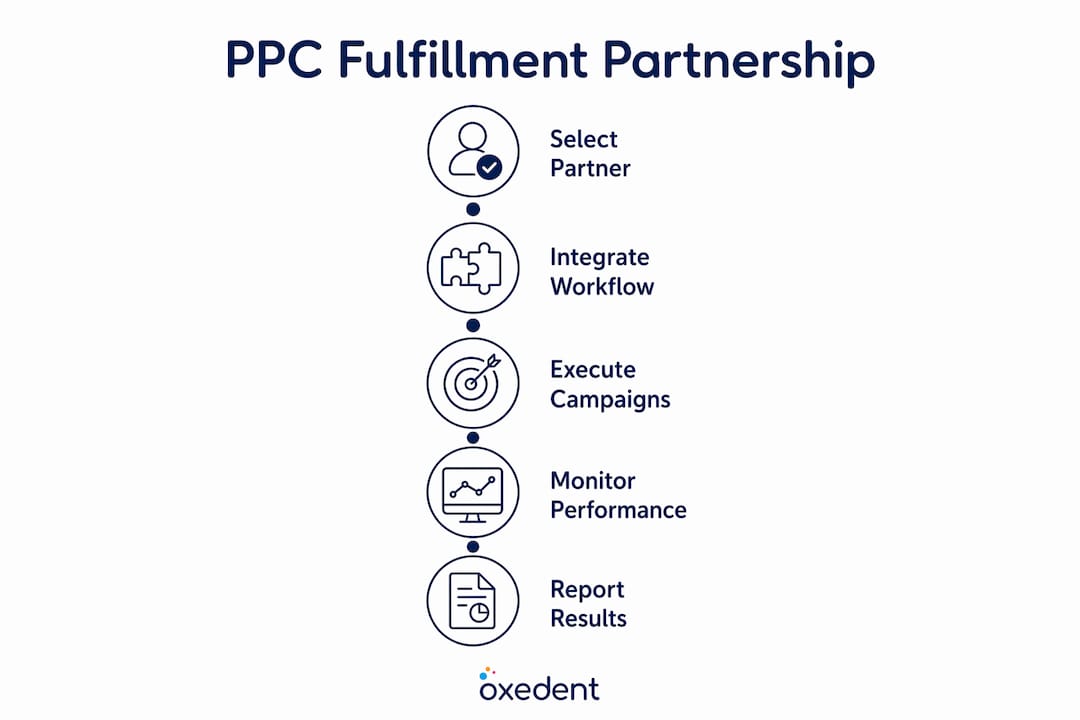

The operational cadence typically includes weekly performance check-ins, monthly strategy reviews, and quarterly account audits. Technology access follows a managed model: the agency grants the partner access to ad accounts without transferring ownership. This distinction matters enormously, as you will see in the governance section below.
Benefits and challenges of using a PPC fulfillment partner
The core benefit is cost efficiency. Monthly fees tied to account volume replace fixed salaries and tool subscriptions, which means your cost base grows only when your client base grows. That predictability is genuinely useful when you are managing cash flow across multiple accounts.
Beyond cost, you gain access to specialist expertise immediately. A quality fulfillment partner brings certified practitioners who work across Google Search, Google Shopping, Display, YouTube, and remarketing every day. That depth of channel knowledge is difficult to replicate in-house unless PPC is your entire operational focus. Oxedent, for example, focuses exclusively on eCommerce PPC management, which means its practitioners are not splitting attention across unrelated disciplines.
The challenges are real, though. Consider these common pitfalls:
- Unclear role boundaries create confusion over who owns campaign decisions
- Insufficient briefing leads to campaigns that miss brand tone or promotional timing
- Weak oversight means performance problems go unnoticed until the client complains
- Poor communication protocols result in delayed responses during critical campaign periods
- Misaligned ROAS targets cause the partner to optimise for the wrong outcome
The agency remains accountable to clients for all results, regardless of who executes the work. Clients hold the agency responsible for campaign performance, full stop. That accountability makes rigorous oversight of your fulfillment partner non-negotiable, not optional.
Comparing this model to building in-house capability is worth doing honestly. The in-house versus agency PPC decision comes down to volume, budget, and how quickly you need to scale. For most growing agencies, the fulfillment model wins on speed and flexibility.
Governance best practices to get the most from your partnership
Governance is where most agency-fulfillment relationships either succeed or fail. The most successful partnerships operate with strict structural controls from the outset.
Follow these steps to protect your agency and your clients:
-
Retain ownership of all ad accounts. You must own the Google Ads and Meta Business Manager accounts. Grant the partner managed access only. Losing account ownership means losing client data and the ability to intervene quickly if performance drops.
-
Own all billing instruments. Your agency’s payment method stays on the account. Never allow a partner to control billing. This protects you from disruption if the relationship ends.
-
Define escalation paths in writing. Specify who contacts whom, and within what timeframe, when a campaign underperforms or a client raises a concern. Ambiguity here costs you client trust.
-
Create a structured onboarding brief. Thorough briefing documents covering ROAS targets, brand guidelines, product priorities, and promotional calendars prevent the majority of early-stage performance problems. Many agencies underestimate this step and spend weeks firefighting as a result.
-
Set a quality assurance cadence. Review campaign structure, negative keyword lists, and ad copy at least monthly. Do not rely solely on the partner’s own reporting to identify issues.
-
Agree on reporting formats before launch. Decide which metrics matter to your clients, and make sure the partner delivers data in that format from week one.
Pro Tip: Treat your fulfillment partner as an extension of your team, not a vendor you check in with occasionally. Partners who act as team extensions with dedicated points of contact consistently outperform those operating at arm’s length.
Agencies that outsource PPC management effectively share one trait: they invest in governance upfront rather than trying to fix problems after they surface.
How to choose a PPC fulfillment partner that fits your needs
Selecting the right digital advertising partner requires more than checking a certifications page. Start with these criteria:
- Platform certifications: Confirm Google Partner or Premier Partner status, and equivalent Meta credentials. Certifications signal baseline competence, not excellence, but they are a necessary starting point.
- Proven return on ad spend: Ask for case studies from e-commerce accounts with similar product categories and budget ranges to yours. Generic case studies tell you little.
- Communication style: Assess how quickly they respond during the vetting process. Slow responses before the contract is signed predict slow responses during live campaigns.
- Reporting transparency: Request a sample report. If it is full of vanity metrics like impressions and clicks without revenue attribution, that is a red flag.
- Strategic input: The best partners do not just execute briefs. They flag opportunities, identify wasted spend, and recommend structural changes proactively.
Use the PPC agency vetting criteria developed specifically for e-commerce owners to structure your evaluation process. It saves significant time during due diligence.
Once you have selected a partner, integration into your existing workflow is the next challenge. Map out how campaign briefs will be submitted, how feedback will be communicated, and how performance data will flow back to your client-facing team. Document this process before the first campaign goes live. Ongoing relationship management requires scheduled reviews, not just reactive conversations when something goes wrong.
For agencies exploring the broader landscape of white-label PPC services, the key differentiator between average and excellent partners is always the same: how deeply they understand your clients’ business goals, not just their ad accounts.
Key takeaways
A PPC fulfillment partner succeeds when the agency combines rigorous governance with a genuinely collaborative working relationship, not when it simply hands over campaign access and hopes for results.
| Point | Details |
|---|---|
| Definition is clear | A PPC fulfillment partner executes campaigns invisibly under your brand, also known as white-label PPC. |
| Governance is non-negotiable | Retain ownership of all ad accounts and billing instruments before granting any partner access. |
| Briefing drives performance | Structured onboarding documents covering ROAS targets and brand guidelines prevent the majority of early failures. |
| Accountability stays with you | Clients hold the agency responsible for results regardless of who executes the work behind the scenes. |
| Vetting criteria matter | Evaluate partners on proven e-commerce ROI, communication speed, and reporting transparency, not certifications alone. |
The part most agencies get wrong about PPC fulfillment
I have seen agencies treat fulfillment partnerships as a simple cost-cutting exercise. They hand over a brief, step back, and assume the partner will deliver. That approach fails more often than it succeeds.
The agencies that get the most from a fulfillment arrangement are the ones that stay genuinely involved. They review campaign structure monthly. They push back on reporting that does not connect to revenue. They treat the partner’s team as colleagues who need context, not contractors who need instructions.
The other thing I would flag is the governance piece. Agencies often discover they have lost account access or billing control only when the relationship breaks down. By then, the damage to client trust is already done. Setting up proper account ownership and access rights on day one takes less than an hour. Fixing the fallout from not doing it can take months.
White-label PPC is not going away. If anything, the model is becoming more common as agencies specialise and clients demand deeper expertise. The agencies that will thrive are those that treat fulfillment partnerships as a structural part of their service delivery, with the governance and communication frameworks to match.
— Biplab
How Oxedent supports agencies and e-commerce brands with PPC
Oxedent is a specialist eCommerce PPC agency with a single operational focus: paid media for online retail brands.

Whether you are an agency looking for a reliable fulfillment partner or an e-commerce business that wants expert PPC campaign management without building an in-house team, Oxedent works exclusively in this space. The team manages Google Ads, Facebook Ads, Google Shopping, and Performance Max with a clear emphasis on return on ad spend and revenue growth. There are no long-term contracts and no vanity metrics. If you want to understand how eCommerce PPC management can support your growth, Oxedent offers a straightforward consultation to assess whether the fit is right.
FAQ
What is a PPC fulfillment partner in simple terms?
A PPC fulfillment partner is a specialist provider that manages pay-per-click campaigns on behalf of an agency, delivering the work invisibly under the agency’s own brand. The industry term for this arrangement is white-label PPC.
How is a PPC fulfillment partner different from a standard PPC agency?
A standard PPC agency works directly with the end client under its own name. A fulfillment partner works behind the scenes for another agency, which then presents the results to its own clients.
Who is responsible if campaign performance drops?
The agency is always responsible to the client, regardless of who executes the work. Clients hold the agency accountable for results, which is why governance and oversight of the fulfillment partner are critical.
What should I include in a fulfillment partner onboarding brief?
A strong onboarding brief covers ROAS targets, brand guidelines, product priorities, promotional calendars, and campaign history. Thorough briefing documents prevent the majority of early-stage performance problems.
How do I know if a PPC fulfillment partner is high quality?
Evaluate partners on proven e-commerce return on ad spend, communication responsiveness, reporting transparency, and their willingness to provide proactive strategic input rather than simply executing briefs.