


A PPC performance review is the structured evaluation of a paid advertising account to confirm that every pound of ad spend is generating measurable business value. The process goes by several names in the industry, including a paid search audit or PPC audit, but the goal is the same: identify what is working, cut what is not, and set a clear path for improvement. For eCommerce business owners and digital marketing professionals, a well-run review is the difference between scaling profitably and burning budget on campaigns that look healthy on the surface but quietly erode margin.
What is a PPC performance review and what does it cover?
A PPC performance review is a systematic audit of your paid advertising campaigns, measuring performance against defined business targets rather than platform vanity metrics. The shift to value-based KPIs means that modern reviews prioritise profit contribution and revenue over volume metrics like click-through rate or impressions. That shift matters because a campaign with a strong CTR can still destroy margin if its cost per acquisition sits well above the profitable threshold.
The review covers every layer of the account: campaign settings, ad group structure, keyword lists, search term reports, bidding strategies, ad creative, and conversion tracking. Each layer can hide a different type of problem. A bidding strategy set to the wrong target, for example, will quietly overspend for weeks before the damage shows up in monthly revenue figures.


Conversion tracking accuracy sits at the foundation of any credible review. If your tracking fires twice on a single purchase, every downstream metric is inflated. Confirming that measurement is correct before drawing any conclusions is not optional. It is the starting point.
Key metrics and components to check in a PPC audit
A thorough PPC performance analysis covers a defined set of metrics and structural checkpoints. The most important metrics for eCommerce accounts are:
- Cost per acquisition (CPA): the total spend divided by the number of conversions. This is your primary efficiency signal.
- Return on ad spend (ROAS): revenue generated per pound spent. For eCommerce, this connects directly to profitability when margins are factored in.
- Quality Score: Google’s rating of ad relevance, expected click-through rate, and landing page experience. Low scores inflate cost per click.
- Conversion rate: the percentage of clicks that result in a purchase or target action. A drop here often signals a landing page or audience mismatch.
- Search term relevance: the actual queries triggering your ads. Irrelevant search terms waste budget at scale.
Campaigns deviating 20% or more from CPA targets are flagged during monthly reviews. Campaigns performing 20% below target may justify a budget increase, while those running 30% above target require urgent intervention to stop waste. That 20% threshold gives you a consistent, objective trigger rather than relying on gut feel.
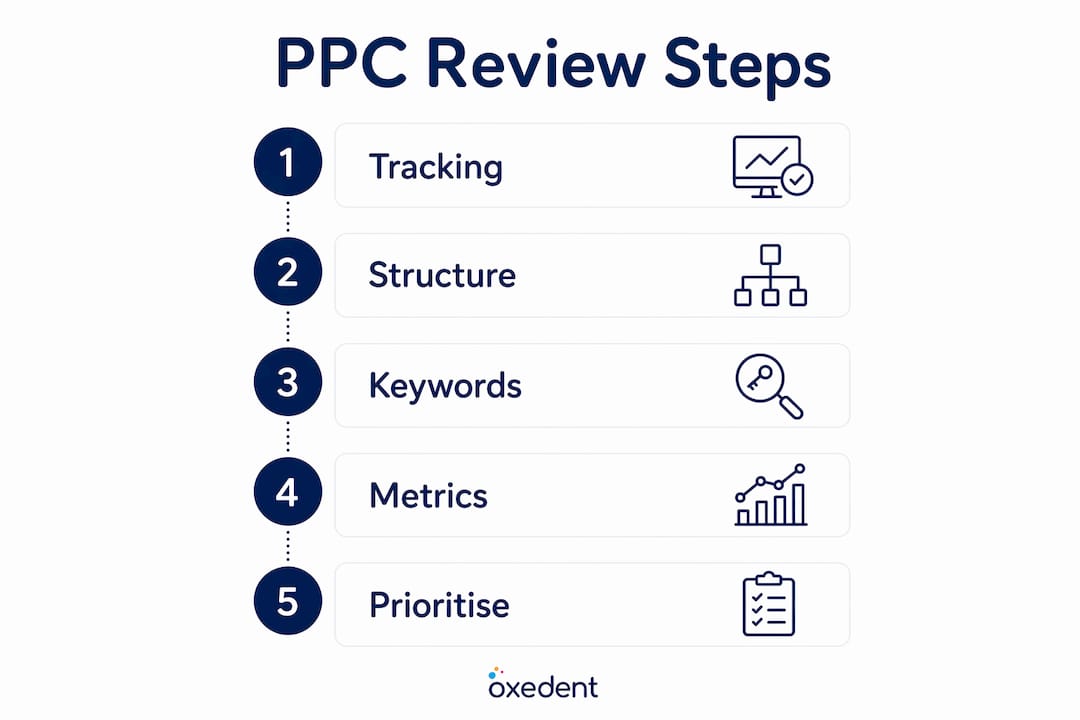
The review process itself follows a logical sequence. You start with tracking verification, move to account structure, then bidding and budget allocation, then ad creative and copy, and finish with audience and targeting settings. Skipping steps or jumping straight to creative changes without checking structure first leads to fixes that address symptoms rather than causes.
Pro Tip: Use colour-coded KPI dashboards at campaign level to flag metrics sitting 20% above or below targets. Visual signals cut review time significantly and help you brief stakeholders without lengthy explanations.

How often should you conduct a PPC review?
Review frequency depends on your monthly ad spend and account complexity. Industry best practice sets three standard cadences:
- Weekly monitoring: search term reports and spend pacing. This catches runaway costs and irrelevant query traffic before they compound.
- Monthly partial audits: required for accounts spending over £5,000 per month. These cover bidding performance, CPA deviation, ad copy testing results, and structural changes.
- Quarterly comprehensive audits: a full account review covering strategy, campaign architecture, audience lists, feed quality for Shopping campaigns, and alignment with business goals.
An immediate audit is triggered whenever performance drops by more than 20% against the prior period or against target. Waiting for the scheduled monthly review when a campaign is haemorrhaging spend is not a process. It is negligence.
Platform changes also create audit triggers. When Google rolls out a significant update to Performance Max or Smart Bidding, accounts running those campaign types need a targeted review. Performance Max campaigns require specific audit attention because of their automated, opaque nature. Recent transparency improvements now allow channel-level and asset-level performance breakdowns, which makes auditing these campaigns more practical than it was two years ago.
The right cadence balances continuous monitoring with scheduled deep dives. Continuous monitoring catches fires early. Scheduled audits challenge the assumptions baked into your account structure before they become expensive habits.
What frameworks help prioritise PPC review findings?
Finding twenty issues in an audit is easy. Knowing which three to fix first is the skill. ICE scoring is the standard framework for prioritising audit tasks. Each potential fix is scored 1–10 across three dimensions: Impact (how much will this improve performance?), Confidence (how certain are you it will work?), and Ease (how quickly can it be implemented?). Multiply the three scores together to get a priority number.
A bid strategy correction that scores 8 for Impact, 9 for Confidence, and 7 for Ease produces a priority score of 504. A creative refresh that scores 5, 4, and 8 produces 160. ICE scoring removes the subjectivity from prioritisation and prevents you from defaulting to easy fixes over high-value ones.
The second critical framework is hierarchical drill-down. Drilling from campaign to ad group to keyword to search term before making any changes prevents counterproductive optimisation based on aggregate data. A campaign with a poor average CPA might contain three ad groups performing well and one destroying the average. Pausing the campaign based on the aggregate number kills the profitable ad groups along with the problem.
| Framework | Purpose | Common mistake it prevents |
|---|---|---|
| ICE scoring | Prioritises fixes by impact, confidence, and ease | Defaulting to easy changes over high-value ones |
| Hierarchical drill-down | Analyses from campaign to search term level | Blanket changes that damage healthy components |
| Value-based KPI focus | Connects metrics to revenue and acquisition cost | Fixating on CTR and CPC as success signals |
Marketers suffer from strategic bias by keeping historically well-performing campaigns that currently underperform. A data-driven review framework removes that emotional attachment and forces decisions based on current evidence.
Pro Tip: When you find a campaign underperforming against target, resist the urge to pause it immediately. Drill to search term level first. You may find that one poorly matched query is responsible for 60% of the wasted spend, and a single negative keyword addition fixes the problem without disrupting what is working.
Practical steps for running an effective PPC performance review
A recommended monthly review sequence starts with confirming measurement accuracy, then moves through business context, account health, structure, search terms, bidding strategy, and finally ad creative. Following that order matters because each step informs the next.
- Step 1: Verify conversion tracking. Check that all conversion actions are firing correctly and that no duplicate tracking exists. This is your data integrity check.
- Step 2: Review business context. Note any promotions, stock changes, or seasonal factors that could explain performance shifts. A revenue drop during a stock-out is not a PPC problem.
- Step 3: Audit account structure. Check campaign and ad group organisation against your targeting strategy. Bloated ad groups with dozens of keywords dilute relevance and Quality Score.
- Step 4: Analyse search terms. Add negatives for irrelevant queries. Identify high-converting terms that deserve their own dedicated ad groups. Use the eCommerce ad account audit checklist to work through this systematically.
- Step 5: Review bidding and budget. Apply the 20% deviation threshold. Reallocate budget from underperforming campaigns to those exceeding targets.
- Step 6: Assess ad creative. Check which ad variants are winning tests. Pause underperformers and introduce new test variants with a single variable changed.
Document every change in a log with the date, what was changed, and the expected outcome. Without a change log, you cannot attribute performance shifts to specific actions. That makes the next review harder and the learning cycle slower.
Connecting PPC metrics directly to revenue and customer acquisition cost is the standard that separates useful reviews from box-ticking exercises. Platform metrics like CTR and CPC are inputs. Revenue and profit are the outputs that matter. Your review should always end with a clear statement of what the account delivered in business terms, not just media terms.
For eCommerce accounts running Google Shopping, a Google Shopping campaign audit adds feed quality checks to the standard review process. Feed errors and poor product titles suppress impression share before bidding strategy even comes into play.
Key takeaways
A PPC performance review is only as useful as the business decisions it drives. Reviews that stop at platform metrics and never connect to revenue, profit, or customer acquisition cost are incomplete by definition.
| Point | Details |
|---|---|
| Start with tracking accuracy | Verify conversion tracking before drawing any conclusions from performance data. |
| Use the 20% deviation threshold | Flag campaigns running 20% above CPA target for immediate intervention to stop waste. |
| Apply ICE scoring | Prioritise fixes by multiplying Impact, Confidence, and Ease scores to focus effort on high-value changes. |
| Drill down before acting | Analyse from campaign to search term level to avoid blanket changes that damage healthy components. |
| Connect metrics to business outcomes | Measure success in revenue and acquisition cost, not CTR or impressions. |
Why PPC reviews deserve more respect than they get
I have seen eCommerce brands treat their monthly PPC review as a five-minute glance at a dashboard. The numbers look roughly similar to last month, nothing has crashed, so the review is done. That approach is how accounts accumulate years of structural debt: redundant ad groups, outdated negative keyword lists, bidding strategies chasing the wrong conversion action, and Shopping feeds that have not been touched since the account launched.
The most effective reviews treat the session as a strategic reset, not a maintenance check. That means questioning whether the current campaign structure still reflects the business’s priorities, whether the bidding targets are still calibrated to current margins, and whether the creative reflects what the brand actually wants to say right now. Those are not questions you answer by glancing at a graph.
The other mistake I see regularly is fixating on platform-level metrics rather than business results. A campaign with a 6% CTR that generates a £90 CPA on a product with a £15 margin is not a success. It is a loss dressed up in impressive-looking numbers. The review process only has value when it is anchored to what the business actually needs from its paid media. Everything else is theatre.
If you are managing a meaningful ad budget and your reviews are not regularly surfacing decisions that change how you allocate spend, the process needs rebuilding from the ground up. The frameworks exist. The discipline is the hard part.
— Biplab
How Oxedent supports ongoing PPC performance reviews
Running thorough, consistent PPC reviews takes time, structure, and deep channel knowledge. For eCommerce brands spending meaningfully on paid media, that combination is hard to maintain in-house alongside everything else the business demands.


Oxedent’s eCommerce PPC management service is built around exactly this kind of disciplined, data-led review process. Every account receives structured audits, change logging, and performance reporting tied to revenue and ROAS rather than surface metrics. The focus is always on profitability and scalable growth, not activity for its own sake. If your current review process is not regularly driving clear decisions about where your budget should go, it is worth having a conversation with a team for whom this is the only thing they do.
FAQ
What is the difference between a PPC review and a PPC audit?
A PPC audit is typically a one-off, in-depth examination of an account, while a PPC review is a scheduled, recurring evaluation. Both assess performance against targets, but reviews are part of an ongoing management cadence.
How long does a PPC performance review take?
A monthly partial review for an account spending over £5,000 typically takes two to four hours. A quarterly comprehensive audit covering strategy, structure, and creative can take a full day or more depending on account size.
Which metrics matter most in a PPC performance analysis?
CPA and ROAS are the primary metrics for eCommerce accounts because they connect directly to profitability. Quality Score, conversion rate, and search term relevance are secondary signals that explain why CPA and ROAS are moving.
When should you trigger an unscheduled PPC audit?
An immediate audit is warranted whenever performance drops more than 20% against the prior period or against your CPA target. Platform updates affecting campaign types like Performance Max also justify an unscheduled review.
What is ICE scoring in a PPC review context?
ICE scoring rates each potential fix on Impact, Confidence, and Ease, each scored 1–10, then multiplies the three numbers to produce a priority score. The highest scores get fixed first, keeping the review focused on changes that move the needle most.