


Most ecommerce advertisers measure success by counting conversions. More purchases mean better campaigns. That logic feels sensible, but it misses the point entirely. What is Google Ads profitability focus? It is the practice of shifting your bidding and measurement from sheer conversion volume towards the actual business value each conversion delivers. Instead of asking “how many sales did we get?” you ask “how much profit did those sales generate?” This distinction shapes every decision in your campaign, from bid strategy to conversion tracking, and it is the difference between scaling a business and scaling your ad spend.
Table of Contents
- Key takeaways
- What is Google Ads profitability focus, really?
- Setting ROAS targets and defining conversion values
- How measurement and data quality shape bidding
- Conversion volume vs profitability focus: a clear comparison
- How to implement profitability focus in your campaigns
- My honest take on where most brands get this wrong
- How Oxedent helps you build profitable Google Ads campaigns
- FAQ
Key takeaways
| Point | Details |
|---|---|
| Value over volume | Profitability focus means optimising for conversion value, not just conversion count. |
| Profit-weighted values matter | Assigning revenue-only conversion values can mislead bidding and scale unprofitable spend. |
| Start conservatively with ROAS | A lower initial Target ROAS allows more learning and volume before tightening efficiency targets. |
| Data quality is non-negotiable | Accurate, consistent conversion tracking is the foundation of any profitable bidding strategy. |
| Profitability focus evolves | Regular measurement and refinement of conversion values and ROAS targets keeps campaigns aligned with business goals. |
What is Google Ads profitability focus, really?
Google’s approach to profitability focus is built around value-based bidding strategies: Maximise Conversion Value and Target ROAS. Both strategies instruct Google’s AI to prioritise bids that generate the highest business value per pound spent, rather than simply winning as many conversions as possible.
The critical distinction here is between conversion counts and conversion values. A campaign optimising for conversion count treats a £10 purchase identically to a £500 purchase. Value-based bidding does not. It assigns a numerical value to each conversion and directs the algorithm to chase the highest total value within your budget constraints. Conversion values allow businesses to measure total campaign worth rather than just counting transactions, enabling far smarter bidding decisions.
Here is what profitability focus actually relies on in practice:
- Conversion tracking that links every completed purchase back to a specific ad click, passing the transaction value directly into Google Ads
- Meaningful conversion values that reflect true business worth, whether that is product revenue, gross profit, or a composite score including repeat-purchase likelihood
- A bid strategy configured to maximise or target a specific return on that value
- Sufficient data volume for Google’s AI to learn patterns and make accurate auction-time predictions
Pro Tip: Switching from Maximise Conversions to Maximise Conversion Value does not require a complete campaign rebuild. In many cases, you can update the bid strategy and conversion action settings within your existing campaigns, then allow a learning period of two to four weeks before drawing conclusions.
The mindset shift here is genuinely significant. You move from “more conversions per £1 spent” to more value per £1 spent. For any ecommerce business where margin varies by product, customer, or category, this shift directly affects your bottom line.


Setting ROAS targets and defining conversion values
Getting profitability focus right starts before you touch a bid strategy. It starts with how you define what a conversion is worth.
Many ecommerce stores pass raw revenue as their conversion value. A customer buys a £200 jacket, so £200 is sent to Google Ads as the conversion value. That sounds reasonable. But if your margin on that jacket is 20%, the value to your business is £40, not £200. If a competing product carries a 60% margin, those two transactions are not remotely equal from a profitability standpoint. Profit-weighted conversion values tell Google’s AI which sales actually matter, preventing you from scaling unprofitable spend on low-margin products.
You can also incorporate factors beyond immediate margin:
- Repeat-purchase probability by product category or customer segment
- Customer lifetime value estimates for first-time versus returning buyers
- Product-level gross profit rather than total revenue
- Promotional adjustments where discounted lines carry lower real value
Once your conversion values are accurately defined, ROAS target setting becomes a calibration exercise. Target ROAS creates a trade-off: set it too high and you restrict the number of auctions entered, limiting both volume and the data Google’s AI needs to learn effectively. Set it too low and you risk generating volume at insufficient efficiency.
Starting with a conservative Target ROAS below your recent performance benchmark gives the algorithm room to enter more auctions, collect data, and refine its predictions. Once you see stable performance over several weeks, you can tighten the target incrementally. This approach consistently outperforms the instinct to set an aggressive ROAS from day one.
Pro Tip: If your margin varies significantly across your product catalogue, consider using conversion value rules in Google Ads to apply multipliers at the product or category level. This allows you to send profit-proportionate signals without rebuilding your conversion tracking from scratch.
How measurement and data quality shape bidding
No bid strategy performs better than the data it receives. This is particularly true for value-based bidding, where auction-time predictions depend on historical and real-time signals being consistent, accurate, and timely.
Ecommerce stores frequently encounter measurement problems that silently degrade campaign performance:
- Delayed conversion reporting caused by server-side tracking lag or third-party checkout platforms passing values hours after the transaction
- Missing transaction values where the conversion fires but the value field is left empty or passed as zero
- Duplicate conversion events from both a website tag and an imported goal, inflating total value signals
- Mismatch between order values sent to Google and those recorded in your ecommerce platform
Each of these issues sends corrupted signals to Smart Bidding. Google’s AI interprets missing or inconsistent data as noise, reducing its confidence in bid adjustments and lowering the overall quality of your profitability focus. Accurate conversion tracking setup is the prerequisite for everything else in this guide.
Pro Tip: Run a weekly audit comparing Google Ads reported conversion value against your ecommerce platform’s revenue for the same period. A variance of more than 5% to 10% usually signals a tracking problem worth investigating immediately. You can also explore fixing conversion tracking issues as a structured process.
For ecommerce stores on Shopify, WooCommerce, or Magento, use Google’s native integrations where available. They offer the most reliable and direct data connection. Where custom setups are needed, Google Tag Manager with a dataLayer implementation gives you precise control over what values are passed and when.
Conversion volume vs profitability focus: a clear comparison
Understanding how these two approaches differ in practice helps you make the right choice for your current business situation.
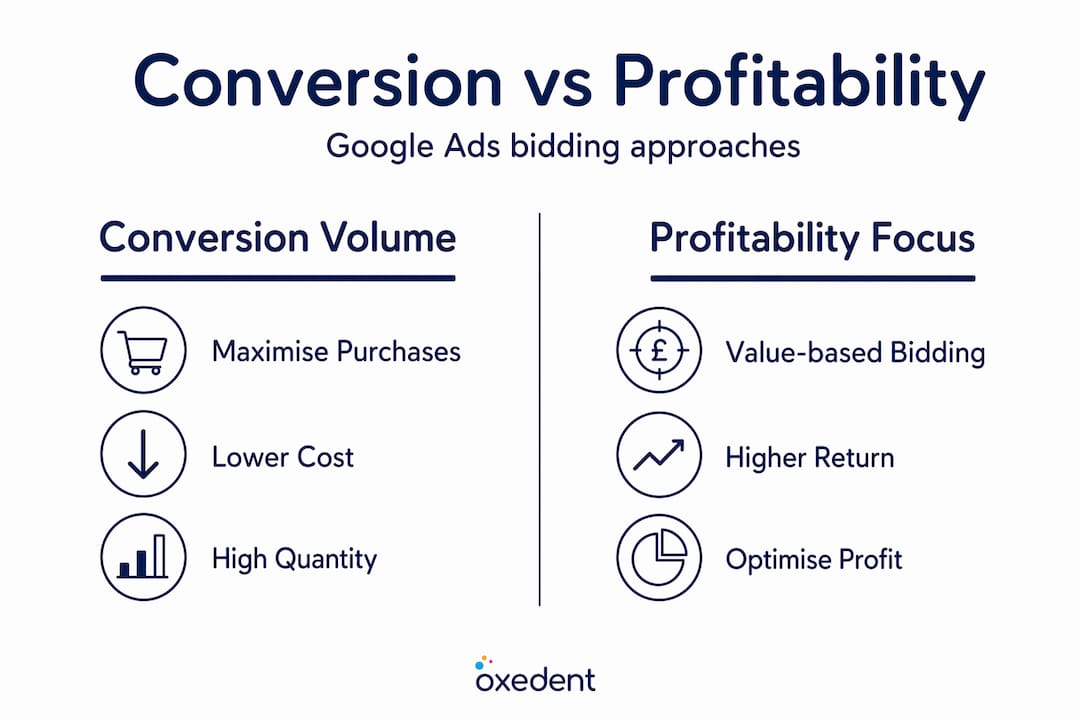

| Factor | Maximise conversions | Value-based bidding |
|---|---|---|
| Optimisation goal | Highest number of purchases | Highest total conversion value |
| Conversion value required | No | Yes |
| Best for | New campaigns, low data volume | Established campaigns with value data |
| Risk | Scales low-margin purchases equally | Requires accurate margin data to work |
| ROAS control | Limited (manual CPC or tCPA) | Direct via Target ROAS |
| Profit visibility | Low | High |
Maximise Conversions works well in specific situations. When you are launching a new product with little historical data, when all your products carry near-identical margins, or when your primary goal is volume for market testing, it is a sensible starting point. Optimising for clicks or generic conversion volume does not align with profitability goals once your catalogue grows and margins diverge.
Value-based bidding truly shines once your conversion tracking is clean, your conversion values reflect real business worth, and you have enough transaction data for the algorithm to detect patterns. At that point, the algorithm actively deprioritises low-value conversions and competes more aggressively for high-value customers. That is where Google Ads cost effectiveness genuinely improves without reducing your overall reach.
The common misconception is that switching to value-based bidding will reduce conversion volume. It often does, initially. But if your conversion values are set correctly, the profit generated per campaign typically rises. Fewer transactions at higher margin beats more transactions at thin margin. That is the core proposition of profitability focus.
How to implement profitability focus in your campaigns
Putting this into practice follows a clear sequence. Work through these steps methodically rather than attempting everything at once.
- Audit your current conversion tracking. Verify that every purchase fires a conversion event and passes the correct transaction value. Cross-reference Google Ads conversion data against your ecommerce platform for the same date range.
- Define your conversion values. Decide whether to pass revenue, gross profit, or a profit-weighted composite. If margins vary by product, plan how you will implement conversion value rules or dynamic values via the dataLayer.
- Set your baseline ROAS. Look at your current conversion value divided by your ad spend over the past 30 to 90 days. That figure is your current effective ROAS. Set your initial Target ROAS at 80% to 90% of that number to give the algorithm room to operate.
- Switch to Maximise Conversion Value or Target ROAS. Apply the new bid strategy at campaign level. Allow a minimum of four weeks before evaluating performance, accounting for Google’s learning period.
- Monitor conversion value per cost. This metric tells you your effective ROAS on a rolling basis. Track it weekly alongside absolute conversion value, ad spend, and profit margin.
- Adjust ROAS targets incrementally. If performance is stable and you want greater efficiency, increase your Target ROAS by 10% to 15% every two to three weeks rather than making large jumps.
Pro Tip: Do not evaluate the success of value-based bidding using conversion count alone. Build a simple reporting dashboard that tracks conversion value, cost, conversion value per cost (your ROAS), and estimated gross profit side by side. This gives you a complete picture of how profitability focus is performing.
For campaigns using Performance Max, the same principles apply. Feed Google accurate conversion values through your product feed and conversion tracking, set a Target ROAS that reflects your profit goals, and allow the campaign to optimise across all Google inventory. You can read more about scaling P.Max profitably as part of a broader ecommerce growth strategy.
My honest take on where most brands get this wrong
I have worked with dozens of ecommerce businesses on their Google Ads accounts, and the same pattern appears repeatedly. The campaigns are technically functional. Conversions are coming in. Revenue is growing. But when we dig into the actual gross profit being generated after ad spend, the picture is far less encouraging.
The most common mistake I see is passing revenue as conversion value and then setting a Target ROAS based on that revenue figure. The business feels like it is achieving a 500% ROAS. What it is actually achieving might be a 200% return on gross profit once you strip out cost of goods. That is a meaningfully different situation, and in many cases it means the campaigns are barely breaking even.
The second issue is impatience with ROAS targets. I have seen advertisers set aggressive targets too early, starve the algorithm of auction volume, and then conclude that value-based bidding “does not work.” In reality, the ROAS ramp dynamics require patience. Starting low and tightening gradually is not a compromise. It is the correct method.
What actually works is treating profitability focus as an ongoing process rather than a one-time configuration. Your product mix changes, your margins shift, and your customer acquisition patterns evolve. The value-based bidding framework needs to be revisited every quarter at minimum. The advertisers I have seen achieve consistent, scalable profitability are not the ones who set it and forget it. They are the ones who treat their conversion values and ROAS targets as living inputs that reflect the business as it is today.
— Biplab
How Oxedent helps you build profitable Google Ads campaigns
If what you have read resonates and you are wondering where your own campaigns stand, Oxedent works exclusively with ecommerce brands to do exactly this.

Oxedent’s ecommerce PPC management covers end-to-end conversion tracking audits, profit-weighted conversion value implementation, and Target ROAS configuration aligned to your actual margins. The focus is never on vanity metrics. Every campaign decision is tied back to what the business actually earns, not just what it spends. If your current campaigns are generating conversions but you are not confident they are generating profit, a structured audit is the right starting point. Oxedent works with established ecommerce businesses that are ready to scale profitably, not just grow their ad spend.
FAQ
What is Google Ads profitability focus?
Google Ads profitability focus means configuring your campaigns to optimise for conversion value rather than conversion count, using bid strategies like Target ROAS or Maximise Conversion Value to maximise business profit per pound spent.
How does value-based bidding improve Google Ads ROI strategy?
Value-based bidding instructs Google’s AI to prioritise high-value conversions over low-value ones, which means your budget is directed towards customers and products that generate the most profit rather than just the most transactions.
What conversion values should I use for ecommerce?
Ideally, pass gross profit rather than revenue as your conversion value. If margins vary by product or category, use conversion value rules to apply profit multipliers so Google’s algorithm receives accurate profitability signals.
Why does Target ROAS affect my conversion volume?
Setting a high Target ROAS restricts the number of auctions your ads enter, which reduces both conversion volume and the data available for learning. Starting with a lower ROAS target and increasing gradually produces better long-term results.
How do I know if my conversion tracking is accurate enough for profitability focus?
Compare your Google Ads reported conversion value against your ecommerce platform’s revenue for the same period. A variance of more than 10% suggests a tracking discrepancy that needs resolving before value-based bidding can work effectively.