The PPC reseller model is a business arrangement where an agency sells paid advertising management under its own brand, while a specialised third-party provider handles campaign execution behind the scenes. Your clients see your branding throughout. They never interact with the provider. This structure lets you offer Google Ads and Facebook Ads management without building an in-house PPC team, making it a practical route for agencies looking to grow their service portfolio without the overhead of hiring specialists.
The core benefits are straightforward:
- No in-house PPC team required — the provider acts as your elastic remote workforce
- Brand identity preserved — all client-facing work carries your agency name
- Lower overhead costs — no salaries, training, or tool licences for PPC staff
- Scalable capacity — add clients without proportional headcount increases
- Access to certified expertise — quality partners hold Google Partner and Meta Business Partner status
One distinction worth making early: white-label PPC software requires your team to manage campaigns themselves, meaning you still need in-house PPC expertise. White-label PPC services outsource execution entirely. If your agency has no PPC specialists, services are the correct model.
How the PPC reseller workflow operates in practice
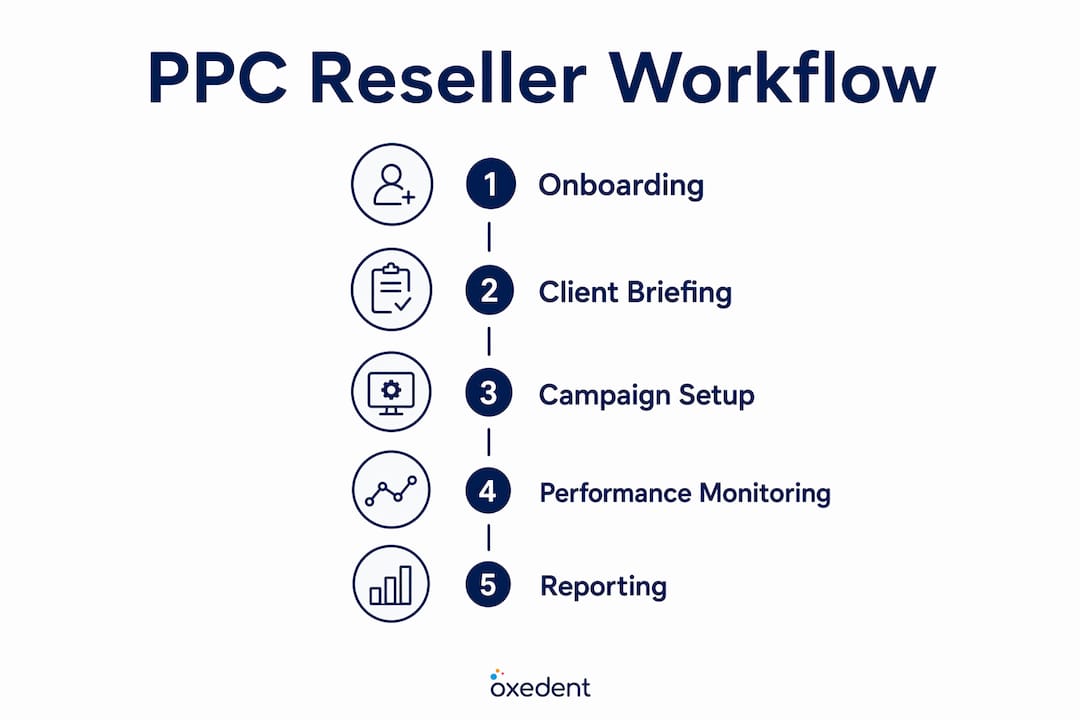
The operational process follows a clear sequence, and where it breaks down is almost always at step three.
- Close the client. You sell PPC management under your agency brand, typically on Google Ads, Facebook Ads, or both. Your contract governs the relationship.
- Run a structured discovery. Gather goals, budgets, target audiences, and conversion priorities. Standardising this intake process is critical. Incomplete briefings passed to a provider are the leading cause of poor results, regardless of how capable the partner is.
- Hand off to your provider. Pass the full brief to your white-label partner. They build, launch, and manage campaigns. The quality of your handoff document directly determines the quality of their output.
- Retain account ownership. Always hold primary ownership of client ad accounts through your own Google Ads MCC and Meta Business Manager. Never allow a provider to own client accounts. If the relationship ends, you need to transition management without disrupting live campaigns.
- Receive unbranded reporting. Quality providers deliver reports via Google Looker Studio or Agency Analytics, formatted without their branding so you can present them directly to clients.
- Present reports under your brand. You review, contextualise, and deliver performance data to your client. Your agency remains the expert in the room.
- Ongoing optimisation. The provider continuously refines campaigns. Strong partners go beyond execution, offering budget guidance, competitive insights, and forecast modelling to support your client retention.
On pricing: PPC reseller arrangements typically use one of four structures: a flat fee per client, a percentage of ad spend, performance-based fees tied to conversions, or a hybrid of flat and percentage. Each suits different client portfolio types, so choose based on your margin targets and client budgets.
On risk: PPC results are immediately measurable and visible. Poor campaign performance causes faster client churn than almost any other service failure. Vet partners on their Google Partner and Meta Business Partner certifications, and review their case study histories before committing. Oxedent’s PPC agency vetting criteria covers the key checks worth running before you sign anything.


Pro Tip: Ask any prospective provider to show you a live unbranded reporting dashboard before you agree terms. If they cannot produce one quickly, their reporting process is not as polished as their pitch.

What your contract must cover
Transparency in client contracts protects your agency’s credibility. The standard approach is to include a clause stating that third-party providers may be used to deliver services, without naming the specific partner. This is now common practice and clients generally accept it. What you must never do is misrepresent the arrangement in a way that creates legal exposure if the relationship surfaces.
Your reseller agreement with the provider should specify account ownership (yours, always), data confidentiality obligations, performance standards, and termination notice periods. Agencies working with partners who manage paid ad campaigns across Google and Meta should also confirm that the provider’s terms do not grant them any rights over client data or creative assets. If you are operating in the UK, standard commercial contract law applies, and a solicitor review of the provider agreement is worth the cost before you scale.
Key takeaways
The PPC reseller model works when account ownership stays with your agency, client briefings are thorough, and partner vetting is rigorous.
| Point | Details |
|---|---|
| Model definition | Your agency sells PPC services under your brand; a specialist provider executes campaigns behind the scenes. |
| Account ownership | Always retain control via your own Google Ads MCC and Meta Business Manager, never the provider’s. |
| Handoff quality | A complete, standardised client brief is the single biggest factor in campaign outcome quality. |
| Partner vetting | Check Google Partner and Meta Business Partner status plus case study histories before committing. |
| Contract clarity | Include a third-party services clause in client contracts and secure data confidentiality terms with your provider. |
Ready to see what specialist eCommerce PPC management looks like when it is built around profitability rather than vanity metrics? Oxedent works exclusively with established eCommerce brands, so every campaign decision is grounded in return on ad spend.