


Prospecting finds new customers; retargeting converts the warm ones you already have. Prospecting is judged on growth and customer acquisition cost (CAC); retargeting is judged on conversion rate and return on ad spend (ROAS). Run both at the same time, with proper tracking underneath, and you get a funnel that fills itself and cashes in.
- Prospecting = cold outreach to new audiences, measured on CAC and reach.
- Retargeting = re-engagement of warm visitors, measured on conversion rate and ROAS.
- Do this now: launch both concurrently, not sequentially, with your Conversions API set up before you scale spend.
Key Takeaways
Coordinated prospecting and retargeting outperform either strategy run alone, because prospecting supplies the new audiences retargeting needs to convert profitably.
| Point | Details |
|---|---|
| Different jobs, different KPIs | Prospecting is judged on CAC and reach; retargeting on conversion rate and ROAS. |
| Retargeting ROAS needs scrutiny | Platform-reported ROAS often overstates true incremental lift without a holdout test. |
| Budget split guideline | Allocate roughly 15 to 30% of paid spend to retargeting, adjusting for traffic volume. |
| Tracking must be resilient | Server-side Conversions API plus first-party data protects performance from signal loss. |
| Oxedent manages the blend | Oxedent runs prospecting and retargeting together for ecommerce clients, judged on blended ROAS. |
Table of Contents
- What is prospecting vs retargeting in practice?
- What is retargeting and why does its ROAS look so strong?
- How do prospecting and retargeting compare side by side?
- When should you lean on prospecting, and when on retargeting?
- Why tracking and privacy resilience matter more in 2026
- Nine steps to set up coordinated campaigns
- How Oxedent allocates and measures blended ROAS
- Get your prospecting and retargeting audited properly
- Frequently asked questions
- Sources
What is prospecting vs retargeting in practice?
Prospecting is the top-of-funnel engine. It puts your brand in front of people who have never heard of you, using lookalike audiences, interest-based targeting, or curated third-party lists. The main channels are social prospecting (Meta, TikTok), YouTube and other video placements, Discovery ads, and broad-match search for category terms rather than branded ones. Prospecting also splits into inbound and outbound motions: inbound relies on content and demand generation drawing people in, while outbound gives you more direct control over who you target and when.
Expect CAC on cold audiences to run noticeably higher than on warm ones, and conversion rates to sit lower, because you’re asking a stranger to trust you in one session.
Statistic to remember: retargeting typically converts 3 to 5 times higher than cold prospecting, which tells you upfront not to judge a prospecting campaign by retargeting-style benchmarks.
Common mistakes:
- Using retargeting-style urgency creative on cold audiences who don’t recognise the brand yet.
- Ignoring frequency caps, which burns budget on the same uninterested users.
- Measuring prospecting purely on immediate ROAS instead of pipeline growth.
What is retargeting and why does its ROAS look so strong?
Retargeting re-engages people who’ve already shown intent: site visitors, cart abandoners, and past purchasers. It runs mainly through dynamic product ads pulled from your product feed, so the creative automatically shows the exact item someone viewed or left in their basket, rather than a generic banner.


Retargeting posts higher conversion rates because you’re talking to people already partway through a decision, not strangers. That’s exactly why its reported ROAS looks so attractive on the platform dashboard.
Statistic to remember: platform-reported retargeting ROAS is often overstated against true incremental lift once you strip out sales that would have happened anyway. Treat the dashboard number as directional, not gospel, and back it with a holdout test where possible.
Guardrails worth setting from day one:
- Cap frequency so the same shopper doesn’t see the same ad twenty times a week.
- Segment by behaviour and recency, not one blanket “all visitors” pool.
- Exclude recent purchasers from generic retargeting to avoid wasting spend and irritating customers.
- Match the offer to intent: a browser needs reassurance, a cart abandoner often needs a nudge.
Some teams also use the term “remarketing” here, as discussed in generative creative for retargeting sequences to boost e-commerce sales. In most agency usage today, remarketing leans towards email re-engagement while retargeting refers to paid ad placements, so keep the vocabulary consistent inside your own reporting.
How do prospecting and retargeting compare side by side?
Once you strip away the jargon, the two strategies sit at opposite ends of the same funnel, and reading the comparison tells you where your next pound of budget should go.
| Dimension | Prospecting | Retargeting |
|---|---|---|
| Funnel stage/goal | Awareness, new customer acquisition | Consideration/purchase, conversion |
| Audience source | Lookalikes, interests, broad lists | Pixel/CAPI data, cart abandoners, past buyers |
| Scale | Large, largely unbounded | Bounded by your own traffic volume |
| Typical KPIs | CAC, reach, new-to-file rate | ROAS, conversion rate, average order value |
| Creative strategy | Broad brand story, social proof | Dynamic product ads matched to viewed items |
| Best channels | Social prospecting, video, Discovery | Feed-based dynamic ads, email/SMS retargeting |
| Frequency/controls | Cap frequency to protect reach | Cap frequency and exclude converters |
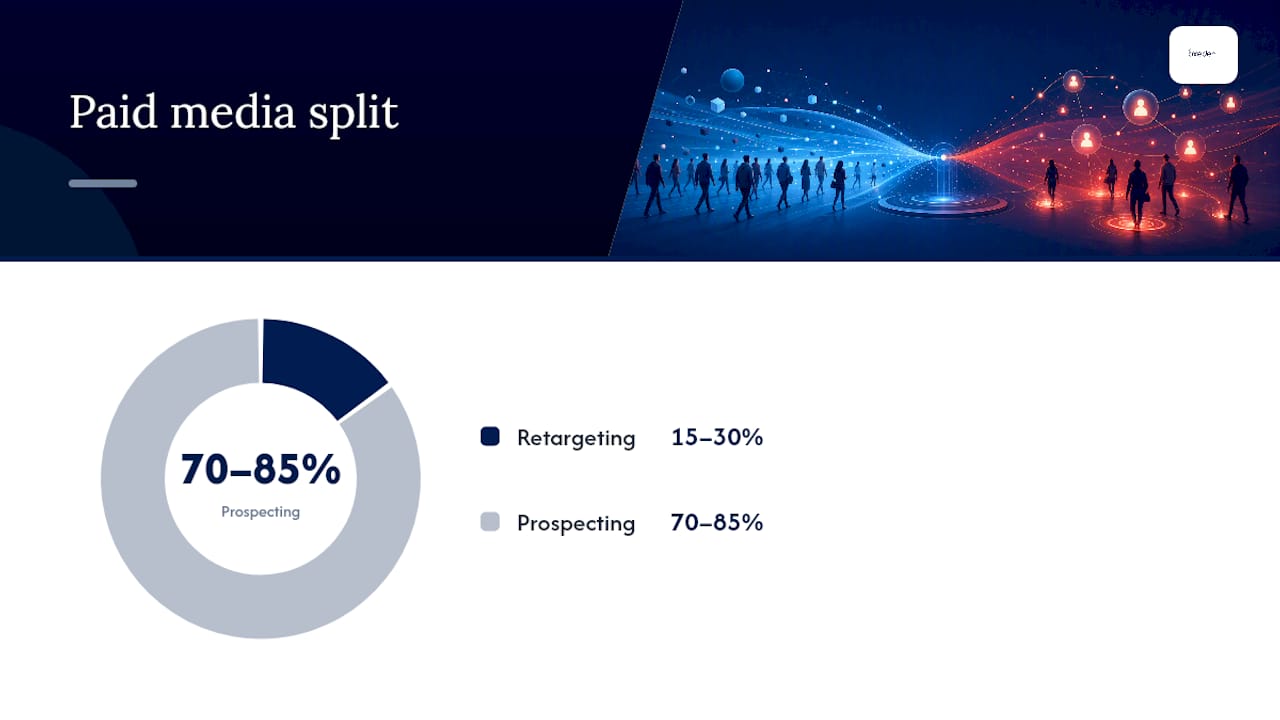

Read that table as a resource allocation map, not a menu you pick one item from. Prospecting has no ceiling on scale because there are always more strangers to reach; retargeting is capped by however many people actually visit your site, which is why over-investing in retargeting alone eventually starves growth.
A workable rule of thumb: allocate roughly 15 to 30% of paid media budget to retargeting, scaling towards the lower end if your site traffic is thin and towards the higher end during a sales spike when your retargeting pool is genuinely full. Our own guidance on ecommerce ad spend walks through how to set that split by revenue stage.
When should you lean on prospecting, and when on retargeting?
1. New product launch. Run prospecting hard in weeks one and two to seed a fresh audience pool around the launch, then shift budget towards retargeting as visitors accumulate and cart activity builds.
2. Catalogue sell-through or seasonal push. Build a tight retargeting sequence around cart abandonment and lifecycle triggers, paired with a strict suppression list so recent buyers don’t see the same discount push twice.
3. Steady-state ecommerce growth. Keep prospecting running continuously in the background, because it feeds tomorrow’s retargeting pool; a dedicated retargeting push works best layered on top of that steady acquisition flow, not instead of it.
Pro Tip: Sequence your creative by micro-behaviour, not just time elapsed. Someone who viewed a product page needs a different message from someone who added to cart and left.
Why tracking and privacy resilience matter more in 2026
A browser pixel alone is fragile, dropping signal every time a cookie gets blocked or a browser update tightens defaults. That’s why server-side ingestion through Conversions API has become close to essential for keeping retargeting performance intact. Pairing it with first-party data, hashed emails, CRM lists, onsite capture forms, gives both prospecting and retargeting a sturdier audience base to build from.
Platform-reported ROAS is a useful signal, not a verdict. Run periodic incremental lift or holdout tests, and judge performance on blended ROAS across the account rather than trusting a single channel’s dashboard number.
Quick checklist for technical teams:
- Map key events (view_item, add_to_cart, purchase) to server-side ingestion.
- Deduplicate between browser pixel and server signals.
- Capture first-party data at every touchpoint, not just checkout.
- Run at least one incrementality test per quarter.
Nine steps to set up coordinated campaigns
- Define exclusions first: convertors out of prospecting, converters out of generic retargeting.
- Build lookalike and interest audiences for prospecting from your best existing customers.
- Segment retargeting by recency and behaviour, not one blanket list.
- Set up dynamic feed-based creative for retargeting.
- Map creative tone to intent: broad story for prospecting, specific product for retargeting.
- Set frequency caps on both campaign types.
- Check audience size before launch so retargeting pools aren’t too small to spend against.
- Verify Conversions API and pixel events are firing and deduplicated.
- Run a holdout or incrementality test within the first month.
How Oxedent allocates and measures blended ROAS
We judge accounts on blended ROAS and CAC trend, not platform-reported numbers in isolation. For growth-stage clients, we typically weight budget more heavily towards prospecting to keep the retargeting pool fed; for maintenance-stage accounts with a mature customer base, the split shifts. This work suits brands with meaningful budgets and clear growth goals, not early-stage stores still testing product-market fit.
Get your prospecting and retargeting audited properly
Getting the prospecting and retargeting split right takes constant attention to feed quality, audience segmentation, and tracking hygiene, which is exactly the kind of ongoing work that pulls focus from running your business. Oxedent manages Google Ads, Facebook Ads, Google Shopping, and Performance Max campaigns exclusively for established ecommerce brands, with blended ROAS and profitability as the measure of success rather than clicks or impressions.

If your account is leaning too hard on retargeting, or your prospecting spend is producing weak CAC with no clear reason why, a proper audit will show you exactly where the waste sits. Explore eCommerce PPC management with Oxedent and get a clear view of your current allocation before you commit more budget to either side of the funnel.
Frequently asked questions
What is prospecting vs retargeting in one sentence?
Prospecting reaches new, cold audiences to drive growth; retargeting re-engages warm visitors who already know your brand to drive conversions.
Is retargeting the same as remarketing?
Not quite. Retargeting usually refers to paid ad re-engagement, while remarketing more often describes email-based re-engagement, though the two terms get used loosely across the industry.
How much budget should go to retargeting versus prospecting?
A common starting range is 15 to 30% of paid media budget on retargeting, adjusted for how much traffic your site generates and how full your retargeting pool actually is.
Why does retargeting show a higher ROAS than prospecting?
Because it targets people already showing intent, so conversion happens faster and cheaper. That reported ROAS can still overstate real incremental impact, which is why testing matters.
Can you run prospecting and retargeting on the same budget?
Yes, and you should. Treat them as one connected system: prospecting fills the pool, retargeting converts from it, and starving either side eventually breaks the other.
Sources
- Prospecting vs Retargeting: Understanding the Difference | iubenda
- Hawky
- What Is Prospecting vs Retargeting? | Eightx