


What is white label Google Ads management?
White label Google Ads management is a fulfilment model where your agency sells Google Ads services under your own brand while a specialist third-party team runs the campaigns behind the scenes. Your client sees your logo on every report, communicates only with you, and has no reason to suspect anyone else is involved.
“White label Google Ads management is when you sell Google Ads to your clients under your own brand, but a third-party team does the actual account work. They build the campaigns, manage the spend, track the conversions, and write the reports, and you stay the face of all of it.” — Grovant
The model covers the full range of Google’s campaign types:
- Search for high-intent buyers actively looking for your client’s products
- Shopping and Performance Max for eCommerce stores running product feeds
- YouTube and Demand Gen for full-funnel brand coverage
For eCommerce agencies, the appeal is direct. You add expert PPC services immediately, increase revenue per client, and avoid the cost and risk of hiring in-house specialists. Branded reports, ongoing optimisation, and conversion tracking all come as part of the arrangement.
Table of Contents
- Common misconceptions and risks you need to understand
- How to choose a white label Google Ads partner for UK eCommerce
- How white label Google Ads works in practice
- How white label PPC affects campaign performance and reporting
- What a white label PPC service typically delivers
- Key takeaways
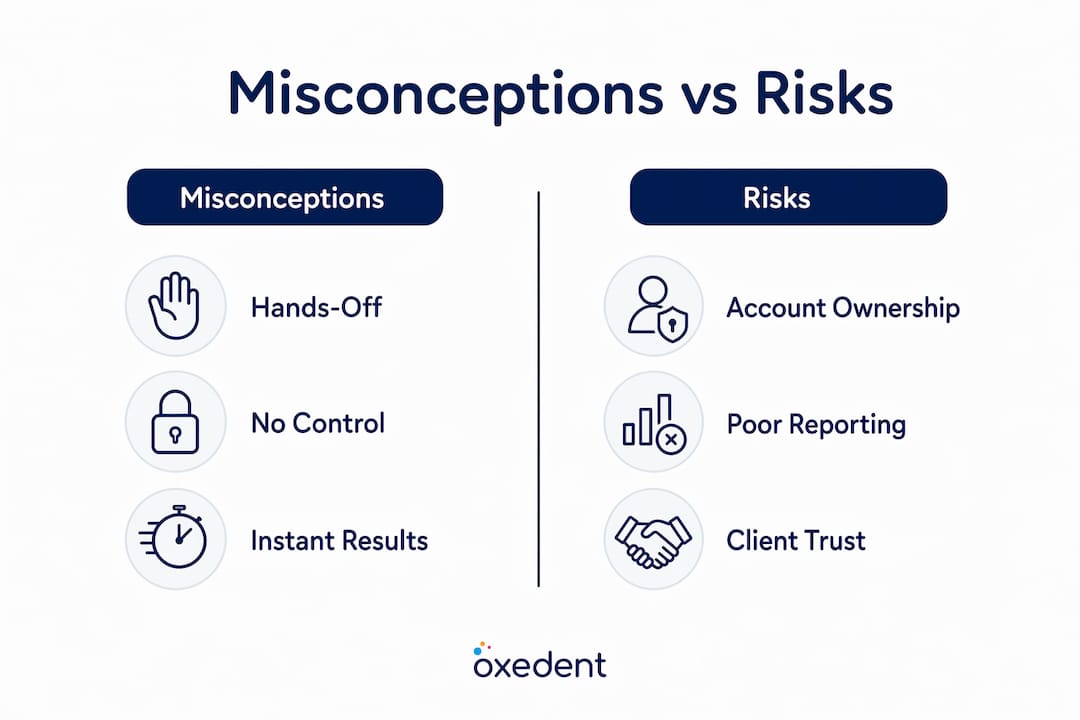
Common misconceptions and risks you need to understand
The biggest mistake agencies make is treating white label PPC as a hands-off arrangement. You hand off the work, but you cannot hand off the strategy. The agency must still set clear goals, communicate client priorities, and hold the partner accountable for results.

Pro Tip: Treat your white label partner like a senior employee, not a vending machine. The brief you give them directly determines the quality of work your client receives.
Risks worth taking seriously before you sign anything:
- Loss of client control. A partner who requires direct client contact or uses rigid, non-customisable reporting compromises your brand authority and client trust. Invisibility is non-optional.
- Budget waste from poor account structure. Accounts can lose 20%–40% of budget to clicks that were never going to convert, with missing negative keywords often the single biggest culprit.
- Broken conversion tracking. If GA4 tags, enhanced conversions, or offline imports are wired incorrectly, every optimisation decision sits on bad data.
- Client churn tax. The lost lifetime value from mismanaged campaigns far exceeds any saving made on a cheaper partner.
- Superficial reporting. A screenshot of the Google Ads dashboard is not a report. Your client is paying for insight, and a weak partner will make you look weak too.
How to choose a white label Google Ads partner for UK eCommerce
Selecting the right partner is where most agencies either protect or destroy their client relationships. Work through this checklist before committing.
Key questions to ask every prospective partner:
- Do they specialise in eCommerce, including Performance Max and Merchant Center feed management?
- Will they remain completely invisible to your clients, with fully branded, customisable reporting?
- How do they handle conversion tracking on new accounts? Do they rebuild it before any optimisation begins?
- What is their account-to-buyer ratio? Experienced teams cap senior buyers at around 28 active accounts, weighted for complexity.
- Can they provide written monthly optimisation logs rather than vague update emails?
- What pricing model do they use, and does it protect your margins as you scale?
- Do they offer detailed case studies from eCommerce clients with comparable budgets?
What good looks like in practice:
- Senior buyers with a documented account architecture standard, adjusted per client rather than copy-pasted
- Performance Max treated as its own discipline, not a set-it-and-forget-it campaign type
- Conversion tracking rebuilt on every new account before a single bid is adjusted
- Reports written by the buyer, in plain English, not auto-generated dashboards with a name attached
A partner who ticks these boxes protects your brand. One who does not will cost you clients.
How white label Google Ads works in practice
The process follows three clear stages. You bring the client brief and remain the sole point of contact throughout. The white label team builds and manages the campaigns, covering keyword research, ad creation, bid management, feed optimisation, and ongoing testing. You receive branded reports and pass them to your client as your own work.


The handoff point that trips up new agencies is account ownership. Clarify upfront who owns the Google Ads account and what happens if the relationship ends. A reputable partner will never hold your client’s account hostage. The day-to-day reporting should reflect strategic adjustments, not just raw data pulls, so your client sees genuine value in every update.
How white label PPC affects campaign performance and reporting
Done well, white label management raises performance by putting specialists on accounts that would otherwise be managed by generalists. The difference shows up in conversion tracking accuracy, feed quality, and bid strategy discipline. Poor partners, by contrast, use cookie-cutter account structures that ignore specific eCommerce margins and product goals, creating hidden performance losses that are difficult to diagnose until a client is already unhappy.
Reporting quality is the visible proof of everything happening underneath. Branded Looker Studio dashboards showing spend, conversions, cost per conversion, and return on ad spend give your client confidence. A plain-English summary of what changed and why is what separates a professional agency from one that just forwards screenshots.
What a white label PPC service typically delivers
A well-run white label arrangement covers every layer of Google Ads management:
- Campaign builds: Search, Shopping, Performance Max, and Demand Gen, structured with tight ad groups and maintained negative keyword lists
- Conversion tracking: GA4 tags, enhanced conversions, and offline conversion imports set up correctly before launch
- Feed management: Merchant Center optimisation for Shopping and Performance Max campaigns
- Ongoing optimisation: Bid strategy adjustments, search term mining, ad copy testing, and budget reallocation toward what converts
- Branded reporting: Monthly reports under your logo, with strategic commentary, not raw data
Key takeaways
White label Google Ads management works when your agency retains strategic control, the partner stays invisible, and conversion tracking is built correctly from day one.
| Point | Details |
|---|---|
| Invisibility is the foundation | Your client must never know a partner is involved; branded reports and sole communication protect your relationship. |
| Budget waste is a real risk | Accounts can lose 20%–40% of budget to poor structure; a specialist partner prevents this with tight negative keyword management. |
| Tracking quality drives results | GA4 tags, enhanced conversions, and offline imports must be correct before any optimisation begins. |
| Partner selection determines outcomes | Cap ratios, documented account standards, and eCommerce expertise separate strong partners from costly ones. |
| Strategic oversight stays with you | White label is not hands-off; the agency must set direction and hold the partner accountable throughout. |